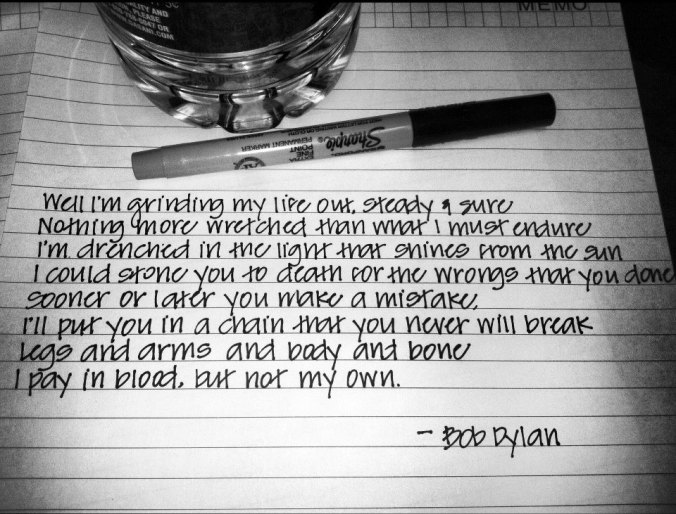
Gospel by Dylan

While Dylan’s lyric may at first seem bleak, in the end he captures the essence of the Gospel.  We do deserve to be put in “a chain that you can never break; legs and arms and body and bone”.  And without the shedding of blood there is no forgiveness of sin.  (Hebrews 9.22) But if we are in Christ, the blood that is paid is not our own.

The True & Better

In this brief video, Tim Keller shows us how Jesus can be seen throughout the familiar narratives of the Old Testament.  This is not an exercise like Where’s Waldo? , where you scour a picture to see if you can find the hidden face.  Nor is this mere metaphor.  This is God’s intended revelation of his grace that was to come.  Each instance is a typology in which, through real life historical figures and events, there is a foreshadowing of the life, work, and/or character of the promised Messiah.  This is why Jesus said to his disciples along the Emmaus Road: “All the Scriptures speak of me.”  (See Luke 24.25-27)

4 Tips That Change the Taste of the Sermon

As a pastor I have come to understand that some people have difficulty concentrating throughout the Sunday message.  Sometimes it’s just me people have trouble following. But sometimes it is something within them.  It may be a short attention span. It may be external distractions.  Or maybe it is the overwhelming wealth of insight being offered throughout the message that leaves some still pondering the previous point when the next gem is thrown at them.  (That last one is my favorite.)

If you’ve ever found yourself to be one who even occasionally experiences a problem concentrating throughout the sermon, let me offer a few practical tips. These are far from perfect, and certainly not exhaustive. But still, I think you will find they are helpful:

1. Write It Down

Many educators will tell you to write things down because it helps you focus and remember.  Often, after writing something down, you’ll find you don’t even need to go back to your notes to recall what you wrote.

I find it interesting that in Deuteronomy 17.18 we learn that every time a new king was installed in Israel he was to write the entire Law of God out by hand. He had to write it himself. He could not delegate it to anyone else.  He could not dictate to his secretary.  But taking pen in hand, the new king had to transcribe the whole thing himself.  The expected result, we learn in v. 19, was that the new king would revere the Lord and follow the law carefully.  I suspect that what is also true, but has no need to be stated, is that the king would remember the Law.

2. Pray It In

When you hear something that strikes you, if the Lord impresses something on you, during the course of the message, stop and pray right then.  Whether it is something that challenges you, encourages you, or even convicts you, ask the Lord right then to apply it to your life.  (This is also true during other parts of the service.  You may be struck by something in a hymn, or during a prayer.  Pray it in.)

A church service is supposed to be more relational than academic.  The Lord promises his presence among his people.  It should be a time of interaction between you and God.  As he speaks to you, deal with it at that moment.

3. Give It Out

After you write it down and pray it in, don’t neglect to give it out. Tell someone about it. If you are married, share your insight with you spouse on the way home: “Honey, do you know what struck me today?”

When you give it out it becomes part of your life.  Your insight may also prove beneficial to the one you share it with.  And giving it out also promotes unity, a oneness, because you are opening up and sharing what God is doing in your heart and life.

4. Move Around

No, I don’t mean you should get up in the middle of the message.  I mean, don’t always sit in the same place.

While the first three are pretty simple, and probably will not receive much of a negative response, this  suggestion poses some risks. It may not only seem strange, but the very notion violates some long standing personal traditions.  I’m convinced that whole sanctuaries must have been built around some people – probably built while they were sitting in one particular spot! Construction crews just worked around them.  God have mercy on the visitor who sits in what he/she consider to be ”MY” place.

But this suggestion is not as silly as it may at first seem.

Studies have shown a direct correlation between academic success levels and where a student sits in the classroom. (I usually sat in the back, which probably says a lot.)  Perhaps it could also have some effect spiritually.

Now, I am not suggesting that those who sit up front are actually more spiritually mature than those in the back.  Spirituality has nothing to do with geographic location.  But there is an attitude that can creep in. Sitting in the same spot, week after week, year after year, things can become a little stale.

Moving around every once in a while offers a new, refreshing perspective.  You see things from a different angle, which seems to stimulate the attention span. You are surrounded by different people, which not only creates a different worship environment, it is also a great way to expand unity within the church.

It’s amazing, but sitting in a different place almost makes it seem like a whole different church, regardless of the size of the sanctuary.  So move around, and mix it up.

Anyway, these are a few of my simple suggestions. Let me know if you try any of them out, and how they worked out for you.

Too Much Religion

Eugene Peterson, in the Introduction to the book of Hebrews in his book The Message, writes:

“It seems odd to have to say so, but too much religion is a bad thing. We can’t get too much of God, can’t get too much faith and obedience, can’t get too much love and worship. But religion – the well intentioned efforts we make to ‘get it all together’ for God – can very well get in the way of what God is doing for us. The main & central action is everywhere, and always what God has done, is doing and will do for us. Jesus is the revelation of that action”.

The Gospel Is…

Gospel means “good news.” The good news is: you are more sinful and flawed than you ever dared believe yet you can be more accepted and loved than you ever dared hope at the same time because Jesus Christ lived and died in your place. As the apostle Paul said, “God made him who had no sin to be sin for us, so that in him we might become the righteousness of God.”

That is the simple formulation of the gospel. More thoroughly we could say that the whole Bible is the gospel. It is a book about the God who rescues people from their moral and spiritual rebellion against him. The teaching of the Bible, the gospel, can be summarized under four heads: God, Man, Jesus Christ, and Our Response.

Firstly, the gospel teaches that God is our creator. Thus he has the right to rule and command us as he does in his law. God is also holy, that is, he is absolutely pure morally, and he hates and punishes rebellion on the part of his creatures. He is more holy than anyone would ever imagine.

Secondly, the gospel teaches us about human beings. We are creatures made by God and for God. We were originally created to live in relationship with God and we were morally pure. But because our first parents rebelled against God (just as we also all have done), human beings are now cut off from relationship with God and are subject to his condemnation. We are more sinful than we ever dared believe.

Thirdly, the gospel teaches us what Jesus Christ has done for sinners like us. He became a man and lived a life of perfect obedience to God’s law, and then died as a sacrifice in our place under the judgment of God. He was raised from the dead and now reigns in heaven. The condemnation that he suffered takes away the necessity that we suffer judgment for our own sins- “God made him who had no sin to be sin for us.” The righteous life he lived is credited to us, not because we are actually righteous, but because of God’s mercy and grace- “in him we might become the righteousness of God.”

Fourthly, the gospel teaches us how to respond to the good news. We turn away from our rebellion and put our trust in Jesus Christ. Despairing of our own worthiness to stand before God, we believe the promise that those who trust in Jesus Christ will be forgiven and declared righteous. Those who put their faith in Jesus Christ are accepted as loved sons and daughters of God, and God sends his Spirit to live in them.

Counterfeit Gospels

Martin Luther said that a sinner trying to believe the gospel was like a drunk man trying to ride a horse; he will always be falling off on one side or the other. The two errors that the sides of the horse represent are 1) legalism or moralism and 2) pragmatism or relativism or antinomianism.

Moralism is the view that a person is made acceptable to God through his own attainments. Moralists are usually very religious, and often very conservative in their religion. Legalism tends to stress truth without grace. Moralists are usually very rules oriented, and depending on their success in keeping the rules they will be either arrogantly self-righteous or depressed and morose. If they go to Jesus for forgiveness, it is just to ask him to fill in the gaps they have left in their own religious performance. For the moralist, the cross is not the only basis for acceptance by God, but is an adjunct to our performance.

Pragmatists are often irreligious, or prefer more liberal religion. They tend to stress grace over truth, assuming everyone is accepted by God and that we each have to decide what we think is true for us. Often relativists will talk about God’s love, but since they do not see them selves as deeply sinful people, God’s love for them costs him nothing. For them the cross is not the necessary condition of our acceptance by God.

The gospel holds out to us a whole new system of approach to God. It rejects our attempts to justify ourselves before God, to be our own saviors and lords. It rejects both our pragmatic presumption and our religious attempts to earn our way into God’s favor. It destroys the perception that Christianity is just an invitation to become more religious. The gospel will not let us think Jesus is just a coach to help us get stronger where we are weak. To be a Christian is to turn from self-justification of all sorts and to rely exclusively on Jesus’ record for a relationship with God.

Christians and non-Christians both stumble over the two counterfeits of the gospel. Many Churches are deeply moralistic or deeply relativistic. Christians who understand the gospel very clearly still look like the drunk man on the horse, as the desire to justify ourselves and trust in our own performance continually reappears.

The gospel tells the pragmatist that he is more flawed and sinful than he ever dared believe. The gospel tells the moralist that he is more loved and accepted than he ever dared hope.

The Missional Puritan: On Mission With God

Hey, this Missional thing is nothing new!  Listen to what the old English Puritan, John Owen, wrote in the 17th Century:

God has work to do in this world; and to desert it because of its difficulties and entanglements, is to cast off His authority. It is not enough that we be just, that we be righteous, and walk with God in holiness; but we must also serve our generation, as David did before he fell asleep. God has a work to do; and not to help Him is to oppose Him.

Missional may be a relatively new term coined to challenge an apathetic or directionless church, but it is not new.  It is the living out our biblical mandate.  God has work to do in this world – and in this community.  If we are in Christ we are enlisted to be as seeds scattered wherever our Sovereign God determines to send us, to take root and bless our generation.  (See Jeremiah 29.4-7)

Remebering 9-11, Remembering God’s Grace

Remembering 9-11.  Remembering God’s Grace even more.

Tim Keller, pastor of Redeemer Presbyterian Church in Manhattan, with 9-11 in sight, reminds us:

Why does God allow evil and suffering? Look at the Cross of Jesus. It can’t be that he does not love us.  It can’t be that he is indifferent.

Listen to Tim’s powerful & poignant post 9-11 message: Truth, Tears, Anger & Grace

The Difference That Makes All the Difference

Francis Schaeffer, of his own testimony, writes:

“I became a Christian once for all upon the basis of the finished work of Christ through faith; that is justification. The Christian life, sanctification, operates on the same basis, but moment by moment. There is the same base (Christ’s work) and the same instrument (faith); the only difference is that one is once for all and the other is moment by moment…  If we try to live the Christian life in our own strength we will have sorrow, but if we live in this way, we will not only serve the Lord, but in place of sorrow, He will be our song. That is the difference. The ‘how’ of the Christian life is the power of the crucified and risen Lord, through the agency of the indwelling Holy Spirit, by faith moment by moment.”

An important -even essential – distinction. It’s not just for the sake of doctrinal precision. It makes all the difference in how we live out our lives.

Center Church

I picked up Tim Keller‘s newest book, Center Church.  It hit the bookstore shelves this morning.  I have as yet read only a few chapters. But as expected it is an excellent expression of holistic gospel-centered ministry.  In short it is a book about forming a Theological Vision for ministry, and living out that vision faithfully in whatever context one may live and serve in such a way as to be fruitful.

In particular I appreciate how from the outset Keller explains the difference and navigates between the two common ministry measuring sticks, success & faithfulness.  It seems to me that too many act as if we should assume these are mutually exclusive  – as if either is a sufficient goal or gauge.  Keller instead prefers fruitfulness, seeing both benefits and limitations of success and faithfulness as the simple objectives.  Fruitfulness is the end result of the complex web of faithfulness, competence, and the work of God’s Spirit. Success, whatever that really is, is not eschewed, but seen in light of the components of fruitfulness within a particular social context.

Now while I have not read the entire book, I did have one criticism from the outset.  While the book is less than 400 pages, and the chapters are easily readable (in other words, one need not be a theological scholar to follow along), the size of the book has the odd dimensions of a textbook.  This will look strange among most of the other books on my shelf.  But, I guess, if that remains my chief gripe, there is not much to complain about.

12 Signs of a Transformed Life

What does a life transformed by the gospel look like? Well, in some ways that might depend upon what it looked like before gospel impact. Yet, Gordon MacDonald took a stab at describing a transformed life in an excellent article for Leadership Journal.

Below are the 12 marks MacDonald identifies:

  1. Has an undiluted devotion to Jesus
  2. Pursues a biblically informed view of the world
  3. Is intentional and disciplined in seeking God’s direction in life
  4. Worships, and has a spirit of continuous repentance
  5. Builds healthy, reciprocal human relationships
  6. Knows how to engage the larger world where faith is not necessarily understood
  7.  Is aware of personal “call” and unique competencies
  8. Is merciful and generous
  9. Appreciates that suffering is part of faithfulness to Jesus
  10. Is eager and ready to express the content of his faith
  11. Overflows with thankfulness
  12. Has a passion for reconciliation

To read MacDonald’s whole excellent article, click: How to Spot a Transformed Life

Cotton Candy Christianity Scorecard

I don’t want to become one of those bloggers who becomes known for what he is against, or for pointing out how wrong other guys are, but this was just too funny to pass up.  It is also important to distinguish the gospel from all its counterfeits. For as Paul warns in Galatians 1.6-7:

I am astonished that you are so quickly deserting the one who called you by the grace of Christ and are turning to a different gospel – which is really no gospel at all. Evidently some people are throwing you into confusion and are trying to pervert the gospel of Christ.

Upon further thought, it might not be as funny as I thought.  It would be funny, if it were not so serious & sad.

Thanks to the folks at Modern Reformation & White Horse Inn for the scorecard. As they said:

“It’s like Bingo… Only better.”

How Deep

VERSE 1
You were broken that I might be healed
You were cast off that I might draw near
You were thirsty that I might come drink
Cried out in anguish that I might sing

CHORUS
How deep is Your love
How high and how wide is Your mercy
How deep is Your grace
Our hearts overflow with praise
To You

VERSE 2
You knew darkness that I might know light
Wept great tears that mine might be dried
Stripped of glory that I might be clothed
Crushed by Your Father to call me Your own

From: Valley of Vision

Paradoxes of Grace

In his excellent, perspective shaping book, Broken-Down House, Paul Tripp reflects some of the amazing paradoxes of the gospel.  Take some time to ponder these; feel the tension. This is what genuine grace is and does:

So grace is a story and grace is a gift. It is God’s character and it is your hope. Grace is a transforming tool and a state of relationship. Grace is a theology and an invitation. Grace is an experience and a calling. Grace will turn your life upside-down while giving you a rest you have never known. Grace will convince you of your unworthiness without ever making you feel unloved.

Grace will make you acknowledge that you cannot earn God’s favor, and it will remove your fear of not measuring up to his standards. Grace will confront you with the fact that you are much less than you thought you were, even as it assures you that you can be far more than you had ever imagined. Grace will put you in your place without ever putting you down.

Grace will enable you to face truths about yourself that you have hesitated to consider, while freeing you from being self-consciously introspective. Grace will confront you with profound weaknesses, and at the same time introduce you to new-found strength. Grace will tell you what you aren’t, while welcoming you to what you can now be. Grace will make you as uncomfortable as you have ever been, while offering you more comfort than you have ever known. Grace will drive you to the end of yourself, while it invites you to fresh starts and new beginnings. Grace will dash your hopes, but never leave you hopeless. Grace will decimate your kingdom as it introduces you to a better King. Grace will expose your blindness as it gives you eyes to see. Grace will make you sadder than you have ever been, while it gives you greater cause for celebration than you have ever known.

Grace enters your life in a moment and will occupy you for eternity. You simply cannot live a productive life in this broken-down world unless you have a practical grasp of the grace you have been given [in Christ].

Lost in Wonder, Love, and Praise


Surely one of the greatest problems of our times is that we have become so nonchalent about the Lord of the cosmos.  Certainly if we were more immersed in God’s splendor we would find ourselves thoroughly “lost in wonder, love, and praise”.  With all the amazing sights and sounds of our cyberspace world, however, many of us no longer recognize that if we but catch a glimpse of GOD – the imperial Lord of the cosmos, the almighty King of the universe – we will be compelled to fall on our faces.  Our awareness of God’s absolute otherness would give us the sense that we could die now because we have seen God.  We would shout with the prophet: “Woe is me, for I am annihilated”. (Isaiah 6.5; Martin Luther’s rendering.)

Marva Dawn, A Royal “Waste” of Time