Here are some words I would be wise to regularly remind myself:
No unwelcome tasks become any the less unwelcome by putting them off till tomorrow. It is only when they are behind us and done, that we begin to find that there is a sweetness to be tasted afterward, and that the remembrance of unwelcome duties unhesitatingly done is welcome and pleasant. Accomplished, they are full of blessing, and there is a smile on their faces as they leave us. Undone, they stand threatening and disturbing our tranquility, and hindering our communion with God. If there be lying before you any bit of work from which you shrink, go straight up to it, and do it at once. The only way to get rid of it is to do it.
In this video, Lane Chaplin convincingly explains the God-given mandate to dig into theology. He also illustrates the practical importance.
Does doctrine divide us? Sadly, sometimes it does – or rather, sometime Christians do divide over doctrine. But doctrine also unites. It unites us with other believers, both of our own day and of ages past. And, when properly discerned, doctrine unites our minds with the mind of God. I would say that is worth a little work.
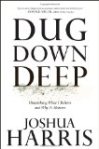
In the first chapter of his excellent book, Dug Down Deep, Joshua Harris writes:
I know the idea of “studying” God often rubs people the wrong way. It sounds cold and theoretical, as if God were a frog carcass to dissect in a lab or a set of ideas that we memorize like math proofs.
I know many professing Christians who personify what Josh describes, including some within our church. There are a number of reasons they find theology – study of God – distasteful. One reason is that it is difficult. Another reason is that doctrine has been a point of contention between Christians for ages, and no one with any sanity enjoys being at odds with others. And for many, previous exposure to theology has been just plain boring.
Harris goes on in his observation, and addresses the concern about doctrine being boring:
But studying God doesn’t have to be like that. You can study him the way you study a sunset that leaves you speechless. You can study him the way a man studies the wife he passionately loves. Does anyone fault him for noting her every like and dislike? Is it clinical for him to desire to know the thoughts and longings of her heart? Or to want to hear her speak?
Knowledge doesn’t have to be dry and lifeless. And when you think about it, exactly what is our alternative? Ignorance? Falsehood?
We’re either building our lives on the reality of what God is truly like and what he’s about, or we’re basing our lives on our own imagination and misconceptions.
We’re all theologians. The question is whether what we know about God true.
I think Josh is correct: The study of theology does not have to be boring.
My own motive for studying and teaching theology is not to put myself above anyone else, nor to find grounds to debate and prove others wrong. My motive is that I have found what Josh describes to be true – I have found beauty in the nature of God. I have found joy through the discovery of his amazing grace. I have experienced – and I am experiencing – the transforming power of his promises and principles in the gospel. And while I have found points where I disagree with others, those disagreements do not diminish my friendships with anyone. So I engage in the study of theology to enhance my own life. And I endeavor to teach theology to offer those same benefits to others who are willing to enjoy them.
As for the study of theology being difficult, well that might be true. Especially when dealing with some important complex issues, such as our Union with Christ. However, in his book, Josh describes an epiphany he had while vacationing in Florida. One morning, while at the beach, it dawned on him that in order to “build a house on rock not sand” requires that we dig until we find the rock. (Matthew 7.24-27) And digging takes work. But in the end the benefits are worth the work.
Sometimes I want to scream! One thing that makes me want to scream is people, Christian people, who under the guise of faith, take scripture out of it’s God-given context and apply it to their own pretentious favor. ARGH!!
I wonder, is there any passage where this more frequently occurs than it does with Philippians 4.13:
“I can do all things through him who gives me strength.”
All too often, it seems, this is claimed as the “life verse” by athletes, coaches, and others facing various forms of adversity. Those involved in athletics so commonly claim this verse that I sometimes, tongue-in-cheek, refer to this mindset as FCA Christianity. (OK. I know that this is not fair to FCA. While this mindset may commonly be heard around FCA Huddles and events, there are also many faithful, deep, godly folks involved with FCA. In truth, I don’t know that this mindset is more prevalent with FCA-ers than it would be in my denomination, PCA, or even the church that I pastor.)
Philippians 4.13 is often invoked whenever the odds of success seem stacked against someone. The person reminds himself/herself: “I can do this… Like Rocky Balboa, I can defy the odds… I can do ALL things through Christ who gives me strength… I can win!!”
What is wrong with this perspective is not the desire to prevail, whatever the endeavor. There is nothing wrong with that. The problem is that to use this verse, and suppose the Bible here champions winning, takes this verse out of it’s context and redirects the aim of the gospel, the purpose of the Christian faith, to serve our agenda and goals. It assumes that our personal success is the goal of the Kingdom. It turns the gospel upside-down.
What is your view of the Puritans? If you are like many people you may not think much of them.
Tim Keller maintains that the Puritans offer us great practical insights. In an article for CCEF, titled Puritan Resources for Biblical Counseling, Keller elaborates on these insights:
The Puritans were committed to the functional authority of the Scripture. For them it was the comprehensive manual for dealing with all problems of the heart.
The Puritans developed a sophisticated and sensitive system of diagnosis for personal problems, distinguishing a variety of physical, spiritual, tempermental and demonic causes.
The Puritans developed a remarkable balance in their treatment because they were not invested in any one ‘personality theory’ other than biblical teaching about the heart.
The Puritans were realistic about difficulties of the Christian life, especially conflicts with remaining, indwelling sin.
The Puritans looked not just at behavior but at underlying root motives and desires. Man is a worshipper; all problems grow out of ‘sinful imagination’ or idol manufacturing.
The Puritans considered the essential spiritual remedy to be belief in the gospel, used in both repentance and the development of proper self-understanding.
Reading the Puritans is not always easy. But thanks to Banner of Truth Trust there are number of Puritan materials offered in revised editions. Many of them are abridged. Most, if not all of them, are translated into more contemporary English. Check out Puritan Paperbacks. These are rich resources for spiritual formation.
From time to time I am asked by some in our church what I mean when I repeatedly declare that we are – and we must be – a Gospel-Centered Church. I think it may be the hyphen that confuses people.
To be “something”-centered is simply to focus on the relation an individual or a church has to a central value. While there could be any number of things at the center of a persons or organizations values, in our case the point of emphasis is the Gospel (or the Cross).
As for what it means to be Gospel-centered, as an individual or as a church, I don’t think I could answer better than Joe Thorn did in a post titled: Gospel-Centered. One of the things Joe points out is:
[T]he gospel-centered life is a life where a Christian experiences a growing personal reliance on the gospel that protects him from depending on his own religious performance and being seduced and overwhelmed by idols.
There are seemingly few resources that help the athlete and the fan channel an enthusiasm for sports to the glory of God. Many misapply Philippians 4.13, taking it out of context, disconnecting it from it’s gospel purpose, and using it as if it is merely a self-help positive thinking slogan. Others assume that sports are just “worldly” banality that, while enjoyable, have no redeeming spiritual value, except perhaps for the platform provided to accomplished Christian athletes in this sport idolatrous culture.
As a life-long sports enthusiast, and former coach and athlete, I have longed for a substantive bridge that connects athletic endeavors with spiritual formation, yet that avoids the shallowness usually exhibited.
Two relatively recent resources provide the connection and substance I have long looked for:
Both these resources help show us how we can redeem our involvement with sports to God’s Glory and our spiritual development, whether an athlete or a fan.
New Years Day has come and gone, and 2011 is trudging along. You want to do some things different this year. You’ve always wanted to read through the Bible, but you’ve never been quite sure how to do it. Or, you have read through the Bible before but you are looking for a different approach.
If one of your Resolutions for 2011 is to make Bible reading a regular part of your daily disciplines, you are in luck (err, you are in Providence)! It is not too late to get started. (It’s never too late.) There are several plans available from the publishers of the ESV.
The folks at Desiring God have published a series of posts from an interview with my friend Paul Miller. Paul is the author of the acclaimed book, A Praying Life; and was the developer of the influential discipleship curriculum SONSHIP.
To read each of the short posts, click the word below reflecting the theme:
The purpose in a man’s heart is like deep water,
but a man of understanding will draw it out.
In short what Solomon explains is that everyone has desires and designs, but often we may not be conscious even of our own. Our purposes are deep down. But the wise person, the “Man of Understanding” will take the time and make the effort to discern his/her own heart.
Here in the first week of the New Year I have posted a series of questions that can help us be men and women of understanding. These questions can help us realize our own deep desires. My hope is that in discovering what may be hidden in the depths we can consequently make wise steps.
Take some time to contemplate these questions:
What one thing do you most regret about last year, and what will you do about it this year?
What single blessing from God do you want to seek most earnestly this year?
In what area of your life do you most need growth, and what will you do about it this year?
What’s the most important trip you want to take this year?
What skill do you most want to learn or improve this year?
To what need or ministry will you try to give an unprecedented amount this year?
What’s the single most important thing you could do to improve the quality of your commute this year?
What one biblical doctrine do you most want to understand better this year, and what will you do about it?
If those who know you best gave you one piece of advice, what would they say? Would they be right? What will you do about it?
What’s the most important new item you want to buy this year?
In what area of your life do you most need change, and what will you do about it this year?
In Building a Bridge to the 18th Century, author Neil Postman suggests that in many ways we have not so much advanced, as a culture, as we have drifted over the years. Postman seems to believe we would do well to return to and reconnect with our philosophical roots and rebuild upon them.
I might say the same thing Spiritually and Theologically.
Like Postman I look to the early-to-mid 18th Century. But I also go back a little further than he does. I suggest we return some of our attention to the 16th & 17th Centuries too.
In particular I believe we benefit by building a bridge back to the Puritans.
Now I realize, for many people the idea of learning from the Puritans is as appealing as black snow. For some, the very notion seems ugly and distasteful. (The Puritans were… well, puritanical, weren’t they?) But I wish this was not such a prevalent view. I am not ashamed to admit that the Puritans are part of my spiritual heritage. In some company I might even refer to myself as a Neo-Puritan. From my perspective, contemporary disregard for the Puritan is our loss.
I understand some of the stains on the Puritan reputation is deserved. It was earned by a representative few who were… idiots. (i.e. Salem Witch Trials) But those folks were not a sufficient sample group by which to judge the entire lot. Sure they held some of the same principles as their Puritan predecessors, but they were a warped expression, at the tail end of a movement, influenced at least as much by superstition and fear as by their Faith traditions. But because of the antics of these relative few fanatics the whole Puritan tradition has been getting a perpetual bad rap. And I suspect that mistaken notions about the Puritans will endure, at least for as long as our perceptions continue to be influenced by erroneous and distorted PR offered by such sources as Arthur Miller’s The Crucible and Nathaniel Hawthorne’s Scarlet Letter.
J.I. Packer, in an essay titled Why We Need the Puritans, which is also the Introduction to his book A Quest for Godliness, outlines a handful of lessons contemporary Christians would do well to learn from these besmirched people of the past:
Integration of Daily Life
Quality of Spiritual Experience
Passion for Effective Action
Program for Family Stability
Sense of Human Worth
Ideal of Church Renewal
A great introduction to the Puritans has been provided by the folks at The Resurgence. They have compiled a series of short articles, by Winfield Bevins, under the title Lessons from the Puritans:
Even if your impression of the Puritans has been shaped by Miller or Hawthorne, I hope you will give some consideration to these short introductory essays. I am confidnet you will be pleasantly surprised by the positive legacy these folks have left us.
Who questions much shall learn much, and retain much.
On New Years Day I posted a set of questions to ponder at the start of the New Year. The following are 10 more questions, from Donald Whitney, to ask ourselves here at the beginning of the New Year:
What’s the most important decision you need to make this year?
What area of your life most needs simplifying, and what’s one way you could simplify in that area?
What’s the most important need you feel burdened to meet this year?
What habit would you most like to establish this year?
Who is the person you most want to encourage this year?
What is your most important financial goal this year, and what is the most important step you can take toward achieving it?
What’s the single most important thing you could do to improve the quality of your work life this year?
What’s one new way you could be a blessing to your pastor (or to another who ministers to you) this year?
What’s one thing you could do this year to enrich the spiritual legacy you will leave to your children and grandchildren?
What book, in addition to the Bible, do you most want to read this year?
Donald Whitney has a knack for asking pertinent probing questions. His questions could be used for getting to know one another in a new small group. But I think they might best be used for personal reflection. Whitney’s questions penetrate into the recesses of our hearts. And if we take the time to reflect upon them and answer honestly, they reveal to us our own motives and deep desires – sometimes, perhaps, even in ways we may not have previously been conscious.
As we embark in the New Year take some time to contemplate these 10 questions:
What’s one thing you could do this year to increase your enjoyment of God?
What’s the most humanly impossible thing you will ask God to do this year?
What’s the single most important thing you could do to improve the quality of your family life this year?
In which spiritual discipline do you most want to make progress this year, and what will you do about it?
What is the single biggest time-waster in your life, and what will you do about it this year?
What is the most helpful new way you could strengthen your church?
For whose salvation will you pray most fervently this year?
What’s the most important way you will, by God’s grace, try to make this year different from last year?
What one thing could you do to improve your prayer life this year?
What single thing that you plan to do this year will matter most in ten years? In eternity?
If you have not seen the Bible brought to life through one of Max McLean‘s performances you have missed out. I first saw him when he came to chapel while I was a student at Reformed Theological Seminary. McLean is an acclaimed thespian who lends his substantial talents to verbatim oral interpretation of Books of the Bible, among other roles.
I learned from Justin Taylor that McLean’s live portrayal of John Mark, author of the Gospel of Mark, from the show run last year in the Chicago Theatre District, is now available on DVD. I also leaned that it is available free online.
Click the chapters and watch McLean bring the Gospel of Mark to life, word-for-word:










 GRACE & PEACE