Author: Dennis Griffith

  • Get the Gospel Right

    If pressed for a quick summary of my philosophy of ministry, I would probably express it something like this:

    • Get the Gospel Right
    • Get the Gospel Out
    • Get the Gospel Out Right

    Without a message there is no mission.

    Unfortunately, it seems, many are so zealous to get about the mission that they make little time getting the message of the gospel right.  They do not stand amazed at what God has done for us in the person of Christ. Consequently, they are not being formed or transformed by the gospel.  They are more anxious about what they will do for God than excited by what God has done for us, and what he is doing in us, and what God has promised to do through us – if only we would root ourselves in the gospel.  And because some are neither formed or being transformed, they go out uninformed.

    If we are not conscious of what God is doing in us, what do we think we have to offer those who are around us?

    While no doubt knowledge without zeal is dead.  It is equally true that zeal without knowledge is deadly.

  • Bible in 6 Minutes

    Is there a particular theme that runs through the whole Bible?  No doubt there are many stories and lessons, but is there a central message by which we can connect all else?

    Dane Ortland asked several pastors and scholars if they could summarize the Bible in one sentence. Here are some notable responses:

    John Frame:

    God glorifies himself in the redemption of sinners.

    Kent Hughes:

    God is redeeming his creation by bringing it under the lordship of Jesus Christ.

    Tom Schreiner:

    God reigns over all things for his glory, but we will only enjoy his saving reign in the new heavens and the new earth if we repent and believe in the gospel of Jesus Christ, who is the crucified and risen Lord and who gave himself on the cross for our salvation.

    Mark Dever:

    God has made promises to bring His people to Himself and He is fulfilling them all through Christ.

    Kevin DeYoung:

    A holy God sends his righteous Son to die for unrighteous sinners so we can be holy and live happily with God forever.

    And, finally, my favorite…

    Ray Ortlund:

    The Lover of our souls won’t let the romance die, but is rekindling it forever.

    In the above video Bible scholar D.A. Carson provides a concise, comprehensive, and comprehensible, summary of the theme that permeates the entire Bible.

  • Christ is Risen

    Great song, by Matt Maher, taken from 1 Corinthians 15.55-57:

    Let no one caught in sin remain
    Inside the lie of inward shame
    But fix our eyes upon the cross
    And run to Him who showed great love
    And bled for us
    Freely You’ve bled for us

    Christ is risen from the dead
    Trampling over death by death
    Come awake, come awake
    Come and rise up from the grave
    Christ is risen from the dead
    We are one with Him again
    Come awake, come awake
    Come and rise up from the grave

    Beneath the weight of all our sin
    You bowed to none but heaven’s will
    No scheme of hell, no scoffer’s crown
    No burden great can hold You down
    In strength You reign
    Forever let Your church proclaim

    O death, where is your sting?
    O hell, where is your victory?
    O church, come stand in the light
    The glory of God has defeated the night

    O death, where is your sting?
    O hell, where is your victory?
    O church, come stand in the light
    Our God is not dead
    He’s alive! He’s alive!

    From the album: Alive Again

  • A Case for Institutional Church

    No doubt an “Organic” church is much more appealing than an Institution.  Yet even Brian McLaren, in his book Church on the Other Side, recognizes that any church that includes more than a handful of people needs some level of organization, and the larger a church gets the more organization it requires.  While the notion of a purely “Organic” church seems nice, it is hardly realistic.  Those clamoring to remove all remnants of the church as an “institution” are not only kidding themselves, they do not seem to me to be thinking Biblically.

    Jared Wilson, a missional practitioner and pastor, offers 10 Reasons for the Institutional Church:

    1. The New Testament presumes church governance
    2. The New Testament commands church discipline
    3. The New Testament designates insiders and outsiders in relation to the church
    4. The image of “the body” presumes unified order
    5. The New Testament churches had recognizable structures. The apostles sent their letters to somebody
    6. “Spirit-filled community or institutional organization” is a false dichotomy that presumes the Spirit is powerless against institution
    7. Logically speaking, there is no such thing as “no institution” except chaos or anarchy. Every community made up of people is institutional to some degree
    8. That institution is not eternal is not grounds for jettisoning it. Marriage isn’t eternal either.
    9. The subjection of kings and nations presumes institutional subjection to Christ and therefore that God works in, with, and through institutions.
    10. No one in 2,000 years has successfully cultivated an enduring institution-less expression of the local church
  • No Need to Reinvent the Church

    Let me just say it straight, up front: I see no need to reinvent the church. What I do see is the need for God’s People to act more faithfully as Christ’s Church.

    I like what Kevin DeYoung has to say in the Introduction to his book, The Good News We Almost Forgot:

    No doubt the church in the West has many new things to learn. But for the most part, everything we need to learn is what we’ve already forgotten. The chief theological task now facing the Western church is not to reinvent or to be relevant but to remember. We must remember the old, old, story. We must remember the faith once delivered to the saints. We must remember the truths that spark reformation, revival, and regeneration.

    So, again, despite the assertions of the Emergents and Seekers and cutting-edge tweekers, I see no need to reinvent the church. God is still at work, just as he has been at work through the ages.

    We would, however, be wise to remember what the Reformers of the 16th Century pointed out:

    The Church is constantly in need of reforming itself to become more conformed to Scripture.

    To do this we  need to be aware of:

    • What God says in Scripture His Church is to be
    • What God has done through history to build His Church

    But while I do not believe we need to reinvent the church, I do believe we must always contextualize the ministry of our congregations to be relevant to the cultures where we live; and to be relevant to any cultures in which we may minister.

    Consider what missiologist Lesslie Newbigin observed:

    If the gospel is to be understood… if it is to be received as something which communicates the Truth about the real human situation, if it is as we say “to make sense”, it has to be communicated in the language of those to whom it is addressed and it has to be clothed in symbols which are meaningful to them.  Those to whom it is addressed must be able to say: “Yes, I see.”

    The desire for Relevance does not necessarily change or minimize the Truths of our Faith.  Instead it is an attempt to express and communicate the historic Biblical Truths in ways that are meaningful and applicable to contemporary and changing contexts.

    In other words, we want to embrace and embody the historic Christian faith in ways that are relevant to the culture(s) in which we live & minister.

    Just as a missionary going to a foreign country would be expected to adopt the language, dress, and appropriate customs & mannerisms of that culture, so we ought to be sensitive to our culture (and various sub-cultures). We use our freedom in Christ to adjust & adopt appropriate forms that will enable us to speak clearly to the people of the glory of Christ, and of the eternal truth of the gospel.

    But while we must be contextual, we must be contextual without negating or neglecting  the foundations laid by our forefathers in the Faith.

    This is what the LORD says: “Stand at the crossroads and look; ask for the ancient paths, ask where the good way is, and walk in it, and you will find rest for your souls. But you said, ‘We will not walk in it.’   – Jeremiah 6.16

    Do not move an ancient boundary stone set up by your forefathers.   – Proverbs 22.28

    Here are some practical principles:

    • I affirm God has worked through His church throughout history, and that the church is God’s primary mission agency.  Much wisdom has been gained through the ages, and we are wise to learn from those who have come before us.
    • Therefore we must be committed to doing ministry & theology, with intentional continuity with the Historic Christian Faith, under the authority of God’s Word.
    • At the same time, we must seek to be sensitive to our culture and contextualize our ministry accordingly. We must also be careful not to fall into the traps of syncretism or cultural accommodation, or any other practice that compromises the gospel of Jesus Christ.
    • Relevance also means that we should be sensitive to specific (sometimes unique) issues facing our contemporary culture(s), and the context in which we live and serve, and to speak prophetically to those issues in accordance with faithful Biblical theology.

    In short, we are informed by the past, and we should be connected to our heritage, but we must be a living community of learners, willing to adapt and change in order to be both more faithful to Christ and more effective for the sake of His Kingdom.

    And rather than reinventing, and becoming like the Emergents, we can adopt convergence.  Convergence means that we take the best practices and resources of the past and integrate them with contemporary expressions in the context of our community.

    This is, in large part, what it means to be Missional. And being missional does not require reinventing, just a little recovering and a little sensitivity and a lot of application.


  • The Glory of the Gospel

    The Gospel would not be good news if it did not reveal the glory of Christ for us to see and savor. It is the glory of Christ that finally satisfies our soul. We are made for Christ, and Christ died so that every obstacle would be removed that keeps us from seeing and savoring the most satisfying treasure in the universe—namely, Christ, who is the image of God.

    ~ John Piper, God is the Gospel, p. 62.

  • Of Paramount Importance

    Take a moment to ponder these observations about the paramount importance of God’s Word:

    Since there is a more excellent appearance of the Spirit of God in the holy scripture than in any other book,  it has more power and ability to convey the Spirit and make us spiritual, by imprinting itself upon our hearts.

    Since there is more of God in it, it will acquaint us more with God, and bring us nearer to Him, and make the reader more reverent  and godly.

    Let scripture be first and most in your hearts and hands, and other books used as subservient to it.

    The endeavor of the devil… is to keep it from you, which is evidence that reading it is most necessary and desirable, and beneficial to you.

    Adapted from the Works of Richard Baxter.

  • In Christ Alone – Keith & Kristyn Getty

    In Christ alone my hope is found
    He is my light, my strength, my song
    This Cornerstone, this solid ground
    Firm through the fiercest drought and storm

    What heights of love, what depths of peace
    When fears are stilled, when strivings cease
    My Comforter, my All in All
    Here in the love of Christ I stand

    In Christ alone, who took on flesh
    Fullness of God in helpless Babe
    This gift of love and righteousness
    Scorned by the ones He came to save

    ‘Til on that cross as Jesus died
    The wrath of God was satisfied
    For every sin on Him was laid
    Here in the death of Christ I live

    There in the ground His body lay
    Light of the world by darkness slain
    Then bursting forth in glorious Day
    Up from the grave He rose again

    And as He stands in victory
    Sin’s curse has lost its grip on me
    For I am His and He is mine
    Bought with the precious blood of Christ

    No guilt in life, no fear in death
    This is the power of Christ in me
    From a life’s first cry to final breath
    Jesus commands my destiny

    No power of hell, no scheme of man
    Could ever pluck me from His hand
    ‘Til He returns or calls me home
    Here in the power of Christ I stand

  • Obama’s Faith

    Suspicions abound. The questions perhaps even more.   What I am referring to is the faith of President Barrack Obama: Is he a Muslim, or what?

    Though I did not vote for him, I was pleasantly intrigued during the 2008 campaign when Obama, speaking with Rick Warren at a forum at Saddleback Church, gave a testimony of personal faith that was both clear and substantive.  He certainly was more on target than anything John McCain offered about his own faith.  But the skeptics still wouldn’t buy it.

    I’ll have to admit, some of Obama’s policies give me reason to question, if not the veracity, the consistency and substance of his faith.  But then again, my own sin and short-comings may sometimes give people I encounter reason to wonder about my faith.

    Then in a speech yesterday, for the National Prayer Breakfast, President Obama gave us another glimpse of his personal faith. CNN  provides the video: Obama’s Faith.

    Many people I know were moved by his words.  But as I’ve listened to the speech a few times, I am still not sure what it reveals.  It seemed genuine, and it was certainly Biblical – far more Biblically faithful than anything I’ve heard Glenn Beck or Sean Hannity utter.  Shoot, he was more Biblical than Joel Osteen.  But some questions remain. There was still something missing.

    My intent is not to knock Mr. Obama, nor his moving,  heartfelt testimony.  The fact is what was missing from his message is often missing from many pulpits.  There was a lot of religion, moralism, and Bible quotes, but there was no Christ.  It was a vivid example of what Michael Horton refers to as Christless Christianity.

    Christ-less Christianity expresses the morals and mandates from the Bible, but makes no mention of Jesus.  He may be assumed or he may be ignored, I don’t know.  And most who express this probably believe in Jesus.  But he is absent from the conversation; never mentioned, invoked, or referred to.

    The problem with Christ-less Christianity is that, at least rhetorically, it cuts the heart out of the Christian faith. It makes Christianity to be like all other religions – merely moralistic.  Jesus Christ is the heart of Christianity – particularly what he accomplished on the Cross and by his Resurrection.  It is by this work of Christ that the Believer is forgiven of sin, adopted by God, declared righteous, and destined for Heaven – if these benefits are appropriated through faith.

    I don’t know the “reality” of Obama’s faith.  I will likely never know.  I never met the guy, and never expect to meet him.  I am not suggesting he is not a Christian.  I was pleased by what he did say.  But I am reminded by what he did not say – what many do not say – that we can never deny nor simply assume Christ if we are trying to testify about the Christian faith.

    As Paul declared:

    He is the image of the invisible God, the firstborn over all creation.  For by him all things were created: things in heaven and on earth, visible and invisible, whether thrones or powers or rulers or authorities; all things were created by him and for him.  He is before all things, and in him all things hold together.    And he is the head of the body, the church; he is the beginning and the firstborn from among the dead, so that in everything he might have the supremacy.  For God was pleased to have all his fullness dwell in him,  and through him to reconcile to himself all things, whether things on earth or things in heaven, by making peace through his blood, shed on the cross.      – Colossians 1.15-20

  • Choosing a Book

    Richard Baxter wrote:

    “Make careful choice of the books which you read.”

    Baxter went on to state:

    You need a judicious teacher at hand to direct you about what books to use or to refuse, for among good books there are some very good that are sound and lively, and some good but mediocre, and some weak and somewhat dull; and some are very good in part, but have mixtures of error, or incautious, injudicious expressions.  These are fitter to puzzle than edify the weak.

    The folks at Together for the Gospel (T4G) have published a series of posts offering counsel for Reading & Studying. While these posts are primarily directed to pastors, the wisdom should be appreciated, and insights appropriated, by anyone serious about growing in grace and godliness.   C.J. Mahaney, Ligon Duncan, and Mark Dever serve as the “judicious teachers” Richard Baxter said we need.

  • Measuring the Value of a Book

    Puritan Richard Baxter offers a few simple questions to guide us in evaluating the value of any book:

    While reading ask oneself:

    1. Could I spend this time any better?
    2. Are there better books that would edify me more?
    3. Are the lovers of this book the greatest lovers of the Book of God – the Bible – and of a holy life?
    4. Does this book increase my love for the Word of God, kill my sin, and prepare me for the life to come?
  • Some Thoughts About Reading

    The writings of  the Divines are nothing else but a preaching of the gospel to the eye, as the voice preaches it to the ear.

    Vocal preaching has the pre-eminence in moving the affections, whenever it is applied to the condition of the hearts in the congregation which hears it.  This way the milk comes warmest from the breast.

    But books have the advantage in many other respects:

    • You may read an able preacher when you have only an average one to hear.  Every congregation cannot hear the most judicious or powerful preachers, but every single person may read the books of the most powerful and judicious.
    • Preachers may be silenced or banished, while books may still be at hand.
    • Books may be kept at a smaller charge than preachers.
    • We may choose books that address the very subject which we desire to hear about; but we cannot choose what subject the preacher shall treat us.
    • Books we may have at hand every day and hour, when we can have sermons but seldom and at set times.
    • If sermons are forgotten, they are gone. But a book we may read over and over, till we remember it. And if we forget it, we may again peruse it at our pleasure, or at our leisure.

    So, good books are a very great blessing to the world.  The Holy Ghost chose writing to preserve His doctrine and laws for the Church, knowing how easy and surely it is a way of keeping it safe for all generations, in comparison with mere verbal traditions.

    ~ adapted from the Works of Richard Baxter

  • Advice on Reading

    Make careful choices of the books which you read:

    • Let the holy scriptures ever have the pre-eminence.
    • Next to Scripture, those solid, lively, heavenly treatises that best expound and apply the scriptures.
    • Next, credible historical books – especially Church History…
    • But be careful about false teachers who will corrupt your understanding.

    ~ from the Works of Richard Baxter.

  • Saved From What?

    Several years ago I was asked by a neighbor couple to meet with them for marriage counseling.  They were a pleasant couple, so I willingly agreed to assist them in any way I could.  Early during our first meeting I asked each to tell me about their spiritual journeys.  Hers was simple but heart-felt.  His… well that was a whole different story:

    “I walked the isle once when I was in high school. So I guess I’m ‘saved’.  I don’t think about it much.”

    When I inquired why he had “walked the isle”, he responded:

    “Well, our whole baseball team was visiting this church – we do it every year – and my coach told us it would be a good thing to do, to walk the isle.  So I did.  That’s when I ‘got saved’.”

    Taking the opportunity to dig a little deeper I inquired: “Saved from what?”  He paused for a moment, scratched his chin, and mused:

    “That’s a good question….” 

    I thought so. That’s why I had asked.  It just seems to me that if we are going to go around saying we “got saved” it might make sense to have some idea of what we got saved from.  (I didn’t have the heart at that moment to ask the other part of that question: What did you ‘get saved’ for? )

    J.I. Packer offers a thoughtful response to the question I asked that day:

    “What are believers saved from? 

    • From their former position under the wrath of God, the dominion of sin, and the power of death.  (i.e. Saved from God.)
    • From their natural condition of being mastered by the world, the flesh and the devil.  (i.e. Saved from Ourselves & Our Enemy.)
    • From the fears that a sinful life engenders, and from the many vicious habits that were part of it. 

    How are believers saved from these things? 

    Through Christ, and in Christ.  Our salvation involves

    1. first, Christ dying for us, and
    2. second, Christ living in us and we living in Christ, united with Him in His death and risen life. 

    This vital union, which is sustained by the Spirit from the divine side and by faith from our side, and which is formed in and through our new birth, presupposes covenantal union in the sense of our eternal election in Christ.”

    So, thanks to J.I. Packer,  if  you were not already, you now will have something to offer if I (or someone else) asks you: “What were you saved from?”   And thanks to J.I. Packer, we now also have something of substance worthy of our meditation.  If we think about these truths, we soon, like the psalmist, will freely declare:

    My salvation and my honor depend on God;
       he is my mighty rock, my refuge.  –Psalm 62.7

  • Biblical Parenting with Tedd Tripp

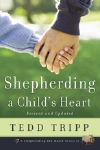
    Tedd Tripp is a renowned Gospel-centered teacher.  His book, Shepherding  A Childs Heart is a must-read for Christian parents.  It is one fo the few resources I have run across that recognizes the heart as the center of development and change.  Most resources on parenting, including Christian parenting resources, focus more on various behavioristic techniques. Tripp recognizes that even if we can get our children to comply, outward obedience is not the objective of Christian discipleship, following the Lord out of heart-felt obedience is.  Tripp explores how targeting the hearts of our children – and revealing the passions and flaws in our own hearts – shapes the child from the inside out.

    In October 2008 Tripp led a Biblical Parenting Conference at Mars Hill Church in Seattle.  Thanks to the folks at The Resurgence the audios of all five session of that conference are available for downloading: