Author: Dennis Griffith

  • Elect or Elite?

    A few years ago, soon after coming to Bristol, I was asked by a godly woman in our church: “What does it mean to be Reformed?”

    She had been talking with someone from another church who had snidely claimed that their church did not associate with our church because we were not Reformed enough.

    What arrogance!

    My response to the inquiring woman was that we were not a TR church (Thoroughly Reformed), but we want to be a HR church (Humbly Reformed).  What’s the difference? Not substance.  Attitude.

    Elliot Grudem offers a wonderful encouragement to cultivate an HR attitude, in an article from the Acts 29 Network blog: Elect or Elite? Why Arrogance Has No Place in Reformed Theology. Below is an edited version of Grudem’s message.  To read the original, or to hear the audio message delivered at an Acts 29 Bootcamp, click the link.

    ***

    Keller, Calvin, Predestination – BINGO!

    When I was in seminary, my friends and I would occasionally play bingo during the classes: what we’d do is write the names of people in our class in the bingo squares, and if that person spoke in class, you got that square – and if you got all the squares in a row then you got ‘bingo.’ We’d always make sure we filled our squares with a couple of ringers that we knew we could get to talk by tipping off their hot-button issues. So if you needed the ringer’s name, you’d ask a questions like, “can someone please tell me what this has to do with homeschooling?” and you knew that individual would ask the next question – and – BINGO!

    We do something similar in Reformed circles.  We have our key names and key phrases that fill our “bingo board” in our minds. And if people mention Keller and Calvin, and “the gospel” two or three times, if they say “predestination” then we think they’re orthodox.

    And if they miss those things – the key phrases and names that make up what we think it means to be Reformed – then we say they’re not Reformed, they’re not “gospel-centered,” they’re not orthodox, regardless of what they have really said.

    Are We Elect or Elite?

    We can rely on our theology too much, thinking that our theological precision is the key to our church’s growth rather than the Holy Spirit. We can fall into phrase-righteousness or name-righteousness thinking that a sermon is heretical if it sounds more like it came from the book of James than from one of Paul’s epistles. We can begin to think that the reason our church is small is because we’re right. And we’re the only one in town that’s truly preaching the truth. We can become theological snobs believing that we and our two or three heroes have a corner on right theology. Or that the Holy Spirit stopped speaking to the church on May 27, 1564 – the day that Calvin died.

    We have a word for people like that, don’t we? The word is proud.

    But unfortunately in our circles we tend to see this type of pride, especially among those who have just discovered the truths of the Reformed tradition.  It doesn’t take much to move from elect to elite.

    But it shouldn’t be that way.

    What Does it mean to be Humbly Reformed?

    To be Reformed one does have to hold to a Reformed soteriology.  But if we’re not talking Reformed Bingo phrase-dropping, what do we mean by that?

    J.I. Packer sums it up: “To Calvinism there is really only one point to be made in the field of soteriology: the point that God saves sinners.”

    Packer is saying that salvation is entirely of the Lord, and sinners have nothing to do with their salvation. That God saves you out of his own good pleasure as an act of his delight. Sinners do not save themselves in any sense at all. Every step is an act of grace. Salvation is entirely an act of God.

    What room does this gospel of grace leave you to boast? What room does it leave you for self-promotion? What need do you have to prove yourself to God and others? If what Paul writes is true, you have none.

    If you really understand this gospel, this message that “God saves sinners,” and really understand Reformed soteriology, then you should be known for your humility, not your pride. You know that everything you have is a gift of grace.

    And the Answer Is…

    John Frame is the Chuck Norris of Systematic Theology, and he also is one of the nicest people you’ll ever meet. Once I heard him ask a question of a man when I was with him during a mock ordination exam. I don’t remember what Frame’s question was but the student took a long time before giving a faltering answer. And Frame laughed and said “that is the best answer I have ever heard in any type of theology exam.”

    What was the student’s answer to the question? “I don’t know.”

    When’s the last time you answered a question like that? Are you really that good? Are there secret things that belong to the Lord? Or is it, like, the Lord and you? How long has it been since you answered a question with ‘I don’t know’?

    ***

    By the way, when I was in seminary my friend David Zavadil and I also played BINGO during classes.  We became somewhat infamous for it.  I guess our tradition lived on… and spread.

  • Practical Importance of Doctrine

    If there was one thing I could impart to the members of our church, or to other pastors, it would be an appreciation for the practical importance of doctrine.  I think it was R.C. Sproul who pointed out: “We are all theologians… the question is whether we are good theologians.”

    Sprouls’ point is valid.  Everything we think, feel, and do is rooted in what we think about God.  Some may not give this conscious attention. Some even repress it or deny it, but then this a-theism is what they think or feel about God, and these folks will act accordingly.

    I suppose that many are turned off by the very idea of doctrine because it has been abused so frequently. I imagine others have been guilty of taking these awesome truths and boring folks with them – something I am sure I share a guilt in.  But the inadequacies of a teacher should not turn people away from seeking to know God better by knowing about God, any more than a bad meal or a bad cook should make people turn away from food.

    In this brief video, pastor/theologian Tim Keller offers a few simple insights about the practical importance of doctrine.  Even if you are a skeptic, give what Tim says at least a few moments thought.

  • Chicken Soup for My Soul

    Feeling a little bit in a funk recently, as if I am failing in some way but I am not sure what… I have been reflecting upon the beautiful words of Psalm 143:

    [1] Hear my prayer, O LORD;
    give ear to my pleas for mercy!
    In your faithfulness answer me, in your righteousness!
    [2] Enter not into judgment with your servant,
    for no one living is righteous before you.

    [3] For the enemy has pursued my soul;
    he has crushed my life to the ground;
    he has made me sit in darkness like those long dead.
    [4] Therefore my spirit faints within me;
    my heart within me is appalled.

    [5] I remember the days of old;
    I meditate on all that you have done;
    I ponder the work of your hands.
    [6] I stretch out my hands to you;
    my soul thirsts for you like a parched land. Selah

    [7] Answer me quickly, O LORD!
    My spirit fails!
    Hide not your face from me,
    lest I be like those who go down to the pit.
    [8] Let me hear in the morning of your steadfast love,
    for in you I trust.
    Make me know the way I should go,
    for to you I lift up my soul.

    [9] Deliver me from my enemies, O LORD!
    I have fled to you for refuge!
    [10] Teach me to do your will,
    for you are my God!
    Let your good Spirit lead me
    on level ground!

    [11] For your name’s sake, O LORD, preserve my life!
    In your righteousness bring my soul out of trouble!
    [12] And in your steadfast love you will cut off my enemies,
    and you will destroy all the adversaries of my soul,
    for I am your servant.

    Psalm 143 – ESV

  • Different Worlds

    While I’ve long known it, recently I’ve finding the following quote to be painfully all too true:

    Following Jesus today requires you to practice the same single-minded non-conformity. And it will produce the same effect in your life that it did with Jesus.  If you truly follow Jesus, in addition to enjoying a most excellent adventure, you will likely end up seeming too Christian for many of your pagan friends and too pagan for many of your Christian friends.  When you truly follow Jesus, you’ll spend considerable time in the world like he did, and as a result, many of your religious friends will think you’re too irreligious. On the other hand, many of your irreligious friends will find it odd that you are so focused on the spiritual.  Thus, you end up seeming both too Christian AND too pagan.

    ~ Dick Staub, Too Christian, Too Pagan

  • Distinct, Not Separated

    John Stott offers a reminder of the task and the tension we, as Christians, must continually navigate when he uses the phrase:

    “spiritually distinct, but NOT socially segregated.”

    And here is a quote expanding this perspective:

    Your business and mine as Christian people is to be in the midst of this world and its affairs, and still remain true and loyal to God, and be kept from evil.  …The task of the Christian is to be right in the midst of this world and its affairs in order that he may do the work of evangelism, spreading the gospel and the Kingdom of God, while the whole time, keeping himself un-spotted from the world.

    ~Martyn Lloyd-Jones, from Safe in the World

  • Friend of Kuyper

    For the better part of the 20th Century the Protestant Church in the USA seemed to have divided into two camps: Those interested in Evangelism and those concerned for Social Issues.  Which one adopted pretty clearly fell along the lines of how seriously one took the Bible.  Conservatives lined up for Evangelism; Liberals for Social Gospel.

    One exception to this appears to have been in the Dutch Reformed Church.  Somehow, seemingly under the radar screen, these folks managed to engage in both Evangelical scholarship and Holistic Ministry – offering valuable contributions to Gospel understanding; and offering valuable contributions to their communities, engaging in meeting felt needs and addressing issues of social justice.

    Perhaps the reason these Dutch Reformed folks were immune to the dichotomy that widely afflicted the rest of American Protestantism probably rest squarely at the feet of a man named Abaham Kuyper – a one time Prime Minister of the Netherlands, newspaper publisher, theologian, etc.  Kuyper was a 19th Century Renaissance Man.

    I’ve seen Kuyper’s most notable statement posted all over the blogosphere, Facebook, etc.:

    In the total expanse of human life there is not a single square inch of which the Christ, who alone is sovereign, does not declare: “‘That is mine!”

    Kuyperian thought is worthy of exploration.

    I have stumbled upon a website that offers a a great introduction to Kuyper: Friend of Kuyper

    Here is a quick summary:

    The Kuyperian worldview is a theological tradition in Christianity (often called “neo-Calvinism”) that focuses on the redemption of all things. It is also called “Reformational Christianity” because it holds to a worldview that tells the Christian story of

    • CREATION
    • FALL
    • REDEMPTION
    • CONSUMMATION

    We are in the chapter of God’s Reformational Story called “Redemption,” and therefore are called to fulfill that portion of the Lord’s Prayer that says, “Thy Kingdom come, thy will be done on earth as it is in heaven.”

    Here are four particular insights of Neo-Calvinism:

    1. Creation Order

    Because the Creation was created “very good,” there is an inherent potential in the created order that is good as well. The “Cultural Mandate” of Genesis 1:28 and 2:15 tells us that humanity has the task of harnessing this potentiality to develop culture as God intended. Technology, popular culture, progress, and yes, even politics, are to be understood as part of God’s original created order.

    2. Antithesis

    Sin not only runs through the hearts of every individual human being, but also through the entire cosmos. Romans 8 tells us that all creation is “groaning”—it suffers as well. While Sin is personal, it also manifests itself in the various organizations of society.

    3. Common Grace

    But God’s creation is still good, though tarnished by sin. If God’s creation is stewarded according to his good will, it still provides good benefits for human beings. By his grace, God not only allows believers to contribute to the common good, but also unbelievers. Because every human is made in the image of God, unbelievers can have true insights and perform beneficial works. This has vast ramifications on our understanding of cultural activity, by both believers and unbelievers, and how we interact together for the common good in societal renewal, technology, politics, etc.

    4. Sphere Sovereignty

    Neo-Calvinism states that God has designed a differentiation within society between different spheres of authority. Sphere Sovereignty offers a different matrix for understanding society from the American “two-sided paradigm” which reduces society to individual and state. Sphere Sovereignty believes there are intermediary social structures such as families, churches, businesses, and schools that contribute to the social fabric as much as individuals and the state.

    In addition to the introduction, this site are a number of contemporary essays exploring Kuyper’s work.

    Holistic ministry is not a new development. Sure, it seemed to have gone away for a while. But what we are seeing in our day is a recovery of an old practice – a Biblical practice.

    If you are an advocate of holistic ministry, I commend becoming of Friend of Kuyper.

  • Love Wins… Does Anyone Lose – Part 2

    Now that the advanced copies of the book have been sent out, people have had opportunity to read it and reflect.

    Kevin DeYoung has thoughtfully analyzed Rob Bell’s Love Wins and published his observations and concerns in a compelling review.  DeYoung’s opening paragraph offers a summary of Bell’s premise:

    Love Wins, by mega-church pastor Rob Bell, is, as the subtitle suggests, “a book about heaven, hell, and the fate of every person who ever lived.” Here’s the gist: Hell is what we create for ourselves when we reject God’s love. Hell is both a present reality for those who resist God and a future reality for those who die unready for God’s love. Hell is what we make of heaven when we cannot accept the good news of God’s forgiveness and mercy. But hell is not forever. God will have his way. How can his good purposes fail? Every sinner will turn to God and realize he has already been reconciled to God, in this life or in the next. There will be no eternal conscious torment. God says no to injustice in the age to come, but he does not pour out wrath (we bring the temporary suffering upon ourselves), and he certainly does not punish for eternity. In the end, love wins.

    I am not sure what the allure of Bell’s thesis is.  Oh, I understand why it appeals to some who are not Christians.  What perplexes me is why some – maybe many – who consider themselves Christ followers are intrigued with this notion of Universalism that has been debunked repeatedly by every expression of Christ’s Church for nearly 1500 years.   Could it be that we, in our feigned wisdom, imagine we might out-do God in compassion?

    It is unusual for me to publish critical posts, and very unusual for me to harp on a trendy issue through repeated posts.  But I do so because I see the intrigue this book has stirred, even among some I know.  As a pastor I would urge folks not to even bother reading it.  There are so many great things out there to feed our minds and our souls, why should we choose warmed over heresy?  What spiritual benefit do you imagine you might gain?

    But should you be among those who succumb to the temptation… please also read DeYoung’s review.

    NOTE: This review is also available in .pdf.

    Click: God is Still Holy and What You Learned in Sunday School is Still True

  • Offensive Grace

    Why does not the faith of the average Christian seem to bring about the change we would hope? Could it be that many have a faulty understanding of the Gospel?

    Dan Allender, in his book Bold Love, offers the following:

    “If our sin is mere failure to conform – simply a mistake to do what is right – forgiveness is really the granting of an opportunity to try again.  In that light, it is like forgetting to finish one’s homework.  We deserve a low grace, and grace becomes merely the privilege of doing it over to get a higher mark.  Such a view of grace might generate appreciation, but it would never drive us to worship.  If, in fact, sin is not only failure to hit the mark of God’s perfection, but also a deep, insidious energy that desires to eradicate from our existence an affronting God who demands perfection, then forgiveness becomes breathtaking, incredible, and wonderfully insulting.”

    It seems we underestimate our sin. Consequently we undervalue God’s grace.

  • A Question of Universalism

    For those following discussions of the recent posts, but who want a clearer understanding of what Universalism actually means, below you will find a good explanation from theologian J.I. Packer:

    A universalist is someone who believes that every human being whom God has created or will create will finally come to enjoy the everlasting salvation into which Christians enter here and now. Universalism is the recognized name for this belief. . . .

    Among Christian theological options it appears as an extreme optimism of grace, or perhaps of nature, and sometimes, it seems, of both. But in itself it is a revisionist challenge to orthodoxy, whether Roman Catholic, Eastern Orthodox, or Protestant evangelical; for the church has officially rated universalism a heresy ever since the second Council of Constantinople (the fifth ecumenical council, A.D. 553), when the doctrine of apokatastasis (the universal return to God and restoration of all souls) that Origen taught was anathematized.

    This passage comes from J. I. Packer’s “Universalism: Will Everyone Ultimately Be Saved? in Hell Under Fire, ed. Morgan and Peterson (Zondervan, 2004), p. 170.

    Thanks to Justin Taylor for originally posting this piece.

  • Love Wins… Does Anyone Lose?

    Apparently the dance goes on and on!

    That is in reference to the opening statement I made in a post yesterday.  A debate about the Doctrine of Hell has been spreading like a wild fire for a couple weeks now.  I only made mention of it because it is a subject that has subsequently been raised by some from our local congregation.  I wanted to touch on it, offer a few insightful links, and move on.

    I am surprised by the interest that post has raised, especially since I came to the dance so late.  Not only are there discussions going on in the comment section, but quite a few folks have visited that post without commenting.

    One of the most practical comments was that some people who are objecting to a book by Rob Bell, which is what apparently sparked the debates, had in fact not even read the book before offering criticisms.  This is true.  I appreciated John Armstrong and Mark Galli, two prominent voices who pointed out this glaring neglect and calling for patience that will lead to clarity once the book is released.  I did point out, however, that the responses were not only to the book, which had not been read, but to the publicity video, which many have viewed.  (See Love Wins).  Therefore, while being slow to speak is always wise counsel, those who wrote were not entirely without basis.

    Now, however, some are chiming in who HAVE read the book; or who at least read the manuscript provided to reviewers.  In particular I commend Tim Challies’ & Aaron Armstorng’s Love Wins – A Review of Rob Bell’s New Book.  For those who were awaiting informed voices to chime in, I think you will find the tune still sounds quite the same.

  • Hellacious Discussions

    I am coming to the dance late, but it appears the party is not yet over. So late may not be too late.  What party? Well, the  “Hell-acious” party that has been going on in the blogosphere.

    Apparently the debate was kicked off by Rob Bell and his new book titled: Love Wins.  Apparently the video promoting the book leans a little too close to affirming Universalism.  Having watched it, I can see why there is some concern.

    There is little I will add to this discussion, other than to affirm that the Bible is clear about Hell being an actual place.  Any notions that the reality of Hell somehow diminishes Grace or is a stain on God’s character are just uninformed and/or thoughtless.  More than that, such theories are not rooted in Scripture.  Thus we can assume they originate from the pit of… well, you know…

    Some notables responding to Bell were:

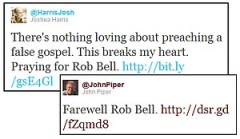
    John Piper & Josh Harris on Twitter:

    Kevin DeYoung

    Justin Taylor

    Tim Keller also republished a post titled The Importance of Hell

    1. Hell is Important Because Jesus taught on it more than all other Biblical authors put together.
    2. Hell is Important because it shows how infinitely dependent we are on God for everything.
    3. Hell is Important because it unveils the seriousness and danger living life for yourself.
    4. The Doctrine of Hell is Important because it is the only way to know how much Jesus loved us and how much he did for us.

    John Armstrong chimed in on the debate, and suggested that some of the responses were just knee jerk reactions.  Armstrong advocates waiting for the book to come out before developing any conclusions about Rob Bell.  Caution and charity is almost always good counsel.

    But, while this discussion is still in vogue, I thought I would direct those interested to a few other resources.  In particular 9 Marks Sept-Oct ’10 e-Journal was devoted to it.  Click: Remembering the Awful Reality.   Two articles from that edition I find worth consideration are summarized below:

    How Does Hell Glorify God? by James Hamilton.

    • Hell shows that God keeps his word.
    • Hell shows God’s infinite worth.
    • Hell demonstrates God’s power to subdue all who rebel against him.
    • Hell shows how unspeakably merciful God is to those who trust him.
    • Hell upholds the reality of love by visiting justice against those who reject God, who is love.
    • Hell vindicates all who suffered to hear or proclaim the truth of God’s Word.
    • Hell shows the enormity of what Jesus accomplished when he died to save all who would trust him from the what they (we) deserved. If there were no hell, there would be no need for the Cross.

    Why is Hell Integral to the Gospel? by Greg Gilbert

    1. Hell shows us how heinous our sin really is.
    2. Hell shows us how unimpeachably just God really is.
    3. Hell shows us how horrific the cross really was, and how great God’s grace really is.
    4. Hell focuses our minds on the task of proclaiming the gospel.

    One final word.  This is not a one sided discussion.  Many are picking up where Bell left off – or where they think he left off.  Wherever Bell will come out on this issue, some folks are running with their own half-baked theories… they are running fast like bats out of… well you know.

  • Out of Whack

    In his book, The Call, Os Guiness observes a few ways our cultural and personal priorites are a little out of whack:

    • We Worship our Work
    • We Work at our Play
    • We Play at our Worship
  • Misusing the Proverbs

    Great post by John Armstrong on Proverbs.  Armstrong asserts:

    Perhaps no part of Holy Scripture has been more frequently abused… than the book of Proverbs.

    Armstrong goes on to explain what the proverbs are and are not, and their God-intended purpose.

    Not long ago a friend and I were discussing this very same problem, after some pastors he knew had thrown around a proverb or two, wielding them as if they were laws.   But proverbs are not laws. They are expressions of wisdom.   Sometimes they are even contradictory wisdom.

    Now I do not believe, as many assert, that the Bible “contradicts” itself.  The laws and promises are consistent in all ways.  One has to remove them from their intended context to make a case that they are contradictory.  But when it comes to the book of Proverbs it is reasonable to see that some sayings offer different outcomes for similar actions.  That is easy enough to explain.  Again, proverbs are not laws or promises, they are expressions of wisdom to help us navigate life.  I’ve heard R.C. Sproul says about Proverbs, essentially, in life “sometimes this will happen, and sometimes that will happen.”  Proverbs prepares us for “this” and “that”.

    Check Out: Misusing the Proverbs