The Advent of Humility

The following article, by Tim Keller, first appeared in the December 2008 edition of Christianity Today Magazine.  In this article Keller explains why the Advent of Jesus gives us reason to stop concentrating on ourselves.

***

Innumerable Christmas devotionals point out the humble circumstances of Jesus’ birth—among shepherds, in a crude stable, with a feed trough for a bassinet. When Jesus himself tried to summarize why people should take up the yoke of following him, he said it was because he was meek and humble (Matt. 11.29). Seldom, however, do we explore the full implications of how Jesus’ radical humility shapes the way we live our lives every day.

Humility is crucial for Christians. We can only receive Christ through meekness and humility (Matt. 5.3, 5; Matt 18.3-4). Jesus humbled himself and was exalted by God (Phil. 2:8-9); therefore joy and power through humility is the very dynamic of the Christian life (Luke 14.11; 18.14; 1 Peter 5.5).

The teaching seems simple and obvious. The problem is that it takes great humility to understand humility, and even more to resist the pride that comes so naturally with even a discussion of the subject.

We are on slippery ground because humility cannot be attained directly. Once we become aware of the poison of pride, we begin to notice it all around us. We hear it in the sarcastic, snarky voices in newspaper columns and weblogs. We see it in civic, cultural, and business leaders who never admit weakness or failure. We see it in our neighbors and some friends with their jealousy, self-pity, and boasting.

And so we vow not to talk or act like that. If we then notice “a humble turn of mind” in ourselves, we immediately become smug—but that is pride in our humility. If we catch ourselves doing that we will be particularly impressed with how nuanced and subtle we have become. Humility is so shy. If you begin talking about it, it leaves. To even ask the question, “Am I humble?” is to not be so. Examining your own heart, even for pride, often leads to being proud about your diligence and circumspection.

Christian humility is not thinking less of yourself; it is thinking of yourself less, as C. S. Lewis so memorably said. It is to be no longer always noticing yourself and how you are doing and how you are being treated. It is “blessed self-forgetfulness.”

Humility is a byproduct of belief in the gospel of Christ. In the gospel, we have a confidence not based in our performance but in the love of God in Christ (Romans 3.22-24). This frees us from having to always be looking at ourselves. Our sin was so great, nothing less than the death of Jesus could save us. He had to die for us. But his love for us was so great, Jesus was glad to die for us. Continue reading

What Sort of People?

The day of the Lord will come like a thief, in which the heavens will pass away with a roar and the elements will be destroyed with intense heat, and the earth and its works will be burned up. Since all these things are to be destroyed in this way, what sort of people ought you to be in holy conduct and godliness, looking for and hastening the coming of the day of God…? [2 Peter 3.10-12]

You and I are on a journey, and only two destinations are possible; we will either arrive at eternal life or eternal destruction. Whatever problems we think we have, whatever decisions we think we face, all merge into one problem, one decision: will we take the path to life or death?

We forget this easily, however, because the big issue is disguised as all the little issues we face every day. We can lose sight of the momentous nature of the choices we make throughout our lives. Sometimes our theology helps to blur our vision. “We are saved by faith,” we say, as if faith could be separated from the way we live our lives. But of course they cannot be separated. Peter clearly believed in no such separation; he showed this in the quote above. To him, the doctrine of the day of the Lord, the Christian belief that God will judge the world and make new heavens and a new earth, leads inexorably to an obvious question: “What sort of people ought you to be, in holy conduct and godliness?”

Of course, it is crucial that I don’t give the wrong picture. You and I are not saved because we are morally successful. Eternal life is not something we can earn or accomplish for ourselves. The gospel is, first of all, about God’s great mercy, how He has forgiven us for our many sins. I am not here to say, “Join me in sinless perfection.” I could never get away with it; I am a sinful, foolish man in many ways. (I know of many ways, and you all could probably show me more ways that I don’t know yet.) I am not saying that we must prove how good we are in order to get eternal life. I know I am not good enough, and I thank God that He is willing to save me anyway.

Yet, as Peter implies, there is a connection between what we believe and how we live. Saving faith and holy living are joined with an unbreakable bond; what we want and believe will inevitably show itself in how we act. We are still sinners, and our lives will show this clearly. But if we are regenerate children of God, our lives will show this as well. Some of us at McKenzie Study Center have been emphasizing this for some time: in Jack Crabtree’s groundbreaking paper “The Anatomy of Sainthood”; in Jack’s teaching on 1 John and Hebrews; in my teaching in James and Matthew; and in the book I expect to finish soon. I sometimes feel as if I teach on nothing else. Even so, it is still easy, perilously easy, to forget what is at stake, to lose sight of the life and death journey before us. And so I want to remind us all again: our faith is something that must be lived out. Today each one of us must take another momentous step in our journey toward life or away from it. My purpose is not to draw a roadmap for the holy way; I just want us to remember Peter’s question: What sort of people ought we to be?

Continue reading

Gospel from Mars Hill

The gospel is like a multifaceted jewel.  Descriptions of it vary but the substance is never altered.  Our appreciation for it’s beauty is enhanced by viewing it from it’s different aspects.  We also see things fresh through the eyes of others, as we understand what they are seeing. For that reason I value whenever I encounter a rich and faithful explanation of the gospel.

The following explanation comes from Mars Hill Church in Seattle:

“Now I would remind you, brothers, of the gospel I preached to you, which you received, in which you stand, and by which you are being saved, if you hold fast to the word I preached to you—unless you believed in vain. For I delivered to you as of first importance what I also received: that Christ died for our sins in accordance with the Scriptures, that he was buried, that he was raised on the third day in accordance with the Scriptures . . .”  ~ 1 Corinthians 15.1–4

What is the Gospel?

The word gospel simply means “good news.” The central message of the Bible is the gospel, or good news, about the person and work of Jesus Christ. In 1 Corinthians 15.1–4, Paul provides the most succinct summary of the gospel: the man Jesus is also God, or Christ, and died on a cross in our place, paying the penalty for our sins; three days later He rose to conquer sin and death and give the gift of salvation to all who believe in Him alone for eternal life.

The great reformer Martin Luther rightly said that, as sinners, we are prone to pursue a relationship with God in one of two ways. The first is religion/spirituality and the second is the gospel. The two are antithetical in every way.

  • Religion says that if we obey God He will love us.
  • The gospel says that it is because God has loved us through Jesus that we can obey.
  • Religion says that the world is filled with good people and bad people.
  • The gospel says that the world is filled with bad people who are either repentant or unrepentant.
  • Religion says that you should trust in what you do as a good moral person.
  • The gospel says that you should trust in the perfectly sinless life of Jesus because He alone is the only good and truly moral person who will ever live.
  • The goal of religion is to get from God such things as health, wealth, insight, power, and control.
  • The goal of the gospel is not the gifts God gives, but rather God as the gift given to us by grace.
  • Religion is about what I have to do.
  • The gospel is about what I get to do.
  • Religion sees hardship in life as punishment from God.
  • The gospel sees hardship in life as sanctifying affliction that reminds us of Jesus’ sufferings and is used by God in love to make us more like Jesus.
  • Religion is about me.
  • The gospel is about Jesus.
  • Religion leads to an uncertainty about my standing before God because I never know if I have done enough to please God.
  • The gospel leads to a certainty about my standing before God because of the finished work of Jesus on my behalf on the cross.
  • Religion ends in either pride (because I think I am better than other people) or despair (because I continually fall short of God’s commands).
  • The gospel ends in humble and confident joy because of the power of Jesus at work for me, in me, through me, and sometimes in spite of me.

This is the gospel.

Legalism in Light of the Gospel

In light of the gospel, let me especially demolish the myth that legalism is a blunder that’s associated only with our initial salvation—with our positional justification in God’s eyes. Most believers realize we could never earn such salvation; we’ve come to accept that no one can work his way into God’s kingdom… .

But when it comes to our sanctification, suddenly we become legalists. In the matter of maturing in Christlikeness—and in continuing to please God and find favor with God and acceptance with God—we suppose it’s all about what we have to accomplish ourselves and all the rules and standards and values we need to adhere to. We seem to inherently assume that our performance is what will finally determine whether our relationship with God is good or bad: so much good behavior from us generates so much affection from God, or so much bad behavior from us generates so much anger from God.

We get the Christian life all backwards. It subtly becomes all about us and what we do (which leads to slavery) instead of being all about Jesus and what he’s done (which leads to freedom). We may not articulate all this theologically, but it sure comes out in the way we live.

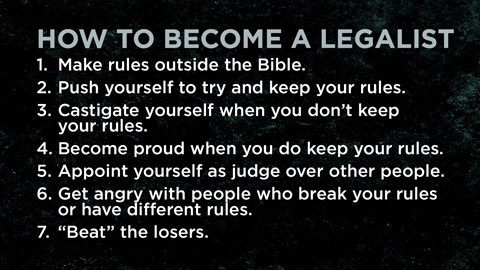
By their behavior, legalists essentially are saying this: “I live the Christian life by the rules—rules that I establish for myself as well as those I expect others to abide by.” They develop specific requirements of behavior beyond what the Bible teaches, and they make observance of those requirements the means by which they judge the acceptability of others in the church.

We’ve all become pretty adept at establishing these rules and standards that we find personally achievable. Legalism therefore provides us with a way to avoid acknowledging our deficiencies and our inabilities. That’s enough right there to make it attractive to us. But it’s also appealing to us in how it puffs us up, giving us the illusion … that we can do it—we can generate our own meaning, our own purpose, our own security, and all our other inmost needs. It’s what Michael Horton pinpoints as “the default setting of the human heart: the religion of self-salvation.”

It’s all so attractive because it’s all about us. Legalism feeds our natural pride. While abiding by our self-established standards and rules, we think pretty highly of ourselves …. And what’s especially fine about being in charge of our situation (though we wouldn’t admit it) is that it’s a way to avoid Jesus.

~ Tullian Tchividjian, from Jesus + Nothing = Everything

Moralism Trap

To reach people in our day, the gospel will have to be distinguished from moralism, because moralism is what most people outside the church think Christianity is all about – rules and standards and behavior and cleaning yourself up.  Millions of people, both inside and outside the church, believe that the essential message of Christianity is: “If you behave, then you belong.”  From a human standpoint, that’s why most people reject Christianity.

~ Tullian Tchividjian, from Jesus + Nothing = Everything

Who Do You Listen To?

I am blessed to have some great friends. While I always enjoy making new friends, there is nothing like an old friend. Someone who has known you long, and known you well. These are the friends who can see right through the veneer we sometimes try to hide beneath. And because they can see through it they won’t let you hide.  These are the ones who ask penetrating questions. I have to come clean because they will know if I am skirting the issue by giving some vague reply.  These are the folks I go to for counsel. These are the folks I always listen to.

In a post not long ago, Perry Noble asked the question: Who Should You Listen To?  He then proceeds to make a list of 8 qualifications.

If you are in leadership (and especially if you are in church leadership) then you have probably discovered the reality that God loves you…and everyone else has an incredible plan for your life!

One of the struggles that we all MUST wrestle with is who to listen to when it comes to making decisions.  The Bible tells us that we unwise to be Lone Rangers (Proverbs 15:22) and the Bible has several stories of people who made bad decisions because they listened to the wrong people (see I Kings 12:1-16.)

However, it is IMPOSSIBLE to listen to everyone. With the barrage of information and opinions coming our way via Facebook, email, twitter and other media, anyone who tries to focus on the opinions of everyone will simply lose his mind, and most likely any leadership effectiveness, if his obsession becomes making everyone happy.

So, who do we listen to?  Who is it that should ALWAYS have access to us…and we should ALWAYS desire their thoughts and insights? Here is Perry Noble’s list:

#1 – Those who know me, who have spent time with me and understand that there is a person behind the personality.

#2 – Those who have seen me at my best and worst…and love me anyway.

#3 – Those who do not automatically assume the worse about me and always give me the benefit of the doubt.  (ALWAYS beware of the person who seeks to pounce on you as soon as they hear something bad!)

#4 – Those who are willing to stand with me in a tough time–THOSE WHO BLEED WITH ME CAN LEAD WITH ME!!!

#5 – Those who offer correction for the purpose of building up rather than tearing down (people who always seek to tear you down should be ignored!  If they do not correct/confront in love then they are nothing more than a resounding gong or a clanging cymbal – see I Corinthians 13:1)

#6 – Those who are willing to take a confrontation straight to the person rather to an online audience.

#7 – Those who are not always looking for a reason to attack/hate you.

#8 – Those who have the goal of restoring you when you mess up and not wounding you!

10 Questions to Ask at a Christmas Gathering

we-wish-you-a-merry-christmas-sara-gore-evans

Do you have any Chrstmas gatherings to attend this holiday season?  My thanks to Don Whitney for suggesting the following questions to spruce up the conversation – perhaps especially at church:

  1. What’s the best thing that’s happened to you since last Christmas?
  2. What was your best Christmas ever? Why?
  3. What’s the most meaningful Christmas gift you’ve ever received?
  4. What was the most appreciated Christmas gift you’ve ever given?
  5. What was your favorite Christmas tradition as a child?
  6. What is your favorite Christmas tradition now?
  7. What do you do to try to keep Christ in Christmas?
  8. Why do you think people started celebrating the birth of Jesus?
  9. Do you think the birth of Jesus deserves such a nearly worldwide celebration?
  10. Why do you think Jesus came to earth?

The Great Physician’s Assistants

The question still resounds in my mind; and resonates in my heart.  An wise old pastor approached the table where I was lunching with my father-in-law and my pastor on the day I was to be examined for ordination.  He sat easily in an open chair with a friendly grin and forewarned me that he was going to ask a couple questions of me later that day during my examination.  Among the questions he was planning to ask was this: “Do you see yourself, as a pastor, more like a policeman or a physician?”

That is a stunningly simple question with profoundly different implications, depending upon how one answers.

The one who views himself as more the policeman is constantly on the lookout for violations of the law and/or of the peace.  Once transgressions are witnessed – or sometimes even merely speculated – the policeman-pastor jumps into action, levying warnings and pressing charges.  The motive is easily understood. God is holy and will not tolerate sin. God calls for his people to “be Holy even as God is Holy”.  And someone has to keep order and direct traffic. And if not the pastor (and Elders) who else will do this necessary thankless task?

The one who views himself more like the physician, on the other hand, also keeps an eye out for evidence of violations. But rather than assuming any ability to sheriff the church (much less the world) the physician-pastor is motivated by compassion.  The physician pastor knows sin abounds in all of us and that it is a condition that kills.   he understands that this condition is so pervasive that even if he could squelch all or most of the active expressions of sin that it would still do only cosmetic good. People would look better, and the world would certainly seem a better place to live, but the condition that is rooted in the heart would still wreak it’s devastating effect upon humanity. He realizes that in many ways the cleaned up life may be more dangerous than the life left exposed.  At least when there is evidence of sin people are concerned. But in an artificially sanitized society – or church – people assume all is clear; everything is OK.  Few if any are willing to listen to the warning bells that informed physicians sound.  The hope of the physician is that people aware of their condition, and it’s terminal nature, will seek out the remedy; the remedy he is commissioned to prescribe frequently and widely – the Gospel of Jesus Christ.

The physician-pastor understands that this prescription has multiple effects. And he reminds his patients that this remedy works from the inside out.  The first effect is that when initially ingested by faith that the terminal threat is immediately voided.  No longer will the effects of sin lead to death, physically or spiritually.  One dose is all it takes.  But he also realizes that the condition of sin, while no longer lethal, has already caused much damage to the individual – some known, much unseen. Left unchecked the lingering effects of sin will continue to cause tremendous damage to infected individuals, spiritually, emotionally, and relationally.  So even while the initial dose effectively terminated the terminal effect of sin, everyone who has been exposed is prescribed to regularly take ongoing dosages to combat and reverse the effects of sin that remaining cancerous traces.

Gospel Greater Than Conservatism & Liberalism

The gospel is neither conservative nor liberal; and at the same time the gospel is both liberal and conservative.  This causes a lot of confusion to folks both inside and outside of the Church.

On the one hand, the gospel is conservative because it declares that there is such a thing as right and wrong, and that there are benefits from choosing right and consequences that accompany wrong.   Each person is responsible for his or her own actions and attitudes.  These are very conservative principles.

On the other hand, the gospel is the free gift that is given to those who have not earned it and cannot afford it.  In fact, we are told the gospel is the riches of Christ redistributed to those who admit their spiritual poverty.  Isaiah says it is like being invited to a party, but the only ones who can come are those who cannot pay, or who are humble enough to admit whatever riches they think they might have are not valid currency.  (Isaiah 55.1-2) These seem to be very liberal ideas and images.

Both are true. Equally true. Both are essential. Leave out one side or the other and you create a “different gospel” – which, as Paul says, is really no gospel at all.  In fact, Paul tells us that anyone trying to pass a counterfeit gospel should be ( and will be) anathema – repeatedly destroyed over and over for all eternity.  (Galatians 1.6-9)

I would suggest, even insist, that both Conservatism and Liberalism are false worldviews and offer counterfeit gospels.  The gospel is not a compromise of liberalism and conservatism, nor is it merely a middle way. The gospel is the expression of God’s very nature and plan.  It is therefore, THE Truth, because God himself – and God alone – is Truth.  And it is eternal Truth because God, who is Truth, is eternally God.

What both Conservatives and Liberals have done, at least those who operate as if these philosophies are the supreme ideologies, is to carve off portions of the Truth that meet their personal preferences at the expense of the valid point of the other.  Both begin with as a reduction of the gospel  Each then proceeds to build their respective worldview upon these faulty foundations of a corrupted gospel.

We begin to escape the confusion when we recognize our own propensity toward either Conservatism or Liberalism, at the expense of the other.  We begin to overcome our limitations when we recognize the whole gospel alone is the Truth, and then commit to a lifelong pursuit of excavating the depths and complexities of the gospel, while at the same time venturing to live out all the implications of the gospel in every aspect of our lives.

Whether theologically or politically, conservatism and liberalism are impotent to effect real, enduring, or godly change. But the gospel, undiluted and undistorted,  is the power of God. (1 Corinthians 1.20-25)

Men & Woman and a Biblical Perspective

Here is a provocative post from Russell Moore concerning Men & Women and authority issues.  The Conservative Southern Baptist Moore may surprise a few people with his opening paragraphs:

Those of us who hold to so-called “traditional gender roles” are often assumed to believe that women should submit to men. This isn’t true.

Indeed, a primary problem in our culture and in our churches isn’t that women aren’t submissive enough to men, but instead that they are far too submissive.

Moore may even shock a few folks when they read the title of this post: Women, STOP Submitting to Men.

I wholeheartedly agree with Moore’s perspective.  So, let’s add this to the Egalitarian vs. Complementarian vs. He-Men Woman Haters Club debates!

To read the rest of Moore’s post, click: Women & Men