The Advent of Humility

The following article, by Tim Keller, first appeared in the December 2008 edition of Christianity Today Magazine.  In this article Keller explains why the Advent of Jesus gives us reason to stop concentrating on ourselves.

***

Innumerable Christmas devotionals point out the humble circumstances of Jesus’ birth—among shepherds, in a crude stable, with a feed trough for a bassinet. When Jesus himself tried to summarize why people should take up the yoke of following him, he said it was because he was meek and humble (Matt. 11.29). Seldom, however, do we explore the full implications of how Jesus’ radical humility shapes the way we live our lives every day.

Humility is crucial for Christians. We can only receive Christ through meekness and humility (Matt. 5.3, 5; Matt 18.3-4). Jesus humbled himself and was exalted by God (Phil. 2:8-9); therefore joy and power through humility is the very dynamic of the Christian life (Luke 14.11; 18.14; 1 Peter 5.5).

The teaching seems simple and obvious. The problem is that it takes great humility to understand humility, and even more to resist the pride that comes so naturally with even a discussion of the subject.

We are on slippery ground because humility cannot be attained directly. Once we become aware of the poison of pride, we begin to notice it all around us. We hear it in the sarcastic, snarky voices in newspaper columns and weblogs. We see it in civic, cultural, and business leaders who never admit weakness or failure. We see it in our neighbors and some friends with their jealousy, self-pity, and boasting.

And so we vow not to talk or act like that. If we then notice “a humble turn of mind” in ourselves, we immediately become smug—but that is pride in our humility. If we catch ourselves doing that we will be particularly impressed with how nuanced and subtle we have become. Humility is so shy. If you begin talking about it, it leaves. To even ask the question, “Am I humble?” is to not be so. Examining your own heart, even for pride, often leads to being proud about your diligence and circumspection.

Christian humility is not thinking less of yourself; it is thinking of yourself less, as C. S. Lewis so memorably said. It is to be no longer always noticing yourself and how you are doing and how you are being treated. It is “blessed self-forgetfulness.”

Humility is a byproduct of belief in the gospel of Christ. In the gospel, we have a confidence not based in our performance but in the love of God in Christ (Romans 3.22-24). This frees us from having to always be looking at ourselves. Our sin was so great, nothing less than the death of Jesus could save us. He had to die for us. But his love for us was so great, Jesus was glad to die for us. Continue reading

What Sort of People?

The day of the Lord will come like a thief, in which the heavens will pass away with a roar and the elements will be destroyed with intense heat, and the earth and its works will be burned up. Since all these things are to be destroyed in this way, what sort of people ought you to be in holy conduct and godliness, looking for and hastening the coming of the day of God…? [2 Peter 3.10-12]

You and I are on a journey, and only two destinations are possible; we will either arrive at eternal life or eternal destruction. Whatever problems we think we have, whatever decisions we think we face, all merge into one problem, one decision: will we take the path to life or death?

We forget this easily, however, because the big issue is disguised as all the little issues we face every day. We can lose sight of the momentous nature of the choices we make throughout our lives. Sometimes our theology helps to blur our vision. “We are saved by faith,” we say, as if faith could be separated from the way we live our lives. But of course they cannot be separated. Peter clearly believed in no such separation; he showed this in the quote above. To him, the doctrine of the day of the Lord, the Christian belief that God will judge the world and make new heavens and a new earth, leads inexorably to an obvious question: “What sort of people ought you to be, in holy conduct and godliness?”

Of course, it is crucial that I don’t give the wrong picture. You and I are not saved because we are morally successful. Eternal life is not something we can earn or accomplish for ourselves. The gospel is, first of all, about God’s great mercy, how He has forgiven us for our many sins. I am not here to say, “Join me in sinless perfection.” I could never get away with it; I am a sinful, foolish man in many ways. (I know of many ways, and you all could probably show me more ways that I don’t know yet.) I am not saying that we must prove how good we are in order to get eternal life. I know I am not good enough, and I thank God that He is willing to save me anyway.

Yet, as Peter implies, there is a connection between what we believe and how we live. Saving faith and holy living are joined with an unbreakable bond; what we want and believe will inevitably show itself in how we act. We are still sinners, and our lives will show this clearly. But if we are regenerate children of God, our lives will show this as well. Some of us at McKenzie Study Center have been emphasizing this for some time: in Jack Crabtree’s groundbreaking paper “The Anatomy of Sainthood”; in Jack’s teaching on 1 John and Hebrews; in my teaching in James and Matthew; and in the book I expect to finish soon. I sometimes feel as if I teach on nothing else. Even so, it is still easy, perilously easy, to forget what is at stake, to lose sight of the life and death journey before us. And so I want to remind us all again: our faith is something that must be lived out. Today each one of us must take another momentous step in our journey toward life or away from it. My purpose is not to draw a roadmap for the holy way; I just want us to remember Peter’s question: What sort of people ought we to be?

Continue reading

Portrait of a Recovering Pharisee

by Nancy Scott     

When Sally first heard the gospel at age eleven, she understood immediately that God’s grace is what saves us. She already knew her heart was full of evil and that she had nothing to bring to God. It made perfect sense that God would have to do the saving, if any saving was to be done. The solution of Jesus’ death on the cross was perfect, and she understood that He had died in her place.

The Bible church where Sally began her pilgrimage strongly taught the concept of grace. She learned that grace meant “undeserved favor.” Grace was getting something you didn’t deserve, whereas mercy was NOT getting what you did deserve. The gospel addressed both of these areas of life in the provision of Jesus’ death on the cross. So she fully understood that she came to Christ because God was reaching deep into her soul to regenerate her and to bring her to an awareness of her need and of His provision for her salvation. She entered the path to the kingdom on her knees, got up, and took off running.

By the time Sally was seventeen, life was not as clear-cut as it had been at the tender age of eleven. She had understood what it meant to be saved by grace; now she began wondering what it meant to live there. She began to struggle with the difficult choices of life and a tension in her desires to do the right thing. When she went to her Bible teachers for advice, they told her that God had given her all the resources she needed to live a victorious Christian life, and she only needed to avail herself of the Spirit of God who now lived inside her. If she tapped into His power, He would grant her the ability–and the desire she lacked–to do the right thing. The Bible teachers asked Sally if she did her daily devotions, and they recommended some helpful Bible studies. These things, they said, would help unleash the Spirit’s power to work in her life.

Sally took off running again. She dove into her daily devotions with renewed vigor, and even though she wasn’t a morning person, she began to get up an hour earlier. Sally was so grateful that God had given her this extra measure of grace to be so dedicated to him at such a young age. Things seemed to improve for a while.

Then something slowly changed. The excitement began to wear off, and Sally suspected that her non-Christian friends were having more fun than she. She indulged with them every now and then, only to feel tremendously guilty and to make a renewed commitment to God with each failure. The longer this pattern went on, the more confused Sally became. Why wasn’t God unleashing His Spirit inside her for victory anymore, even when she carried out all her spiritual practices and dedication? Why was the evil around her becoming more attractive instead of less attractive? Was it normal for her to find herself rededicating her life to God so routinely? Was this what it meant to live by grace?

Continue reading

The Old Man and the Flesh

by Robin Boisvert

What actually changes when one becomes a Christian?  Confusion about this is common, especially when we realize that we continue to struggle with sin and temptation even after conversion.  Paul tells us in Galatians that we have a war that goes on within us after conversion: “For the desires of the flesh are against the Spirit, and the desires of the Spirit are against the flesh, for these are opposed to each other, to keep you from doing the things you want to do. ” (Galatians 5.17)   In this short essay Robin Boisvert helps bring some clarity.  ~ WDG

***

Some of the terms which the apostle Paul uses in discussing the believer’s relationship to sin can cause confusion. I’m speaking of terms such as “old man,” “new man,” “body of sin,” “flesh,” and others. These can be difficult to understand. Add to this the variations which modern translators have given these words and the subject can appear daunting.

We know a profound change has occurred in the life of the believer through conversion, but just how has the believer changed?

For we know that our old self was crucified with him so that the body of sin might be done away with, that we should no longer be slaves to sin — because anyone who has died has been freed from sin. (Romans 6.6-7, emphasis added)

Let’s begin by trying to define our terms. “Old man” (as it is translated in the King James Version and American Standard Version) is equivalent to “old self”  (NIV, NASV).  This term refers to the unregenerate life we lived before we were converted. As John R.W. Stott has written, the old self “denotes not our old unregenerate nature [flesh], but our old unregenerate life. Not my lower self, but my former self. So what was crucified with Christ was not a part of me called my ‘old nature’, but the whole of me as I was before I was converted.”1  John Murray’s definition concurs:

“‘Old man’ is a designation of the person in his unity as dominated by the flesh and sin.”2

It’s important for us to see that the believer is not at the same time an “old self” and a “new self,” alternately dominated and directed by one or the other. We are indebted again to Murray’s insight:

The old man is the unregenerate man; the new man is the regenerate man created in Christ Jesus unto good works. It is no more feasible to call the believer a new man and an old man, than it is to call him a regenerate man and an unregenerate.  And neither is it warranted to speak of the believer as having in him the old man and the new man. 3

Thus, terms like “old man,” “old self,” “unregenerate life,” and “former self” are synonymous, all referring to the entity that was crucified with Christ.

Notice two significant grammatical features of the passage from Romans 6 cited above. First, the verb is used in the past tense: “our old self  crucified…” The crucifixion of the old self is a finished fact. Second, the verb is also passive in voice, meaning that the subject (our old self) is being acted upon. In other words, the crucifixion of the old self is not something we must do, but something that is done to us.

Another important concept in the biblical doctrine of sanctification has traditionally been designated by the word “flesh” (King James Version). The New International Version uses “sinful nature.” According to Stott, “flesh” refers to a “lower” nature, that part of our being inclined toward rebellion against God. This is that part of you that wants to pass on a juicy bit of gossip; that urges you to take a second look at the  immodest images on the television screen. “Whatever we may call this tendency [“indwelling sin,” 4 “remnants of corruption,”5 “vestiges of sin,”6 or “my sinful nature”7]  we must remember that even after we have been regenerated we still have such sinful impulses, and must still fight against them as long as we live.” 8

In Romans 6.6 Paul calls our sinful nature (i.e. flesh) the “body of sin.” He says our old self was crucified with Christ so that this “body of sin might be done away with…” To be “done away with” here means to be put out of action, rendered powerless. It does not mean to be annihilated, gone without a trace. But our sinful nature’s mastery over us has been broken.

Some, not understanding the distinction between the “old self” and the “sinful nature” have gotten Romans 6.6 confused with Galatians 5.24, which also speaks of crucifixion and the believer. Consider two translations of this verse:

  •  Those who belong to Christ Jesus have crucified the sinful nature with its passions and desires. (Galatians 5.24 NIV)
  •  And they that are Christ’s have crucified the flesh with the affections and lusts. (Galatians 5.24 KJV)

Though helpless to take anything but a passive stance in regard to the old self (Romans 6.6), we do have an active part to play, as the Galatians learned, in the subjugation of the flesh. Stott sums this up with characteristic clarity:

 First, we have been crucified with Christ; but then we not only have decisively crucified (i.e. repudiated) the flesh with its passions and desires, but we take up our cross daily  and follow Christ to crucifixion (Luke 9.23). The first is a legal death, a death to the penalty of sin; the second is a moral death, a death to the power of sin. The first belongs to the past, and is unique and unrepeatable: I died (in Christ) to sin once. The second belongs to the present, and is continuous and repeatable: I die (like Christ) to self daily. It is with the first of these two that Romans 6 is concerned. 9

And Galatians 5 is concerned with the second.

So the old self has been dealt with. In its place we have been given a new self: “Therefore, if anyone is in Christ, he is a new creation; the old has gone, the new has come!” (2 Corinthians 5.17). And while our sinful nature (the flesh, indwelling sin, etc.) is still very much with us, its dominion over us has ended.

Continue reading

You Can Change

I started reading You Can Change by Tim Chester of The Crowded House.  It is different from most books about transformation and personal growth because Chester roots everything in the dual truths of the Christian’s new identities and the power of the gospel. 

This video is Tim’s introduction and explanation of the book.

Here is what a couple others are saying about You Can Change:

A book about Christian growth that is neither quietistic nor moralistic is rare. A book that is truly practical is even rarer. Tim Chester’s new volume falls into both categories and therefore fills a gap.  ~ Tim Keller

There are few books that are shockingly honest, carefully theological, and gloriously hopeful all at the same time. Tim Chester’s book, You Can Change, is all of these and more. He skilfully uses the deepest insights of the theology of the Word as a lens to help you understand yourself and the way of change, and, in so doing, helps you to experience practically what you thought you already knew. The carefully crafted personal ‘reflection’ and ‘change project’ sections are worth the price of the book by themselves. It is wonderful to be reminded that you and I are not stuck, and it’s comforting to be guided by someone who knows well the road from where we are to where we need to be. ~ Paul Tripp

Who Does What?

Reading Jerry Bridges’ book Discipline of Grace, especially chapter 6, prompted me to think about the importance of understanding “Who does What?” in our salvation.

Here are a few observations that I hope will provide some clarification:

  • Many are frustrated to unfortunate degree because they do not understand that sanctification is a process.
  • Many are spiritually stunted because they do not realize spiritual growth and maturity is a process in which we must actively and intentionally participate.
  • Many people just assume that, now that they are “New Creations”, Christ-likeness will inevitably emerge from within them whether they do anything or not.
  • But spiritual growthis not automatic.  God calls us to cooperate with his grace, by actively engaging in the Means of Grace (Word, Sacraments, Prayer), responding to the Spirit by his grace.
  • The confusion seems to be rooted in misunderstanding the differences and the relationship between justification (conversion) and sanctification (growth). 
  • While it is true that we can do nothing to bring about our justification, our new birth, any more than we can do anything to bring about our physical birth; it is not true that we can do nothing, or should do nothing to cultivate healthy spiritual growth.  Just as in our physical growth, where we develop in accord with our God-given DNA in no small part through healthy eating and activity, we grow spiritually by God-given grace AND healthy activity (i.e. Means of Grace, Obedience, Active Mission and Spiritual Disciplines).

Gospel-Driven Sanctification

The first thing to remember is that we must never separate the benefits (regeneration, justification, sanctification) from the Benefactor (Jesus Christ). The Christians who are most focused on their own spirituality may give the impression of being the most spiritual but from the New Testament’s point of view, those who have almost forgotten about their own spirituality because their focus is so exclusively on their union with Jesus Christ and what He has accomplished are those who are growing and exhibiting fruitfulness. Historically speaking, whenever the piety of a particular group is focused on OUR spirituality, that piety will eventually exhaust itself on its own resources. Only where our piety forgets about us and focuses on Jesus Christ will our piety be nourished by the ongoing resources the Spirit brings to us from the source of all true piety, our Lord Jesus Christ.

~ Sinclair Ferguson

My Spiritual EKG

“How are you doing, Spiritually?” That is an important question.

The Great Physician, by both direct and indirect statements in his Word, repeatedly encourages us to examine our hearts. But while many may be  aware that it ought to be our regular practice to take a Spiritual pulse, I suspect that relatively few know how to read the gauges even if they try. Consequently, if we are not certain what we are looking for, it follows that we are not always quite sure how to answer our opening question. So, it seems, the typical response we might give, even to those who may genuinely care, is an awful lot like the responses we give to the stranger on the street, or the hotel clerk we see each morning on vacation, when they ask “How are you today?” “Fine, thanks. And you?” But this is too important a question to simply perpetuate the standard reflex response.

I have benefited from regularly asking myself 10 Questions I learned from Don Whitney and his short but helpful book: 10 Questions to Diagnose Your Spiritual Health. Asking myself these questions, or considering observations people have offered about me as they relate to these questions, serves as a good spiritual check-up.

Each of the 10 Questions below is a link to an excerpt of respective chapters from Whitney’s book:

  1. Are you more thirsty for God than ever before?
  2. Are you more and more loving?
  3. Are you more sensitive to and aware of God than ever before?
  4. Are you governed more and more by God’s Word?
  5. Are you concerned more and more with the physical and spiritual needs of others?
  6. Are you more and more concerned with the Church and the Kingdom of God?
  7. Are the disciplines of the Christian life more and more important to you?
  8. Are you more and more aware of your sin?
  9. Are you more and more willing to forgive others?
  10. Are you thinking more and more of heaven and of being with the Lord Jesus?

Offensive Grace

Why does not the faith of the average Christian seem to bring about the change we would hope? Could it be that many have a faulty understanding of the Gospel?

Dan Allender, in his book Bold Love, offers the following:

“If our sin is mere failure to conform – simply a mistake to do what is right – forgiveness is really the granting of an opportunity to try again.  In that light, it is like forgetting to finish one’s homework.  We deserve a low grace, and grace becomes merely the privilege of doing it over to get a higher mark.  Such a view of grace might generate appreciation, but it would never drive us to worship.  If, in fact, sin is not only failure to hit the mark of God’s perfection, but also a deep, insidious energy that desires to eradicate from our existence an affronting God who demands perfection, then forgiveness becomes breathtaking, incredible, and wonderfully insulting.”

It seems we underestimate our sin. Consequently we undervalue God’s grace.

5 Views on Sanctification

Several years ago a book was released attempting to outline and compare the major divergent views about the doctrine of sanctification, Five Views on Sanctification.  In this book five respected theologians, each a proponent of one of the respective positions gave an outline explanation of the positions: Wesleyan/Holiness, Reformed/Puritan, Keswick, Dispensational, and Pentecostal.  Following the introduction by the adherent theologian, each of the other theologians then interact with the presented view in a rebuttal/defense discussion that reflects the strengths and weaknesses of the various positions.

This is an important discussion because it reflects one of the major areas where Christians view things from vastly different perspectives.  But unlike other areas where sincere Believers differ (i.e. Eschatology, Baptism, Church Government, Complementarian vs. Egalitarian) this subject is not often as clearly articulated as those other subjects.  Rather, sanctification seems to be assumed.  I am not making the case that we add this discussion to our all too common arguments, as we might add another log on a fire.  But I do see a value in awareness of these differences so that we can talk to one another. Failure to understand that many hold different views on this subject lead to speaking in different languages and/or talking at one another instead of talking to one another.

For this reason I appreciate an essay by Mike Sullivan of Xenos Christian Fellowship.  Mike has summarized the fore mentioned book in an essay, 5 Views of Sanctification.  Mike summarizes the positions and interacts with the book, then adds his own comments to the subject.

While the book is not long, it is not something I expect a lot of people will take time to read.  Mike’s essay makes this subject much more accessible to us.

I Want Change

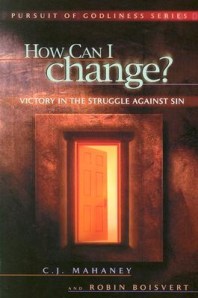
Change is inevitable, but it is not always pleasant.  But perhaps even less pleasant than unexpected change is the lack of change when it is desired and needed – particularly change in ourselves and in our spiritual development.  The questions are common: How Can I Change? When Will I Change? 

C.J. Mahaney & Robin Boisvert have written a helpful little book that addresses these very questions.  Here is an excperpt from the Foreword:

“In a day when quick solutions to longstanding problems are too easily offered, we wish to recommend the old paths, having found them tried and true. There is no short course to Christian maturity. There is no cross-less way to follow Christ, no instant secret to the Christian life. But like distance running, if the way of the cross is not easy, neither is it complicated. God presents us with a pathway that is narrow yet straight. He makes his ways plain to those who are sincerely interested in following him, and he will show himself strong on behalf of all whose hearts are fully his.

Although our vigorous effort is required, all growth is by his grace. With that wonderful truth as our starting block, let us press on toward the mark, each confident that ‘he who began a good work in you will carry it on to completion until the day of Christ Jesus.’ (Philippians 1:6).”

Thanks to Sovereign Grace Ministrires, this little book is available in .pdf for FREE.  Click on the Chapter Titles to read or download:

Introduction

  1. Caught in the Gap Trap
  2. Where It All Begins
  3. United With Christ
  4. The Battle Against Sin
  5. Tools of the Trade – Part 1
  6. Tools of the Trade – Part 2
  7. Living for That Final Day

Appendices

  • Appendix A – Different Roads to Holiness
  • Appendix B – The Old Man and the Flesh 

Spiritual Pride

Here is a great insight from Jonathan Edwards as relevant today as it was in his Colonial American culture:

The first and worst cause of error that prevails in our day is spiritual pride. This is the main door by which the devil comes into the hearts of those who are zealous for the advancement of Christ. It is the chief inlet of smoke from the bottomless pit to darken the mind and mislead the judgment, and the main handle by which Satan takes hold of Christians to hinder a work of God. Until this disease is cured, medicines are applied in vain to heal all other diseases.

Pride is much more difficult to discern than any other corruption because, by nature, pride is a person having too high a thought of himself. Is it any surprise, then, that a person who has too high a thought of himself is unaware of it? He thinks the opinion he has of himself has just grounds and therefore is not too high. As a result, there is no other matter in which the heart is more deceitful and unsearchable. The very nature of it is to work self-confidence and drive away any suspicion of evil respecting itself.

Pride takes many forms and shapes and encompasses the heart like the layers of an onion- when you pull off one layer, there is another underneath. Therefore, we need to have the greatest watch imaginable over our hearts with respect to this matter and to cry most earnestly to the great searcher of hearts for His help. He who trusts his own heart is a fool.

Since spiritual pride in its own nature is secretive, it cannot be well discerned by immediate intuition of the thing itself. It is best identified by its fruits and effects, some of which I will mention together with the contrary fruits of Christian humility.

The spiritually proud person is full of light already and feels that he does not need instruction, so he is ready to despise the offer of it. On the other hand, the humble person is like a little child who easily receives instruction. He is cautious in his estimate of himself, sensitive as to how liable he is to go astray. If it is suggested to him that he does go astray, he is most ready to inquire into the matter.

Proud people tend to speak of other’s sins, the miserable delusion of hypocrites, the deadness of some saints with bitterness, or the opposition to holiness of many believers. Pure Christian humility, however, is silent about the sins of others, or speaks of them with grief and pity. The spiritually proud person finds fault with other saints for their lack of progress in grace, while the humble Christian sees so much evil in his own heart, and is so concerned about it, that he is not apt to be very busy with other hearts. He complains most of himself and his own spiritual coldness and readily hopes that most everybody has more love and thankfulness to God than he.

Spiritually proud people often speak of almost everything they see in others in the harshest, most severe language. Commonly, their criticism is directed against not only wicked men but also toward true children of God and those who are their superiors. The humble, however, even when they have extraordinary discoveries of God’s glory, are overwhelmed with their own vileness and sinfulness. Their exhortations to fellow Christians are given in a loving and humble manner, and they treat others with as much humility and gentleness as Christ, who is infinitely above them, treats them.

Spiritual pride often disposes people to act different in external appearance, to assume a different way of speaking, countenance, or behavior. However, the humble Christian, though he will be firm in his duty; going the way of heaven alone even if all the world forsake him; yet he does not delight in being different for difference’s sake. He does not try to set himself up to be viewed and observed as one distinguished, but on the contrary, is disposed to become all things to all men, to yield to others, to conform to them, and to please them in all but sin.

Proud people take great notice of opposition and injuries, and are prone to speak often about them with an air of bitterness or contempt. Christian humility, on the other hand, disposes a person to be more like his blessed Lord, who when reviled did not open His mouth but committed Himself in silence to Him who judges righteously. For the humble Christian, the more clamorous and furious the world is against him, the more silent and still he will be.

Another pattern of spiritually proud people is to behave in ways that make them the focus of others. It is natural for a person under the influence of pride to take all the respect that is paid to him. If others show a disposition to submit to him and yield in deference to him, he is open to it and freely receives it. In fact, they come to expect such treatment and to form an ill opinion of those who do not give them what they feel they deserve.

***

Adapted from Jonathan Edwards’ Some Thoughts Concerning the Present Revival of Religion in New England. This article previously appeared in Banner of Truth.

God’s Workmanship

One of the glories of Christianity is the assurance that we are God’s workmanship, created in Christ Jesus to do good works, which God prepared in advance for us to do” (Ephesians 2.10). 

This statement by Paul that we are “created” does not simply refer to our physical formation, as God has, of course, created all human beings (see Genesis1.26-27). Rather, Paul is talking about being “created in Christ.” It means that every person who believes in Christ does so because she or he is the object of a process of God’s “spiritual creation.”
 
The word workmanship is very important; it is the Greek word poema from which we get our word “poem.” It means that every believer is essentially a work of art – God’s art!
 
Consider how artists work, whether they are writers, musicians, painters, sculptors, etc. They labor long and hard and with the utmost care and detailed attention. Sometimes they do very little, only a stroke here or there. Other times they make massive changes. But always they seek to bring the raw material into line with an artistic vision. Thus Paul is telling us that God labors over all believers throughout our entire lives, intervening and guiding and shaping us to bring us into line with a vision he has for us. This is mentioned also in Ephesians 2.10 -“created to… good works,  which God prepared in advance for us to do.” Thus, God has a particular set of “good works” for us to do, for which he prepares us our whole lives.
 
Looking at Our Lives
  
It is therefore of utmost importance to look back on our lives and see everything that has happened through this grid, namely that:
  • God has been at work through the various influences of our lives – “created in Christ.” All of our experiences and troubles and our family and friends must be seen as the instruments of an artist used to mold and shape us. He has been at work all of our lives!
  • God has been at work to make us something beautiful – “workmanship.” God is out to make our beings something great—to give us characters of love, joy, peace, patience, kindness, integrity, humility and self-control.
  • God has been at work to make us something useful – “good works… prepared beforehand.” God is also out to make our doings something great – to make us helpful and able to serve others in special ways.
Paul uses this “doctrine of workmanship” like a pair of spectacles through which to view his entire life.
 
First, in Galatians 1.13-23, he shows us that he now sees God at work throughout his whole life (“God, who set me apart from birth and called me,” v.15).
 
Secondly, he now sees that God used the gospel to make him something beautiful. He had been a fanatically intense person who felt superior in his self-righteousness and only criticized others (“intensely I persecuted… extremely zealous for the traditions,” v.14). But God humbled him and showed him he was nothing apart from undeserved grace (“called me by his grace and was pleased to reveal his Son in me”) so that now he loves to lead people to praise and thanks (“they praised God because of me,” v.24). 
 
Thirdly, he realizes that though his obsessive study of the Bible and theology (“the traditions”) was originally motivated by self-righteousness and the need to feel superior, he was now, as a Christian, uniquely equipped to be a preacher, teacher and evangelist (“so that I might preach him among the Gentiles”). His scholarship and knowledge of the Bible enabled him to bridge the gap between Christianity and various pagan philosophies and religions.

-Taken from Tim Keller’s A Gospel Changed Life

Beyond the Sick List

It is one of my peeves. And it seems to be one of the most difficult habits to break church members of. I am referring to the common pracactice of praying the sick list.  For some reason it is difficult to get even seasoned Christians to pray for much else.

David Powlison takes up this issue in an article published in ByFaith Magazine.  Powlison writes:

Why don’t people pray beyond the sick list? We want circumstances to improve so that we might feel better and life might get better. These are often honest and good prayers—unless they’re the only requests. Unhinged from the purposes of sanctification and from groaning for the coming of the King, prayers for circumstances become self-centered.

Powlison observes:

[T]he majority of prayers in the Bible focus on other things. As shorthand, here are three emphases of biblical prayer:

1. Circumstantial Prayers

Sometimes we ask God to change our circumstances—heal the sick, give us daily bread, protect us from suffering and evildoers, make our political leaders just, convert our friends and family, make our work and ministries prosper, provide us with a spouse, quiet this dangerous storm, send us rain, give us a child.

2. Wisdom Prayers

Sometimes we ask God to change us—deepen our faith, teach us to love each other, forgive our sins, make us wise where we tend to be foolish, help us know You better, give us understanding of Scripture, teach us how to encourage others.

3. Kingdom Prayers 

Sometimes we ask God to change everything by revealing Himself more fully on the stage of real life, magnifying the degree to which His glory and rule are obvious—Your kingdom come, Your will be done on earth as it is in heaven, be exalted above the heavens, let Your glory be over all of the earth, let Your glory fill the earth as the waters cover the sea, come Lord Jesus.

They are tightly interwoven when we pray rightly.  When any of these three strands of prayer gets detached from the other two, prayer tends to go sour.

To read Powlison’s insights click: Praying Beyond the Sick List.