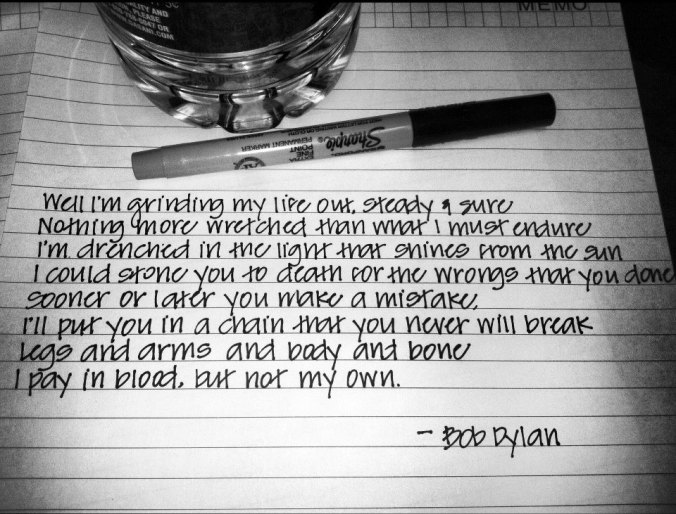
Gospel by Dylan

While Dylan’s lyric may at first seem bleak, in the end he captures the essence of the Gospel.  We do deserve to be put in “a chain that you can never break; legs and arms and body and bone”.  And without the shedding of blood there is no forgiveness of sin.  (Hebrews 9.22) But if we are in Christ, the blood that is paid is not our own.

The Gospel Is…

Gospel means “good news.” The good news is: you are more sinful and flawed than you ever dared believe yet you can be more accepted and loved than you ever dared hope at the same time because Jesus Christ lived and died in your place. As the apostle Paul said, “God made him who had no sin to be sin for us, so that in him we might become the righteousness of God.”

That is the simple formulation of the gospel. More thoroughly we could say that the whole Bible is the gospel. It is a book about the God who rescues people from their moral and spiritual rebellion against him. The teaching of the Bible, the gospel, can be summarized under four heads: God, Man, Jesus Christ, and Our Response.

Firstly, the gospel teaches that God is our creator. Thus he has the right to rule and command us as he does in his law. God is also holy, that is, he is absolutely pure morally, and he hates and punishes rebellion on the part of his creatures. He is more holy than anyone would ever imagine.

Secondly, the gospel teaches us about human beings. We are creatures made by God and for God. We were originally created to live in relationship with God and we were morally pure. But because our first parents rebelled against God (just as we also all have done), human beings are now cut off from relationship with God and are subject to his condemnation. We are more sinful than we ever dared believe.

Thirdly, the gospel teaches us what Jesus Christ has done for sinners like us. He became a man and lived a life of perfect obedience to God’s law, and then died as a sacrifice in our place under the judgment of God. He was raised from the dead and now reigns in heaven. The condemnation that he suffered takes away the necessity that we suffer judgment for our own sins- “God made him who had no sin to be sin for us.” The righteous life he lived is credited to us, not because we are actually righteous, but because of God’s mercy and grace- “in him we might become the righteousness of God.”

Fourthly, the gospel teaches us how to respond to the good news. We turn away from our rebellion and put our trust in Jesus Christ. Despairing of our own worthiness to stand before God, we believe the promise that those who trust in Jesus Christ will be forgiven and declared righteous. Those who put their faith in Jesus Christ are accepted as loved sons and daughters of God, and God sends his Spirit to live in them.

Counterfeit Gospels

Martin Luther said that a sinner trying to believe the gospel was like a drunk man trying to ride a horse; he will always be falling off on one side or the other. The two errors that the sides of the horse represent are 1) legalism or moralism and 2) pragmatism or relativism or antinomianism.

Moralism is the view that a person is made acceptable to God through his own attainments. Moralists are usually very religious, and often very conservative in their religion. Legalism tends to stress truth without grace. Moralists are usually very rules oriented, and depending on their success in keeping the rules they will be either arrogantly self-righteous or depressed and morose. If they go to Jesus for forgiveness, it is just to ask him to fill in the gaps they have left in their own religious performance. For the moralist, the cross is not the only basis for acceptance by God, but is an adjunct to our performance.

Pragmatists are often irreligious, or prefer more liberal religion. They tend to stress grace over truth, assuming everyone is accepted by God and that we each have to decide what we think is true for us. Often relativists will talk about God’s love, but since they do not see them selves as deeply sinful people, God’s love for them costs him nothing. For them the cross is not the necessary condition of our acceptance by God.

The gospel holds out to us a whole new system of approach to God. It rejects our attempts to justify ourselves before God, to be our own saviors and lords. It rejects both our pragmatic presumption and our religious attempts to earn our way into God’s favor. It destroys the perception that Christianity is just an invitation to become more religious. The gospel will not let us think Jesus is just a coach to help us get stronger where we are weak. To be a Christian is to turn from self-justification of all sorts and to rely exclusively on Jesus’ record for a relationship with God.

Christians and non-Christians both stumble over the two counterfeits of the gospel. Many Churches are deeply moralistic or deeply relativistic. Christians who understand the gospel very clearly still look like the drunk man on the horse, as the desire to justify ourselves and trust in our own performance continually reappears.

The gospel tells the pragmatist that he is more flawed and sinful than he ever dared believe. The gospel tells the moralist that he is more loved and accepted than he ever dared hope.

The Difference That Makes All the Difference

Francis Schaeffer, of his own testimony, writes:

“I became a Christian once for all upon the basis of the finished work of Christ through faith; that is justification. The Christian life, sanctification, operates on the same basis, but moment by moment. There is the same base (Christ’s work) and the same instrument (faith); the only difference is that one is once for all and the other is moment by moment…  If we try to live the Christian life in our own strength we will have sorrow, but if we live in this way, we will not only serve the Lord, but in place of sorrow, He will be our song. That is the difference. The ‘how’ of the Christian life is the power of the crucified and risen Lord, through the agency of the indwelling Holy Spirit, by faith moment by moment.”

An important -even essential – distinction. It’s not just for the sake of doctrinal precision. It makes all the difference in how we live out our lives.

Cotton Candy Christianity Scorecard

I don’t want to become one of those bloggers who becomes known for what he is against, or for pointing out how wrong other guys are, but this was just too funny to pass up.  It is also important to distinguish the gospel from all its counterfeits. For as Paul warns in Galatians 1.6-7:

I am astonished that you are so quickly deserting the one who called you by the grace of Christ and are turning to a different gospel – which is really no gospel at all. Evidently some people are throwing you into confusion and are trying to pervert the gospel of Christ.

Upon further thought, it might not be as funny as I thought.  It would be funny, if it were not so serious & sad.

Thanks to the folks at Modern Reformation & White Horse Inn for the scorecard. As they said:

“It’s like Bingo… Only better.”

Paradoxes of Grace

In his excellent, perspective shaping book, Broken-Down House, Paul Tripp reflects some of the amazing paradoxes of the gospel.  Take some time to ponder these; feel the tension. This is what genuine grace is and does:

So grace is a story and grace is a gift. It is God’s character and it is your hope. Grace is a transforming tool and a state of relationship. Grace is a theology and an invitation. Grace is an experience and a calling. Grace will turn your life upside-down while giving you a rest you have never known. Grace will convince you of your unworthiness without ever making you feel unloved.

Grace will make you acknowledge that you cannot earn God’s favor, and it will remove your fear of not measuring up to his standards. Grace will confront you with the fact that you are much less than you thought you were, even as it assures you that you can be far more than you had ever imagined. Grace will put you in your place without ever putting you down.

Grace will enable you to face truths about yourself that you have hesitated to consider, while freeing you from being self-consciously introspective. Grace will confront you with profound weaknesses, and at the same time introduce you to new-found strength. Grace will tell you what you aren’t, while welcoming you to what you can now be. Grace will make you as uncomfortable as you have ever been, while offering you more comfort than you have ever known. Grace will drive you to the end of yourself, while it invites you to fresh starts and new beginnings. Grace will dash your hopes, but never leave you hopeless. Grace will decimate your kingdom as it introduces you to a better King. Grace will expose your blindness as it gives you eyes to see. Grace will make you sadder than you have ever been, while it gives you greater cause for celebration than you have ever known.

Grace enters your life in a moment and will occupy you for eternity. You simply cannot live a productive life in this broken-down world unless you have a practical grasp of the grace you have been given [in Christ].

Tough Questions From a Pre-Teen Girl

The following are answers to questions asked by a then-12 year old girl.  This young lady had had a very, very difficult life, but was very bright and determined.   At the time she wrote the note to me asking these questions, she had only recently come to live with her father – a godly man.  Now twenty-something, she has grown into a beautiful and sharp young woman.

She has given her permission to use our correspondence for this post.

***

1.      Why do people look so depressing, sad, and miserable when we pray? 

This is a good question.  There is no good reason to be sad & miserable when we pray, but I think you are right that sometimes we look that way.

I guess the reason is that people want to be reverent, or to be serious, when they approach our Holy God.  This is a good thing, since the Bible calls us to “Fear the Lord”.  (Deuteronomy 6:13; Proverbs 9:10)   BUT, if Christians do not have joy as they pray, then they are forgetting that God loves us; that He is our Father, and wants us to come to him with joy & thanksgiving.  We are unbalanced between Fearing God & Loving God.

 2.      Why does God choose some people, but not all, to spread His Word?

I am guessing that you have two questions combined here.

First, Why does God not call everyone to be a Christian?  The answer is that everyone is to hear the call to follow Christ, but only those God chooses are able to become Christians.  Why does he choose some but not others? We don’t know.

Second, Why are not all Christians called to spread his Word?  The answer: All are called to spread his Word, by teaching and by our actions.  Some are called to spread his Word to other countries. Some are called to spread his Word by preaching in the church. Some to spread it by teaching Sunday school. Others are called to spread it to their friends, neighbors, and family.  Not everyone does it, but all are called to spread the Word somewhere & somehow.

3.      Why did God flood the earth when not everybody was being bad? 

Romans 3:10 and 3:23 tell us that there is no one who is good.  This is difficult to hear, but it is true. It is also important to help understand my answer to your question.

If you read Genesis 6:5 it says “The Lord saw …man’s wickedness…” There was no one good on the earth, everyone was being bad. Romans 6:23 says: “The wages of sin is death.”  This means that anyone & everyone who sins deserves death – in this case by drowning in a flood.

In Genesis 6:8-9 it says “Noah found favor in God’s eyes…” and “…he walked with God”.  This does not mean that Noah was perfect, and that he was not doing bad – though he was better than most men. (Remember Romans 3:23 “All sinned… fall short of the glory of God.”) That he “found favor in the eyes of the Lord” means that God chose to love him even though he was a sinner.  Genesis 6:9 says: “Noah was a righteous man”… this means that he believed in God, and trusted God for his salvation. Noah did not believe he was good enough, and knew he needed God’s grace.  (Romans 1:17 tells us that righteousness comes by faith. Hebrews 11:6 says: “Without faith it is impossible to please God…”)

Now the great thing about this is that God does the same thing with us.  You & I, and everyone else, are sinners.  We may be better than many people, but we are still not perfect like God wants us to be.

But read Romans 5:6-8… Is that great or what?!!

The important thing, though, is to believe what God has provided for our salvation from his punishment.  For Noah it was the Ark, but really it was a Savior.  For us (and for Noah, too, really) it is Jesus – a person not a boat!

Read 1 John 5, and it shows the importance of believing & trusting in Jesus for our salvation and forgiveness of our sin.

(A guy named Fritz Ridenhour has written a cool book for teenagers, How to Be a Christian Without Being Religious. It is about all this Romans stuff.  I have a copy if you want to borrow it from me.)

4.      Why does God make some peoples’ lives worse than others? 

This is a difficult question, and I am so sorry that you have had some very hard things happen in your life.  But the best way I can answer this is in two ways.

First, sin is in this world and hurts people –both those who sin and those they sin against.  It will continue to hurt people until Jesus returns to take us with Him.  This does not mean that God does not love us or care for us, or that he will not protect us.  He does, and He shows it all the time.  But what he also does is remind us that someday soon he will take us where there is no sin.

Look at it this way, before your Dad had you with him, he loved you, and cared for you. He gave you some good times, even though some bad things were happening around you. But he also told you that he wanted you to live with him.  Even before you got to live with him you had both good & bad times. You looked forward to when you could be with him, and this gave you hope.  Now that you have moved in with him many of the bad things are away from you.  God continues to give us this same type hope when he reminds us of heaven – except all bad things will be away from us in Heaven. Until then our lives will be mixed with good and bad.

Why are some worse than others? That I do not know. The book of Job is a good example of your question, but God does not totally answer it.  God simply says we should trust him, because we know He is good.

Second, some of our hardships come from decisions we make. There are consequences to our actions. If you commit a crime, you may go to jail. If unmarried teenagers are sexually active a pregnancy may result.

But even the consequences to our own actions are not all bad.  Hebrews 12:6 says: “The Lord disciplines those He loves.”  And please read 1 Peter 1:3-9 for encouragement.

Continue reading

Lingering Guilt & Insulting God’s Integrity

What do you do with the person who says: “I’ve asked God to forgive me, but I still feel guilty?”

A noted writer (R.C. Sproul, I think) was asked [this] once.  [His reply:] “Well,  if You still feel guilty, then pray to God again, but this time don’t ask Him to forgive you for the sin that is haunting you. Rather ask Him to forgive you for insulting His integrity by refusing to accept His forgiveness. Who are you to refuse to forgive yourself when God has forgiven you…it is often a very difficult thing to accept the grace of God. Our human arrogance makes us want to atone for our own sins to make it up to God with works of super-righteousness”.

~ Steve Brown

Our Universal Need

“Just so you know, the need for repentance, redemption, and forgiveness is universal. I don’t care if you are a liberal or a conservative, a religious fanatic or a militant atheist, a ‘spiritual’/’religious’ person or someone who runs from all that. It doesn’t matter to me if you listen to Billy Graham or follow Camus – you are in need.  No one in the human race is exempt.  Its in our DNA…

When we finally acknowledge our need for forgiveness and come to God in repentance, we find true power; for we now have nothing to hide or protect, we don’t care what people say or think about us, we are willing to speak truth gently, and we are enabled to speak with tremendous, supernatural power.”

~ Steve Brown, from Three Free Sins

NOTE: Watch a preview video and listen to Tullian Tchividjian interview Steve Brown about Thee Free Sins: here

Gospel-centered Foundation

Tom Wood and Scott Thomas explain the essence and importance of being truly gospel-centered:

We are persuaded that the gospel must be the central foundation for effective, God-honoring biblical [leadership].  It is imperative, therefore, that we know what the gospel is and how it informs our practices. Terms like justification, adoption, sanctification, and sin are often clearly defined in several historical church documents, creeds, and confessions of the church. But there are surprisingly few classical definitions of the gospel.

There is a reason for this.  Some have attempted to distill the deep truths of the gospel in terms of laws (the “Four Spiritual Laws, for example) or have tried to visually illustrate the message by means of a bridge.  Others summarize the main points with headings like: God, Sin, Christ, and Faith, or by giving the high points of the story arc of the Bible.  This approach communicates the gospel through movements in redemptive history and is often summarized by creation, sin, and redemption, or by creation, fall, redemption, and restoration.

In truth, the gospel is more of a story than a simple definition.  In order to really grasp the gospel message, you have to immerse yourself in the narratives of the Bible, because transforming faith is more than just a statement that we accept; it is something that connects with both our minds and our hearts. It is a true story, rich with drama, action, and eternal significance.

This passage is excerpted from their excellent book, Gospel Coach.

Recovering the Grand Cosmic Significance

“We need to recover the grand, cosmic significance of Jesus’ saving activity that moves the gospel out of the narrow realm of self-preoccupation. One of the marvelous things about the gospel is that He has saved us so that we can be a part of His redeeming activity. The gospel, properly understood, is much broader than our concerns for personal survival, security, significance, success, or even self-centered sanctification. It presents us with a plunderer, and it bids us to throw ourselves away in the pursuit of this new world order.”

~ Bob Heppe

Two Contents, Two Realities

Francis Schaeffer said: “there are four things which are absolutely necessary if we as Christians are going to meet the need of our age and the overwhelming pressure we are increasingly facing.” These four things are two contents and two realities:

The First Content: Sound Doctrine 

The Second Content: Honest Answers to Honest Questions 

The First Reality: True Spirituality

The Second Reality: The Beauty of Human Relationships

Each link above will take you the substance of the respective  Contents and Realities. I am convinced they are worth consideration.  Why? Because I believe Schaeffer was right when he wrote:

[W]hen there are the two contents and the two realities, we will begin to see something profound happen in our generation.

Wading in the Gospel Deep

The message of the gospel is shallow enough for a child to wade in and yet deep enough to drown an elephant, and to grasp it we suggest following the summary of the gospel story through the four narrative acts of Creation, Fall, Redemption, and Restoration. As each act of the drama unfolds, it’s important to keep in mind that the gospel is first and foremost God’s story.  Though it has important implications for our lives today, it is a story written and conceived by God himself.  It describes how his created beings committed cosmic treason against his just and loving rule, and how he took the loving initiative to rescue his people out of their rebellion and from the consequences of our folly, guilt, and certain death.  The full story of the gospel communicates the compelling truth about God, what he requires of us, and what he has done for us. It tells us the truth – about our world, about who we really are, and about our destiny.

~ Tom Wood & Scott Thomas, from Gospel Coach

Living & Loving to Please God

Steve Brown, professor at Reformed Theological Seminary and president of Key Life Network, penned a marvelous word picture of the motive and expression of a life gripped by God’s grace:

When I became a Christian, two things happened. I got saved, and I got loved.  I got loved so deeply that it still amazes me when I think about it. Because I got loved so deeply, I want to please the One who loved me that much. I may not always please him – sometimes I even run in the other direction, because his love can really hurt.  I may chafe against pleasing him; I may not even speak to him. But I’ll tell you something: I want to please him, and when I don’t please him, it hurts. Now if I really want to please him, I must know what pleases him. I find that out by reading the Word and listening to his commandments. When I know what he wants, I want what he wants. Love does that to you.  But I must know what he wants. That is why we must never soften the teaching of the Law of God. Holiness is a very important teaching as long as it is given in the context of God’s love.

~ from When Being Good Isn’t Good Enough

Transforming Power of the Gospel

“The good news of the Kingdom is that our King has won a marvelous victory for us. Through his sinless life, sacrificial death as our substitute, resurrection, and ascension, he has not only conquered death for us, removing its penalty, but he has also conquered sin’s power over us… Now through repentance faith, God means for us to tap into the powerful victory of our King, so that we might be transformed into true worshippers of God and more authentic lovers of people… Through faith we are always to be placing our affections on Christ”.

NOTE: This quote was taken from Steve Childers‘ unpublished paper True Spirituality: The Transforming Power of the Gospel. Steve is president of Global Church Advancement and professor at Reformed Theological Seminary – Orlando.  The whole article is well worth reading, and can be accessed and downloaded from GCA web page. Click: True Spirituality