I could never myself believe in God, if it were not for the cross. The only God I believe in is the one Nietzsche ridiculed as “God on the Cross.” In the real world of pain, how could one worship a God who was immune to it? I have entered many Buddhist temples and stood respectfully before the statue of Buddha, his legs crossed, arms folded, eyes closed, the ghost of a smile playing round his mouth, a remote look on his face, detached from the agonies of this world. But each time after a while I have had to turn away. And in imagination I have turned instead to that lonely, twisted, tortured figure on the cross, nails through hands and feet, back lacerated, limbs wrenched, brow bleeding from the thorn-pricks, mouth dry and intolerably thirsty, plunged in God-forsaken darkness. That is the God for me! He laid aside his immunity to pain. He entered into our world of flesh and blood, tears and death. He suffered for us.
~ John Stott
Worship
O Great God
10 Principles for Worship

The highest calling and greatest privilege of all Christians is to love and worship God. In worship we encounter God with increasing awareness of who he is. In worship we together magnify God’s glory.
The following are 10 principles, developed over a number of years, and influenced by a variety of sources, that not only express my philosophy of worship, but shape my practice of worship. By no means is this exhaustive, nor is it unchangeable. But I do hope it might be helpful.
1. God-centeredness:
A high priority must be placed on the vertical focus in our Sunday morning service. The ultimate aim is to so experience God that he is glorified in our affections. (Deuteronomy 6.4-5, 13-15; Isaiah 42.8; Matthew 4.10)
2. Bible Based:
The content of God’s Word will be our ground of authority for all elements & appeal, and will be woven through all we do in worship. The content of our singing, our praying, our teaching, and our activity will always conform to the truth of Scripture. (Isaiah 29.13; Deuteronomy 12.32; Matthew 15.9)
3. Trinitarian:
God has existed from all eternity in three persons: the Father, the Son, and the Holy Spirit. These three are one God, the same in substance, and equal in power and glory. Our worship ought to reflect this truth, and recognize all three persons (1 John 5.7; Matthew 28.9)
4. Expecting the Powerful Presence of God:
Worship is not a memorial service, nor merely our offering of ourselves toward God. True worship earnestly seeks to experience the present reality of Christ, by the work of the Holy Spirit, particularly through the Word & Sacraments. We believe that in worship God draws near to us in power, and makes himself known & felt for his glory, our good, and the salvation of unbelievers in our midst. (Psalm 139.7-10; Genesis 28.16; Matthew 28.20; Acts 2; Psalm 89.15; Ezekiel 46.3; Acts 10.33)
5. Aiming for Head & Heart:
Worship should aim at kindling & carrying deep, strong, real emotions toward God, but should not manipulate people’s emotions by failing to appeal to clear thinking about spiritual things. (Isaiah 29.13; Matthew 15.8)
6. Participatory:
Worship is an active expression of the corporate body. It is not performance by a few to be viewed by spectators. Therefore our worship shall be ordered to give the greatest opportunity for all to participate in song, prayer, testimony & confession. All choirs, singers, musicians, speakers & liturgists are to be used in such a way that they stimulate & facilitate participatory worship throughout the congregation. (1 Peter 2.9)
7. Freedom & Form:
Knowing that God has given us differing personalities, heritage & experiences we desire to allow people to express themselves in worship as they are led by the Spirit. Therefore we will not discourage the raising of hands in praise, bowing for prayer & repentance, or other such activities done decently & in order. Yet, neither will we seek to artificially stimulate such demonstrative expression within the congregation.
8. Undistracting Excellence:
Worship is to be focused on God. Therefore we will strive to sing, pray, teach & act in such a way that people’s attention will not be diverted from the substance of worship by shoddy performance, nor excessive finesse, elegance or refinement. (1 Corinthians 10.31; 2 Samuel 24.24)
9. Convergent:
Many wonderful & beautiful traditions of the church have been passed down through the ages. They are varied from culture to culture, and from generation to generation. Nevertheless, the best of these traditions convey the same love, reverence & adoration for God as we seek to experience & express. Therefore, in order to draw from the wealth of our forefathers, we will implement many of these songs, confessions & liturgies in ways & forms which are sensitive, meaningful & appropriate for the contemporary church. To be convergent means to bring the best resources of the present together with the past. (Proverbs 22.28; Hebrews 11.4c)
10. Contempory Blend:
It is a common mistake to assume that contemporary means “that which has been composed in this generation”, and traditional is a label for things composed in times past. For timeless hymns such as Amazing Grace, Be Thou My Vision, and the Gloria Patri speak to us today as clearly as they did to the Church at the time of their composition. Yet, our worship should always be contemporary in that it should speak to us clearly & faithfully of eternal truth, while being reflective of our current age & culture. Therefore, our worship should not reflect just our own age, for that would be to exclude those of the corporate body of Christ in the past. Nor should it reflect a limited scope from the past, for that would be to exclude the godly creative expressions of our own age. But in all things we seek the honor & glory of God, and we will transform traditions to to involve the truth of his Church from all ages. (Proverbs 22.28; Psalm 149.1)
There is a Land of Pure Delight
I Have a Shelter
This seems like an appropriate song for the first Sunday after Hurricane Sandy.
4 Tips That Change the Taste of the Sermon

As a pastor I have come to understand that some people have difficulty concentrating throughout the Sunday message. Sometimes it’s just me people have trouble following. But sometimes it is something within them. It may be a short attention span. It may be external distractions. Or maybe it is the overwhelming wealth of insight being offered throughout the message that leaves some still pondering the previous point when the next gem is thrown at them. (That last one is my favorite.)
If you’ve ever found yourself to be one who even occasionally experiences a problem concentrating throughout the sermon, let me offer a few practical tips. These are far from perfect, and certainly not exhaustive. But still, I think you will find they are helpful:
1. Write It Down
Many educators will tell you to write things down because it helps you focus and remember. Often, after writing something down, you’ll find you don’t even need to go back to your notes to recall what you wrote.
I find it interesting that in Deuteronomy 17.18 we learn that every time a new king was installed in Israel he was to write the entire Law of God out by hand. He had to write it himself. He could not delegate it to anyone else. He could not dictate to his secretary. But taking pen in hand, the new king had to transcribe the whole thing himself. The expected result, we learn in v. 19, was that the new king would revere the Lord and follow the law carefully. I suspect that what is also true, but has no need to be stated, is that the king would remember the Law.
2. Pray It In
When you hear something that strikes you, if the Lord impresses something on you, during the course of the message, stop and pray right then. Whether it is something that challenges you, encourages you, or even convicts you, ask the Lord right then to apply it to your life. (This is also true during other parts of the service. You may be struck by something in a hymn, or during a prayer. Pray it in.)
A church service is supposed to be more relational than academic. The Lord promises his presence among his people. It should be a time of interaction between you and God. As he speaks to you, deal with it at that moment.
3. Give It Out
After you write it down and pray it in, don’t neglect to give it out. Tell someone about it. If you are married, share your insight with you spouse on the way home: “Honey, do you know what struck me today?”
When you give it out it becomes part of your life. Your insight may also prove beneficial to the one you share it with. And giving it out also promotes unity, a oneness, because you are opening up and sharing what God is doing in your heart and life.
4. Move Around
No, I don’t mean you should get up in the middle of the message. I mean, don’t always sit in the same place.
While the first three are pretty simple, and probably will not receive much of a negative response, this suggestion poses some risks. It may not only seem strange, but the very notion violates some long standing personal traditions. I’m convinced that whole sanctuaries must have been built around some people – probably built while they were sitting in one particular spot! Construction crews just worked around them. God have mercy on the visitor who sits in what he/she consider to be ”MY” place.
But this suggestion is not as silly as it may at first seem.
Studies have shown a direct correlation between academic success levels and where a student sits in the classroom. (I usually sat in the back, which probably says a lot.) Perhaps it could also have some effect spiritually.
Now, I am not suggesting that those who sit up front are actually more spiritually mature than those in the back. Spirituality has nothing to do with geographic location. But there is an attitude that can creep in. Sitting in the same spot, week after week, year after year, things can become a little stale.
Moving around every once in a while offers a new, refreshing perspective. You see things from a different angle, which seems to stimulate the attention span. You are surrounded by different people, which not only creates a different worship environment, it is also a great way to expand unity within the church.
It’s amazing, but sitting in a different place almost makes it seem like a whole different church, regardless of the size of the sanctuary. So move around, and mix it up.
Anyway, these are a few of my simple suggestions. Let me know if you try any of them out, and how they worked out for you.
How Deep
VERSE 1
You were broken that I might be healed
You were cast off that I might draw near
You were thirsty that I might come drink
Cried out in anguish that I might singCHORUS
How deep is Your love
How high and how wide is Your mercy
How deep is Your grace
Our hearts overflow with praise
To YouVERSE 2
You knew darkness that I might know light
Wept great tears that mine might be dried
Stripped of glory that I might be clothed
Crushed by Your Father to call me Your own
From: Valley of Vision
Lost in Wonder, Love, and Praise

Surely one of the greatest problems of our times is that we have become so nonchalent about the Lord of the cosmos. Certainly if we were more immersed in God’s splendor we would find ourselves thoroughly “lost in wonder, love, and praise”. With all the amazing sights and sounds of our cyberspace world, however, many of us no longer recognize that if we but catch a glimpse of GOD – the imperial Lord of the cosmos, the almighty King of the universe – we will be compelled to fall on our faces. Our awareness of God’s absolute otherness would give us the sense that we could die now because we have seen God. We would shout with the prophet: “Woe is me, for I am annihilated”. (Isaiah 6.5; Martin Luther’s rendering.)
– Marva Dawn, A Royal “Waste” of Time
Help My Unbelief
If I had a favorite hymn from Red Mountain Music, this would probably be it. It reflects the common duality of our hearts, simultaneously Believing and Struggling to Believe; simultaneously Saints & Sinners. (See Mark 9.24) It reflects and explains the cause of Paul’s dimemma: Failing to do what he wanted to do, and doing what he hated. (Romans 7.15) It points us to the answer: Resting in the Grace & Power of Christ.
I Asked the Lord to Grow in Grace
This song comes from a beautiful poem by John Newton. It is a powerful reminder to me about God’s grace and how God works.
Like Newton in the opening lines of this poem, I often ask God to grow me in grace and faith and the fruits of his Spirit.
I asked the Lord that I might grow
In faith, and love, and every grace;
Might more of His salvation know,
And seek, more earnestly, His face.
And like Newton expresses in the third stanza, in my mind this is something noble and therefore should be experienced mystically, gently and painlessly:
I hoped that in some favored hour,
At once He’d answer my request;
And by His love’s constraining pow’r,
Subdue my sins, and give me rest.
Spiritual growth is easy, right? It should be automatic. Like sleeping, or breathing. Certainly it should be no more difficult than eating, or learning to ride a bike or drive…
The Lamb is a Lion
Weak from the journey, the long travelling days/ Hungry to worship, to join in the praise/ Shock mad with anger that burned on His face/ As He entered the wasteland of that barren place
Chorus:
And the Lamb is a Lion who’s roaring with rage/At the empty religion that’s filling their days/ They’ll flee from the hug of the Carpenter’s strong arm/ And come to know the scourging anger of the Lord
Priests and the merchants demanded some proof/ For their hearts were hardened and blind to the Truth/ But Satan’s own law is to sell and to buy/ But God’s only way is to give and to die
– Repeat Chorus-
The noise and confusion gave way to His word At last sacred silence so God could be heard…
There is a Fountain Filled With Blood
There is a fountain filled with blood
drawn from Emmanuel’s veins;
and sinners plunged beneath that flood
lose all their guilty stains.
and sinners plunged beneath that flood
lose all their guilty stains.The dying thief rejoiced to see
that fountain in his day;
and there may I, though vile as he,
wash all my sins away.
and there may I, though vile as he,
wash all my sins away.Dear dying Lamb, thy precious blood
shall never lose its power
’till all the ransomed church of God
be saved, to sin no more.
’till all the ransomed church of God
be saved, to sin no more.E’er since, by faith, I saw the stream
thy flowing wounds supply,
redeeming love has been my theme,
and shall be till I die.
redeeming love has been my theme,
and shall be till I die.Words: William Cowper
Video: Red Mountain Music
5 Songs for Good Friday
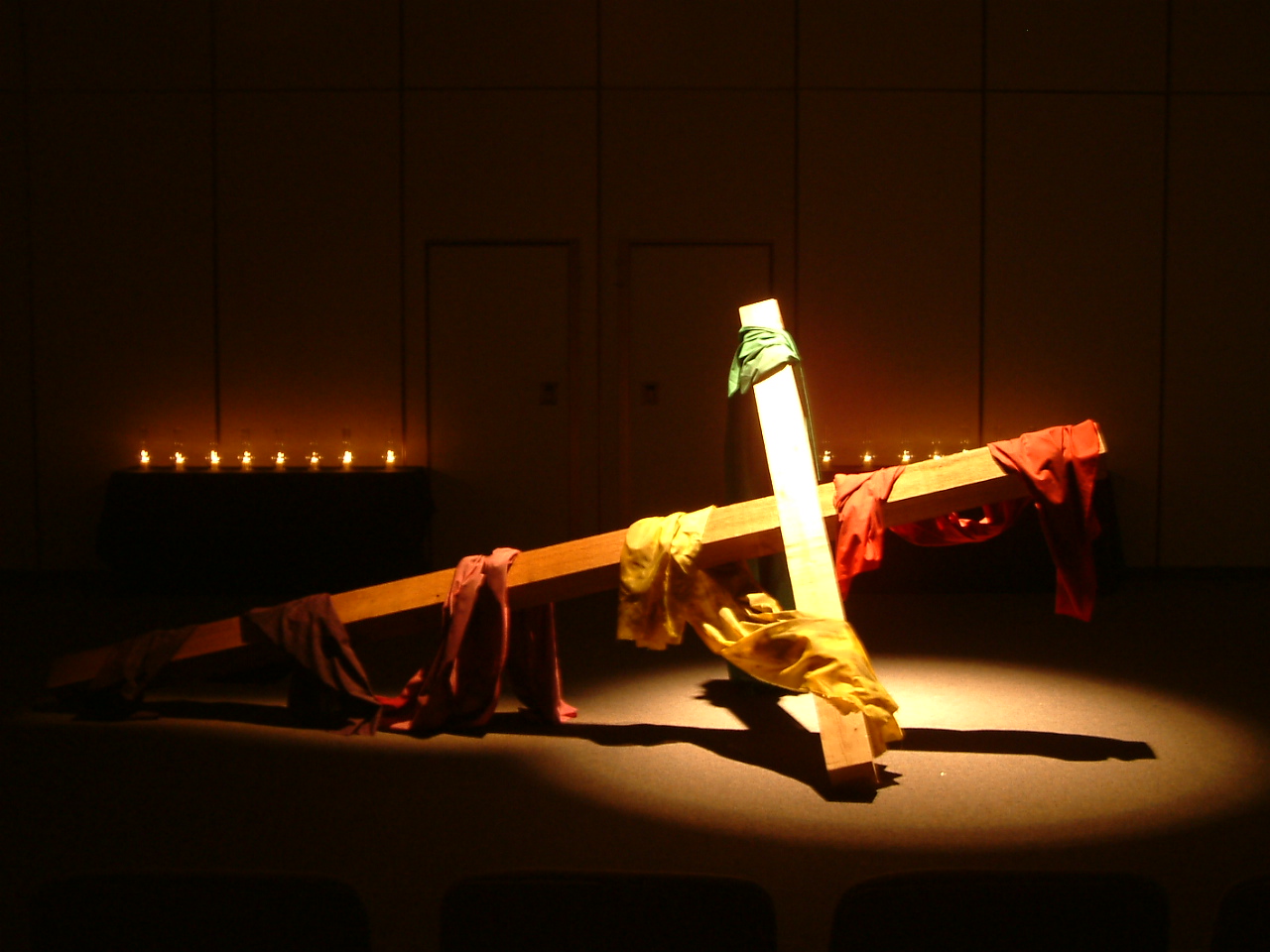
With Easter coming Sunday, the MOST Holy day on the Christian calendar, it is easy to overlook or undervalue Good Friday. But to do so deprives us of great opportunity to glory in the Cross.
When I was a kid, I remember asking my mother one day: “Why do they call it Good Friday, if that’s the day they killed Jesus?” My mother, who is not a theologian, gave the best answer she could: “Well, I guess it because we know he rose again.”
My mother was right. No doubt the death of Jesus cannot be considered apart from the Resurrection that was to follow. All our blessings are wrapped up in these two inseparable events.
But there is even more to it than that. The death of Christ itself, not alone but as a distinct redemptive act, carries it’s own beauty when viewed from this side of the Cross. It was Jesus’ blood shed on the Cross that paid the debt for all my depravity, and set my sin into remission. It is by Jesus’ voluntary death that we most vividly view the love of God – that we most clearly see nearly all of God’s attributes, really.
So with this in mind, and in hope to redeem the day for our greatest good, here are 5 songs for Good Friday that focus us on the blessing of that GREAT first Good Friday:
- Before the Cross by Sovereign Grace Music
- Alas! and Did My Savior Bleed? by Sovereign Grace Music
- The Precious Blood by Sovereign Grace Music
- It Is Finished by Red Mountain Church
- There is a Fountain Filled With Blood by Red Mountain Church
NOTE: All songs played on MOG. You may have to sign up for this free app to listen. But once you listen, you’ll agree it was worth it.
Worship For the “Me” Church
Order of Sunday Fellow-Hip

A number of years ago I ran across this satirical outline for all-too-common worship planning. It is a sad but almost realistic caricature of what takes place in many churches every Sunday. See if you recognize any of these things.
***
Prologue
Fellowshippers shall enter the sanctuary garrulously, centering their attention on each other, and gaily exchanging their news of the past week.
If there be an overhead projector, the acolyles shall light it.
The minister shall begin the Morning Fellowship by chanting the Greeting: “Good Morning.” Then shall not more than 50% and not less than 10% fellowshippers respond, chanting in the wise: “Good Morning.”
NOTE: If it be a hot day, the Minister shall at his discretion add: “Ya’ll don’t mind if I take off my jacket.” He shall then drape such vestment over the pastoral chair, or stuff it in some other place he may deem convenient.
The Glad-handing of the Peace
Then the Minister shall say: “Why don’t we all shake hands with the person on our left and on our right and say ‘Good Morning’.”
NOTE: The glad-handing may be omitted, provided it be practiced any Sunday when there is at least one visitor present and, of course, on Mother’s Day and Missionary Sunday.
When the general hubbub has subsided, the Minister shall say: “You may be seated.”
THEN… If there be any visitors present, the Minister shall embarrass them by commanding: “Will all of our visitors please stand up and introduce themselves.”
The Old Hymn & Special Music
During the last stanza of the Old Hymn (which is not to have been composed before 1900 nor after 1950) the accompaniment tape shall be slipped into the sound system, or the organist shall warm up with a few lively runs up and down the keyboard.
THEN shall be sung the “Special” Music appointed for the day.
The Reading
Then shall be read an arbitrary Scripture passage of the Minister’s choosing, so long as it has no relation to the time of the Church Year/Liturgical Calendar.
Sharesicles, Prayersickles, and Praisicle of the Day
Here may be inserted a time for a bunch of individual fellowshippers to give their testimonies, and share what the Lord has just-really-done in their lives.
THEN, … if the fellowshippers be Charismatically inclined, shall follow:
The Cacophony
Here many loud prayers, in English or other Prayer Languages, shall be offered simultaneously.
Prayer for the State of a Bunch of Individual Christians
And after these shall follow a L-O-N-G pastoral prayer, the people devoutly sitting. The Minister shall begin: “O Lord, we just-really-praise-you…” and continue with selected prayer requests, as many as he can recall from memory, for no less than 10 and no more than 20 minutes.
NOTE: Under no circumstances shall the Minister risk offending anyone. He shall avoid praying for actual spiritual growth among the members (- as if they need it. They are Christian’s after all.) And Minister shall avoid such vain repetition as The Lord’s Prayer.
The Offertory Sentences
“Count you blessings, Name them one by one. Count your blessing, See what God has done.”
The Contemporary American Evangelical Creed
I believe in God who once was Almighty, but sovereignly chose not to be sovereign; and Jesus my personaLord-and-Savior, Who loves me and has a wonderful plan for my life; Who came into my life when I asked him to, and is now seated at the right ventricle of my belief in him; Who walks with me and talks with me along life’s narrow way, and tells me I am His own; Who shall come again with secrecy to Rapture us outta here; Whose Kingdom shall last One Thousand years (not a day more or a day less).
And I believe in the Holy Ghost, Who did some weird stuff at Pentecost, but doesn’t do much anymore, except speak secretly to the hearts of individual believers. And I believe in this local, independent, and powerless church, insofar as it is in line with my personal interpretation of the Bible and does stuff I like; in one Believer’s Baptism for public proof of my decision for Christ; and giving my personal testimony for soul winning. And I look for the identity of the anti-Christ, and know for sure that the Last Days are now upon us. ~Ay-men!
 GRACE & PEACE