The Difference That Makes All the Difference

Francis Schaeffer, of his own testimony, writes:

“I became a Christian once for all upon the basis of the finished work of Christ through faith; that is justification. The Christian life, sanctification, operates on the same basis, but moment by moment. There is the same base (Christ’s work) and the same instrument (faith); the only difference is that one is once for all and the other is moment by moment…  If we try to live the Christian life in our own strength we will have sorrow, but if we live in this way, we will not only serve the Lord, but in place of sorrow, He will be our song. That is the difference. The ‘how’ of the Christian life is the power of the crucified and risen Lord, through the agency of the indwelling Holy Spirit, by faith moment by moment.”

An important -even essential – distinction. It’s not just for the sake of doctrinal precision. It makes all the difference in how we live out our lives.

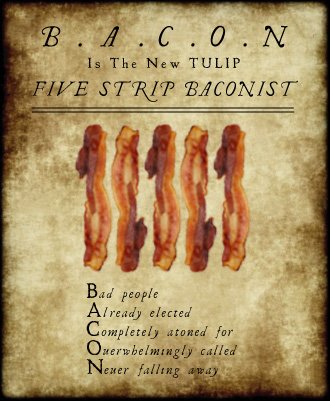
Cotton Candy Christianity Scorecard

I don’t want to become one of those bloggers who becomes known for what he is against, or for pointing out how wrong other guys are, but this was just too funny to pass up.  It is also important to distinguish the gospel from all its counterfeits. For as Paul warns in Galatians 1.6-7:

I am astonished that you are so quickly deserting the one who called you by the grace of Christ and are turning to a different gospel – which is really no gospel at all. Evidently some people are throwing you into confusion and are trying to pervert the gospel of Christ.

Upon further thought, it might not be as funny as I thought.  It would be funny, if it were not so serious & sad.

Thanks to the folks at Modern Reformation & White Horse Inn for the scorecard. As they said:

“It’s like Bingo… Only better.”

Tough Questions From a Pre-Teen Girl

The following are answers to questions asked by a then-12 year old girl.  This young lady had had a very, very difficult life, but was very bright and determined.   At the time she wrote the note to me asking these questions, she had only recently come to live with her father – a godly man.  Now twenty-something, she has grown into a beautiful and sharp young woman.

She has given her permission to use our correspondence for this post.

***

1.      Why do people look so depressing, sad, and miserable when we pray? 

This is a good question.  There is no good reason to be sad & miserable when we pray, but I think you are right that sometimes we look that way.

I guess the reason is that people want to be reverent, or to be serious, when they approach our Holy God.  This is a good thing, since the Bible calls us to “Fear the Lord”.  (Deuteronomy 6:13; Proverbs 9:10)   BUT, if Christians do not have joy as they pray, then they are forgetting that God loves us; that He is our Father, and wants us to come to him with joy & thanksgiving.  We are unbalanced between Fearing God & Loving God.

 2.      Why does God choose some people, but not all, to spread His Word?

I am guessing that you have two questions combined here.

First, Why does God not call everyone to be a Christian?  The answer is that everyone is to hear the call to follow Christ, but only those God chooses are able to become Christians.  Why does he choose some but not others? We don’t know.

Second, Why are not all Christians called to spread his Word?  The answer: All are called to spread his Word, by teaching and by our actions.  Some are called to spread his Word to other countries. Some are called to spread his Word by preaching in the church. Some to spread it by teaching Sunday school. Others are called to spread it to their friends, neighbors, and family.  Not everyone does it, but all are called to spread the Word somewhere & somehow.

3.      Why did God flood the earth when not everybody was being bad? 

Romans 3:10 and 3:23 tell us that there is no one who is good.  This is difficult to hear, but it is true. It is also important to help understand my answer to your question.

If you read Genesis 6:5 it says “The Lord saw …man’s wickedness…” There was no one good on the earth, everyone was being bad. Romans 6:23 says: “The wages of sin is death.”  This means that anyone & everyone who sins deserves death – in this case by drowning in a flood.

In Genesis 6:8-9 it says “Noah found favor in God’s eyes…” and “…he walked with God”.  This does not mean that Noah was perfect, and that he was not doing bad – though he was better than most men. (Remember Romans 3:23 “All sinned… fall short of the glory of God.”) That he “found favor in the eyes of the Lord” means that God chose to love him even though he was a sinner.  Genesis 6:9 says: “Noah was a righteous man”… this means that he believed in God, and trusted God for his salvation. Noah did not believe he was good enough, and knew he needed God’s grace.  (Romans 1:17 tells us that righteousness comes by faith. Hebrews 11:6 says: “Without faith it is impossible to please God…”)

Now the great thing about this is that God does the same thing with us.  You & I, and everyone else, are sinners.  We may be better than many people, but we are still not perfect like God wants us to be.

But read Romans 5:6-8… Is that great or what?!!

The important thing, though, is to believe what God has provided for our salvation from his punishment.  For Noah it was the Ark, but really it was a Savior.  For us (and for Noah, too, really) it is Jesus – a person not a boat!

Read 1 John 5, and it shows the importance of believing & trusting in Jesus for our salvation and forgiveness of our sin.

(A guy named Fritz Ridenhour has written a cool book for teenagers, How to Be a Christian Without Being Religious. It is about all this Romans stuff.  I have a copy if you want to borrow it from me.)

4.      Why does God make some peoples’ lives worse than others? 

This is a difficult question, and I am so sorry that you have had some very hard things happen in your life.  But the best way I can answer this is in two ways.

First, sin is in this world and hurts people –both those who sin and those they sin against.  It will continue to hurt people until Jesus returns to take us with Him.  This does not mean that God does not love us or care for us, or that he will not protect us.  He does, and He shows it all the time.  But what he also does is remind us that someday soon he will take us where there is no sin.

Look at it this way, before your Dad had you with him, he loved you, and cared for you. He gave you some good times, even though some bad things were happening around you. But he also told you that he wanted you to live with him.  Even before you got to live with him you had both good & bad times. You looked forward to when you could be with him, and this gave you hope.  Now that you have moved in with him many of the bad things are away from you.  God continues to give us this same type hope when he reminds us of heaven – except all bad things will be away from us in Heaven. Until then our lives will be mixed with good and bad.

Why are some worse than others? That I do not know. The book of Job is a good example of your question, but God does not totally answer it.  God simply says we should trust him, because we know He is good.

Second, some of our hardships come from decisions we make. There are consequences to our actions. If you commit a crime, you may go to jail. If unmarried teenagers are sexually active a pregnancy may result.

But even the consequences to our own actions are not all bad.  Hebrews 12:6 says: “The Lord disciplines those He loves.”  And please read 1 Peter 1:3-9 for encouragement.

Continue reading

Broken-Down House: Living Productively in a World Gone Bad

I began reading Paul Tripp’s Broken Down House earlier this week. I had read it before, or rather I should say I skimmed it before, but did not take the time to allow Tripp’s poignant insights to resonate in my soul.  I raced through it last time, getting the general gist, but not digesting much in the way of spiritual nourishment.  That’s a mistake I am carefully avoiding this time through.

In Broken Down House Tripp uses the analogy of a home in serious disrepair as a reflection of our life in this world.  In the video above he introduces the themes he writes about.

Recommended Reading: Holy Spirit

The Holy Spirit has garnered a few nicknames through the ages. Among the more appropriate and familiar:

  • The Shy member of the Trinity
  • The Forgotten member of the Trinity

When considering the person of the Holy Spirit, there are few things that are vital to remember:

  • The Holy Spirit is a person, a “He” not an “It”.
  • As the Third Person if the Trinity, the Holy Spirit is fully God, and equal with God the Father and God the Son (Jesus) in glory, honor, and power; and equally worthy to receive worship.

The Holy Spirit functions in specific ways:

  • Regeneration – giving life to those who are spiritually dead.
  • Salvation (Justification) – the Holy Spirit grants both faith and repentance as gifts of grace. Through these, and these alone, is man justified.
  • Sanctification – “For those whom God justifies he also sanctifies. ” In other words, there is no one who is “saved” who is not also “sanctified”.  Sanctification is both definite and an ongoing process.  In work of sanctification Believers are expected to “cooperate” with the Holy Spirit, employing the means of grace. These actions we engage in are not magical, nor automatic, as if anyone who does them will automatically grow in grace. But they are effective.  The Holy Spirit works grace in us through these means.  We normally see a corresponding maturity in those who regularly and rightly make use of the means of grace, while we see little to no change in those who are lax.  But the one constant dynamic is that the Holy Spirit grants both faith and repentance to the believer for sanctification just as he does for justification.  In other words, the Christian life consists of continual repentance and renewed belief in the gospel.
  • The Holy Spirit cultivates the Fruit of the Spirit in believers.
  • The Holy Spirit bestows Spiritual Gifts upon all who believe, for the use in participating and the building up of the local body – The Church – which together advances the Kingdom of God.

Here are some suggested readings to grow in our understanding of the Person & Work of the Holy Spirit:

Ordo Salutis Illustrated

John Bunyan has a wondrous grasp of the theology of the Christian Life.  Pilgrim’s Progress is evidence of that.  In this classic literary masterpiece, Bunyan uses allegory to illustrate the reality, and the perils, of life in this world for God’s redeemed people.  And in the illustration above someone has taken Bunyan’s allegory and writings and made a poster of some of one of the more complex theological issues, the Ordo Salutis – or the Order of Salvation.

Why should anyone care about the Ordo Salutis? Well, a Biblical understanding of the way God has laid out our salvation not only will offer us comfort in time of our discouragement, it will move you to worship the God of our salvation when you ponder the amazing grace he has orchestrated.

I have enjoyed reflecting upon this map.  It evokes deep questions to ponder, which are also answered and illustrated on this map.  But the picture above is difficult to read clearly. To see the map in full size, or even blown up, download it by clicking: Bunyan Ordo Map

Sabbath Rest: The Above All Commandment

Like many people, I get easily wearied by many of the Sabbath debates. What can you do? What can’t you do?  While not unimportant, these questions miss the point.

Jesus told us:

“Sabbath was made for man, not man for the Sabbath.” (Mark 2.27)

In other words, Sabbath is a gift made or established by God for us. True, it is for God’s glory, and is therefore to be kept holy. (Exodus 20.8) But we must remember that our greatest good is wrapped up in God’s glory.  And as John Piper reminds us: “God is most glorified when we are most satisfied in him.”

God gave us the gift of the Sabbath as a means that we might be satisfied in him and thereby glorify him.

Sadly, the debate seems to revolve around polarized positions, with contemporary Pharisees on the one side and supposed free spirited antinomians on the other.  The Pharisee says: “Do”, or mostly “Don’t Do”.  The antinomian (which means “against Law”) holds to the notion that he can do as he pleases, and has no obligation.  The one squeezes the life out of the gift. The other, perhaps unwittingly, responds to God’s gift by saying: “No Thanks”.

In an article from Christianity Today magazine, Kevin Emmert winsomely makes a case for Sabbath observation.  Emmert rightly describes it as a spiritual discipline of resting.  And he acknowledges that this notion somehow seems antithetical to both our spiritual growth and God’s glory:

It is difficult, and ironic, to imagine rest as the most transformative element in the Christian life. For evangelicals especially, transformation and sanctification are closely linked to activity. We appropriately begin with the idea that our works do not merit justification (being declared righteous by God). We can do nothing to earn our salvation. But most of us imagine we must play an active role in our sanctification, the ongoing process of becoming more like Christ. Sanctification, we assume, involves work and effort on our part.

This is good news to evangelical ears. We like activities. We conduct Bible studies, participate in small groups, and attend prayer meetings. We engage in worship services and outreach. We like inspirational books that teach us how to become better Christians. We have a sense of duty that compels us to evangelize and demonstrate Christ’s love to those around us. Indeed, these activities are good and find their foundation in biblical teachings.

And this is precisely why we find it so difficult to imagine rest as the most transformative feature of the Christian life.

Yet Emmert convincingly contends that this discipline, perhaps more than any other, and certainly no less than any other, provides the greatest spiritual benefits:

Why is the Sabbath so important? After all, it’s a command to do nothing; it requires no activity or effort. And that may be precisely the point.

This “above all” command encourages us to trust in God in a way that no other activity can. So much more could be accomplished by adding another day of labor, but the Sabbath requires us to trust that God will provide for all our needs and that he will continue to manage the world without our help. The Sabbath is a practical reminder that we are completely dependent on God.

It is when we realize our complete dependence upon God that we experience how great a thing it is to have the right to call him “Father”.

Check out Emmert’s short article: The Above All Commandment

Our Great Shepherd

“The Lord’s my shepherd – I shall not be in want.”

(Psalm 23.1)

I am completely satisfied with his management of my life.  Why? Because He is the sheepman to whom no trouble is too great as He cares for His flock.  He is the rancher who is outstanding because of His fondness for sheep – Who loves them for their own sake as well as his personal pleasure in them.  He will, if necessary, be on the job twenty-four hours a day to see that they are properly provided for in every detail.  Above all, He is very jealous of His name and high reputation as ‘The Good Shepherd’.

~ Phillip Keller, from A Shepherd Looks at Psalm 23

John Piper is BAD

Michael Jackson asked:

“Who’s BADD?”

The answer, apparently: John Piper.

I don’t know if it is because John Piper staunchly believes in the doctrine of Total Depravity (as do I) – which recognizes that as a consequnce of the Fall all humnaity is infected by sin in every aspect of our personality – or if there is some other underlying motive, but someone has produced this clever video:

Just in case you are curious, Piper has seen the video and he thinks it’s funny.

The Scandal of American Evangelicalism

I was not there, but I am now wishing I had been, at least for R.C. Sproul Jr.’s address.   The Layman Online reports that Sproul prophetically challenged those gathered for 2012 Ligonier National Conference “… about the true scandal of the evangelical mind.”

Developing his message from 1 Corinthians 1.18-31 Sproul briefly outlined the Christian faith, and emphasized the Unity of those within the faith.  He then contrasted the unity of Believers with the perspective of Christians “by those outside of the room – the Greek, the Gentile…” reminding his hearers that “the story [the Gospel] is a scandal. It is foolishness. It is a stumbling block.”

This is an important reminder.

As Sproul elaborated:  “Paul wasn’t just saying they don’t get it.  Paul says, ‘they don’t get you!’ They think you are foolish … They won’t take you seriously.” And those in the evangelical church perceive this distaste and displeasure.

So we see that the unbelievers around us don’t get us, and don’t appreciate the Gospel.  This should be no surprise. This is as God said it would be.  But here is where what Sproul said really begins to carry weight:

“What scandalizes me is that this truth scandalizes us … that we, who embrace this Gospel that is an offense to the world, are offended that they are offended by us!”

I think this is so true.  Despite the fact that we are told that we will be despised and rejected, we seem surprised.  We don’t like it.

“Evangelicals grouse and complain. They go on television to complain about how they are presented on television. We want to insist that Paul is wrong – and not just Paul, of course. This is the wisdom of the Holy Spirit here … The text says ‘this is how the world will see you.’”

The greater scandal is not that we are “scandalized” by the worlds rejection but how many seem to respond:

“Some Evangelicals not only fight back and argue against it, We insist on our rights and worse of all we begin to adapt. We begin to reshape ourselves and our story. We diminish the stumbling block and, to establish our credibility, we begin to rewrite the story.”

“If we are Emergent… We say it is just our story. You have your narrative. We have our narrative. All God’s children have their narrative … You don’t need to be scandalized. I just have a different story, and I’m not sure about my story. Will you let me into your cool club?”

“If we are Seeker-sensitive, then we take the story and remove the sharp edges of talking about sin and judgment and wrath because people don’t want to hear about that.”

I won’t go into much more detail. Instead let me encourage you to check out the whole story at The Layman Online. They have done an excellent job of chronicling Sproul’s message.  But I do want to share one more of Sproul’s observations, related to the laments listed above about some common responses:

“When we remember the Gospel – when we remember our own salvation – we remember the necessity of resting in His provision. In our sanctification, we are called to have our heart, mind and soul rest in His wisdom.”

And this is also true of our mission.

The primary aim of our mission is to extend the Gospel of the Kingdom. To do this we must faithfully proclaim the rich, deep, truth of the gospel in all it’s dimensions.  Our hope is that this message will impact many, many people.  BUT we must be clear, and we must regularly remind ourselves and one another, that we cannot make the hope of impacting many people the priority over faithful proclamation.

I am afraid many are inverting these priorities.  The measure of success, in such cases, is numbers of people at the expense if gospel fidelity.  So we embrace either the Seeker or Emergent approach Sproul mentioned above, or something of a similar ilk.   But when we are willing to accept a gospel that is not complete, or even necessarily accurate, we then are preaching a different Gospel than the one that is faithful to Christ.  Success may be apparent, but as Paul warned, if anyone is preaching a gospel different from the one the Apostles preached they are “perverting” the gospel. What they are preaching is “no gospel at all”.  (Galatians 1.6-9)

If what is preached is not faithful to Christ, then it follows that the mission cannot be of Christ.  We may want to offer it to him, but it is not his mission. Christ is the King. He dictates the message, the means, and the motive.

So if such mission, mission in the name of Christ but without the genuine message of Christ, is not really mission for Christ, then who is it for?  Us. For our own sense of importance; For our own apparent success in the eyes of those around us;  Perhaps even, we think and hope, so that God will be pleased with us.  But regardless of the motive, such motive for mission is not so much for God’s glory as it is for selfish ambition. (See Philippians 1.17, Philippians 2.3)

What Sproul suggests about our sanctification, that we must “rest in his provision”, must also be applied to our mission ambition. We must rest in his provision of pure gospel and gospel power.

Lord of Heaven & Earth

Michael Horton, in his book The Gospel Commission, offers this important corrective perspective of Christ:

The privatized view of Jesus merely as ‘personal Lord and Savior’ does not really provoke controversy today.  After all, our non-Christian neighbors shrug: ‘Whatever works for you’.  However, these ascriptions of praise to Jesus Christ were subversive on the lips of early Christians in the Roman Empire. After all, they were titles that Caesar had ascribed to himself.  People could believe whatever they wanted to in private.  Whatever they found morally useful, therapeutically valuable, or spiritually and intellectually enlightening was fine.  In fact, when it came to gods, the more the merrier.  The Roman Empire was a melting pot of cultures and religions.  However, whatever varied religions and spiritualities it tolerated, Rome insisted that they contribute to the civil religion that included the cult of the emperor.  God could have his heaven, or the inner soul, but Caesar was ‘Lord of the Earth’.

The early Christians were not fed to wild beasts or dipped in wax and set ablaze as lamps in Nero’s garden because they thought Jesus was a helpful life coach or role model, but because they witnessed to him as the only Lord and Savior of the world.  Jesus does not just live in the private hearts of individuals as the source of an inner peace. He is the Creator, Ruler, Redeemer, and Judge of all the earth. And now he commands everyone everywhere to repent.

Horton’s contrast between the early days and the common contemporary caricature is stark.  While the contemporary view is not so much wrong as it is deceivingly inadequate, we would do well to recalibrate any simple ‘Jesus meek and mild’ notions by reflection on the provocative power portrayed in the testimony of the Forefathers of our Faith.

Why We Need Jesus

According to Michael Horton: “Reason and morality cannot show us a good and gracious God. For that, we need the Incarnation.”

***

A passenger on a recent plane trip happily divulged his spiritual views. Raised in a conservative religious home, he proudly dismissed traditional Christianity, with its radical claims about Jesus of Nazareth, because it substitutes dogma for reason, he said. Fifteen minutes later, he became an apologist for a sacred cosmos, with tarot cards and astrology. But of course, he said, these were true just for him.

The encounter epitomized what we have all experienced in a culture that identifies reason with naturalism and faith with feeling. And it comes from a deeper problem: the attempt to “climb to heaven” on the rungs of reason, morality, and experience. The “search for the sacred” is what happens when our God-centered nature is taken captive by sin. Religion and spirituality are all about what we feel and think deep within our precious, delightful, individual souls. The true God calls us outdoors into a history that sweeps us into its wake. Yet we prefer to sit inside our own souls and minds, stewing in our own juices.

Biblical faith emphasizes that we cannot ascend to God on our own; rather, the God of the Bible descends down to us. Our inner self is not the playground of “spirit,” but the haunted plains on which we build our towers of Babel. In other words, our hearts are idol factories, in bondage to sin and spin. As Jeremiah declared, “The heart is deceitful above all things, and desperately sick; who can understand it?” (17.9, ESV, used throughout). We look for a god we can manage rather than the God who is actually there.

In Romans 1 and 2, Paul affirms this. He says that everyone knows God exists and is a sovereign, righteous, and all-knowing judge. Jew and Gentile alike know God’s moral will and so “are without excuse,” but “by their unrighteousness suppress the truth” (1.18-23). Quoting the psalmist, Paul presents the universal indictment: “… all, both Jews and Greeks, are under sin, as it is written, ‘None is righteous, no, not one; no one understands; no one seeks for God. All have turned aside; together they have become worthless; no one does good, not even one’?” (Rom. 3:9-12).

Given all this, we need to receive an external word from outside our hearts and to our hearts—one that stops our spin and gives us new hearts even as it is spoken. That’s just where Paul turns next in Romans:

But now the righteousness of God has been manifested apart from the law, although the Law and the Prophets bear witness to it—the righteousness of God through faith in Jesus Christ for all who believe. For there is no distinction: for all have sinned and fall short of the glory of God, and are justified by his grace as a gift, through the redemption that is in Christ Jesus …. (3:21-24)

In other words, our hearts create spiritualities, therapies, and programs that arise out of our natural knowledge of the law, which we distort. Outside our hearts, and at the core of special revelation, is the surprising God, known uniquely in his Son.

There are, however, strong forces that tempt us to grasp the divine on our own accord.

Continue reading