Secret Mystery of Francis Chan

OK, the title of this post is purely to solicit interest. It is a play on the Charlie Chan Mystery series of the 1930’s.  So far as I know Francis Chan is not hiding any secrets.

That said, many are still mystified why Chan would walk away from a successful ministry, and the newfound celebrity he was enjoying as a result of his books, in order to explore other unknown opportunities.  So, at least in that sense, Francis Chan is a man of mystery.

In this video two of Chans peers, Joshua Harris & Mark Driscoll, sit down and try to get Chan to explain his somewhat unusual departure, among other issues.  It is a good discussion.

Practical Difference Makers

One of the vows folks are required to affirm if they are to become a member of our church – or a member of any church in the PCA, for that matter – is:

Do you promise to support the Church in its worship and work to the best of you ability?

This seems simple enough. I don’t recall anyone ever hesitating on that one.  In fact I don’t recall anyone even asking a question for clarification. But, how does one actually DO that? How does one support the worship and the work of the church?

In the closing message of NEXT 2010, Kevin DeYoung offered a list of suggestions for the conference participants to become “difference makers” in their local church:

• Find a good local church.
• Get involved.
• Become a member.
• Stay there as long as you can.
• Put away thoughts of a revolution for a while.
• Join the plodding visionaries.
• Go to church this Sunday and worship in Spirit and truth.
• Be patient with your leaders.
• Rejoice when the gospel is faithfully proclaimed.
• Bear with those who hurt you.
• Give people the benefit of the doubt.
• Say “hi” to the teenager that no one notices.
• Welcome the old ladies with the blue hair and the young men with tattoos.
• Volunteer for the nursery.
• Attend the congregational meeting.
• Bring your fried chicken to the potluck like everybody else.
• Invite a friend.
• Take a new couple out for coffee.
• Give to the Christmas offering.
• Sing like you mean it.
• Be thankful someone vacuumed the carpet for you.
• Enjoy the Sundays that “click.”
• Pray extra hard on the Sundays that don’t.
• And in all of this, do not despise the days and weeks and years of small things (Zechariah 4:8–10).

Seems so simple, doesn’t it?  But I can tell you if even a handful of people adopted these things in a local congregation the difference would be noticeable.  As a pastor, I would be thrilled.

Ah!! You Just Said a BAD Word!

Tony Campolo is famous – or infamous – for a statement made at a Christian college chapel service:

“The United Nations reports that over ten thousand people starve to death each day, and most of you don’t give a SH%T.  However, what is even more tragic is that most of you are more concerned about the fact that I just said “sh%t” than you are about the fact that ten thousand people are going to starve today.”

Let me ask you:

  • What was your first thought when you read that quote?  Did you visualize thousands of starving people? Or were you stunned by the use of the “bad” word?
  • Imagine if you had been in the congregation at your church and he made that statement. What would have struck you then?
  • Can think of any better way to point out that sometimes we do not have the heart and priority of Christ? 
  • Can you think of a better way to reveal our tendency toward self-righteousness and legalism?

I’ve never had the nerve to say anything like this from the pulpit. Maybe if I was a traveling speaker who didn’t have to face the same crowd again a week later I might have considered it…

Taking Pieces of Heaven to Place of Hell On Earth

Jesus says: “I will build my church and the gates of Hell will not stand up…” –Matthew 16.18

First it is important to remind ourselves that in this challenge Jesus is calling his church to take an Offensive stike, not a Defensive response. The church is to take the initiative, go, and storm the gates. This verse does not suggest the church create a fortress and stand guard, as we too freequently have done.

Second, we must ask ourselves what this means practically. I’ve been through some pretty rough neighborhoods, but I have yet to see a literal enterence to the actual Hell.  So how can we act out on this passage?

Palmer Chinchen offers us some insights.  In the line of thinking presented in Richard Stearns’ The Hole in Our Gospel, Chinchen challenges Christ’s church to come together to make a difference, and storm the gates and stem the growth of Hells on Earth. 

Chinchen, pastor of The Grove in Chandler, Arizona, is brother of one of my old seminary classmates.  I don’t know Palmer, but have high regard for Paul. Now I also have high regard for Palmer’s passion.

Prophets, Priests, and Kings

An important concept to explore and implement in the ministry of the local church is the reflection of the Offices of Christ: Prophet, Priest, and King.  This is known as Tri-Perspectivalism or Multi-Perspectivalism.  I have written and spoken a little about this, but I am still far more a student than an expert when it comes to the implications.

Richard Lovelace, author of Dynamics of Spiritual Life – a MUST READ for those charges with ministry leadership – offers this insight:

“Our union with the Messiah and his desire to continue his earthly ministry by living his life through us are so strong that we may be said to share his three offices of leadership.  We are priests as we pray for those near us and draw them into the sphere of God’s mercy and blessing.  We are prophets as we hold a biblical straightedge against whatever is crooked around us.  And we are kings as we use whatever powers we have to straighten what is crooked, reshaping whatever falls within the scope of our responsibility until it reflects the order of heaven.”  

Being Sent


This past Sunday I offered a brief exposition of John 17.6-21 & John 20.21, explaining what it means to be “sent” into our community and world in the same way God the Father sent Jesus into our world.  These texts demand that we understand, as John Stott says: “Our God is a missionary God.”  They also demand that we continually ask ourselves:

  • In what way was Jesus sent?
  • How am I responding to/reflecting being sent?

 While in no way exhaustive, I offered 5 simple observations for us to put into practice:

  1. More Incarnational than Attractional
  2. Focus More on Building Bridges than Building Walls
  3. Prioritize Service > “Serve Us”
  4. Move Beyond Fellowship to Functional Unity
  5. Measure Our Effectiveness More by Our Impact than Our Attendance.

Right People, Right Direction

There are two common maxims offered to pastors when entering a new ministry.  Both are wise and true. But they are mutually exlusive:

  • “Don’t change anything in the first year.”
  • “If you don’t change anything in the first year, you will never be able to change anything later.”

One way to resolve the tension is to realize that not all churches are the same. And not all churches are in the same condition when a pastor, or others, assumes leadership. Therefore wisdom dictates applying the proper suggestion to the present state of the church. 

For instance,

The first established church I pastored was a total mess.  The church had existed for nearly 50 years, and had fired every pastor. The longest tenure, prior to my arrival, had been 5 years.  Presbytery was sick and tired of the church’s shenanigans, and threatened to remove them from the denomination if they persisted.  The church averaged about 25 people on Sunday morning, and had only two children under age 18.  Obviously change was needed. Equally obvious was that change needed to happen immediately.

The second church I pastored had enjoyed solid numerical growth in the years prior to my arrival. Much of this growth was not healthy, however, but that was not particularly apparent to most people.  There were a lot of good things going on, but still areas that needed attention and revision.  Wisdom would have been to learn the landscape and go slower with initial changes.

The present church I pastor, Walnut Hill Church, was in many ways healthy when I came on board.  My predecessor had enjoyed 16 years of relatively effective ministry, and the Interim Pastor between us was (and is) a gem. The church leadership had come to a conclusion that this church, while in many ways good, was not functioning on all cylinders, and therefore needed to take the opportunity afforded by a transition to reevaluate the ministry.  Change is needed, and even desired, but what is the best approach: quick or slow?

Change is always needed. My college football coach, Johnny Majors, frequently reminded us that we never stay the same. Each day we either get better or we decline.  And, at least in this way, what is true of football teams, and athletes, is also true of churches and organizations. 

But one of the problems resulting from change, perhaps especially in a church, is disenfranchisement.  People have invested themselves in a church long before changes are even on the radar. In fact, people are often part of a particular church, even with it’s warts and weaknesses, because they like that church the way it is. When change starts taking place, whether systematic or unintentional, fear often accompanies it.  And fear keeps whispering in the ear: Am I sure I will still like this place if it changes?   

This is an important dynamic working against change, and against leaders who bring change.  And the problem is enhanced when the leader is focused more on bringing the change, and the anticipated positive results, than they are on the people in the church.  Not only is this recipe un-pastoral, it is ultimately ineffective.

I am not suggesting that the leader is responsible to appease all the people.  That is not possible – and it is not our job.  I am suggesting that sometime, as pastors, we have been so exhorted by the experts and the know-it-all books to make necessary changes for the sake of the ultimate “potential” good, that we may lose perspective.  We are anxious for success but forget what our success really looks like.

While it is true that to lead any necessary change, to chart any specific vision, risks losing some people, I wonder what place among our priorities  Jesus’ instruction to “count the cost” holds. I wonder if we tally everything up correctly, or if sometimes we cook our books like ENRON did – counting only the gains, ignoring the losses. 

The fact is sometimes some people need to go. This is especially true in an unhealthy church. (How else did it become unhealthy unless the stakeholders allowed it to become unhealthy and unfaithful?)   This is a sometimes painful reality. (At other times it is really not so painful. It may even feel blissful. But, as pastors, we’re not supposed to say that.) The questions are: How many losses are necessary? How many are appropriate? How many could have been averted, yet still allow the church to be faithful to the new (or renewed) vision and purpose? 

Tomorrow I plan to post the insights of leadership expert, John Kotter, about the stages of effective change. That post will apply Kotter’s insights to the mission of bringing appropriate, and necessary, change to the local church; and the ways pastors and churches  commonly act unwisely. Chief among them is moving too quickly to implement a new vision. But that will be for tomorrow.  At present, however, I want to ask the question: How many people might we keep if we were wiser about the change process?  What if we  moved a little slower, in cases that allow for it?  Of course, we will never know the real answer. But one thing I am convinced of: More harm than good is done in many churches because of unwise implementation of change.

In a post last week I introduced the following quote by Jim Collins, from his best-selling book Good to Great

The executives who ignited the transformations from good to great did not first figure out where to drive the bus and then get people to take it there. No, they first got the right people on the bus (and the wrong people off the bus) and then figured out where to drive it. They said, in essence, “Look, I don’t really know where we should take this bus. But I know this much: If we get the right people on the bus, the right people in the right seats, and the wrong people off the bus, then we’ll figure out how to take it someplace great.

I am convinced what Collins observed should be an important element for consideration in the early stages of all church vision and mission planning.  Clearly his approach does not eliminate the loss of some – maybe even many – people. But his approach does guard against the loss of good people who avoidably become disenfranchised due to  premature implementation of new direction. 

One last observation. Collins is not stating that the leader does not have any idea about where he/she might like to take the “bus”.  He is saying that the effective leader places a priority on the right people, and does not see himself as the sole navigator.  I suspect that the effective leader may well have a good idea of where the bus should go, but in genuine humility he is willing to consider the God-given insights of others.  What Collins is suggesting, as applied to the church, is that we lead to where God would have us go, and be less concerned about whether the destination is primarily according to the leader’s preconceived atlas.

Putting a Bus Stop at Our Church

A generation ago it was not uncommon for a churches to have bus ministries. Volunteers would drive a bus to pick people up from around the community and shuttle them to and from the church.  Jim Collins, in his best-selling book Good to Great, seems to suggest churches still need to get people on and off the “bus”.  But Collins, if we apply what he writes to ministry, has a more allegorical idea about the Church Bus:

The executives who ignited the transformations from good to great did not first figure out where to drive the bus and then get people to take it there. No, they first got the right people on the bus (and the wrong people off the bus) and then figured out where to drive it. They said, in essence, “Look, I don’t really know where we should take this bus. But I know this much: If we get the right people on the bus, the right people in the right seats, and the wrong people off the bus, then we’ll figure out how to take it someplace great.

Collins’ insight offers great wisdom to those leading churches and minstries.  Thom Rainer picks up and develops this idea, in his book Breakout Churches, calling it the Who/What Simultrack. I am certainly giving it serious consideration as the church I have the privilege to pastor, Walnut Hill Presbyterian Church, gives thought to our mission and vision. 

First, I think Collins’ observation is consistent with Solomon’s counsel of Proverbs 15.22:

Plans fail for lack of counsel, but with many advisers they succeed.

Anyone can offer a two-bit opinion. But to gain wise counsel we need the insights of the right people.

Second, it reminds me that people are at the very heart of God, not necessarily success.  To be  successful a church must focus on people. People are our mission, not programs.

Third, it inclines me toward humility. If Collins is right (and I believe he is) then I cannot do this alone.  I need the people God will bring into the picture, or will put on the bus, in order for us to be what God intends us to be and do what he has purposed for us to do. We have already seen examples of that, as God has brought certain people, and their gifts, to add to those who were already aboard. 

Fourth, it promotes patience. There are people who we need to get on our bus, but they won’t get on until we get to their stop.  It is foolishness, and counter-productive, to assume that the people  already with us will do all we need done; that they will do what God has not desgined them to do.  We must patiently depend upon God to introduce us to the people he wants to use.  As Rainer points out: Better to leave a postion unfulled for a long time than to rush to fill it with the wrong person.

The Deep Church

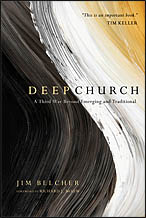
At the suggestion of a friend, I recently read Jim Belcher’s Deep Church. I was not disappointed. This is thoughtful and thought-provoking book. 

The subtitle really captures the theme of this book: A Third Way. 

With all the discussions about “how” to do church, and the polemic approaches of the Traditionalists and the Emerging/Emergent, some of us find ourselves caught somewhere in the middle.  I see strengths and weakness in both movements. 

Belcher offers understanding of both worlds. With his understanding he offers honest reflections.  Belchers experience and research are helpful for bringing clarity about the issues of the debate and the players doing the debating.  I especially appreciated his dilineation of the “protests” being offered by the Emergning/Emergents against the practices of traditional church:

  1. Captivity to Enlightenment Rationalism
  2. A Narrow View of Salvation
  3. Belief Before Belonging
  4. Uncontextualized Worship
  5. Ineffective Preaching
  6. Weak Ecclesiology
  7. Tribalism

Honestly, I share these collective frustrations – though I cannot endorse the Emergent solutions.

More than just offering perspective, Belcher offers his thought process as he wrestles with the strengths and weaknesses of both the Emerging/Emergent and Traditionalist arguments.  He does not seem to be trying to convince anyone to embrace his positions, only sharing the insights of his personal and spiritual leadership journey.  I found this helpful. It was almost as if I had someone to talk with about these issues as I contemplate my own positions, questions, and inclinations. 

Most important, at no point does Belcher compromise by seeking the “middle way”.  Instead, listening to both sides of the debate, he searches and wrestles with Scripture to find “A Third Way”. 

The Bereans would be proud.

7 Reasons We Need Small Groups

Our church has begun a process to initiate Small Group ministry.  Though I am familiar with the “whys” and the methods of small groups, I am by no measure an expert.  Fortunately, we do have in our church others who a far more knowledgeable than I am about the implementation of this aspect of ministry.  Still, the early going has been difficult. 

People in our church are not sure why they need to be part of this type of group.  Our church has been blessed to have strong relational ties and a welcoming mentality that easily embraces those who join us.  At our church “outsiders” are relatively few – and those who are probably are so by choice.  So those who are active in our church seem confused about why they need “one more activity”. 

Again, I do not have all the answers. I can articulate the benefits of a committed small group, but sometimes my explanations are found wanting.  Fortunately there are others who offer better counsel. One person in particular: John Piper.

When John Piper met with the small group leaders of the Downtown Campus of Bethlehem Baptist Church, in Minneapolis, he tried to show them how essential their role is at the church by giving them seven reasons why his preaching is not enough—seven reasons why perseverance in faith and growth in faith call for Christians to meet regularly in a face-to-face way to “serve one another, as good stewards of God’s varied grace” (1 Peter 4:10).

Piper says: “God intends to do things in us which he will only do through the ministry of other believers.”

Here are Pipers’ 7 Reasons We Need Small Groups:

He has given pastors to the church “to equip the saints for the work of ministry, for building up the body of Christ” (Ephesians 4:11-12).

I believe in what I do. And I believe that it is not enough. Here are the seven reasons I gave the small group leaders.

  1. The impulse to avoid painful growth by disappearing safely into the crowd in corporate worship is very strong.
  2. The tendency toward passivity in listening to a sermon is part of our human weakness.
  3. Listeners in a big group can more easily evade redemptive crises. If tears well up in your eyes in a small group, wise friends will gently find out why. But in a large gathering, you can just walk away from it.
  4. Listeners in a large group tend to neglect efforts of personal application. The sermon may touch a nerve of conviction, but without someone to press in, it can easily be avoided.
  5. Opportunity for questions leading to growth is missing. Sermons are not dialogue. Nor should they be. But asking questions is a key to understanding and growth. Small groups are great occasions for this.
  6. Accountability for follow-through on good resolves is missing. But if someone knows what you intended to do, the resolve is stronger.
  7. Prayer support for a specific need or conviction or resolve goes wanting. O how many blessings we do not have because we are not surrounded by a band of friends who pray for us.

Piper goes on to say:

So please know that when this small-group ministry of our church is lifted up, I don’t think it’s an optional add-on to basic Christian living. I think it is normal, healthy, needed, New Testament Christianity. I pray that you will be part of one of these small groups or that you will get the training and start one. This is the main strategy through which our pastors and elders shepherd the flock: Elders > small group leaders > members to one another.

I could not have said all that better myself.

7 Rules for Reconciliation

To live in community is to live with – at least – the potential for conflict. I have acted wrongly on too many occasions; I have wronged others; and I have been wronged by others. 

I find few things more emotionally taxing than living in conflict. But God calls us to live in community, where conflict will almost surely take place from time to time. I suspect this is because living in community is one of God’s chief tools for sanctifiying us.  But for God’s sanctifying process to have effect we must understand the principles for living in peace and for restoring peace.

The following “rules” are from a post by Ray Ortland, of Immanuel Church in Nashville:

  1. We can rejoice in one another, because the Lord rejoices in us.
  2. We can create an environment of trust rather than negative scrutiny.
  3. We can judge ourselves, even as we give each other the benefit of the doubt.
  4. If a problem must be addressed, we can talk to, not about.  Gossip destroys.
  5. If a problem must be addressed, we can avoid blanket statements but identify factual specifics, offer a positive path forward and preserve everyone’s dignity.
  6. We can always extend kindness.
  7. When we do wrong one another, we can say to the person harmed, “I was wrong.  I am sorry.  It won’t happen again.  Is there anything I could do now that might make a positive difference?”

To read Ray Ortand’s rationale and explanations for each Rule click: Guard & Repair

Reflecting Jesus in Christ’s Church


If, as most Christians profess, Jesus is indeed the only Head of the Church, it seems reasonable that Christ’s Church should reflect His personality in it’s ministries and structure. 

One way that Jesus is reflected in the ministry of faithful churches has been the recovery of a balanced Word & Deed holistic ministry. By balanced I am in no way suggesting a compromise. Instead I am referring to churches that are uncompromising BOTH in their pursuit of sound Biblical and theological instruction AND in thier practice of meeting the real – spiritual and tangible – needs of their neighbors. 

This only makes sense, since Jesus is himself the Word Incarnated and the one who “came to serve, not to be served”. (See Mark 10.45)  Jesus’ service was expressed through miraculous practical, provision and help. And Jesus is the one who said to his disciples: “Just as the Father has sent me, I am sending you.” (See John 20.21)  Traditionally churches have structured their leadership into the offices of Elder and Deacon, in accord with Biblical directive, to reflect Word & Deed. (Elders = Word; Deacons = Deed)

But I am increasingly becoming convinced that there is another, an additional, way that the personality of Jesus should be expressed in the Church.  This additional way, often referrred to as Tri-Perspectivalism or Multi-Perspectivalism, should be expressed in the Leadership Structure and in the ministry of the church. In fact, I am convinced that it needs to be the guage by which we evaluate the faithfulness of our congregations.

The Bible teaches that Jesus exercised three distinct offices:

  • Prophet
  • Priest
  • King

Each of these offices carry a significance.  In exercising these three offices Jesus also reveals aspects of his personality.

The Westminster Shorter Catechism summarizes for us how Jesus exercised each of these offices:

Q. 24. As a Prophet, Christ reveals the Will of God to us for our salvation by His Word and Spirit.

Q. 25. As a Priest, Christ offered himself up once as a sacrifice for us to satisfy divine justice and to reconcile us to God; and He continually intercedes for us.

Q. 26. As a King, Christ brings us under His power, rules and defends us, and restrains and conquers all his and our enemies.

Another way of looking at these distinct roles is:

Prophet is concerned with understanding and communicating God’s Truth, and applying it to every aspect of life.

Priest is concerned with the Spiritual Renewal and Transformation of all Christ’s People. The Priest is concerned not only for the conversion and intial reconcilation of the Believer to God, but also that all our lives be increasingly lived out in the joy and freedom that the Gospel secures and applies to us.

King is concerned with the advancement of Christ’s Kingdom, with both the Future fulfillment and Present Realities in mind.  In that sense, the King is concerned about both the mission and the structures of his Church.

What I have discovered is that each of these offices offers a unique perspective for leadership and ministry.  Each is equally important. Each must be equally considered. If all three are not equally considered the ministry of the church is unbalanced. In fact, if all three aspects, or perspectives, are not equally considered the ministry is not only unbalanced it is unfaithful.  It is not faithful to reflect the whole person of Christ, who is not only the Head but also the Model. Continue reading

7 Ways to Be a Great Host

There is an ancient rule among the Benedictines

“Let every guest who arrives be received like Christ. For He is going to say, ‘I came as a guest and you received me’.”

This would be a good concept for all churches to remember and instill.

Unlike most churches in our country, the church I have the privilege to pastor frequently and regularly has new visitors.  But like most churches, we have much to learn before we could claim that the Rule of Benedict is an accurate description of our congregational practice.

I am confident some would feel it is true of us already. I have never been part of a church that better demonstrates a love for one another than Walnut Hill Church does. And that love is frequently extended to our guests.  That’s why many of them are now part of the family.

But I also suspect that there are others, for whatever reasons, who have come and gone without necessarily having experienced the same thing. While it is obvious that we will never get to the point where we will keep everyone, I am concerned about those who do not stick because they did not feel loved, or perhaps even welcomed.

Studies indicate that the typical church needs to keep 16% of first-time guests in order to have a growth rate that roughly keeps pace with the annual national birth rate.  Churches that are growing and healthy generally see a 25-30% rate of assimilation/integration of those who visit.  (By the way, on average, 85% of guests who return the following week generally join with that church.) 

Gary McIntosh, in his book, Beyond the First Visit, offers seven suggestions about how church members can move beyond being friendly to becomming great hosts:

  1. Invite your guests with a personal invitation.
  2. Arrive early and make sure everything is prepared for your guests’ arrival.
  3. Greet the guests warmly at the entrance and escort them to their seats.
  4. Assist guests with understanding what is taking place.
  5. Anticipate as many questions as possible in advance, so guests do not have to ask.
  6. Do something extra to make your guests’ visit special.
  7. Walk guests to the door and invite them back.

Let me suggest that these suggestions be adopted by individual church members. Don’t try to program this as much as cultivate it.  There is no need to wait for the pastor, or some formal committee, to be hospitable.

Keller on Being Salt & Light

Working through the Sermon on the Mount on Sunday mornings, a few weeks ago I preached from Matthew 5.13-16, the Salt & Light passage. What I explained to our congregation is that, after instrucitng us about what our attitude ought to be as citizens of the Kingdom, Jesus goes on to reveal the Influence he expects his people to have on the communites where we live, and on the world around us.

In this video Tim Keller offers his thoughts about being Salt & Light.