What If We Omitted Gospel, Community, or Mission?

The refrain from an old song says: “Two out of three ain’t bad.”  But would this be true for a church, or a Christian, who incorporates 2 out of 3 of the core values: Gospel, Community, Mission?

Consider these thoughts, framed as a mathematical equation:

Gospel + Community – Mission

If we have a Gospel Community, without the mission or ‘sent’ aspect in our DNA, then we become a church that is all about ourselves.  We may love the gospel, and love that the good news has impacted our minds, and even desire to live that out with other people like us.  But living as ‘sent ones’ to our neighborhood seems too difficult.  When this happens a Christian ghetto surrounds the church, and an “us vs them” mentality is created.  This misses the entire point of the “go” in Christ’s great commission. (Matthew 28.17-21)

Such communities of believers are often very good at living as gospel families.  They take care of each other well: they provide for one anothers’ needs, and they draw very close to one another. But the lack of  engagement with the world, and and absence of multiplication,  is  vividly evident.  Sometimes such an inward focus is even worn as a badge of honor, since it may be believed by our isolation we are not being ‘polluted’ by the world.

Such communities usually have a heavy emphasis on bible studies, men’s groups, women’s group, children’s programs, etc.  The groups will usually have an “open invitation” to those on the outside. But because they don’t believe they are “sent” to their community, they rarely see disciples made of the un-churched people around them.   Numerical growth typically comes from like-minded people moving into their area, or through having children, or stealing the members from other churches that may offer fewer activities or which may be going through some turbulent times.  Rarely will they be faced with the general public pushing into the Kingdom, because they never engage general public with the gospel message outside the walls of their church building.

The overall goal is usually to prompt a great understanding of the Word and theology, but it is often intellectually gluttonous and missionally starved… because the reason for the Word and theology is to drive us to glorify God and show us our role in God’s redemptive drama.  If it’s not being used towards that end then it’s being misused.

Continue reading

Broken-Down House: Living Productively in a World Gone Bad

I began reading Paul Tripp’s Broken Down House earlier this week. I had read it before, or rather I should say I skimmed it before, but did not take the time to allow Tripp’s poignant insights to resonate in my soul.  I raced through it last time, getting the general gist, but not digesting much in the way of spiritual nourishment.  That’s a mistake I am carefully avoiding this time through.

In Broken Down House Tripp uses the analogy of a home in serious disrepair as a reflection of our life in this world.  In the video above he introduces the themes he writes about.

Two Contents, Two Realities

Francis Schaeffer said: “there are four things which are absolutely necessary if we as Christians are going to meet the need of our age and the overwhelming pressure we are increasingly facing.” These four things are two contents and two realities:

The First Content: Sound Doctrine 

The Second Content: Honest Answers to Honest Questions 

The First Reality: True Spirituality

The Second Reality: The Beauty of Human Relationships

Each link above will take you the substance of the respective  Contents and Realities. I am convinced they are worth consideration.  Why? Because I believe Schaeffer was right when he wrote:

[W]hen there are the two contents and the two realities, we will begin to see something profound happen in our generation.

Contextual Asessment Starter Questions

One of the greater frustrations I have experienced in the church I serve has not come from the people within the church as much as it has from well intended (I presume) outsiders and fringe folks who espouse a missional approach. This is surprising because I want to embrace a missional approach. But much of the advice I repeatedly get is to make implementation without regard for the context of the culture in which our church is set, and without regard to the understanding of the people that have long been within the church.

The models that these well-intended Christians admire (and the models these folks have often reminded me are far different from what I have to-date effectively implemented) look a lot like those models I read about from cutting edge missional churches in Seattle, Dallas, and Metro Atlanta. They are excellent examples of missional thinking put in practice. And it is exciting to read about what God is doing in those cities. But I don’t live in any of those places. Nor, obviously, does anyone who regularly attends our church.   Nor do any of our neighbors that God has put us here to love.

So, in short, the reality is that much of the well intended criticism I receive is by those who desperately want to be missional, but whose advice is not really so much “missional” as it is the imposing of particular personal preferences on a people through practices and structures.  The irony is that their advice is just as much driven by their own personal preference as are the practices of the “Traditional Church” these folks rail against.

One of the primary marks of missional is to actually exegete the culture where you live and worship.  It requires an understanding of the real values, the faith shapers and influencers, and the idols that may offer peculiar obstacles to the gospel specific to ones own area.

The question is, then, how to determine what those factors may be in a particular community or region.

Continue reading

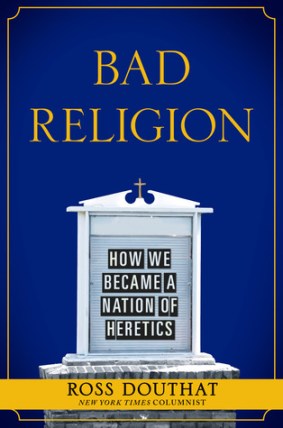
Bad Religion: How We Became a Nation of Heretics – An Interview

I am not a fan of Diane Rehm, by any measure.  Not only do I find her views unpalatable, her voice grates my ears.  But as I was driving to an appointment today I clicked the NPR preset on my JEEP radio and in the matter of seconds had my attention arrested by the discussion between Rehm and her guest, New York Times columnist Ross Douthat.  Earlier this week Douthat released a book provocatively titled Bad Religion: How We Became a Nation of Heretics.  This book was only on my “To Read” list – or at least, it was on the list to put on my list, but now it on my “Definite Read” list.

I have no doubt that there are areas of doctrinal difference that I have with Douthat, but as I listened to him make his points and respond to Rehm and some of her regulars, I could not help but nod in agreement.   Douthat offers some astute cultural observations that, being missional, I cannot ignore.

To listen to today’s interview click: Bad Religion

5 Causes of the Decline of the American Church

Previewing Ross Douthat’s new book, Bad Religion: How We Became a Nation of Heretics,  which hit bookstore shelves yesterday, Tim Keller draws five observations about the causes of decline in the American Church.

As Keller notes:

In his second chapter, Douthat attributes the change to five major social catalysts that have gained steam since the 1960s…

Here are the five factors:

  1. First, the political polarization that has occurred between the Left and Right drew many churches into it (mainline Protestants toward the Left, evangelicals toward the Right). This has greatly weakened the church’s credibility in the broader culture, with many viewing churches as mere appendages and pawns of political parties.
  2. Second, the sexual revolution means that the Biblical sex ethic now looks unreasonable and perverse to millions of people, making Christianity appear implausible, unhealthy, and regressive.
  3. Third, the era of decolonization and Third World empowerment, together with the dawn of globalization, has given the impression that Christianity was imperialistically “western” and supportive of European civilization’s record of racism, colonialism, and anti-Semitism.
  4. The fourth factor has been the enormous growth in the kind of material prosperity and consumerism that always works against faith and undermines Christian community.
  5. The fifth factor is  that all the other four factors had their greatest initial impact on the more educated and affluent classes – the gatekeepers of the main culture-shaping institutions such as the media, the academy, the arts, the main foundations, and much of the government and business world.

I find these observations significant. As God’s missional people, it is important that Christians recognize not only the reality of the decline of our influence within our culture, but the specific contributing factors.  Simply wishing things were the way they used to be won’t accomplish anything.  It is akin to sticking our heads in the sand.  But when we discern what is going on in the world around us, a number of signs direct us toward ways we may address the causes,  both directly and indirectly.

Read Keller’s entire article: Redeemer City to City

Pay Attention!

In his book, Joy Unspeakable, Martyn Lloyd-Jones notes:

Pay attention!

I am certain that the world outside is not going to pay much attention to all the organized efforts of the Christian church.  The one thing she will pay attention to is a body of people filled with the spirit of rejoicing.  That is how Christianity conquered the ancient world. It was this amazing joy of these people.  Even when you threw them into prison, or even to death, it did not matter, they went on rejoicing; rejoicing in tribulations.

Perhaps we would be wise to recover this attitude.  It seems to me, many of our contemporaries spend too much energy griping about the world, and about lessened stature in the estimation of the culture.  But if we recover the joy that should be an inherent attribute of our faith,  perhaps we can regain our effectiveness as redeeming and preserving agents in this world.

Lost Art of Discipleship

Sometimes we need to face up to difficult questions. Michael Horton, in his book The Gospel Commission, asks some really tough ones that every church, every church leader, every church member needs to ask themselves:

Instead of reaching the lost, are we losing the reached? Or are those reared in our own churches being truly reached in the first place? Do they know what they believe and why they believe it? Are we making disciples even of our own members – our own children – much less the Nations?

I honestly wonder if making disciples is even really the goal of many Christians or churches.  Some are apathetic and/or complacent. Some seem to think taking the time to instruct people in sound doctrine (what we must believe about God and Man) somehow gets in the way with mission.  Some are so contented in their own activity and busyness for the Lord that they sense no need to spend time with the Lord. And many seem to be satisfied with sheer increase in numbers.

Perhaps the task of making disciples seems daunting.  But Jesus gave good news to those who are willing to reclaim this priority:

  • All authority in heaven and on earth has been given to me. …And behold, I am with you always, to the end of the age.” (Matthew 28.18, 20)
  • But you will receive power when the Holy Spirit has come upon you, and you will be my witnesses in Jerusalem and in all Judea and Samaria, and to the end of the earth.” (Acts 1.8)

He provides his authority, his power, and his presence to all who endeavor to make disciples.

The Scandal of American Evangelicalism

I was not there, but I am now wishing I had been, at least for R.C. Sproul Jr.’s address.   The Layman Online reports that Sproul prophetically challenged those gathered for 2012 Ligonier National Conference “… about the true scandal of the evangelical mind.”

Developing his message from 1 Corinthians 1.18-31 Sproul briefly outlined the Christian faith, and emphasized the Unity of those within the faith.  He then contrasted the unity of Believers with the perspective of Christians “by those outside of the room – the Greek, the Gentile…” reminding his hearers that “the story [the Gospel] is a scandal. It is foolishness. It is a stumbling block.”

This is an important reminder.

As Sproul elaborated:  “Paul wasn’t just saying they don’t get it.  Paul says, ‘they don’t get you!’ They think you are foolish … They won’t take you seriously.” And those in the evangelical church perceive this distaste and displeasure.

So we see that the unbelievers around us don’t get us, and don’t appreciate the Gospel.  This should be no surprise. This is as God said it would be.  But here is where what Sproul said really begins to carry weight:

“What scandalizes me is that this truth scandalizes us … that we, who embrace this Gospel that is an offense to the world, are offended that they are offended by us!”

I think this is so true.  Despite the fact that we are told that we will be despised and rejected, we seem surprised.  We don’t like it.

“Evangelicals grouse and complain. They go on television to complain about how they are presented on television. We want to insist that Paul is wrong – and not just Paul, of course. This is the wisdom of the Holy Spirit here … The text says ‘this is how the world will see you.’”

The greater scandal is not that we are “scandalized” by the worlds rejection but how many seem to respond:

“Some Evangelicals not only fight back and argue against it, We insist on our rights and worse of all we begin to adapt. We begin to reshape ourselves and our story. We diminish the stumbling block and, to establish our credibility, we begin to rewrite the story.”

“If we are Emergent… We say it is just our story. You have your narrative. We have our narrative. All God’s children have their narrative … You don’t need to be scandalized. I just have a different story, and I’m not sure about my story. Will you let me into your cool club?”

“If we are Seeker-sensitive, then we take the story and remove the sharp edges of talking about sin and judgment and wrath because people don’t want to hear about that.”

I won’t go into much more detail. Instead let me encourage you to check out the whole story at The Layman Online. They have done an excellent job of chronicling Sproul’s message.  But I do want to share one more of Sproul’s observations, related to the laments listed above about some common responses:

“When we remember the Gospel – when we remember our own salvation – we remember the necessity of resting in His provision. In our sanctification, we are called to have our heart, mind and soul rest in His wisdom.”

And this is also true of our mission.

The primary aim of our mission is to extend the Gospel of the Kingdom. To do this we must faithfully proclaim the rich, deep, truth of the gospel in all it’s dimensions.  Our hope is that this message will impact many, many people.  BUT we must be clear, and we must regularly remind ourselves and one another, that we cannot make the hope of impacting many people the priority over faithful proclamation.

I am afraid many are inverting these priorities.  The measure of success, in such cases, is numbers of people at the expense if gospel fidelity.  So we embrace either the Seeker or Emergent approach Sproul mentioned above, or something of a similar ilk.   But when we are willing to accept a gospel that is not complete, or even necessarily accurate, we then are preaching a different Gospel than the one that is faithful to Christ.  Success may be apparent, but as Paul warned, if anyone is preaching a gospel different from the one the Apostles preached they are “perverting” the gospel. What they are preaching is “no gospel at all”.  (Galatians 1.6-9)

If what is preached is not faithful to Christ, then it follows that the mission cannot be of Christ.  We may want to offer it to him, but it is not his mission. Christ is the King. He dictates the message, the means, and the motive.

So if such mission, mission in the name of Christ but without the genuine message of Christ, is not really mission for Christ, then who is it for?  Us. For our own sense of importance; For our own apparent success in the eyes of those around us;  Perhaps even, we think and hope, so that God will be pleased with us.  But regardless of the motive, such motive for mission is not so much for God’s glory as it is for selfish ambition. (See Philippians 1.17, Philippians 2.3)

What Sproul suggests about our sanctification, that we must “rest in his provision”, must also be applied to our mission ambition. We must rest in his provision of pure gospel and gospel power.

Can Mission Become an Idol?

“There is a first-rate commitment to a second-rate mission.” That is what Roger, a leader in global church planting, said as he looked at the rock climbers ascending a cliff in the Alps. Many of us called into ministry feel the same way. Rather than giving our lives to climbing a rock, building a business, or amassing a fortune, we are committed to what really matters; a first-rate mission – advancing the Gospel and the Church of Jesus Christ.

But what if we’re wrong?

Roger spent decades serving Christ by planting churches on four continents. But after reflecting on his labors for the kingdom of God, his confession surprised many of us. “I’ve given most of my energy to a second-rate mission as well,” he said. “Don’t get me wrong. Church planting is important. But someday that mission will end. My first calling is to live with God. That must be my first commitment.”

What Roger articulated was a temptation that many of us in ministry face. To put it simply, many church leaders unknowingly replace the transcendent vitality of a life with God for the ego satisfaction they derive from a life for God. Before exploring how this shift occurs in church leaders, let me take a step or two backwards and explain how I have seen this tendency within the Christian college students I’ve worked with in recent years.

Is impact everything?

The students I meet with often worry about what awaits them after graduation. This is a reasonable concern for any young adult, but for many of them the worry extends far beyond finding a job with benefits. They fixate, and some obsess, about “making a difference in the world.” They fear living lives of insignificance. They worry about not achieving the right things, or not enough of the right things. Behind all of this is the belief that their value is determined by what they achieve. I’ve learned that when a student asks me, “What should I do with my life?” what he or she really wants to know is, “How can I prove that I am valuable?”

When we come believe that our faith is primarily about what we can do for God in the world, it is like throwing gasoline on our fear of insignificance. The resulting fire may be presented to others as a godly ambition, a holy desire to see God’s mission advance–the kind of drive evident in the Apostle Paul’s life. But when these flames are fueled by fear they reveal none of the peace, joy, or love displayed by Paul and rooted in the Spirit. Instead the relentless drive to prove our worth can quickly become destructive.

Sometimes the people who fear insignificance the most are driven to accomplish the greatest things. As a result they are highly praised within Christian communities for their good works. This temporarily soothes their fear until the next goal can be achieved. But there is a dark side to this drivenness. Gordon MacDonald calls it “missionalism.” It is “the belief that the worth of one’s life is determined by the achievement of a grand objective.”

Continue reading

Gospel Clarity for Missional Calling

The article below by World Harvest Mission‘s Josiah Bancroft is a tremendously insightful and clear explanation of the relationship of the gospel to culture.  Not only is this an important understanding for the mission field overseas, but Josiah explains why it is essential even within the local church in North America.

The video above is an interview with Josiah by Collin Hansen of The Gospel Coalition.

***

by Josiah Bancroft

How do you keep the gospel clear and focused on missional calling when so many competing forces, influences, and voices speak into your life, ministry, and church? I am learning that gospel clarity is tied in large part to how we understand our cross-cultural mission in very practical ways.

For example, I was picking up a large short-term team outside of Dublin to introduce them to our Irish partners and co-workers. When the jet-lagged U.S. visitors stumbled from the bus, one of the passengers asked to pray and gathered us around her. She thanked God for safe travel, for the opportunity to serve, and then prayed for “all our boys in harms way” and asked God to protect our troops from our enemies.

As soon as she said a tearful and happy amen and walked away, my Irish friends inundated me with questions: Who were “our boys”? Was the church supporting a national war? How were those “our” enemies that the U.S. troops were killing? Of course Ireland was neutral in the war, so their questions were reasonable and predictable. After all, they were Christians, not Americans.

Navigating culture and mission with gospel clarity doesn’t just happen, so how—practically—can we keep clear about the gospel while pursuing our cross-cultural missional calling? We all interpret the world as cultural beings. That’s how God has made us. And yet many American believers have struggled with the basic idea that they are part of a culture or a sub-culture. That is now changing.

With the rapid changes in U.S. culture during recent years, our churches are beginning to see U.S. culture more clearly. Our culture has changed so much and so quickly that the church sometimes struggles to engage. We are hard pressed to maintain the mental and spiritual clarity that can respond powerfully to a such pervasive cultural forces. So what can help us with our struggle? I’d like to make a few suggestions.

1. We Need Clear Kingdom Identity and Allegiance

As missional people we belong to the kingdom of God and live in the United States as strangers and aliens. Keeping my kingdom identity clear as a believer keeps me from identifying completely with this present age. God has given each of us a role in our culture, so we should embrace our lives and do well here. But this present time and place isn’t everything, and this age doesn’t fully define a believer. So while I work to bring all things under the rule of Christ in my life and mission, I do it as an outsider. Where I forget this missional identity, I can confuse my interests and culture with the kingdom of God. Then I lose my gospel clarity and muddle the message with my culture.

Practical Help: Keep the horizon of God’s larger global mission clearly in view even in local ministry work, so that all your concerns are kept in the right perspective for new kingdom people. Without this missional global horizon, local ministry easily appears so large to us that it obscures everything else.

2. We All Answered the Universal Call to Cross-cultural Missional Life

Since we are each part of God’s mission to reach the world, and because we live as strangers and aliens, therefore all of our ministry and mission is necessarily cross-cultural. All church planting is a cross-cultural exercise. All evangelism reaches across cultural boundaries, even in our own families and neighborhoods. The struggles between generations are in part cross-cultural conflicts, because the world has shifted so quickly and radically. Every attempt to reach out or serve in the church must recognize and communicate to our own culture with cross-cultural understanding and sensitivity. All ministry here is cross-cultural.

Practical Help: We need a steady flow of outsiders and missionaries who bring in tales of the kingdom moving and struggles to take the gospel into difficult places. What worked in Congo? What is God doing in Russia? How is the God moving in the Czech Republic? Hearing how culture works and is navigated practically in other places gives us new perspectives on what things belong to the kingdom and what belongs to the culture.

3. We Enter Other Cultures

As a missional people we are responsible to cross the cultural barriers with the gospel rather than wait and require those outside to come and understand. Actually that’s one of the big differences that came with the church in the first century. Everyone doesn’t have to become Jewish to have access to God. Today in the church we must learn the new languages, not the nations . . . remember Pentecost? We adapt rather than require others to “eat kosher.” We go, rather than having everyone come to us. When I bear the weight of reaching out to others, here or in foreign countries, I best imitate Christ who became like us in love and won us with great sacrifice. When the gospel is small in my life, when my flesh and home culture press in, then I am unwilling to change or sacrifice for others to bring them the gospel. Missions pushes me to clarify my commitment to the gospel and to Christ.

Practical Help: Get a larger heart for the world by spending time with others who love their enemies. That love is what motivated Christ to do the work of incarnation. Roll up your sleeves and find a place to sacrifice time, work, and money for the expansion of the kingdom in places you will never see as well as in your hometown. Turn every group in the church outward with a cross-cultural eye to be true missional communities.

4. We Go

We know the gospel is how we enter the kingdom. The gospel promises are also how we live daily before God in repentance and faith. And the gospel is the central message of the church as we go into the world. This might seem obvious, but it is so easy to mix cultural pieces into our speaking about Christ that we need to be clear. Paul tells Titus in his church planting and leadership to emphasize—even insist on—and confidently affirm the gospel as the life and message of the church (Titus 3:8).

Practical Help: Get involved in short-term missions and create a global missional team to find those in your fellowship who need to go. Join with cross-cultural workers who have more experience so that you can learn from them. The New Testament way requires us to listen to these cross-cultural workers. Of course the greatest was Christ. But Paul also qualifies, and as a cross-cultural missionary he was wonderfully equipped to lead churches and planting in various places without confusing his culture or Roman culture with the call of the kingdom. I would love for our churches to find his gospel clarity and passion renewing us all for global missions and partnership in new ways.

Perhaps there is another way to say all of this simply. The gospel always leads us believers to a global vision and a heart willing to sacrifice for a lost world. That’s what it means to follow our Savior. And learning to keep our vision clear, listening to others engaged in that same struggle, and feeding your heart with the gospel promises and the kingdom calling from Scripture are all essential to keep our missional calling centered on the gospel.

***

Both the article and the video first appeared on The Gospel Coalition blog.

Numbering Those on the Ranch

With the following illustration, Alan Hirsch offers a different way of gauging a church’s effectiveness:

In some farming communities, the farmers might build fences around their properties to keep their livestock in and the livestock of neighbor farms out.  This is a bounded set. But in rural communities where farms or ranches cover an enormous geographic area, fencing a property is out of the question. In our home of Australia, ranches (called Stations) are so vast that fences are superfluous. Under these conditions a farmer has to sink a bore and create a well, a precious water supply in the Outback.  It is assumed that livestock, though they will stray, will never roam too far from the well, lest they die.  That is centered set.  As long as there is a clean supply of water the livestock will remain close by.

The essential difference is between measuring Influence instead of simply membership and/or attendance.  The bounded-set, as Hirsch calls it, draws a clear line between those on the inside (i.e. members and regular attenders) and those outside.  The centered-set, on the other hand, measures how many people are in some relation to the ministry of the church and gauges the various relative distances from the center values.

Though I do not see these grids as being mutually exclusive, as if one must choose one or the other, I do find Hirsch to have provided a helpful distinction.

In our church, for instance, we have some precious members who do not regularly participate in any of the Life of the Church. They come occasionally to any number of things, including infrequently to the Sunday morning worship service. To assume we are having an active influence in their spiritual growth would be, at best, presumptuous. On the other hand, there are people who are not members of our church, nor even attenders, but who are being actively influenced through ministries of counseling, discipleship, mercy, etc.  While these folks are not part of the quantifiable membership, they are nevertheless beneficiaries of the mission of the church.   In many ways some of these folks are closer to our center-set than are some of the irregular members.

So again, as I think about it, I see both of these grids as being beneficial.  In fact, I would hope to see growth on both gauges.  We long to see our influence expand, and realize that many whom we influence will never become part of our congregation. Some are members of other churches, and therefore should stay there and bless the people in those churches.  But we also should be laboring, and praying, for those who are not part of a particular congregation to become connected to some expression of of the visible church – hopefully many with ours.

So, I don’t see that we need to make a choice between these two ways of measuring our congregations. I think we ought to use both. But, I guess, since relatively few are aware of Hirsch’s Ranch, we would be wise to spend our energies to cultivate and cast the importance of the centered-set.

Moralism Trap

To reach people in our day, the gospel will have to be distinguished from moralism, because moralism is what most people outside the church think Christianity is all about – rules and standards and behavior and cleaning yourself up.  Millions of people, both inside and outside the church, believe that the essential message of Christianity is: “If you behave, then you belong.”  From a human standpoint, that’s why most people reject Christianity.

~ Tullian Tchividjian, from Jesus + Nothing = Everything

Lessons from The Externally Focused Church


 Although everyone outside the Church is a potential ministry focus, the Externally Focused  Church moves intentionally toward two groups:

  1. Those on the margins
  2. The City

– from Externally Focused Church 

These are important points to remember when designing an outreach strategy for the local church.  The first, people on the margins of society, probably needs no explanation.  The second, while in some ways obvious, may be helpful to explain, at least a little. 

The focus on the city does not necessarily mean our focus must be on the mega metropolitan areas throughout the country and around the world.  While no doubt those places are important, when you think of “city” think simply of “places where people gather”.  Externally Focused Churches work to benefit the common good more than create places to which Christians withdraw from others.  (Jeremiah 29.7)