Natural Born Skeptics

luther

To doubt the good will of God is an inborn suspicion of God with all of us.

Besides, the devil…goes about seeking to devour us by roaring: ‘God is angry at you and is going to destroy you forever.’

In all these difficulties we have only one support, the Gospel of Christ. To hold on to it, that is the trick. 

Christ cannot be perceived with the senses…

The heart does not feel His helpful presence…

Especially in times of trials a Christian feels the power of sin, the infirmity of his flesh, the goading darts of the devil…the scowl and judgment of God.  All these things cry out against us, death thunders at us, the devil roars at us.

In the midst of the clamor the Spirit of Christ cries in our hearts, ‘Abba, Father.’ 

And this little cry of the Spirit transcends the hullabaloo of the Law, sin, death, and the devil, and finds a hearing with God.  The Spirit cries because of our weakness…(and) is sent forth into our hearts…to assure us of the grace of God.”  

– Martin Luther, Commentary on Galatians

Grace of Repentance


Today is Ash Wednesday. That does not mean much to many in my theological circles.  But for many other Christians it is a day that launches the Season leading to Easter – the Season of Lent.  This day is designated Ash Wednesday because of an ancient practice of marking believers with ashes as a symbol of repentance. 

Hopefully it is more than symblolic, but is also a reminder that, as Martin Luther said, “When Christ said ‘Repent’ he called for the entire lives of Believers to be lived out in repentance.” 

Repentance is a lost art.  Repentance is also a neglected practice.  I suspect that many assume repentance is someting to be avoided; that repentance is what we must do if we have sinned; but if we can avoid sin we have no need of repentance. 

Seems logical. Except it mischaracterizes the nature of sin.  Sin is not what we do, sin is the condition we have, whether we are aware of it or not.  I find helpful the old saying: “We are not sinners because we sin. We sin because we are sinners.”  Thus, as Luther suggested, the necessity of life lived out in repentance. 

Perhaps a better way of putting it might be that our lives should include repentance.  I say that because repentance never stands alone. Repentance should always accompany Faith; and Faith should always accompany Repentance.  They are two sides of the same coin of Gospel Christianity.

I like the way the old Puritan Thomas Watson says it:

“Faith and Repentance are the two wings by which we fly toward heaven.” 

I love the imagery. It shows us that our salvation involves not only our conversions (which, by the way, requires both Faith & Repentance), but is a sanctifying journey which requires us to grow in our awarenss of both our ungodliness and the greatness of the Gospel.  To have one wing longer than the other; or worse, to have only one wing, would be disastrous.  Try it for yourself.  Try flying one of those balsa wood planes, with one wing longer than the other and see how it flies.  But this is life without both Faith & Repentance.

Three books I have found helpful in shaping my understanding and appreciation of the need of ongoing repentance:

Repentance & 21st Century Man by C. John Miller

The Doctrine of Repentance by Thomas Watson

Repentance: The First Word of the Gospel by Richard Owen Roberts

More Narrow Than Conservative

 swinging-bridge

In the Foreword to CJ Mahaney’s book, Worldliness, John Piper writes:

“The gospel makes all the difference between whether you are merely conservative or whether you are conquering worldliness in the power of the Spirit for the glory of Christ.”

What an awesome and insightful statement.  In my circles I encounter way too many people who assume conservatism is an ends, and not a means to an end; that conservatism in itself is akin to godliness; and that the only real battle for godliness is against liberalism.  Yet Jesus tells us that the road is narrow (Matthew 7.13-14); and Proverbs warns us not to lean to the left or to the right (Proverbs 4.27).

The Jesus Pledge


cross-in-the-sky1


What does it mean to be a disciple of Christ? What does it mean to be Gospel-driven?  I think my friend, Paul Miller, expresses it beautifully in The Jesus Pledge:

I pledge my life to Jesus and the Gospel.  I want Jesus not to be just part of my life or something that makes me feel good, but to be the very center – controlling everything.  I want only the knowledge of the love of God.  I want to know Christ. 

I want no desire, idol, or sinful way of dealing with hurt to control any part of my life no matter how small.  I put away from myself the love of money, power, comfort, and success.  I count everything rubbish. 

I bind myself to Christ as bond-servant for life.  I want no master other than Christ.  I purpose to own nothing.  I surrender to Jesus my family, my friends, my ministry, my ideas, my possessions, and my future. 

I commit myself to submission to others and a willingness to learn from all kinds of Christians.  I commit myself to speak only your words, not my own.  I commit myself to speak the truth in love to others.

I want to love people.  I want to lay down my life for others, especially those closest to me, as God gives us grace.  I want to love people by telling them about Jesus.

I understand that this will mean suffering in my life, that I will join in the sufferings of Christ.  But that I always want to be dying, so that I can always be living in Christ. 

Dynamics of the Spiritual Life

Christians who are no longer sure that God loves and accepts them in Jesus, apart from their present spiritual achievements, are subconsciously radically insecure persons – much less secure than non-Christians, because they have too much light to rest easily under the constant bulletins they receive from their Christian environment about the holiness of God and the righteousness they are supposed to have.  Their insecurity shows itself in pride, a fierce defensive assertion of their own righteousness and defensive criticism of others… They cling desperately to legal, pharisaical righteousness, but envy, jealousy and other branches on the tree of sin grow out of their fundamental insecurity…

[I]t is often necessary to convince sinners (even sinful Christians) of the grace and love of God toward them, before we can get them to look at their problems.  Then the vision of grace and the sense of God’s forgiving acceptance may actually cure most of the problems.

This may account for Paul’s frequent fusing of justification and sanctification.  

~ Richard Lovelace, Dynamics of Spiritual Life

Enduring Aroma of the Gospel

painters-cup

People don’t earn God’s approval or receive life and salvation because of anything they’ve done. Rather, the only reason they receive life and salvation is because of God’s kindness through Christ. There is no other way.

Many Christians are tired of hearing this teaching over and over. They think that they learned it all long ago. However, they barely understand how important it really is. If it continues to be taught as truth, the Christian church will remain united and pure — free from decay. This truth alone makes and sustains Christianity. You might hear an immature Christian brag about how well he knows that we receive God’s approval through God’s kindness and not because of anything we do to earn it. But if he goes on to say that this is easy to put into practice, then have no doubt he doesn’t know what he’s talking about, and he probably never will. We can never learn this truth completely or brag that we understand it fully. Learning this truth is an art. We will always remain students of it, and it will always be our teacher.

The people who truly understand that they receive God’s approval by faith and put this into practice don’t brag that they have fully mastered it. Rather, they think of it as a pleasant taste or aroma that they are always pursuing. These people are astonished that they can’t comprehend it as fully as they would like. They hunger and thirst for it. They yearn for it more and more. They never get tired of hearing about this truth.

– Martin Luther

What About Gay Marriage?

 comet-mcnaught

Anger at the disproportionate number of African Americans who voted for California’s same-sex marriage ban “has been widely noted”, says Jeff Jacoby in the Boston Globe. But “for sheer hatefuless” the “hatemongering” directed against Mormons for pushing the ballot measure can’t be beat.  (See The Week for full article.)

I’ve watched the news with some amazement at the craze taking place in the streets of California.  I have little sympathy for the protesters, at least for the position that is mobilizing them.  But I find myself reacting the the charges they levy: bigotry and fear. 

While concerned about the cultural repercussions if “gay marriage” receives constitutional support, I don’t believe I live in “fear”. In one sense, if this measure passes, some things will become more vividly clear, such as those who are committed to Biblical standards concerning marriage and those who are not.  The words of the Apostle Paul come to mind:

Do everything without complaining or arguing, so that you may become blameless and pure, children of God without fault in a crooked and depraved generation, in which you shine like stars in the universe as you hold out the Word of Life. ” (Philippians 2.14-16

In other words, those who maintain the characteristics of godliness shine like stars against the dark backdrop of the culture.  Therefore, if this measure passes in California, and elsewhere, it is not a cause for fear, necessarily, but an opportunity to shine in contrast. 

However, Paul’s words also cause me a little discomfort. 

First, while faithful believers may stand firm and shine in contrast to darkness in the culture, there are others who share our opposition to same-sex marriages who do not shine in the same way. In fact, some don’t shine at all. They are just what they are accused of being: bigoted and fearful.  I’m not sure that the differences of standards behind the sharing of  moral/political positions are always so obvious to those who hold the opposing view.  How, then, can we stand out like stars shining in the darkness, when some who stand with us are only a different shade of darkness from the culture they oppose? 

I’m sure that this difference is all the more distorted because many of us who are driven by Biblical standards are also tainted, to some degree or another, with the sins of bigotry and fear.  Our righteous motives are blended with unrighteous, sometimes even without our being conscious of the mixture.  To whatever extent this is true, the shine on our star is dimmed, at least somewhat.

Second, Paul’s words encourage us to do everything without complaining or arguing.  I’m not sure that from the perspective of the gay community, and their allies, that we Evangelicals have lived up to that counsel.  I’m not sure even from my own perspective that we’ve met that standard. 

Certainly the most militant proponents of “gay rights” don’t want to hear any Evangelical voice (nor do they support our right to a voice), but I am not confident we have exhausted all the means to express our voice.  We have used politics and the media to protect our position.  But have we expressed the full grace of the gospel with equal effort?  I’m not talking about a cheap grace that simply overlooks sin and calls it acceptable. I’m talking about the demanding gospel that demonstrates brokenness over our own sin – past and present – the experience of forgiveness in Chirst that reconciles us to God AND moves us out to love a broken and decaying world.  While this verse in no way mitigates our responsibility – and right – to stand up for righteous things, I have to wonder, if we lived out the gospel, if this was our primary voice, if there would be as many of our opponents who would hope we would just “shut up”.   Our civil rights are not abrogated, but we must not mistake exercsing our common civil rights as that which makes us stars.  It is the gospel embraced, lived out, and faithfully expressed, that makes us shine.  I suspect that is a voice that would be more readily heard.

Let me conclude with this: Many people are quite clear as to what their position is, but not as well thought out about the “why’s” behind the positions. 

Honestly, that is probably true of me.  I’ve given some thought, perhaps more thought than some others have, to this issue, but I’ve been pretty set in my position without wondering if there were some aspects I have been neglecting.  To the extent I have failed to clearly think through this polarizing issue, remaining ignorantly contented in my position, I suspect I am exercsing a form of bigotry.   And to the extent that I am willing to maintian my position without discerning how the gospel can be brought to bear to bring about reconciliation and greater resolution,  I am failing to shine.  I am not suggesting compromise and retreat, but reflection and humility. 

Dr. Geri Huminski has written a thought provoking article for Harvest USA titled: What About Gay Marriage?   Harvest USA is an uncompromising Evangelical ministry that reaches out to those who are effected by sexual addictions.  They offer a perspective, both experientially and biblically, that I don’t find elsewhere.  This article has helped me think more clearly about this culture defining issue.  I am still not sure I am ready to embrace all that is suggested (particularly in regard to taxes and shared benefits), but it is helping me think through both my “what” and my “why’s”.  

My hope is that I will be more shaped by the gospel and the advancement of the Kingdom of God than by the mere maintaining of the political status quo.  I suspect my “position” won’t change much, but maybe my shine can get a polish.

Sharing the Father’s Welcome

Tim Keller’s new book, The Prodigal God: Recovering the Heart of the Christian Faith, will be released in a few weeks, on October 31. In the book Keller presents a powerful expression of the gospel, rooted in the parable of the Prodigal Son.  Having heard Keller teach from this parable, I am looking forward to the written form.

But Keller’s insights were not developed in a vacuum.  They were cultivated by careful and thoughtful study and prayer. They were built upon a foundation of those who had walked before him, like Edwards and Chalmers. And they were influenced by the wisdom of those who invested in him. Among them, Dr. Ed Clowney, former president of Westminster Seminary, whom Keller credits in the Introduction of this upcoming book as having provided the inspiration: 

Many excellent studies have been written on this Biblical text over the last several years, but the foundation for my understanding of it was a sermon I heard preached over thirty years ago by Dr. Edmund P. Clowney. Listening to that sermon changed the way I understood Christianity. I almost felt I had discovered the secret heart of Christianity.  (Click: article.)

Crossway Books has made available Clowney’s sermon, Sharing the Father’s Welcome.  I hope it not only whets you appetite for Keller’s upcoming book, but that it opens your eyes to see how high and wide and long and deep is the love of God for we, his children.

(NOTE: My thanks to Justin Taylor of Between Two Worlds for tipping me off about this.)

Respectable Sins

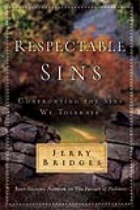
One of the books on my bedside table is Respectable Sins, by Jerry Bridges.  The subtitle of the book is: Confronting the Sins We Tolerate. The theme becomes self explanatory. 

In his preface Bridges explains the motive behind the book:

“The motivation for this book stems from a growing conviction that those of us whom I call conservative evangelicals may have become so preoccupied with some of the major sins of society around us that we have lost sight of the need to deal with our own more “refined” or subtle sins.”

I think Bridges is correct.  The whole notion of sin seems to have been lost on our society, and confused in our churches. 

Conservatives often lament the absence of any sense of, or concern about, sin reflected in our society.  In this glaring absence in our collective cultural conscience we have seen the arrival of government sanctioned killing through abortion and euthanasia; the crumbling of the family due to divorce, rampant pornography, and the redefining of it to embrace homosexuality as an acceptable norm; and a widespread apathy toward God. Those who speak out about such matters are right to be concerned.  The problem is that while we talk about those things that are infecting others, we are failing to address the very real sin in our own lives.  And we are therefore seen to be hypocrites – and probably rightly so.

Jesus instructed his followers to “first take the plank out of you own eye, then worry about the speck in the eye of another.”  I am not suggesting that those sins that are freely expressed in our society are minor specks.  They are not. They are serious.  And I am convinced that if we heed Jesus’s perscriptive counsel we will again experience the moral authority to speak. 

More serious than even the loss of our moral authority, many Evangelicals are confused about how we relate to God.  We have become disconnected from our own need of the Gospel, and our need of it every day. We fail to see the subtle, yet serious, ways we function as “unbelievers” and tolerate cancerous sin in our own hearts and relationships.  In fact, as the title of Bridges’ book suggests, we have not merely tolerated these things, but have functionally elevated them to a level of respectability.

Recognizing our sin, despite how it may seem, is not an entirely ugly proposition.  It is important to our spiritual vitality.  And makes practical sense. 

Let me explain it this way: We should be at least as concerned about our spiritual vitality as we are about our computers. 

I regularly receive updates from McAfee, and I run a scan on my computer at least a few times a week. Why? Because I have experienced the slow down, the unresponsiveness, and even a crash when I failed to have my computer checked for viruses that can infect it.  Once McAfee has performed a scan, if it has identified any potential threats I am able to deal with it. I either delete it, or in some cases quarantine the file. But either way, my computer functions much better because I have taken the time to perform this taks.

Sin in our lives, even that which seems minor, infects our hearts, our perceptions, our relationships, even our productivity.   We need to “scan” our hearts and lives regularly to see if there is anything there that may cause problems down the road. (This is what the Psalmist is advocating in Psalm 139)  Once we determine if there is anything there we can deal with it accordingly. In taking the appropriate precaustions we prevent problems because we are more able to keep things from spreading over and infecting other areas of our lives.

Despite what you may suspect due to my ranting thus far, this book is actually very positive, practical, and encouraging. 

In chapters 1-4 Bridges does a wonderful job explaining the Gospel, its practical importance, and its important practicality.

Chapter 5 discusses the Power of the Holy Spirit, and expalins how the Spirit is at work in the Gospel.

Chapter 6, titled: Directions for Dealing with Sins, serves as a practical preface to the rest of the book.  This chapter alone would be worth the price of the book, because it shows us how we can practice preaching the Gospel to ourselves. 

Chapters 7-20 deal with specific “acceptable” and “respectable” sins.  I have deeply appreciated Bridges’ talent for defining words of our Christian jargon that have at times confused me, or words that I’ve generally understood yet was still somewhat fuzzy about.  This understanding has been helpful in identifying some of the sin I carry around in my heart, and how it expresses itself in my life and in relationships..

The final chapter, chapter 21, simply asks the question: Where Do We Go from Here?

Each chapter is short and easily readable.  My intention is to read a few chapters a week over the next month or two so that I can digest Bridges’ insight, and deal with my own heart.  I may even journal my insights here on my blog. I haven’t decided yet.

But one thing I have decided to do. My friend, David Zavadil, has been working through this book and posting his observations on his blog, By His Grace.  Whether I develop my own posts or not, I will join the discussion David has started. I invite you to join me over there.

The Gospel in 6 Minutes

What is the Gospel? 

While in many ways this should be a simple question to answer, experience has taught me that many people are confused about what the Gsopel is.  Most agree that the Gospel is something good.  But they are confused about what particularly defines the Gospel. 

Some see the Gospel as merely that message necessary to receive salvation, but have no idea it has a huge impact on how we live our lives even after becomming Christians. Some associate it with a style of music often found in a rural church.  Some view at is as a synonym for “Truth”.  Others simply think of the whole Bible, or at least the New Testament, as being the Gospel. 

While the latter statement is true in a sense, there is a particular message that runs throughout the Bible that is most properly seen as the Gospel; and by which the entirely of Scripture can be said to be Gospel. This message is at times more detectable than  at other times.  It may be said to be like a stream that runs both above and under ground. Even when it is not obvious, if you look closely its presence can be seen.

Getting the Gospel right is essential to a healthy and vibrant spiritual life.  Many problems experienced by Christians in their spiritual and emotional lives, and in evangelsim and mission, can be traced to a misunderstanding or masapplication of the Gospel.  That’s why I want to take every opportunity to clearly declare and define the Gospel.

John Piper succinctly explains this vital message in this brief video.  (It is well worth the few minutes.)

Thoughts About the Resurrection

That the resurrection is an essential aspect of Christianity seems to me to be a ‘no brainer’.  But recently I had a dialogue with an individual who does not share this view.  As I have thought about that dialogue I have come to realize that this person is not entirely wrong, though still, I think, confused.

Let me explain.

The resurrection is necessary to Christianity. Without the resurrection we would have no assurance that the death of Christ satisfied the justice of God.  We would have no way of knowing if Christ’s death paid the price of the debt of our sin or not. We would not know if he was a mere man or not.  Therefore, we would live, at best, with a presumptive hope, but no faith, no actual trust, that we had been reconciled to God. 

Actually, had Jesus not been raised from the tomb we would have serious reason to doubt anything positive had happend at all, since Jesus predicted his own resurrection. (See Matthew 12.40-41 & Luke 11.29-32).   Had he not raisen, he would have been shown to have been wrong.  And as good as he may have been otherwise, had he been wrong about this he would not have been perfect.  In fact, he would have himself been guilty of sin by making claims about himself – and about God – that just were not true. (That’s called blasphemy.)  And if he had sinned, even in this one instance, he could not have been God.   And if Jesus is not God, and was in fact himself a sinner, he could not reconcile us to God.  He would not even have been able to reconcile himself to God!

So, without ther Resurrection there is no Gospel.

The resurrection is so essential to the Christian Faith that the Apostle Paul wrote:

If Christ has not been raised, our preaching is useless and so is your faith.  More than that, we are then found to be false witnesses about God, for we have testified about God that he raised Christ from the dead… If Christ has not been raised, your faith is futile; you are still in your sins.

If only for this life we have hope in Christ, we are to be pitied more than all men.

Clearly the Resurrection is an aspect of the Gospel essential to Christianity.

Why, then, you may ask, did I say that the person who does not consider the Resurrection to be an essential part of Christianity is “not entirely wrong”? 

What that person sees, I suspect, is the beauty of the life and teaching of Christ. Even if the resurrection had not occured, the life Jesus lived, and the life that lives in conformity to his teaching, is beautiful.  That is somethng I have to concede. And in that sense what some might call Christianity, even without the resurrection, has value. 

The Christian Gospel is not only the promise of forgiven sin, but also the promise of the power to grow to become more Christ-like. In other words the Gospel includes the power, subsequent to being forgiven, to live a more and more beautiul life. These truths are like two lanes of the same highway.

Sadly, it seems too many who call themselves Christians are willing to embrace the saving grace of the Gospel, but fail to take seriously – who don’t even really desire to adorn themselves with – the beauty of a life lived in accordance with the model & teaching of Jesus.  And I suspect that glaring absence is what leads some to embrace, what I will call, a Gospel-less Christianity.  

If some are willing to accept that Christianity can be salvation apart from a correspondng holiness, I suppose it is not diificult to understand why others would assume it OK to accept morality without a corresponding redemption to also be Christianity.  Both have simply divided the highway.

But that is as far as I am capable of going with this thought.  Because beautiful or not, Paul is right, Christianity without the resurrection is futile. It is a mere fragment, and not Christianity.  Christianity is the whole revelation of Christ. It is the whole Gospel, or it becomes something entirely different. To pick out bits and pieces is inauthentic, even if well-intentioned. 

Let me illustrate it this way: If my house is disassembled for some reason, and someone attempts to rebuild it using materials from the orignal, yet does not use all the material, and build it according to the same design, it is not my house any longer.  It may have many of the same pieces, but it is not the same thing.

Likewise, a Christianity rooted in the moral principals and example of Christ, but that does not include the redemption accomplished by Christ through his death and resurrection, may look nice, but it is not Christianity. 

The resurrectionis essential.

But while I was thinking about this, something struck me.  What Paul is emphasizing in 1 Corinthians 15 is not only the resurrection of Christ, but the promise of the resurrection to come.  It is the promise of our resurrection!  In fact, it could be, should be, said, that our future resurrection is an essential element to Christianity.  

That’s just awesome!  It is the promise of Heaven!
Hard Grace

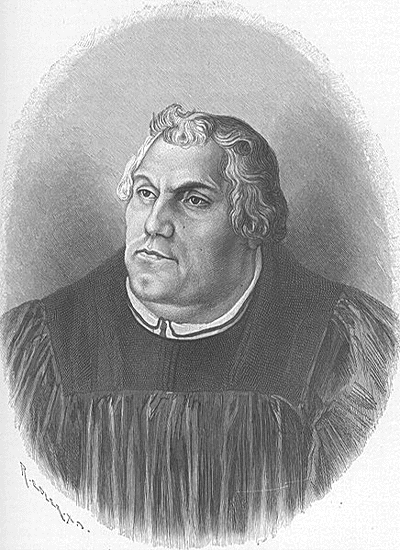
“Even though we are now in faith, the heart is always ready to boast itself before God and say: ‘After all, I have preached the law, and lived so well and done so much that surely He will take this into account ‘.  

We even want to haggle with God to make Him regard our life, but it cannot be done. With men you may boast: ‘I have done the best I could… If anything is lacking, I will still try to make recompense.’  But when you come before God, leave all that boasting at home.  Remember to appeal from justice into grace. 

But let anybody try this and he will see and experience how exceedingly hard and bitter a thing it is for a man who, all his life, has been marred and has worked righteousness to pull himself out of it with all his heart, to rise up through faith in the one mediator.

I myself have been preaching and cultivating it through reading and writing for almost twenty years and still feel the old clinging dirt of wanting to deal so with God that I may contribute something so that He will give me His grace in exchange for my holiness. Still I cannot get it into my head that I should surrender myself completely to sheer grace. 

Yet I know that this is what I should and must do.”  

– Excerpted and edited from Martin Luther, Commentary on Galatians

The A-to-Z of the Christian Life

“The gospel shows us that our spiritual problem lies not only in failing to obey God, but also in relying on our obedience to make us fully acceptable to God, ourselves and others.

Every kind of character flaw comes from this natural impulse to be our own savior through our performance and achievement. On the one hand, proud and disdainful personalities come from basing your identity on your performance and thinking you are succeeding. But on the other hand, discouraged and self-loathing personalities also come from basing your identity on your performance and thinking you are failing.

Belief in the gospel is not just the way to enter the kingdom of God; it is the way to address every obstacle and grow in every aspect. The gospel is not just the “ABCs” but the “A-to-Z” of the Christian life.

The gospel is the way that anything is renewed and transformed by Christ — whether a heart, a relationship, a church, or a community. All our problems come from a lack of orientation to the gospel. Put positively, the gospel transforms our hearts, our thinking and our approach to absolutely everything.”

– Timothy Keller

Share this:

The Gospel & Parental Sin

Last week I became rightfully angry at one of my children. (I won’t say which one.)  But in my anger I sinned against him. (Okay, the ‘him’ narrows it down some.) I had neglected the counsel of King David, who wrote: “In your anger do not sin.” (Psalm 4:4)  In my reprimand I was way too harsh.

A few moments later I went back and apologized. While remaining firm about his offense, I told him my offense was even worse and asked for his forgiveness.

Things are normal now.

I am sure I am not the only parent who has crossed this line. In fact we all do. And we may wonder what the lingering effect will be on our child, and on our relationship… 

At such times we need to remind oursleves of the hope of the Gospel.

I appreciate C.J. Mahaney and, right now in particular, a very brief message of his I stumbled across this week titled: The Gospel + Parental Sin.    C.J. discusses our moments of failure as parents, and how the Gospel relates.

If you, like me, ever cross the line as a parent, I recommend taking the time to hear what C.J. has to say. (Run time = 2:39)

Antithesis Manifesto


Several years ago a now defunct web-based organization, Antithesis or ChristianCounterCulture.com, published a manifesto that prophetically challenges contemporary Evanglicalism.  It resonated with me then and, with the exception of the dating in the opening paragraph, it remains timely. 

From time to time I re-read, what I call, the Antithesis Manifesto to refresh my thoughts. As I reflect on it this afternoon I want to sumarize some of the assertions:

1. Today’s Christian Culture is destroying Christianity

While we are prone to lament the “world” and the decaying values, the truth is that we Evangelicals bear much responsibility for this.  We want so desperately to be accepted by the world (for the sake of evangelism) that we have largely become indistinguishable from it.  We mimic whatever is popular, and many seem to be driven by the same values systems.  (Think about it, How do we guage a “successful” church?  Often by size, money, fame, and political clout.) 

This value shift has not escaped notice. Not from those outside the Church. And not from a generation inside the church that has grown weary of our impotence, if not our outright hypocrissy.  

I recall John Stott saying that if the culture is decaying it is the fault of the church not being the preserving “Salt” it is supposed to be. (See Matthew 5:13)  Stott said you can no more blame the culture for decaying than you can a piece of meat. It is the salt that bears the responsibility to the work of preserving.

If we think the world is having a negative influence on the church it is only because the church has chosen to be like the world.  It is not the world that is destroying us. We are doing it to ourselves. And collectively, I’m afraid, we Westerners are doing little toward our mandate to preserve our culture. (See Jeremiah 29:7)

2. We must Practice Truth

It is not enough to claim the Bible is truth. We must live that truth.  This requires a serious assessment of all of our practices – ecclesiastical as well as personal – and an intentional submission of them to Biblical standards.  We need to be “formed” by the Word, not merely familiar with it.  And there is no sphere of our lives that is exempt from constant need of re-formation.

3. Our Fellowships must be REAL Communities.

The Gospel not only forms us as “new creations”, but it forms a New Community.  As the Manifesto correctly observes: “Too many of our churches are really teaching stations and activity generators. The ‘sharing of life’ in community has had little place.” 

The Gospel formed community is an open, inviting, honest place, where participants are interdependent.  This runs contrary to our individualism (another value we have assumed from the culture), but it is the Biblical model, and the environment in which Gospel Transformation really takes place. 

Conclusion

The whole manifesto reveals a definite touch of Francis Schaeffer’s influence.  Perhaps that’s why it resonates with me.  But a simple periodic review is not enough. We need to make the appropriate changes.  Without them this whole thing is rather ominous.  But if there is change there is also reason for great hope.

The Antithesis Manifesto itself concludes with these words:

If Christians take these factors into account, then we may hope for the stirring of a revolution in our day. And, should our Lord delay his return, the century before us may be marked as a time when radical Christian proclamation went forth yet again – in the power of the Holy Spirit – turning the world upside down, forever altering the cultural landscape.

(To read the original document click: Antithesis Manifesto.pdf)