Gospel
What is the Gospel? Interview w/ Sam Storms
What is the Gospel? An Interview w/ Michael Horton
Offensive Grace

Why does not the faith of the average Christian seem to bring about the change we would hope? Could it be that many have a faulty understanding of the Gospel?
Dan Allender, in his book Bold Love, offers the following:
“If our sin is mere failure to conform – simply a mistake to do what is right – forgiveness is really the granting of an opportunity to try again. In that light, it is like forgetting to finish one’s homework. We deserve a low grace, and grace becomes merely the privilege of doing it over to get a higher mark. Such a view of grace might generate appreciation, but it would never drive us to worship. If, in fact, sin is not only failure to hit the mark of God’s perfection, but also a deep, insidious energy that desires to eradicate from our existence an affronting God who demands perfection, then forgiveness becomes breathtaking, incredible, and wonderfully insulting.”
It seems we underestimate our sin. Consequently we undervalue God’s grace.
Get the Gospel Right

If pressed for a quick summary of my philosophy of ministry, I would probably express it something like this:
- Get the Gospel Right
- Get the Gospel Out
- Get the Gospel Out Right
Without a message there is no mission.
Unfortunately, it seems, many are so zealous to get about the mission that they make little time getting the message of the gospel right. They do not stand amazed at what God has done for us in the person of Christ. Consequently, they are not being formed or transformed by the gospel. They are more anxious about what they will do for God than excited by what God has done for us, and what he is doing in us, and what God has promised to do through us – if only we would root ourselves in the gospel. And because some are neither formed or being transformed, they go out uninformed.
If we are not conscious of what God is doing in us, what do we think we have to offer those who are around us?
While no doubt knowledge without zeal is dead. It is equally true that zeal without knowledge is deadly.
The Glory of the Gospel

The Gospel would not be good news if it did not reveal the glory of Christ for us to see and savor. It is the glory of Christ that finally satisfies our soul. We are made for Christ, and Christ died so that every obstacle would be removed that keeps us from seeing and savoring the most satisfying treasure in the universe—namely, Christ, who is the image of God.
~ John Piper, God is the Gospel, p. 62.
A Right Definition of Faith

How shall we distinguish a healthy faith from one that is built on more shaky ground? Consider this insight from John Calvin:
“Now we shall possess a right definition of faith if we call it a firm and certain knowledge of God’s benevolence toward us, founded upon the truth of the freely given promise in Christ, both revealed to our minds and sealed upon our hearts through the Holy Spirit…..
If then, we would be assured that God is pleased with and [is] kindly disposed toward us, we must fix our eyes …on Christ… We see that our whole salvation, and all its parts, are comprehended in Christ. We should, therefore, take care not to derive the least portion of it from anywhere else.”
Celebrating Gospel-Centeredness

A good article by Trevin Wax illustrating the importance of, not only Gospel-centeredness but, Gospel Celebration. Wax asserts:
“What you celebrate as a Church is just as important as what you believe.”
I am not sure I fully agree with that statement, but I do see how what is celebrated practically shapes the church, and therefore its people and mission. And, I suspect it is also true that if we truly understand the Gospel we will celebrate it – and especially the God who authored the Gospel and the Messiah who embodies the Gospel. To celebrate anything else merely exposes our true values – in other words, our idols. To not celebrate Christ above all else reveals that we do not actually understand the Gospel.
So, practically speaking, I guess I do agree with that statement more than I first thought.
Wax goes on to suggest:
Celebrate the gospel, and cross-cultural ministry will bubble up in surprising ways. Celebrate your church’s preferential distinctions, and your congregation will become an insular group of like-minded individuals.
Wax drives his point home with two true-to-life illustrations.
To read the article click: Celebration
Praying for Forgiveness

In the title song of Toby Keith‘s movie and soundtrack, Broken Bridges, the first line of the chorus is:
Here I am, prayin’ for forgiveness…
If you’ve seen the movie on CMT it makes sense. It is a story of a guy facing up to his past mistakes and the people he has hurt. It is a process of reconciling broken relationships.
But this line also begs a question: Why “pray” for forgiveness?
Puritan Pastor Richard Sibbes considered this issue. Sibbes posed the question, then proposed a profound and practical response:
Q. Why do we pray for forgiveness?
A. We pray for clear evidence of what we have.
I don’t know if you have ever wondered about this, but Sibbes’ question is a good one. If, as we profess, Jesus’ death and resurrection secured forgiveness of sin past, present, and future for all who Believe, then what is the point in asking for it if forgiveness is already granted. Is this merely a politeness – somewhat like saying “Excuse me” after a burp?
What Sibbes answers makes great sense. The issue is not what we do or do not have. The issue is what we experience. We do not need to pray to get forgiveness. Those who are trusting Christ already have it. What we need is the renewed experience, the realization, of that forgiveness already granted.
Our perspective is limited. Our feeling of assurance is often fleeting. Like a child momentarily separated from his parents may feel lost, abandoned, and even alienated, the Christian may experience a twinge of anxiety when we realize all over again that, though we have been justified, we are still sinners. (To not have this “uh-oh” feeling would make me wonder if someone has a conscience.)
We know the child is not abandoned just because the parents are out of his/her line of sight. And the believer should know that God is faithful to his promise without condition. As we are told in 2 Timothy:
[Even] if we are faithless, he remains faithful, for he cannot disown himself.
What is in view inthis verse is not the person who is not a Believer, but the Christian who is not appropriating faith at a particular moment. In such moments we are functionally like the child who fears the parents are “lost” or gone. And unless we seriously deceive ourselves, we must admit that we all have these moments – many of them. This is especially true at moments when we are aware of and grieved by our sin and disobedience.
What Sibbes points out at those moments – moments when we reflexively cry out for forgiveness – what we are really asking for is not so much for forgiveness, but a new dose of evidence of our forgiveness that we cling to for comfort and to dry our tears.
Let me finish with this: All the evidence we need is found at the Cross. The evidence is the same today as it was yesterday; and it will be the same tomorrow as it is today.
Romans 5.8 reminds us:
But God demonstrates his own love for us in this: While we were still sinners, Christ died for us.
And John practically applies this to us in 1 John 1:
If we confess our sins, he is faithful and just and will forgive us our sins and purify us from all unrighteousness.
Explosive Power of the Gospel

“The Gospel is God’s explosive power that changes everything.
The gospel makes us Christians…. God forgives your sin, declares you righteous in Christ, gives you eternal life, adopts you as His child, and ushers you into an intimate relationship with Himself, through the Holy Spirit.
Secondly, the gospel grows us. The gospel is not merely the way we enter, it is the way we make all progress…it is the ‘way of righteousness from first to last.’… Since the gospel not only makes us Christians, but also grows us as Christians, the most desperate need of both unbelievers and believers… is to hear and appropriate the Gospel to their lives.
Thirdly, the gospel empowers us to serve…with a whole new motivational structure…setting us free to love and serve unconditionally in response to God’s grace in Christ”.
-Dick Kaufmann
What’s Love?
In this short video Paul Tripp challenges the common conception of our culture concerning love. He rightly roots genuine love in one historic event. That event is both our model and our motive for love.
Gospel-Centered Church

Gospel-centeredness is a vital strategic principle for ministry in the 21st (and the 1st!) century. I do not simply mean by ‘gospel-centered’ that ministry is to be doctrinally orthodox. Of course it must certainly be that. I am speaking more specifically.
(1.) The gospel is “I am accepted through Christ, therefore I obey” while every other religion operates on the principle of “I obey, therefore I am accepted.”
(2.) Martin Luther’s fundamental insight was that this latter principle, the principle of ‘religion’ is the deep default mode of the human heart. The heart continues to work in that way even after conversion to Christ. Though we recognize and embrace the principle of the gospel, our hearts will always be trying to return to the mode of self-salvation, which leads to much spiritual deadness, pride and strife, and ministry ineffectiveness.
(3.) We must communicate the gospel clearly – not a click toward legalism and not a click toward license. Legalism/moralism is truth without grace (which is not real truth); relativism is grace without truth (which is not real grace). To the degree a ministry fails to do justice to both, it simply loses life-changing power.
Text: Acts 15:1-25
Here we see Paul, in the middle of a church-planting career, going to Jerusalem for a big theological debate. Now, why do that? Surely we ministers need to be about the work of evangelism, not going in for theological discussions! But Paul makes no bifurcation here. Chapter 15 is down the middle of Paul’s mission! It’s clarifying the gospel itself.
(1) The cause of the debate is that the earliest Gentile converts to Christianity had already become Jewish culturally. That is, many of them were “God-fearers” who had been circumcised and/or abided by the clean laws and the Mosaic legislation.
(2) Then Paul began bringing in real pagans or God-fearers who had not become culturally Jewish. And he was not demanding that, when they became Christians, that they had to adopt Jewish cultural patterns.
(3) Then a group arose (15:1) saying, “unless you are circumcised according to the custom taught by Moses, you cannot be saved”. They had taken cultural norms and promoted them to be matters of virtue and spiritual merit. When they did that, they lost grasp on the gospel of grace and slid into ‘religion’.
(4) The Council on the one hand in Peter, got hold of one end of the stick: v.6-11 No! We believe it is through the grace of our Lord Jesus that we [Jews] are saved, just as they are.”
(5) But, wouldn’t you know it – James gets a hold of the other end of the stick. He agrees with Peter, but rightly asserts that Gentile Christians, though free from any requirements as to salvation, are not free to live as they like as members of a Christian community. They are obliged to live in love and to respect the scruples of culturally different Jewish brethren. So they are ordered (we tend to miss this) to live in such a way that does not offend or distress their brethren who are culturally different. (They are not to eat raw meat, they are to abide by Levitical marriage laws, and so on.) There could hardly be a better case study of the old Luther – proverb that expresses the balance of the gospel. We are “saved by faith alone, but not by faith that is alone.” We are not saved by how we behave, but once we are saved we behave in love.
So “religion” just drains the spiritual life out of a church. But you can “fall off the horse” on the other side too. You can miss the gospel not only through legalism but through relativism. When God is whoever you want to make him, and right and wrong are whatever you want to make them – you have also drained the spiritual life out of a church. If God is preached as simply a demanding, angry God or if he is preached as simply an all-loving God who never demands anything – in either case the listeners will not be transformed. They may be frightened or inspired or soothed, but they will not have their lives changed at the root, because they are not hearing the gospel. The gospel shows us that God is far more holy and absolute than the moralists’ god, because he could not be satisfied by our moral efforts, even the best! On the other hand the gospel shows us that God is far more loving and gracious than the relativists’ god. They say that God (if he exists) just loves everyone no matter what they do. The true God of the gospel had to suffer and die to save us, while the god of the relativist pays no price to love us.
The gospel produces a unique blend of humility and boldness/joy in the convert. If you preach just a demanding God, the listener will have “low self-esteem”; if you preach just an all-loving God, the listener will have higher self-esteem. But the gospel produces something beyond both of those. The gospel says: I am so lost Jesus had to die to save me. But I am so loved that Jesus was glad to die to save me. That changes the very basis of my identity – it transforms me from the root.
I can’t tell you how important this is in all mission and ministry. Unless you distinguish the gospel from both religion and irreligion – from both traditional moralism and liberal relativism – then newcomers in your services will automatically think you are simply calling them to be good and nice people. They will be bored. But when, as here in Acts 15, the gospel is communicated in its unique, counter-intuitive balance of truth and love, then listeners will be surprised. Most people today try to place the church somewhere along a spectrum from “liberal” to “conservative” – from the relativistic to the moralistic. But when they see a church filled with people who insist on the truth, but without a shred of superiority or self-righteousness – this simply explodes their categories. To them, people who have the truth are not gracious, people who are gracious and accepting say “who knows what is the truth?” Christians are enormously bold to tell the truth, but without a shred of superiority, because you are sinner saved by grace. This balance of boldness and utter humility, truth and love – is not somewhere in the middle between legalistic fundamentalism and relativistic liberalism. It is actually off the charts.
Paul knew that ‘getting the gospel straight’ – not falling off into either legalism on the one hand or license on the other – is absolutely critical to the mission of the church. The secret of ministry power is getting the gospel clear. To be even slightly off to one side or another, loses tons of spiritual power. And people don’t get really converted. Legalistic churches reform people’s behavior through social coercion, but the people stay radically insecure and hyper-critical. They don’t achieve the new inner peace that the grace of God brings. The more relativistic churches give members some self-esteem and the veneer of peace but in the end that is superficial too. The result, Archibald Alexander said, is like trying to put a signet ring on the wax to seal a letter, but without any heat! Either the ring will affect the surface of the wax only or break it into pieces. You need heat to permanently change the wax into the likeness of the ring. So without the Holy Spirit working through the gospel, radically humbling and radically exalting us and changing them from the inside out, the religion either of the hard or soft variety will not avail.
Conclusion: Who is sufficient for these things? Not me! But fortunately, Jesus is the great church planter! He said, “I will plant my church, and the gates of hell will not prevail against it!” (Matthew 16) and “Therefore, go to every ethnic group and bring them to be my followers.” (Matthew 28). It’s a good thing he is really the church planter–or we’d have no hope. But since he is the church planter, we have all the hope in the world!
The Connection of the Law With the Gospel

There is a common question about how the Law of God and the Grace of God relate to one another. Some seem to wonder how they even co-exist.
Spurgeon, though, when once asked how he reconciled the Law and the Gospel, replied:
“There is no need to reconcile friends.”
Granted, there is some tension between these two great Biblical themes. But there is an answer – a wonderful, glorious answer.
Charles Bridges, a 19th Century Anglican pastor-theologian, takes up this issue and offers some profound and practical answers in an essay titled: The Connection of the Law With the Gospel.
Bridges’ language is a bit archaic, but with some effort most people should be able to grasp the richness of his insights. Having found it nowhere else on the web, I post his essay below for the benefit those willing to work through it.
But I have been thinking: Perhaps one day I will edit and translate this essay to language for our day… and post it again.
Scandalous Freedom

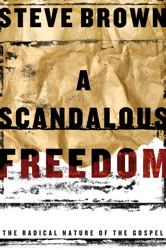
In his book A Scandalous Freedom, Steve Brown provocatively writes:
They lied to you about being a Christian. When you first “joined the club,” they promised you’d be set free. But let’s get honest, you’re not free. In fact, you’re religious, afraid, guilty, and bound. What’s worse, now that you’ve been in the club awhile, you’re stuck pretending you’re better than you are. And worse than that, you prefer the security and rules of your self-imposed boundaries. It’s time for a change. You need Scandalous Freedom.
There is no question in my mind that Steve Brown is correct.
So many Christians are imprisioned by their own consciences. What I think is startling about this is that most don’t even seem to be aware of their spiritual and emotional bondage. In fact, since most people they know are in the same condition, they assume this is the norm, and that THIS is the freedom for which Christ came to set us free! And even more perplexing is that, when faced with the radical nature of the gospel, many seem to prefer this state of existence to the freedom offered and secured by the gospel!
I see it all the time. I do it all the time.
But Steve Brown winsomely, humorously, and profoundly, calls it like it is. And he offers us a path to freedom. It is not a path Steve has blazed. He is one, of many, who has simply labored to uncover the path for us that Jesus laid out. Sadly much of what Jesus paved seems to have been covered over by the garbage of religious tradition and fundamentalism.
Listen Steve Brown’s related podcast series: Scandalous Freedom.
10 Gospel-centered Questions

Here are 10 questions to ask yourself – and maybe those few closest to you – that help uncover rivals of Christ as the functional savior of your heart:
- What are you desiring more than anything else?
- What do you find yourself day dreaming or fantasizing about?
- What lies are you subtly believing that undermine the truth of the gospel?
- Are you astonished with the gospel?
- In what ways have you recently made much of yourself and little of God?
- Is technology stealing attention from your family?
- Is work replacing your spouse’s place in your heart?
- Where do your thoughts drift to when you enter a social setting?
- What fears are paralyzing your heart from enjoying God?
- What consumes your thoughts when you have alone time?
Notice that many of these questions assumes some level of guilt. Others are simply good guages of our priorities. That’s what makes them good gospel-centered questions – questions that continually keep our hearts centered on the gospel.
Remember the gospel has two aspects – one positive, one negative. Paraprasing Jack Miller, the gospel reminds us:
- You are much greater sinner than you would ever dare admit, even to yourself.
- You are loved far more by God than you would ever dare dream.
Believing the gospel frees us to admit our flaws, and drives us to explore the love of God demonstrated in the Cross of Christ. So go ahead, ask yourself the above questions.
 GRACE & PEACE