The Old Man and the Flesh

by Robin Boisvert

What actually changes when one becomes a Christian?  Confusion about this is common, especially when we realize that we continue to struggle with sin and temptation even after conversion.  Paul tells us in Galatians that we have a war that goes on within us after conversion: “For the desires of the flesh are against the Spirit, and the desires of the Spirit are against the flesh, for these are opposed to each other, to keep you from doing the things you want to do. ” (Galatians 5.17)   In this short essay Robin Boisvert helps bring some clarity.  ~ WDG

***

Some of the terms which the apostle Paul uses in discussing the believer’s relationship to sin can cause confusion. I’m speaking of terms such as “old man,” “new man,” “body of sin,” “flesh,” and others. These can be difficult to understand. Add to this the variations which modern translators have given these words and the subject can appear daunting.

We know a profound change has occurred in the life of the believer through conversion, but just how has the believer changed?

For we know that our old self was crucified with him so that the body of sin might be done away with, that we should no longer be slaves to sin — because anyone who has died has been freed from sin. (Romans 6.6-7, emphasis added)

Let’s begin by trying to define our terms. “Old man” (as it is translated in the King James Version and American Standard Version) is equivalent to “old self”  (NIV, NASV).  This term refers to the unregenerate life we lived before we were converted. As John R.W. Stott has written, the old self “denotes not our old unregenerate nature [flesh], but our old unregenerate life. Not my lower self, but my former self. So what was crucified with Christ was not a part of me called my ‘old nature’, but the whole of me as I was before I was converted.”1  John Murray’s definition concurs:

“‘Old man’ is a designation of the person in his unity as dominated by the flesh and sin.”2

It’s important for us to see that the believer is not at the same time an “old self” and a “new self,” alternately dominated and directed by one or the other. We are indebted again to Murray’s insight:

The old man is the unregenerate man; the new man is the regenerate man created in Christ Jesus unto good works. It is no more feasible to call the believer a new man and an old man, than it is to call him a regenerate man and an unregenerate.  And neither is it warranted to speak of the believer as having in him the old man and the new man. 3

Thus, terms like “old man,” “old self,” “unregenerate life,” and “former self” are synonymous, all referring to the entity that was crucified with Christ.

Notice two significant grammatical features of the passage from Romans 6 cited above. First, the verb is used in the past tense: “our old self  crucified…” The crucifixion of the old self is a finished fact. Second, the verb is also passive in voice, meaning that the subject (our old self) is being acted upon. In other words, the crucifixion of the old self is not something we must do, but something that is done to us.

Another important concept in the biblical doctrine of sanctification has traditionally been designated by the word “flesh” (King James Version). The New International Version uses “sinful nature.” According to Stott, “flesh” refers to a “lower” nature, that part of our being inclined toward rebellion against God. This is that part of you that wants to pass on a juicy bit of gossip; that urges you to take a second look at the  immodest images on the television screen. “Whatever we may call this tendency [“indwelling sin,” 4 “remnants of corruption,”5 “vestiges of sin,”6 or “my sinful nature”7]  we must remember that even after we have been regenerated we still have such sinful impulses, and must still fight against them as long as we live.” 8

In Romans 6.6 Paul calls our sinful nature (i.e. flesh) the “body of sin.” He says our old self was crucified with Christ so that this “body of sin might be done away with…” To be “done away with” here means to be put out of action, rendered powerless. It does not mean to be annihilated, gone without a trace. But our sinful nature’s mastery over us has been broken.

Some, not understanding the distinction between the “old self” and the “sinful nature” have gotten Romans 6.6 confused with Galatians 5.24, which also speaks of crucifixion and the believer. Consider two translations of this verse:

  •  Those who belong to Christ Jesus have crucified the sinful nature with its passions and desires. (Galatians 5.24 NIV)
  •  And they that are Christ’s have crucified the flesh with the affections and lusts. (Galatians 5.24 KJV)

Though helpless to take anything but a passive stance in regard to the old self (Romans 6.6), we do have an active part to play, as the Galatians learned, in the subjugation of the flesh. Stott sums this up with characteristic clarity:

 First, we have been crucified with Christ; but then we not only have decisively crucified (i.e. repudiated) the flesh with its passions and desires, but we take up our cross daily  and follow Christ to crucifixion (Luke 9.23). The first is a legal death, a death to the penalty of sin; the second is a moral death, a death to the power of sin. The first belongs to the past, and is unique and unrepeatable: I died (in Christ) to sin once. The second belongs to the present, and is continuous and repeatable: I die (like Christ) to self daily. It is with the first of these two that Romans 6 is concerned. 9

And Galatians 5 is concerned with the second.

So the old self has been dealt with. In its place we have been given a new self: “Therefore, if anyone is in Christ, he is a new creation; the old has gone, the new has come!” (2 Corinthians 5.17). And while our sinful nature (the flesh, indwelling sin, etc.) is still very much with us, its dominion over us has ended.

Continue reading

The Un-Churched Next Door

It has been an encouraging trend.  After several months during which we observed a score of painful defections from our church, the past few months have seen a rebound.  We have been blessed to see a number of new folks join our fellowship. Among them are a handful of mature transplants, Christians new to our area, who bring with them a measure of much appreciated stability. But maybe even more exciting is the number of those who had been previously un-churched.  These folks add something refreshing.  They are a reminder of an important aspect of what we are about – or at least what we should be about as the church of Jesus Christ in our community.  I want us to be a church that sees growth primarily through conversion, and by assimilating the formerly un-churched and de-churched,  not growth by enticing the transient hoppers to come from whatever pews they are presently adorning.

I use the term “un-churched” intentionally.  I know it has been common in the past to refer to reaching the “lost” – something I agree is important.  I also realize that this shift to reach the “un-churched” has caused a bit of concern to some who fear that this is somehow a compromise of our evangelistic mandate. But this is no compromise.

Our forefathers in the Faith long asserted that “ordinarily there is no salvation apart from the church”.  The word “ordinarily” is important, because it admits that there are circumstances where men and women are legitimately regenerated and converted and yet, for whatever the reasons, are not a part of any visible expression of the Body of Christ.  But the word ordinarily also conveys that this situation ought to be highly unusual.  Implied in this expression is that whenever someone is not a part of a visible church, genuine Believer or not, there is reason to assume that they are not Christians. This is not judgment. It is simply a rational assumption based on evidence and what scripture declares to be the expected norm.

What I appreciate about this position is the simplicity.  Rather than attempting to discern which of the un-churched are Christians and which are among the “lost” – a task that is essentially near impossible, since I cannot see into each heart as God does –  instead assume all are in need of grace.  My role, and our role as the church, is simply to express the gospel to them through both Word & Deed, and encourage them to unite with some faithful congregation – hopefully many of them to ours.  In the region where we live (Appalachia), where most people make some profession of being a Christian, even if many have no idea of what that actually means, it certainly clarifies our mandate for outreach and evangelism.

But with the number of un-churched friends we are now making, I am reminded of an important detail: Not all the un-churched are the same, and thus they should not all be treated exactly the same.  In other words there are distinctions between the un-churched, categories or levels of their un-churchedness.

Thom Rainer, in his book The Unchurched Next Door, reveals the findings of research by the Rainer Group that is both important and helpful.  Rainer observes that there are five categories, or five degrees, of un-churched:

Continue reading

10 Signs of Approaching Meltdown

Perry Noble reveals and responds to a stunning statistic:

My counselor shared a statistic with me two years ago that floored me – 90% of the people entering ministry do not retire from ministry. They either quit or have some sort of moral/ethical failure that disqualifies them.

Jesus did not call us to this or wants this for our lives. Yet so many of us church leaders struggle in this area (usually inwardly because if we said out loud that we are dying inside, people might perceive us as weak).

While I am stunned by these stats, I am not surprised.  I’ve seen too many friends flee the frenzy of ministry.  And I myself have peeked over the edge on a few occasions, only to be pulled back onto solid ground  by good friends and gracious church members.  But I concur with Noble: This is not what Jesus wants for those in ministry – whether pastors or church leaders, or volunteers in other areas of the Church.

One reason we know this is not what Jesus wants is because Peter tells us as much:

Be shepherds of God’s flock that is under your care, watching over them — not because you must, but because you are willing, as God wants you to be…  ~ 1 Peter 5.2

But the interesting thing about this verse is that Peter tells us both that God wants leading the church to be enjoyable and that it is going to be emotionally taxing.   On the one hand, lead and shepherd because the joy set before us makes you want to do it.  On the other hand, by acknowledging that ministry will sometimes seem like a chore, a duty,  a mere responsibility, Peter implies that there will likely be times when something will rob the leader of the delight.

In his post Noble lists 10 Signs you are on the verge of a meltdown or burnout:

  1. You are beginning to despise people and your compassion for them is continually decreasing rather than increasing.
  2. You often think about doing something other than ministry and your biggest desire isn’t to honor God and reach people, but to simply find relief from the pressure that seems to be building daily inside you.
  3. You cannot remember the last time you simply had fun with family and friends, and joy is something you talk about but are not experiencing for yourself.
  4. You are disconnected at home and when you get there, you do not want to engage with your spouse or your children; you cannot enjoy being around them. You spend more time online than you do with your family and you find yourself wanting to sleep all of the time.
  5. You continually tell yourself and those you love that “this is just a really busy season and that you will slow down soon.” However, the truth is that you have been most likely “singing that same song” for years!
  6. You are continually becoming obsessed with what others say about you and one negative comment from someone who does not like you can put you in an incredibly deep valley and cause you to feel hopeless.
  7. You begin to make easy decisions rather than the right ones, because the right ones take too much work.
  8. There is no hope in you and you actually despair of life. You have thought of death and have even entertained suicidal thoughts.
  9. You are experiencing unexplained depression and/or anxiety. You are having panic attacks and can’t explain it.
  10. You are increasingly becoming withdrawn from family and friends.

While I cannot say that I have experienced all of the above symptoms, I am familiar with most. Apparently so is Noble.  He says he drafted this list from his own life. (See: Meltdown)

Continue reading

Reformation Essentials

On October 31, 1517 a young college professor, heavy of heart, wanted to discuss some of the things he was thinking.  Posting his thoughts on the front doors of the church in the center of town – the 16th Century version of Facebook or blogging – a flame ignited that  still burns today.  In fact, with the recent resurgence of the Reformed tradition that flame is burning bright.

On this 494th anniversary of Martin Luther’s simple act, I thought I would post a piece that reminds us of the essence of the movement that rocked the world.

***

by Michael Horton

In May, 1989, a conference jointly sponsored by the National Association of Evangelicals and Trinity Evangelical Divinity School was held at the Trinity campus in Illinois. Dubbed a consultation on Evangelical Affirmations, the meeting revealed more than it settled. In the published addresses (Zondervan, 1990), Carl F. H. Henry, the dean of American evangelicalism, sets the tone for book with his opening line: “The term ‘evangelical’ has taken on conflicting nuances in the twentieth century. Wittingly or unwittingly, evangelical constituencies no less than their critics have contributed to this confusion and misunderstanding.” He warned that “evangelical” was being understood, not according to Scriptural teaching and “the theological ‘ought,'” but according to the sociological and empirical “is.” In other words, Henry was disturbed that evangelicalism is increasingly being defined by its most recent trends rather than by its normative theological identity. Author after author (presumably, speaker after speaker) echoed the same fears that before long “evangelical” will be useless as any meaningful identification.

The term itself derives from the Greek word euangelion, translated “Gospel,” and it became a noun when the Protestant reformers began their work of bringing the “one holy, catholic and apostolic church” back to that message by which and for which it was created. People still used other labels, too, like “Lutheran,” “Reformed,” and later, “Puritans,” “Pietists,” and “Wesleyans.” Nevertheless, the belief was that the same Gospel that had united the “evangelicals” against Rome’s errors could also unite them against the creeping naturalism and secularism of the Enlightenment in the eighteenth century. The so-called “Evangelical Awakening” in Britain coincided with America’s own “Great Awakening,” as Wesley, Whitefield, Edwards, Tennant, and so many others centered their preaching on the atonement. Later, of course, Wesley’s zeal for Arminian emphases divided the work in Britain, but the Reformation emphases were clearly and unambiguously articulated in the Great Awakening.

Out of this heritage, those today who call themselves “evangelicals” (or who are in these churches, but might not know that they are in this tradition) are heirs also to the Second Great Awakening. Radically altering the “evangel” from a concern with the object of faith, the Second Great Awakening and the revivalism that emerged from it focused on the act and experience of faith, in dependence on the proper “excitements”, as Finney and others expressed it, to trigger the right response. In our estimation, this Second Great Awakening was the most important seismic shift in American religious history. Although the Reformation emphases of sin and grace continued to exercise some influence, they were being constantly revised to make the “Gospel” more acceptable to those who thought they could pull themselves up by their own bootstraps.

Only in the last decade of this century have many of the movement’s mainstream leaders considered the loss of an evangelical substance. No longer is the evangel the focus of the movement’s identity, but it is now known more by a sub-culture, a collection of political, moral and social causes, and an acute interest in rather exotic notions about the end-times. At a loss for words, one friend answered a man’s question, “Who are the evangelicals?” with the reply, “They’re people who like Billy Graham.”

It is at this point that those of us who are heirs to the Reformation–which bequeathed to evangelicalism a distinct theological identity that has been since lost–call attention once more to the solas (only or alone) that framed the entire sixteenth-century debate: “Only Scripture,” “Only Christ,” “Only Grace,” “Only Faith,” and “To God Alone Be Glory.”

Continue reading

Here I Stand

Today being Reformation Sunday, the day on the ecclesiastical calender commemorating the anniversary of Martin Luther posting his 95 Theses on the doors of the church at Wittenburg, which inadvertantly set into motion a radical transformation of both the church and Western Culture, I thought it might be appropriate to review the roots of what we celebrate.

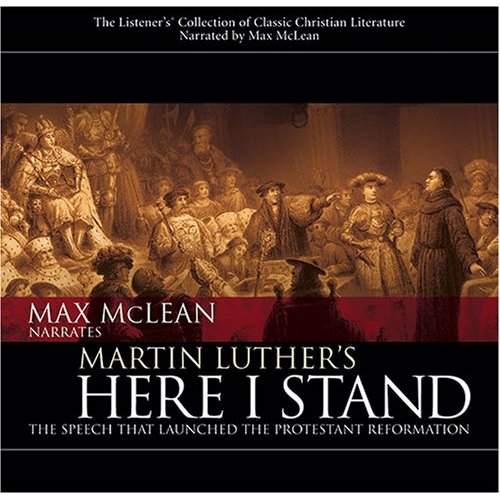
The standard for Luther biography is set by historian Roland Bainton in his seminal work, Here I Stand.  Taking his cue from Bainton’s work, acclaimed narrator Max McLean introduces the events leading up to the Diet of Worms:

  • Martin Luther’s prayer the night before he delivered his speech
  • Luther’s stirring defense
  • the Catholic church’s rebuttal
  • Luther’s final heartfelt response

The entire audio is available below:

Total run time is 24 minutes.

McLeans cd and mp3 can be purchased by clicking: Here I Stand

Gospel Centrality & Insanity

If you think about it, Paul makes a rather peculiar declaration when he asserts: “I am  not ashamed of the gospel…”.  (Romans 1.16)  Usually I don’t give these words much thought. But with a little reflection I find myself asking questions like:

  • Who suggested Paul was ashamed?
  • What Christians are ashamed of the gospel?
  • What does it look like for someone be ashamed of the gospel?

As one who is committed to gospel-centrality for both my ministry and my life, I want to be able to share Paul’s steadfastness.  And I do.  But I also understand the temptations to waver.  There are times I ask myself what I am doing? I wonder if we should add something more to the arsenal.  Is gospel fidelity enough?

What are we doing when we commit to gospel-centered preaching and teaching in the face of non-apparent results? Every chance we get we hold up Jesus Christ as preeminent and precious, we exult in his glorious excellencies, and we present the gospel boldly, clearly, and with unction. Still nary a crack in the surface of reception. It is like preaching, as they say, to a brick wall.

Should we switch things up? Try another tack? Testable non-results is one of the reasons so many churches tuck the gospel behind fog and lasers or adjust their teaching to the 7 Steps busywork of moralistic therapeutic deism. I mean, isn’t the definition of insanity doing the same thing over and over again and expecting different results?

Jared Wilson asks, wrestles with, and ultimately answers these vital questions in an excellent short post titled: Gospel Centrality and Insanity.

I appreciate Jared’s candor.  And I commend his thoughts to anyone who may sometimes struggle with temptations to look for something other than or in addtion to the gospel to procalim – to others, or to ourselves.  Let’s remind ourselves, and one another, that it is the Gospel that is the “power of God for salvation to everyone who believes…” (Romans 1.16)

4 Thoughts About True Spiritual Worship

John Piper has astutely asserted:

Missions is not the ultimate goal of the Church. Worship is. Missions exists because worship doesn’t. Worship is ultimate, not missions, because God is ultimate, not man. When this age is over, and the countless millions of the redeemed fall on their faces before the throne of God, missions will be no more. It is a temporary necessity. But worship abides forever.

So why do so few Christians seem to value or even understand worship?  I do not recall the actual statistics, but I remember hearing George Barna say that his polling showed only a small percentage of Christians actually worship even when they gather together on Sunday mornings (or whenever their fellowship assembles).  According to Barna, shockingly few say they have ever experienced the presence of God in the midst of a worship service.

So with such widespread tepidness where worship is concerned, I think these 4 sage thoughts from J.C. Ryle about True Spiritual Worship are worth some contemplation:

1) True spiritual worship affects a person’s heart and conscience.

True spiritual worship will make a person feel more of the sinfulness of sin, and their own unworthiness. This will lead to a deeper humility and inner life. It will strengthen a person spiritually, thus enabling them to grow in the Christian life; whereas false worship can only weaken a person spiritually.

2) True spiritual worship will draw a person into close communion with Jesus Christ.

True worship lifts a person above the need for material adjuncts to the King Himself. The more they worship the more they will be satisfied with Christ alone. In the time of need they will turn instinctively to Christ and not to some external helps.

3) True spiritual worship will extend spiritual knowledge.

True worship leads to a more full knowledge of self, God, heaven, duty, doctrine, practice and experience. A religion with these points is very much alive. On the other hand, false worship is dead, and although it involves much hard work, it never leads to any increase at all.

4) True spiritual worship leads to an increase in holiness.

True worship causes a person to be more watchful about their daily life and habits. They begin to use their time and abilities in a Christlike way, and their conscience guides them more decidedly.

► Summary: Such true worship will stand the test of Christ’s great principle, “By their fruits you shall know them”. It sanctifies the Christian’s life, and makes them walk with God, lifting them above fear and love of the world. It enables a Christian to show God to other people. Such worship comes from heaven, and has the mark of God upon it.

NOTE: Taken from Ryle’s book Worship: It’s Priority, Principles, and Practice


Sojourn Thru This World

“We are not citizens of this world trying to make our way to heaven; we are citizens of heaven trying to make our way through this world.”

That radical Christian insight can be life-changing. We are not to live so as to earn God’s love, inherit heaven, and purchase our salvation. All those are given to us as gifts; gifts bought by Jesus on the cross and handed over to us.

  • We are to live as God’s redeemed, as heirs of heaven, and as citizens of another land: the Kingdom of God.
  • We live a those who are on a journey home: a home we know will have the lights on and the door open and our Father waiting for us when we arrive.

That means in all adversity:

  • Our worship of God is joyful.
  • Our life is hopeful.
  • Our future is secure.

There is nothing we can lose on earth that can rob you of the treasures God has given and will give us.

~ Adapted from The Landisfarne

Appropriating the Justifying Work of Christ

Only a fraction of the present body of professing Christians are solidly appropriating the justifying work of Christ in their lives.

Many have so light an apprehension of God’s holiness and of the extent and guilt of their sin, that consciously they see little need for justification. Below the surface, however, they are deeply guilt-ridden and insecure. Many others have a theoretical commitment to this doctrine, but in their day-to-day existence they rely on their sanctification for justification….drawing their assurance of acceptance with God from their sincerity…their recent religious performance or the relative infrequency of their conscious, willful disobedience.

Few start each day with a thoroughgoing stand upon Luther’s platform: you are accepted, looking outward in faith and claiming the wholly alien righteousness of Christ as the only ground for acceptance, relaxing in that quality of trust which will produce increasing sanctification as faith is active in love and gratitude.

~ Richard Lovelace, Dynamics of Spiritual Life