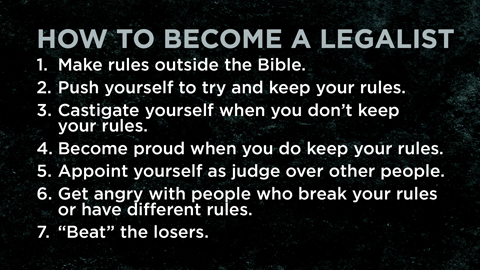
Source: The Resurgence
Source: The Resurgence

To reach people in our day, the gospel will have to be distinguished from moralism, because moralism is what most people outside the church think Christianity is all about – rules and standards and behavior and cleaning yourself up. Millions of people, both inside and outside the church, believe that the essential message of Christianity is: “If you behave, then you belong.” From a human standpoint, that’s why most people reject Christianity.

I am blessed to have some great friends. While I always enjoy making new friends, there is nothing like an old friend. Someone who has known you long, and known you well. These are the friends who can see right through the veneer we sometimes try to hide beneath. And because they can see through it they won’t let you hide. These are the ones who ask penetrating questions. I have to come clean because they will know if I am skirting the issue by giving some vague reply. These are the folks I go to for counsel. These are the folks I always listen to.
In a post not long ago, Perry Noble asked the question: Who Should You Listen To? He then proceeds to make a list of 8 qualifications.
If you are in leadership (and especially if you are in church leadership) then you have probably discovered the reality that God loves you…and everyone else has an incredible plan for your life!
One of the struggles that we all MUST wrestle with is who to listen to when it comes to making decisions. The Bible tells us that we unwise to be Lone Rangers (Proverbs 15:22) and the Bible has several stories of people who made bad decisions because they listened to the wrong people (see I Kings 12:1-16.)
However, it is IMPOSSIBLE to listen to everyone. With the barrage of information and opinions coming our way via Facebook, email, twitter and other media, anyone who tries to focus on the opinions of everyone will simply lose his mind, and most likely any leadership effectiveness, if his obsession becomes making everyone happy.
So, who do we listen to? Who is it that should ALWAYS have access to us…and we should ALWAYS desire their thoughts and insights? Here is Perry Noble’s list:
#1 – Those who know me, who have spent time with me and understand that there is a person behind the personality.
#2 – Those who have seen me at my best and worst…and love me anyway.
#3 – Those who do not automatically assume the worse about me and always give me the benefit of the doubt. (ALWAYS beware of the person who seeks to pounce on you as soon as they hear something bad!)
#4 – Those who are willing to stand with me in a tough time–THOSE WHO BLEED WITH ME CAN LEAD WITH ME!!!
#5 – Those who offer correction for the purpose of building up rather than tearing down (people who always seek to tear you down should be ignored! If they do not correct/confront in love then they are nothing more than a resounding gong or a clanging cymbal – see I Corinthians 13:1)
#6 – Those who are willing to take a confrontation straight to the person rather to an online audience.
#7 – Those who are not always looking for a reason to attack/hate you.
#8 – Those who have the goal of restoring you when you mess up and not wounding you!

Do you have any Chrstmas gatherings to attend this holiday season? My thanks to Don Whitney for suggesting the following questions to spruce up the conversation – perhaps especially at church:
- What’s the best thing that’s happened to you since last Christmas?
- What was your best Christmas ever? Why?
- What’s the most meaningful Christmas gift you’ve ever received?
- What was the most appreciated Christmas gift you’ve ever given?
- What was your favorite Christmas tradition as a child?
- What is your favorite Christmas tradition now?
- What do you do to try to keep Christ in Christmas?
- Why do you think people started celebrating the birth of Jesus?
- Do you think the birth of Jesus deserves such a nearly worldwide celebration?
- Why do you think Jesus came to earth?

The question still resounds in my mind; and resonates in my heart. An wise old pastor approached the table where I was lunching with my father-in-law and my pastor on the day I was to be examined for ordination. He sat easily in an open chair with a friendly grin and forewarned me that he was going to ask a couple questions of me later that day during my examination. Among the questions he was planning to ask was this: “Do you see yourself, as a pastor, more like a policeman or a physician?”
That is a stunningly simple question with profoundly different implications, depending upon how one answers.
The one who views himself as more the policeman is constantly on the lookout for violations of the law and/or of the peace. Once transgressions are witnessed – or sometimes even merely speculated – the policeman-pastor jumps into action, levying warnings and pressing charges. The motive is easily understood. God is holy and will not tolerate sin. God calls for his people to “be Holy even as God is Holy”. And someone has to keep order and direct traffic. And if not the pastor (and Elders) who else will do this necessary thankless task?
The one who views himself more like the physician, on the other hand, also keeps an eye out for evidence of violations. But rather than assuming any ability to sheriff the church (much less the world) the physician-pastor is motivated by compassion. The physician pastor knows sin abounds in all of us and that it is a condition that kills. he understands that this condition is so pervasive that even if he could squelch all or most of the active expressions of sin that it would still do only cosmetic good. People would look better, and the world would certainly seem a better place to live, but the condition that is rooted in the heart would still wreak it’s devastating effect upon humanity. He realizes that in many ways the cleaned up life may be more dangerous than the life left exposed. At least when there is evidence of sin people are concerned. But in an artificially sanitized society – or church – people assume all is clear; everything is OK. Few if any are willing to listen to the warning bells that informed physicians sound. The hope of the physician is that people aware of their condition, and it’s terminal nature, will seek out the remedy; the remedy he is commissioned to prescribe frequently and widely – the Gospel of Jesus Christ.
The physician-pastor understands that this prescription has multiple effects. And he reminds his patients that this remedy works from the inside out. The first effect is that when initially ingested by faith that the terminal threat is immediately voided. No longer will the effects of sin lead to death, physically or spiritually. One dose is all it takes. But he also realizes that the condition of sin, while no longer lethal, has already caused much damage to the individual – some known, much unseen. Left unchecked the lingering effects of sin will continue to cause tremendous damage to infected individuals, spiritually, emotionally, and relationally. So even while the initial dose effectively terminated the terminal effect of sin, everyone who has been exposed is prescribed to regularly take ongoing dosages to combat and reverse the effects of sin that remaining cancerous traces.
Wow! In this message Matt Chandler rants against the consumeristic climate catered to and cultivated by the contemporary Evangelical culture…
I wish I had said this!
OK, I have said this. I just wish I had said it as well as Matt does!

The gospel is neither conservative nor liberal; and at the same time the gospel is both liberal and conservative. This causes a lot of confusion to folks both inside and outside of the Church.
On the one hand, the gospel is conservative because it declares that there is such a thing as right and wrong, and that there are benefits from choosing right and consequences that accompany wrong. Each person is responsible for his or her own actions and attitudes. These are very conservative principles.
On the other hand, the gospel is the free gift that is given to those who have not earned it and cannot afford it. In fact, we are told the gospel is the riches of Christ redistributed to those who admit their spiritual poverty. Isaiah says it is like being invited to a party, but the only ones who can come are those who cannot pay, or who are humble enough to admit whatever riches they think they might have are not valid currency. (Isaiah 55.1-2) These seem to be very liberal ideas and images.
Both are true. Equally true. Both are essential. Leave out one side or the other and you create a “different gospel” – which, as Paul says, is really no gospel at all. In fact, Paul tells us that anyone trying to pass a counterfeit gospel should be ( and will be) anathema – repeatedly destroyed over and over for all eternity. (Galatians 1.6-9)
I would suggest, even insist, that both Conservatism and Liberalism are false worldviews and offer counterfeit gospels. The gospel is not a compromise of liberalism and conservatism, nor is it merely a middle way. The gospel is the expression of God’s very nature and plan. It is therefore, THE Truth, because God himself – and God alone – is Truth. And it is eternal Truth because God, who is Truth, is eternally God.
What both Conservatives and Liberals have done, at least those who operate as if these philosophies are the supreme ideologies, is to carve off portions of the Truth that meet their personal preferences at the expense of the valid point of the other. Both begin with as a reduction of the gospel Each then proceeds to build their respective worldview upon these faulty foundations of a corrupted gospel.
We begin to escape the confusion when we recognize our own propensity toward either Conservatism or Liberalism, at the expense of the other. We begin to overcome our limitations when we recognize the whole gospel alone is the Truth, and then commit to a lifelong pursuit of excavating the depths and complexities of the gospel, while at the same time venturing to live out all the implications of the gospel in every aspect of our lives.
Whether theologically or politically, conservatism and liberalism are impotent to effect real, enduring, or godly change. But the gospel, undiluted and undistorted, is the power of God. (1 Corinthians 1.20-25)

Here is a provocative post from Russell Moore concerning Men & Women and authority issues. The Conservative Southern Baptist Moore may surprise a few people with his opening paragraphs:
Those of us who hold to so-called “traditional gender roles” are often assumed to believe that women should submit to men. This isn’t true.
Indeed, a primary problem in our culture and in our churches isn’t that women aren’t submissive enough to men, but instead that they are far too submissive.
Moore may even shock a few folks when they read the title of this post: Women, STOP Submitting to Men.
I wholeheartedly agree with Moore’s perspective. So, let’s add this to the Egalitarian vs. Complementarian vs. He-Men Woman Haters Club debates!
To read the rest of Moore’s post, click: Women & Men

If you think about it, Fundamentalist and Liberal Christians have more on common with one another than either does with Gospel-centered Christianity. While Fundamentalists and Liberals would seem to be very different from the other, almost even polar opposites, I am convinced this is true. For both of those traditions tend to view the purpose of Christianity to be to make one a good person, or to validate a persons goodness. Fundamentalist assume what makes one a “good” person is to keep the rules. Liberal Christians, on the other hand, maintain that “good” people are never judgmental (except, perhaps, about judgmental people). So both are in essence legalists. At the center of their faith is the Law. The only thing to distinguishes them from one another is how they view and relate to the Law. Both are driven by personal performance.
Gospel-centered Christianity, on the other hand, in line with the message of the Prophets and Apostles, and even Jesus himself, is not centered on the law nor driven by personal performance. Gospel-centered Christianity is centered on the person of Jesus. Unlike the other two traditions, Gospel-centered Christianity agrees with Jesus’ words: There are no good people – not when the standard is God’s holiness. (Mark 10.18) Gospel-centered Christianity understands that Jesus, and what he has done on our behalf, is our only hope. And Gospel-centered Christians take comfort, even delight, in that, because Jesus is the only hope and comfort we need.

by Nancy Scott
When Sally first heard the gospel at age eleven, she understood immediately that God’s grace is what saves us. She already knew her heart was full of evil and that she had nothing to bring to God. It made perfect sense that God would have to do the saving, if any saving was to be done. The solution of Jesus’ death on the cross was perfect, and she understood that He had died in her place.
The Bible church where Sally began her pilgrimage strongly taught the concept of grace. She learned that grace meant “undeserved favor.” Grace was getting something you didn’t deserve, whereas mercy was NOT getting what you did deserve. The gospel addressed both of these areas of life in the provision of Jesus’ death on the cross. So she fully understood that she came to Christ because God was reaching deep into her soul to regenerate her and to bring her to an awareness of her need and of His provision for her salvation. She entered the path to the kingdom on her knees, got up, and took off running.
By the time Sally was seventeen, life was not as clear-cut as it had been at the tender age of eleven. She had understood what it meant to be saved by grace; now she began wondering what it meant to live there. She began to struggle with the difficult choices of life and a tension in her desires to do the right thing. When she went to her Bible teachers for advice, they told her that God had given her all the resources she needed to live a victorious Christian life, and she only needed to avail herself of the Spirit of God who now lived inside her. If she tapped into His power, He would grant her the ability–and the desire she lacked–to do the right thing. The Bible teachers asked Sally if she did her daily devotions, and they recommended some helpful Bible studies. These things, they said, would help unleash the Spirit’s power to work in her life.
Sally took off running again. She dove into her daily devotions with renewed vigor, and even though she wasn’t a morning person, she began to get up an hour earlier. Sally was so grateful that God had given her this extra measure of grace to be so dedicated to him at such a young age. Things seemed to improve for a while.
Then something slowly changed. The excitement began to wear off, and Sally suspected that her non-Christian friends were having more fun than she. She indulged with them every now and then, only to feel tremendously guilty and to make a renewed commitment to God with each failure. The longer this pattern went on, the more confused Sally became. Why wasn’t God unleashing His Spirit inside her for victory anymore, even when she carried out all her spiritual practices and dedication? Why was the evil around her becoming more attractive instead of less attractive? Was it normal for her to find herself rededicating her life to God so routinely? Was this what it meant to live by grace?

Let’s face it, it is one of the bummers of being in ministry – or for that matter, of being a part of a church. While death and taxes may be among life’s inevitables, sadly, if you are part of a church, so is periodically watching people go out the doors.
With the Wal-Martization of the American church the contemporary mindset seems to be: “What’s the big deal?” Which makes sense. I’d be a bit perturbed if I got attitude from the manager and/or employees of Wal-Mart simply because they learned I had recently been frequenting Target. So what if someone decides to “shop” at First Church of What’s Happenin’ Now instead of the congregation in which they had taken vows to “support the work and the worship to the best of their ability”?
I get it. I just don’t agree. The church is not supposed to be like a Wal-Mart. It is supposed to be a Covenant Family. But not all church members see it that way; not all churches either, for that matter. So there is not much those left behind can do about it. Despite the revolving doors local congregations just need to press on.
But what if an opportunity presented itself to say something to one of God’s wayward wanderers? What would you say? What should you say?
In a recent article for 9 Marks blog by Jonathan Leeman muses:
Let’s face it: there are better and worse reasons to leave a church. Are you moving to another city? That’s a good reason. Are you harboring bitterness toward someone who has offended you? That’s a bad reason. Does the church neglect to preach biblical sermons weekly? A good reason. Do you not like the church’s style? Probably a bad reason.
The question is, how should you respond to a fellow member who is leaving for what sounds like a bad reason?
I really appreciated Leeman’s, thoughtful, Biblcial, practical, suggestions. To read the rest of Leeman’s post, click: What to Say to Church Members Leave for Bad Reasons.

I will rise and seek my God,
And bowed down beneath my load,
Lay all my sins before Him;
Then He will wash my soul from sin,
And put a new heart me within,
And teach me to adore Him.
O ye that fain would find the joy –
The only one that wants alloy –
Which never is deceiving;
Come to the Well of Life with me
And drink, as it is proffered, free,
The gospel draught receiving.
I come to Christ because I know
The very worst are called to go;
And when in faith I find Him,
I’ll walk in Him, and lean on Him,
Because I cannot move a limb
Until He say: “Unbind him”.
A beautiful song of prayer based on the title from Valley of Vision. The music and arrangement are by Sovereign Grace Music.
 GRACE & PEACE