What We Celebrate At Christmas Is Why We Go to Church

As Christmas Day falls on a Sunday this year, church leaders across the country are making decisions about whether their respective congregation will hold services or forgo them. As one who holds a firm resolve about the prudency, even the appropriateness, of arbitrarily canceling services on any Sunday, no matter how noble-sounding the reasoning, I appreciate Grayson Gilbert’s thoughts on this matter, posted for Chorus In The Chaos:

Every set number of years, the church has an opportunity to gather with the saints on Christmas Day—and yet this often becomes a point of controversy for professing Christians. Some churches cancel services, while many others keep their doors open. I will admit at the onset of this that I believe those who shut their doors are not only doing a disservice to their congregants, but are in disobedience to the Scriptures.

The call to gather with the saints in the local assembly of believers is one that holds few exceptions to the rule. What has been traditionally held is that unless one is barred from attending church due to the providence of God or works of necessity, Christians should be among God’s people on the Lord’s Day (i.e., Sunday service). That time should be a designated time for all who profess faith in Christ simply because it is a time where the Spirit is uniquely present to work in and through His people as they serve one another, through the proclamation of the Word, the public reading of Scripture, corporate prayer, and congregational signing. In other words, unless we are providentially hindered or performing works of necessity, church attendance should be a non-negotiable to us. That is the general rule.

Continue reading

Dangers of Spiritual Resolutions

I’ve been there. Likely, so have you.  The year begins with good intentions, and maybe even a strong start, only to fizzle days later.  The Statistic Brain Research Institute reports that 75% of New Years Resolutions are broken within the first week of the New Year.  No doubt most of the others go down soon thereafter.

Among the more frequent vows is a renewed commitment to read the Bible:

  • Read the whole Bible in one year
  • Read the Bible daily, or just more often

This seems a noble resolve. And as a church pastor, it is certainly one I applaud.  In fact, I often share some Bible Reading plans for anyone who endeavors to take up this challenge.  (Like this one: Bible Reading Plan for Slackers & Shirkers)

But in the brief (3 minute) video above, Steve Childers, of Global Church Advancement, offers a caution about making such resolutions – even resolutions such as to pray more or to read the Bible.

It may seem odd that I am posting such caution about making spiritual resolutions, especially since I commended the Resolutions of Jonathan Edwards in a post just yesterday.  But without denying the potential benefit of reflecting upon Edwards’ Resolutions, nor even the positive effects of increased Bible reading and prayer during the coming year, I think Childers makes a good point.

Consider this:

The state of our heart is of utmost importance as we practice spiritual disciplines. It’s possible to read our Bibles, pray, attend Lord’s Day worship, and even take the Lord’s Supper for all types of reasons. But unless we do it for God’s glory, and our joy in him, it does us no ultimate good.

Or as Charles Spurgeon reasoned:

“It is not enough to do the correct thing; it must be done in a right spirit, and with a 
pure motive. A good action is not wholly good unless it be done for the glory of God, 
and because of the greatness and goodness of his holy name.”

In no way would I ever dissuade anyone from increasing their spiritual vitality through partaking in such means of grace as prayer and Bible study. Nor does Childers.  But Childers does wisely warn against resolutions that may result in merely going through religious motions – even if those motions come more frequently.  Instead Childers points us to the source of all grace, and encourages us to avail ourselves of all that is offered.

Take a moment to watch the video, and to consider what Childers says.  For those who prefer to read, a transcript of the message can be read on Childers’ blog: Pathway Learning

How to Preach the Gospel to Yourself

Preaching Gospel to Self

Paul, in Colossians 2.6, instructs us: “So then, just as you received Christ Jesus as Lord, continue to live your lives in him…”  Simple words, but powerfully practical when unpacked.

How did we “receive” Jesus?  By faith and repentance – or by repentance and faith.  We are not quite sure which comes first, but perhaps that does not matter.  It may be that the order is different with different people. What matters is that genuine conversion involves both of these elements: Repentance of our sin and of all our desire and attempts to save ourselves through our good behavior; Faith in the gospel – the good news – of what Jesus has done on our behalf, and what is offered to us in him.

If these are the two elements by which we received Jesus then, according to the Apostle’s instruction, these are the two elements that should be characteristic of our day-to-day life in Jesus.  The old Puritan Thomas Watson once wisely noted: “Faith and repentance are the two wings by which we fly toward heaven.”  In other words, faith and repentance are not only the instruments by which the journey of salvation is initiated, these are the practices by which we travel.  These are the ingredients of spiritual growth leading to maturity.

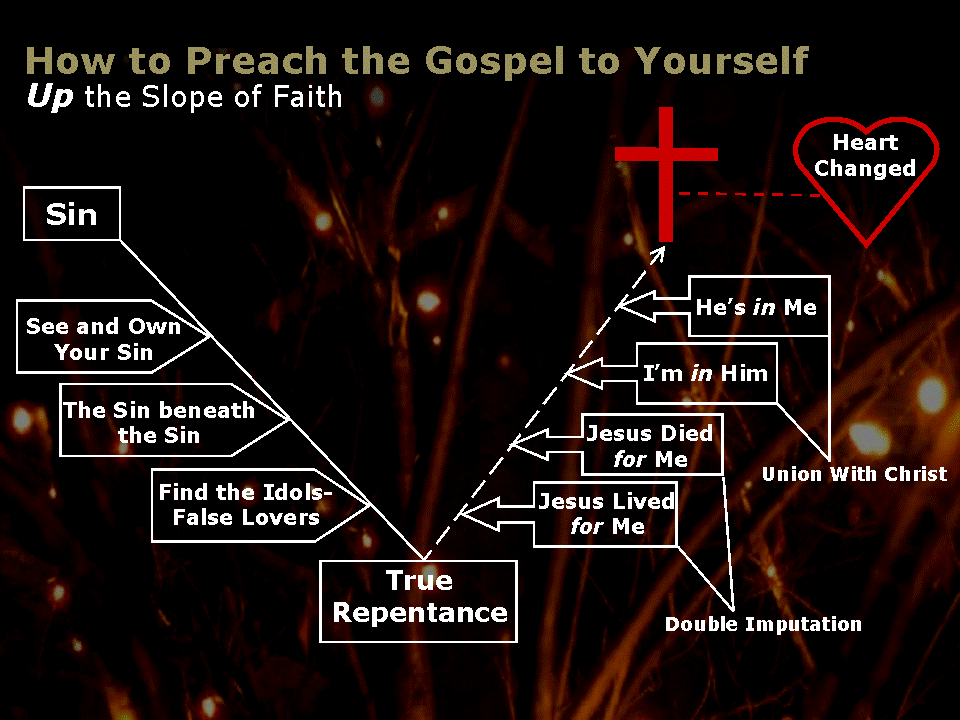
The chart above reflects both faith and repentance, and provides a tool to help us be able to “preach the gospel to ourselves”.

It reminds us that when recognize sin in our lives, our response should not be to simply resolve to “stop it”. We need to discern its source.  In other words, the sin we see, the sin which shows itself in our behavior (and in our attitudes), has deeper roots and causes.  So, like an explorer commissioned to trace the a great river to discover its tributaries and its origin, we are called upon to discover what “root sins” are tributaries of our behavior, and ultimately what idols are the original source.  Once discovered – or even while in the process of discovery – “putting sin to death” requires that we confess it and repent of it.  All of it – the sinful behaviors, the attitudes that lead to it, and the idols that source it.  Growth in grace is greater than mere moral reform.  Growth in grace is a work of the Spirit upon the heart which eventually and inevitably leads to a change in behavior.

Yet growth in grace does not come by confession and repentance alone.  Such may lead to behavior change, if we feel guilty enough and desire to change. But that is not growth in grace.  Growth in grace requires that we believe what grace gives; that we ponder what is true, and good, and beautiful: chiefly among such things is the gospel, the good news of what God promises – and does – when we trust  in Jesus.  (Philippians 4.8)   Reminded of the truths of the gospel, our hearts change; they turn toward God, causing us to hunger to grow more like him, and enabling us to rely more on his promise that what he began he will complete.  (Philippians 1.6)

This is the spiritual discipline of preaching the gospel to ourselves.

Resolutions for the New Year

calvin-hobbs-resolutions

Each year, during the first week of January, I have made it my habit to review a series of personal resolutions written long, long ago – the Resolutions of Jonathan Edwards.  While these are not necessarily my own resolutions, at least not the whole, they are worthy of reflection. In reading and re-reading this list by Edwards I find that areas of my own life are exposed, sometimes encouragingly, other times as areas in need of attention. And whether or not Edwards’ personal resolutions fit, in reading them I also find ideas of my own.

Please note that I have revamped the language somewhat to speak to contemporary ears.  I hope in doing this I have not dulled any of the original intent.

***

Aware that I am unable to do anything without God’s help, I do pray that, by his grace, he will enable me to keep these Resolutions, so far as they are in line with his will, and that they will honor Christ.

NOTE: Remember to read over these Resolutions once a week.

1. Resolved:  I will DO whatever I think will be most to God’s glory; and my own good, profit and pleasure, for as long as I live. I will do all these things without any consideration of the time they take.  Resolved: to do whatever I understand to be my duty and will provide the most good and benefit to mankind in general. Resolved to do this, whatever difficulties I encounter, and no matter how many I experience or how severe they may be.

2. Resolved: I will continually endeavor to find new ways to practice and promote the things from Resolution 1.

3. Resolved: If ever – really, whenever – I fail & fall and/or grow weary & dull; whenever I begin to neglect the keeping of any part of these Resolutions; I will repent of  everything I can remember that I have violated or neglected, …as soon as I come to my senses again.

4. Resolved: Never to do anything, whether physically or spiritually, except what glorifies God.  In fact, I resolve not only to this commitment, but I resolve not to to even grieve and gripe about these things, …if I can avoid it.

5. Resolved: Never lose one moment of time; but seize the time to use it in the most profitable way I possibly can.

6. Resolved: To live with all my might, …while I do live.

7. Resolved: Never to do anything which I would be afraid to do if it were the last hour of my life.

8. Resolved: To act, in all respects, both in speaking and doing, as if nobody had ever been as sinful as I am; and when I encounter sin in others, I will feel (at least in my own mind& heart) as if I had committed the same sins, or had the same weaknesses or failings as others.  I will use the knowledge of their failings to promote nothing but humility – even shame – in myself. I will use awareness of their sinfulness and weakness only as an occasion to confess my own sins and misery to God.

Continue reading

5 Reasons to Recover the Practice of Confession

My Confession

Is confession something that Evangelical Christians should practice regularly? or Is confession a practice rooted in the superstition of some by-gone tradition?

Joe Thorn gives a handful of good reasons why Confession should be part of the regular Christian practice:

1. Confession Acknowledges God’s Place and Authority In our Lives

By a sincere and hearty confession of sin we acknowledge God to be our Sovereign Lord, and that he has the right to impose his law upon us.  (Exodus 20)

2. Confession Agrees With God’s Judgment Against Sin

By confessing our sin, we subscribe to his righteous judgments that are pronounced against it.  (Psalm 51.3 – 4)

3. Confession Admits We Are Unworthy of God’s Grace

By the confessing of sin, we show how little we deserve the least mercy from God.

4. Confession Affirms Our Hatred of Sin 

By [confessing sin] we show whether our hearts love sin, or hate sin. He who heartily confesses his sin, is like him who having a thief or a traitor in his house, brings him out to condign punishment; but he that forbears to confess, is like him who hides a thief or traitor against the laws and peace of our Lord the King.

5. Confession Accepts God’s Grace as Our Only Hope

He that confesseth his sin, casts himself at the feet of God’s mercy, utterly condemns and casts away his own righteousness, and concludes there is no way to stand just and acquit before God, but by and through the righteousness of another; whether God is resolved to bring us, if ever he saves our souls.  (Psalm 51.1-3; 1 John 1.9; Philippians 3.6-8)

Click  to read the original and slightly expanded post: Confession

Sailboat Spirituality

Do you sometimes have difficulty understanding or remembering who does what in our Spiritual maturation? We get that it is God who must make us alive to believe (regeneration), and that he gives us the gift of faith to believe, which leads to salvation (justification).  But then what?  Surely there is something we must do.  What about spiritual disciplines? But then, how does grace work? What does the Holy Spirit do?

I love the imagery Jared Wilson offers in his excellent book Gospel-Wakefulness:

As long as we are thinking of achieving the fruit of the Spirit by our own efforts to be more fruitful and joyful, we may be working in their direction, but we’re getting there by the sweat of our brow.  We’ve embraced rowboat spirituality.   But think of the obedient work of the Christian life like a sailboat.  There are lots of things to do on a sailboat. Sailors don’t just sit there – at least, not for too long.  There are lots of working parts on a sailboat and lots of things to pay attention to. But none of those things make the boat go.  The boat doesn’t go unless the wind catches the sail.

What we are picturing here is the work of the Spiritual Disciplines in conformity with the law of God found in Scriptures, not as the means of propulsion, but as the means of setting the conditions for Spiritual fertility. In obedience, we till the soil of our hearts so that they are more receptive for the planting and growth of the Word in our lives.  We obey both in response to the Spirit’s awakening us and in order to raise the sail for the Spirit’s movement.

“If we live by the Spirit, let us also walk by the Spirit.” ~ Galatians 5.25

Sabbath Rest: The Above All Commandment

Like many people, I get easily wearied by many of the Sabbath debates. What can you do? What can’t you do?  While not unimportant, these questions miss the point.

Jesus told us:

“Sabbath was made for man, not man for the Sabbath.” (Mark 2.27)

In other words, Sabbath is a gift made or established by God for us. True, it is for God’s glory, and is therefore to be kept holy. (Exodus 20.8) But we must remember that our greatest good is wrapped up in God’s glory.  And as John Piper reminds us: “God is most glorified when we are most satisfied in him.”

God gave us the gift of the Sabbath as a means that we might be satisfied in him and thereby glorify him.

Sadly, the debate seems to revolve around polarized positions, with contemporary Pharisees on the one side and supposed free spirited antinomians on the other.  The Pharisee says: “Do”, or mostly “Don’t Do”.  The antinomian (which means “against Law”) holds to the notion that he can do as he pleases, and has no obligation.  The one squeezes the life out of the gift. The other, perhaps unwittingly, responds to God’s gift by saying: “No Thanks”.

In an article from Christianity Today magazine, Kevin Emmert winsomely makes a case for Sabbath observation.  Emmert rightly describes it as a spiritual discipline of resting.  And he acknowledges that this notion somehow seems antithetical to both our spiritual growth and God’s glory:

It is difficult, and ironic, to imagine rest as the most transformative element in the Christian life. For evangelicals especially, transformation and sanctification are closely linked to activity. We appropriately begin with the idea that our works do not merit justification (being declared righteous by God). We can do nothing to earn our salvation. But most of us imagine we must play an active role in our sanctification, the ongoing process of becoming more like Christ. Sanctification, we assume, involves work and effort on our part.

This is good news to evangelical ears. We like activities. We conduct Bible studies, participate in small groups, and attend prayer meetings. We engage in worship services and outreach. We like inspirational books that teach us how to become better Christians. We have a sense of duty that compels us to evangelize and demonstrate Christ’s love to those around us. Indeed, these activities are good and find their foundation in biblical teachings.

And this is precisely why we find it so difficult to imagine rest as the most transformative feature of the Christian life.

Yet Emmert convincingly contends that this discipline, perhaps more than any other, and certainly no less than any other, provides the greatest spiritual benefits:

Why is the Sabbath so important? After all, it’s a command to do nothing; it requires no activity or effort. And that may be precisely the point.

This “above all” command encourages us to trust in God in a way that no other activity can. So much more could be accomplished by adding another day of labor, but the Sabbath requires us to trust that God will provide for all our needs and that he will continue to manage the world without our help. The Sabbath is a practical reminder that we are completely dependent on God.

It is when we realize our complete dependence upon God that we experience how great a thing it is to have the right to call him “Father”.

Check out Emmert’s short article: The Above All Commandment

Revised Resolutions of Jonathan Edwards

As a young man – a teenager, really – Jonathan Edwards set down on paper a series of thoughts and practices to help cultivate growth in grace.  (See 2 Peter 3.18)  Edwards then re-read this list at least once a week to keep his mind focused and renewed.  The result: A man of humble godliness, who was to become a significant spark used to ignite one of the greatest revivals known to history.  Even many unbelieving scholars admit Edwards may have been the greatest mind to have been born on the North American continent.

The Resolutions of Jonathan Edwards are still a practical and beneficial tool for spiritual cultivation.  But one problem for many is that the early 18th Century language makes it sometimes difficult to grasp what Edwards wrote.   I have taken it upon myself to attempt to translate Edwards’ meaning in hopes that these resolutions might be used by some who might otherwise feel discouraged by the archaic words.  And while I admit that there are a few of these resolutions that I cannot embrace, I will leave it to each individual to pick out anything that might seem worthy for adoption among his/her own personal resolutions.

***

Aware that I am unable to do anything without God’s help, I do pray that, by his grace, he will enable me to keep these Resolutions, so far as they are in line with his will, and that they will honor Christ.

NOTE: Remember to read over these Resolutions once a week.

1. Resolved:  I will DO whatever I think will be most to God’s glory; and my own good, profit and pleasure, for as long as I live. I will do all these things without any consideration of the time they take.  Resolved: to do whatever I understand to be my duty and will provide the most good and benefit to mankind in general. Resolved to do this, whatever difficulties I encounter, and no matter how many I experience or how severe they may be.

2. Resolved: I will continually endeavor to find new ways to practice and promote the things from Resolution 1.

3. Resolved: If ever – really, whenever – I fail & fall and/or grow weary & dull; whenever I begin to neglect the keeping of any part of these Resolutions; I will repent of  everything I can remember that I have violated or neglected, …as soon as I come to my senses again.

4. Resolved: Never to do anything, whether physically or spiritually, except what glorifies God.  In fact, I resolve not only to this commitment, but I resolve not to to even grieve and gripe about these things, …if I can avoid it.

5. Resolved: Never lose one moment of time; but seize the time to use it in the most profitable way I possibly can.

6. Resolved: To live with all my might, …while I do live.

7. Resolved: Never to do anything which I would be afraid to do if it were the last hour of my life.

8. Resolved: To act, in all respects, both in speaking and doing, as if nobody had ever been as sinful as I am; and when I encounter sin in others, I will feel (at least in my own mind& heart) as if I had committed the same sins, or had the same weaknesses or failings as others.  I will use the knowledge of their failings to promote nothing but humility – even shame – in myself. I will use awareness of their sinfulness and weakness only as an occasion to confess my own sins and misery to God.

9. Resolved: To think much, on all occasions, about my own dying, and of the common things which are involved with and surround death.

10. Resolved: When I feel pain, to think of the pains of martyrdom – both of Jesus and of Believers around the world;  and remind myself of the reality of hell.

11. Resolved:  When I think of any theological question to be resolved, I will immediately do whatever I can to solve it, … if circumstances don’t hinder.

12. Resolved: If I find myself taking delight in any gratification of pride or vanity, or on any other such empty virtue, I will immediately discard this gratification.

13. Resolved: To be endeavoring to discover worthy objects of charity and liberality.

14. Resolved: Never to do anything out of revenge.

15. Resolved: Never to suffer the least emotions of anger about irrational beings.

16. Resolved: Never to speak evil of anyone, except if it is necessary for some real good.

17. Resolved: I will live in such a way as I will wish I had done when I come to die.

18. Resolved: To live, at all times, in those ways I think are best in me during my most spiritual moments and seasons – those times when I have clearest understanding of the gospel and awareness of the World that is to come.

Continue reading

How to – or NOT to – Read Your Bible

How should we read our Bibles? There are a number of good ways.  But Dane Ortland offers some suggestions about how not to approach it:

  • The Gold Mine Approach – reading the Bible as a vast, cavernous, dark mine, in which one occasionally stumbles upon a nugget of inspiration. Result: confused reading.
  • The Hero Approach – reading the Bible as a moral hall of fame that gives us one example after another of heroic spiritual giants to emulate. Result: despairing reading.
  • The Rules Approach – reading the Bible on the lookout for commands to obey to subtly reinforce a sense of personal superiority. Result: Pharisaical reading.
  • The Artifact Approach – reading the Bible as an ancient document about events in the Middle East a few thousand years ago that are irrelevant to my life today. Result: bored reading.
  • The Guidebook Approach – reading the Bible as a roadmap to tell me where to work, whom to marry, and what shampoo to use. Result: anxious reading.
  • The Doctrine Approach – reading the Bible as a theological repository to plunder for ammunition for my next theology debate at Starbucks. Result: cold reading.

This post is excerpted from Ortland’s post on The Resurgence blog: Transform Your Bible Reading.  The expanded article offers some valuable insights.

Organic Church

You will observe that I am not merely exhorting you “to go to church.” “Going to church” is in any case good. But what I am exhorting you to do is go to your own church – to give your presence and active religious participation to every stated meeting for worship of the institution as an institution. Thus you will do your part to give to the institution an organic religious life, and you will draw out from the organic religious life of the institution a support and inspiration for your own personal religious life which you can get nowhere else, and which you can cannot afford to miss – if, that is, you have a care to your religious quickening and growth. To be an active member of a living religious body is the condition of healthy religious functioning.

B.B. Warfield

Bible Reading Plans for 2011

New Years Day has come and gone, and 2011 is trudging along.  You want to do some things different this year.  You’ve always wanted to read through the Bible, but you’ve never been quite sure how to do it.  Or, you have read through the Bible before but you are looking for a different approach.

If one of your Resolutions for 2011 is to make Bible reading a regular part of your daily disciplines, you are in luck (err, you are in Providence)!  It is not too late to get started. (It’s never too late.) There are several plans available from the publishers of the ESV.

Click: Bible Reading Plans