Dangers of Spiritual Resolutions

I’ve been there. Likely, so have you.  The year begins with good intentions, and maybe even a strong start, only to fizzle days later.  The Statistic Brain Research Institute reports that 75% of New Years Resolutions are broken within the first week of the New Year.  No doubt most of the others go down soon thereafter.

Among the more frequent vows is a renewed commitment to read the Bible:

  • Read the whole Bible in one year
  • Read the Bible daily, or just more often

This seems a noble resolve. And as a church pastor, it is certainly one I applaud.  In fact, I often share some Bible Reading plans for anyone who endeavors to take up this challenge.  (Like this one: Bible Reading Plan for Slackers & Shirkers)

But in the brief (3 minute) video above, Steve Childers, of Global Church Advancement, offers a caution about making such resolutions – even resolutions such as to pray more or to read the Bible.

It may seem odd that I am posting such caution about making spiritual resolutions, especially since I commended the Resolutions of Jonathan Edwards in a post just yesterday.  But without denying the potential benefit of reflecting upon Edwards’ Resolutions, nor even the positive effects of increased Bible reading and prayer during the coming year, I think Childers makes a good point.

Consider this:

The state of our heart is of utmost importance as we practice spiritual disciplines. It’s possible to read our Bibles, pray, attend Lord’s Day worship, and even take the Lord’s Supper for all types of reasons. But unless we do it for God’s glory, and our joy in him, it does us no ultimate good.

Or as Charles Spurgeon reasoned:

“It is not enough to do the correct thing; it must be done in a right spirit, and with a 
pure motive. A good action is not wholly good unless it be done for the glory of God, 
and because of the greatness and goodness of his holy name.”

In no way would I ever dissuade anyone from increasing their spiritual vitality through partaking in such means of grace as prayer and Bible study. Nor does Childers.  But Childers does wisely warn against resolutions that may result in merely going through religious motions – even if those motions come more frequently.  Instead Childers points us to the source of all grace, and encourages us to avail ourselves of all that is offered.

Take a moment to watch the video, and to consider what Childers says.  For those who prefer to read, a transcript of the message can be read on Childers’ blog: Pathway Learning

Desiring Truth

An Evening Walk (Besnard)

by Wesley Hurd

At the end of one of his films, Deconstructing Harry, writer/actor Woody Allen delivers a movie-ending confession that offers a perverted coherence to the film:

“All people know the truth. Our lives consist of how we choose to distort it.”

For believers, though, desiring truth – undistorted – is central to the process and experience of our salvation. Nothing is more fundamental in our striving for sanctification – our striving to be good as God is good – than our embracing the truth at every level at which it confronts us.

One of the most common names for the presence of God in our lives is the Spirit of Truth. He is the author and source of all that is valuable, good, pure, and true. It follows, then, that believers in the true Gospel – a work the Spirit of Truth authors in our hearts – will seek what is true. Our commitment to living according to what is true is a “litmus test” for whether we are authentically interested in knowing God and learning to love what He loves – truth, justice, and mercy. Are we interested in knowing God? Then, in the end, we will be open to following the truth wherever it leads us. This will be a lifelong process for us, however, because, like our distant ancestors Adam and Eve, we are more inclined to hide from truth than to seek it or to embrace its consequences. Our fallen, darkened hearts do not naturally respond well to truth, especially when it surprises and inconveniences us, when believing and acting upon the truth costs us something.

In his gospel narrative (John 18.28ff), the Apostle John portrays a powerful scene in which Jesus and his captor, Pontius Pilate, engage in a profound exchange over this issue of truth. Their conversation shows two levels at which truth confronts all humans. Both levels can potentially reflect a person’s moral disposition, but the second level proves to be spiritually crucial. Let me explain.

The first level of discovering truth involves whether or not a person believes truth exists at all in a practical and philosophical sense. Is there truth? If so, how do I know it? How can I be confident in what appears to me to be true? In the John passage, Pilate interrogates Jesus and his accusers, attempting to ascertain the true circumstances that led to Jesus’ arrest. At this level of truth seeking, Pilate assumes the truth can be known and assessed. His inquiry proves he believes truth is objectively available and can be sought and found. Having received adequate firsthand testimony, Pilate determines that Jesus is innocent of the allegations against him. The truth made itself plain to Pilate. Pilate then attempts political maneuvers to free Jesus, but he fails when Jesus’ accusers threaten anarchy that would put Pilate himself in political jeopardy.

Yet Jesus intrigues Pilate, who engages Jesus further, asking Him questions that lead Jesus to claim, “For this I have been born…to bear witness to the truth. Every one who is of the truth hears My voice.” Now the second level of our relationship to truth appears. Once we believe we know what is true, are we willing to embrace it and to act accordingly? Pilate was not willing. His reply to Jesus, “What is truth?”, enables Pilate to keep the conversation at the philosophical level rather than going to the second level of personal, existential response.

Jesus identified himself with the vital truths about a person’s relationship to God and eternal destiny. Jesus spoke the truth about God — who He is, what His will is, and how human creatures can align themselves with those truths. Jesus was concerned not only about the factual truthfulness of what one believes (truth at level one), but also about the deeply personal moral posture of one’s heart toward factual truthfulness. Does one’s heart lean toward or away from letting the truth have its way in one’s thought, choices, and behavior? For example, I can know and agree with the theological truthfulness of man’s sin and fallenness, while simultaneously refusing to allow its factual truthfulness to penetrate my personal conscience and thereby own the truth of my guilt and need for repentance.

Continue reading

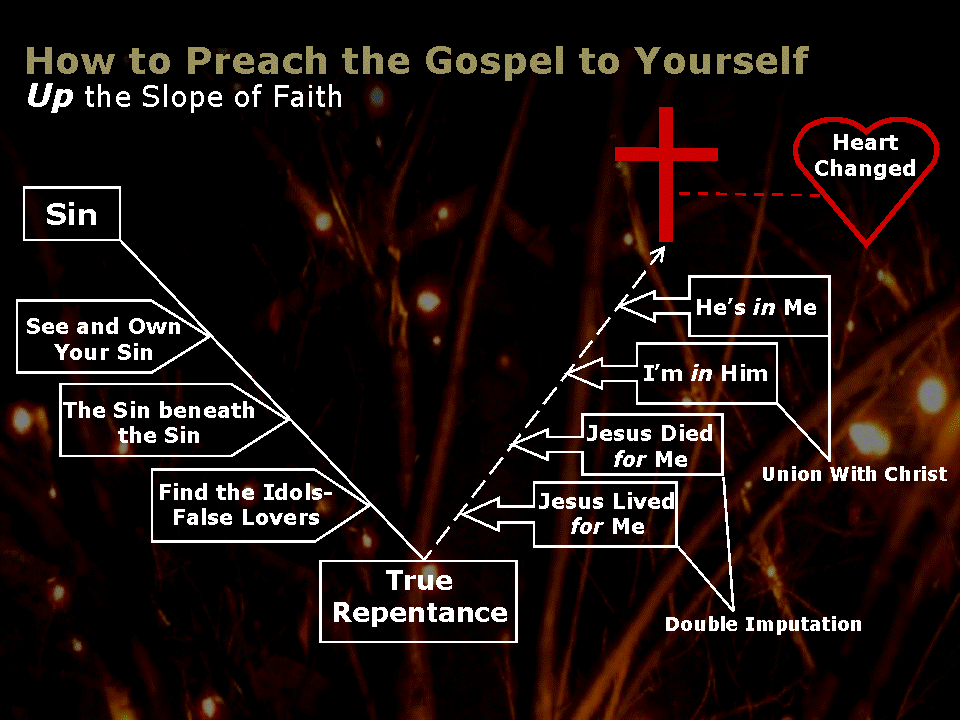
How to Preach the Gospel to Yourself

Preaching Gospel to Self

Paul, in Colossians 2.6, instructs us: “So then, just as you received Christ Jesus as Lord, continue to live your lives in him…”  Simple words, but powerfully practical when unpacked.

How did we “receive” Jesus?  By faith and repentance – or by repentance and faith.  We are not quite sure which comes first, but perhaps that does not matter.  It may be that the order is different with different people. What matters is that genuine conversion involves both of these elements: Repentance of our sin and of all our desire and attempts to save ourselves through our good behavior; Faith in the gospel – the good news – of what Jesus has done on our behalf, and what is offered to us in him.

If these are the two elements by which we received Jesus then, according to the Apostle’s instruction, these are the two elements that should be characteristic of our day-to-day life in Jesus.  The old Puritan Thomas Watson once wisely noted: “Faith and repentance are the two wings by which we fly toward heaven.”  In other words, faith and repentance are not only the instruments by which the journey of salvation is initiated, these are the practices by which we travel.  These are the ingredients of spiritual growth leading to maturity.

The chart above reflects both faith and repentance, and provides a tool to help us be able to “preach the gospel to ourselves”.

It reminds us that when recognize sin in our lives, our response should not be to simply resolve to “stop it”. We need to discern its source.  In other words, the sin we see, the sin which shows itself in our behavior (and in our attitudes), has deeper roots and causes.  So, like an explorer commissioned to trace the a great river to discover its tributaries and its origin, we are called upon to discover what “root sins” are tributaries of our behavior, and ultimately what idols are the original source.  Once discovered – or even while in the process of discovery – “putting sin to death” requires that we confess it and repent of it.  All of it – the sinful behaviors, the attitudes that lead to it, and the idols that source it.  Growth in grace is greater than mere moral reform.  Growth in grace is a work of the Spirit upon the heart which eventually and inevitably leads to a change in behavior.

Yet growth in grace does not come by confession and repentance alone.  Such may lead to behavior change, if we feel guilty enough and desire to change. But that is not growth in grace.  Growth in grace requires that we believe what grace gives; that we ponder what is true, and good, and beautiful: chiefly among such things is the gospel, the good news of what God promises – and does – when we trust  in Jesus.  (Philippians 4.8)   Reminded of the truths of the gospel, our hearts change; they turn toward God, causing us to hunger to grow more like him, and enabling us to rely more on his promise that what he began he will complete.  (Philippians 1.6)

This is the spiritual discipline of preaching the gospel to ourselves.

5 Obedience Killing Lies

Colorful Confusion

No doubt in my mind, it is one of the more difficult aspects of living in line with the gospel. Is it about grace, or is it about obedience?  If I say “both” – which I do – then how does this not add a requirement of works to the gospel requirement of faith alone for our justification/salvation?  If I say obedience is not necessary to our salvation – which I also say – then are we not very close to the precipice of anti-nomianism (lawlessness)?  No wonder people scratch their heads, and then revert back to patterns learned or to personal instinct – both of which are often wrong.

To avoid confusion, I answered “Yes” to both grace and obedience for a reason.  Let me clarify.

I must say that our obedience is not necessary to our salvation, because we are incapable of perfect obedience – and perfect obedience is what the Law demands.  To add any measure of obedience to our justification would be to minimize the law and deny the gospel at the same time.  Christ became like us, and lived in perfect obedience to his Father, and then died in our place, because we are not and cannot be perfectly obedient.  And it we are not perfectly obedient, we are not obedient.  But by faith, we are counted as righteous – credited with Jesus’ righteousness as if it were our very own.  But part of what we must believe, as part of that faith is that we are disobedient.  In a real sense the admission of being disobedient is requisite to be saved. How then could we say that obedience is required for salvation?

On the other hand, God does demand obedience – and he is worthy of our total obedience.  But two things occur here, in some ways simultaneously.  First, the demand for what we do not and cannot do highlights our brokenness and our dependence upon grace – the grace of a savior.  The demand, coupled with our lack of obedience, drives us to either despair or to the cross. Those driven to the cross find, not condemnation, but forgiveness and love, through unmerited grace extended to us by God, because of Jesus.  This breaking, because we become aware of our disobedience, is a necessary step toward healing and wholeness.  But second, God’s demands are not a mere bait and switch. When he commands obedience, he means it.  Inability it no excuse.  He commands because obedience not only pleases him, we find that his ways are the ways the work, that lead us to the greatest joy.  In short, we find in both obedience and our failures to obey that God’s commands are really a tremendous gift of his love.

While I hope the reader will see the dichotomy – the two distinct tracks – I also hope all will be able to see how these two tracks work together.  Obedience cannot be required for salvation, because it denies both our reality and the necessity of the gospel.  But in walking with God, obedience is expected – though we fail, and are reminded of our continual need of grace – but it is expected, demanded, because through obedience we are able to bring joy to both God and ourselves.  Failure, or disobedience as a Christian does not cause the forfeiture of our salvation; but as Job discovered, we can forfeit the grace of joy that would otherwise be ours – and rob God of the joy that we would give to him.  But if that drives us back to the cross, we find grace anew, and we are renewed in faith, strength, to experience the joy that comes through gospel-prompted obedience.

Because this can be such a dizzying subject, I was appreciative when I recently read a short piece by Brad Watson, titled 5 Obedience Killing Lies.  Watson rightly notes:

Our ability to quit and become sidetracked is great.

I believe we get sidetracked by the confusion of the place of obedience, as well as by many other things that creep into our consciousness that hinder our pursuit of obedience.  Watson focuses on the more practical issues, rather than the confusion of the relationship of Law vs. Grace.  As he says in his article:

Our hearts are constantly being attacked by lies that keep us from persevering in faith. These five lies are particularly successful. They are deceptive and effective in killing our conviction to follow Jesus and trust in his work.

Continue reading

Gospel Wakefulness

One of the more helpful works I have read concerning gospel-centered Christianity is Jared Wilson‘s Gospel Wakefulness.  Perhaps most insightful to me was Jared’s point that gospel-centeredness can be explained but cannot be taught.  In other words, it requires a grace of the holy spirit.  I do not think this realization moves gospel-centeredness into a neo-gnostic or higher life kind of category.  It simply is the realization that it is God who must work in us in our sanctification.  Thus the phrase Jared Wilson uses is Gospel Wakefulness.

In this video, Jared Wilson explain what Gospel-Wakefulness is.   This is not a short video, by any measure.  But it is worth taking the time – whether in one sitting, or in a series of starts-and-stops.

Counterfeit Gospels

Having begun a new series of messages at our church, Freedom: A Study of Galatians, I am struck anew by the passion with which the Apostle Paul uncompromisingly declares: “There is NO OTHER Gospel!”  What Paul does throughout his letter to the Galatians, and vividly in the opening verses, is to impress that claim upon his readers as he points out and combats the counterfeit gospels – philosophies which purport themselves to be good news, but which are in reality fraudulent teachings dressed in Christianese garb.  Paul’s response to these philosophies is to declare: “Even if we (Apostles, including he himself), or an angel from heaven comes and teaches you something other than the gospel you originally received, let them be eternally cursed!.” The essence of what he says is: “Anyone who tries to teach a fraudulent gospel can just go to hell!”  He is obviously serious about this to offer such a severe retort.

Counterfeit gospels are not just something from the Apostolic age.  They are all too prevalent today – and not only in heterodox churches.  They are present in the best of churches, and in the hearts of some of the most sincere followers of Christ. I suspect it is in our spiritual DNA, part of our broken nature. Are hearts are deceitful. (Jeremiah 17.9)  We are susceptible to gospel distortions – which Paul reminds us “are no gospel at all”.

Some time ago I picked up and read a book by Trevin Wax, Counterfiet Gospels.  I found it to be among the most helpful books I have read.Counterfeit Gospels

In one sense, nothing in the book was new for me.  Still, Trevin does an excellent job of explaining the gospel in it’s various aspects:

  • Gospel Story: Creation, Fall, Redemption, Restoration
  • Gospel Announcement: Life, Death, Resurrection, and Exaltation of Jesus
  • Gospel Community: The Church

Just as important, he takes some commonly held notions and connects them to the different dimensions of the gospel. Included among the categories he connects with and compares to the gospel:

  • Activist Gospel
  • Moralistic Gospel
  • Pietistic or Quietistic Gospel
  • Therapeutic Gospel
  • Judgmentlessness Gospel
  • Churchless Gospel

In exploring these ideas, he shows that while at root they are in may respects good, yet how when misunderstood or misapplied they are contributing to an erosion of  the Faith.

What I don’t think I had ever before adequately considered was the connection of the categories Trevin identifies with the gospel. And what I think I appreciated most is that he identifies and examines not only the negatives of these  ideas, but he also explains their positives points as well.  He astutely points out that it is the very real positive aspects that make these points popular and palatable, and yet which also make them easily confused and dangerous.

In the short video above Trevin Wax provides a quick overview of his book, and briefly explains the categories he identifies.  So even if you find my description of his book a little fuzzy or confusing, take a moment to watch the video so Trevin can clarify what I am trying to convey.

11 Personal Heart Examination Points to Consider

EKG

It might be beneficial to periodically take some moments to consider if, to some degree, we are functionally forgetting the gospel.

“Forgetting the gospel?”

Yep.  As absurd as such a thing may sound, it is a very common spiritual issue for all of us.

Consider 2 Peter 1.3-9:

His divine power has granted to us all things that pertain to life and godliness, through the knowledge of him who called us to his own glory and excellence, by which he has granted to us his precious and very great promises, so that through them you may become partakers of the divine nature, having escaped from the corruption that is in the world because of sinful desire. For this very reason, make every effort to supplement your faith with virtue, and virtue with knowledge, and knowledge with self-control, and self-control with steadfastness, and steadfastness with godliness, and godliness with brotherly affection, and brotherly affection with love. For if these qualities are yours and are increasing, they keep you from being ineffective or unfruitful in the knowledge of our Lord Jesus Christ. For whoever lacks these qualities is so nearsighted that he is blind, having forgotten that he was cleansed from his former sins.

What Peter is saying here, after reminding us of some of the implications of the gospel (v. 3-4), that we should be diligent about cultivating godly characteristics (v. 5-7) because this cultivation process is part of God’s means of producing spritual fruit in us (v. 8).  Conversely, the absence of, or lack of, godly characteristic and/or spiritual fruit is not primarily from a lack of diligence, but due to a mental disconnect from the gospel (v. 9).  Peter is not at all suggesting that we have lost our slavation. He is simply explaining that when we turn our attention from the gospel – that we have been “cleansed from our former sins” – the transforming power of the gospel is somewhat diminished in its potency.  This forgetting the gospel is the cause of fruitlessness and lack of spiritual growth.

So it is a good idea to consider things like the following descriptions. If some of these apply, it may be an indication that at this point in time we are functionally forgetting the gospel.

  • The gospel doesn’t interest you – or it maybe it does, but just not as much as some other religious subjects.
  • You take nearly everything personally.
  • You frequently worry about what other people think.
  • You treat inconveniences like minor tragedies (or maybe even major tragedies).
  • You are impatient with people.
  • In general, you have trouble seeing the fruit of the Spirit in your life.  (Galatians 5.22-23)
  • The Word of God holds little interest.
  • You have great difficulty forgiving.
  • You are told frequently by your spouse, a close friend, or some other family members that you are too “clingy” or too controlling.
  • You think someone besides yourself is the worst sinner you know.  (1 Timothy 1.15)

If we find some of these description appy, it is not reason to despair. The remedy is simply to remind ourselves of the gospel – ponder it; preach it to ourselves. (Gospel Primer by Milton Vincent is a good resource to remind us of the gospel.)

Remember: We renew ourselves in the gospel by reminding ourselves of the gospel.

7 Signs of Living to Please God

Soul Strength

Am I now trying to win the approval of men, or of God?”    ~ Galatians 1:10

At this time of the year many of us see an opportunity for a new start. Whether you are one who makes New Years Resolutions or not, there seems to be a sense of “Do Over” that comes almost as soon as that ball drops in Times Square, and as the pigskin begins to make way for the roundball and puck.

The question cited at the top of this post was posed by the Apostle Paul. His question raises another, more fundamental question: Who are we supposed to live to please? I hope that question will be given consideration in this new year (and every year).

It would not be appropriate to suppose Paul is suggest that receiving affirmation from the people around us is a bad thing. On many occasions Paul expresses his thankfulness for having been well received, for the friendships with many among whom he lived and ministered. So clearly, Paul is not indifferent to the benefits of healthy affirming relationships. Yet I hope Paul’s question will remind us that, as the Westminster Catechism says, “The primary purpose of man is to glorify and enjoy God”. In other words, as good as it is to please those around us, and especially those closest to us, the one we exist to please is the One and only God.  And while earning esteem at work, in your neighborhood, or among family members is often a good thing, Paul reminds us that when pleasing those around us is our driving motivation we are then likely to be out of accord with the very purpose for which we are created – and for which we have been redeemed.

So how do we know when we are falling into this pattern of people pleasing? (Yes, when, not if.)

The great English Puritan, Richard Baxter, provides us with some thoughts, and exhorts us: “See therefore that you live for God’s approval as that which you chiefly seek, and as that will suffice you.”

You may discover yourself by these signs:

1. You will be careful to understand the Scripture, to know what pleases and displeases God

2. You will be more careful in the doing of every task, to fit it to the pleasure of God rather than men.

3. You will look to your hearts, and not only to your actions; to your goals, and thoughts, and the inward manner and degree.

4. You will look to secret duties as well as public, and to that which men do not see as well as those which they see.

5. You will revere your conscience, paying close attention to it, and not slighting it; when it tells you of God’s displeasure, it will disquiet you; when it tells you of His approval, it will comfort you.

6. Your pleasing men will be charitable for their good, and pious (holy) in order to please God, not proud and ambitious for your honor among men, nor impious against the pleasing of God.

7. Whether men are pleased or displeased, how they judge you or what they call you, will seem a small matter to you, as their own interests, in comparison to God’s judgment. You don’t live for them. You can bear their displeasure, and comments, if God is pleased.

These will be your evidences.

Resolutions for the New Year

calvin-hobbs-resolutions

Each year, during the first week of January, I have made it my habit to review a series of personal resolutions written long, long ago – the Resolutions of Jonathan Edwards.  While these are not necessarily my own resolutions, at least not the whole, they are worthy of reflection. In reading and re-reading this list by Edwards I find that areas of my own life are exposed, sometimes encouragingly, other times as areas in need of attention. And whether or not Edwards’ personal resolutions fit, in reading them I also find ideas of my own.

Please note that I have revamped the language somewhat to speak to contemporary ears.  I hope in doing this I have not dulled any of the original intent.

***

Aware that I am unable to do anything without God’s help, I do pray that, by his grace, he will enable me to keep these Resolutions, so far as they are in line with his will, and that they will honor Christ.

NOTE: Remember to read over these Resolutions once a week.

1. Resolved:  I will DO whatever I think will be most to God’s glory; and my own good, profit and pleasure, for as long as I live. I will do all these things without any consideration of the time they take.  Resolved: to do whatever I understand to be my duty and will provide the most good and benefit to mankind in general. Resolved to do this, whatever difficulties I encounter, and no matter how many I experience or how severe they may be.

2. Resolved: I will continually endeavor to find new ways to practice and promote the things from Resolution 1.

3. Resolved: If ever – really, whenever – I fail & fall and/or grow weary & dull; whenever I begin to neglect the keeping of any part of these Resolutions; I will repent of  everything I can remember that I have violated or neglected, …as soon as I come to my senses again.

4. Resolved: Never to do anything, whether physically or spiritually, except what glorifies God.  In fact, I resolve not only to this commitment, but I resolve not to to even grieve and gripe about these things, …if I can avoid it.

5. Resolved: Never lose one moment of time; but seize the time to use it in the most profitable way I possibly can.

6. Resolved: To live with all my might, …while I do live.

7. Resolved: Never to do anything which I would be afraid to do if it were the last hour of my life.

8. Resolved: To act, in all respects, both in speaking and doing, as if nobody had ever been as sinful as I am; and when I encounter sin in others, I will feel (at least in my own mind& heart) as if I had committed the same sins, or had the same weaknesses or failings as others.  I will use the knowledge of their failings to promote nothing but humility – even shame – in myself. I will use awareness of their sinfulness and weakness only as an occasion to confess my own sins and misery to God.

Continue reading

Birdwatching: Medicine for My Soul

Osprey with Fish

I love this perspective from Paul Tripp:

“When you are struglling with anxiety, look at creation. Embedded in the physical world are constant reminders that God does not abandon the work of his hands.”

Tripp appropriately spiritualizes something that I have experienced but had never really contemplated sufficiently.  My tendency has long been to retreat into creation – whether it be the mountains of Tennessee, or the forests and river beaches here in Hampton Roads, or wherever – just to regain a sense of peace. I am reminded of God’s greatness and presence in such places.  And while I have long understood, advocated, and preached that standing on a mountain top or on the ocean shores can offer a sense of God’s awesomeness and beauty, I don’t know that I have really given adequate thought to the the practical theological principle behind the practice that relieves angst.  

I am reminded of Jesus’ counsel in Matthew 6:

“Therefore I tell you, do not be anxious about your life, what you will eat or what you will drink, nor about your body, what you will put on. Is not life more than food, and the body more than clothing? Look at the birds of the air: they neither sow nor reap nor gather into barns, and yet your heavenly Father feeds them. Are you not of more value than they? And which of you by being anxious can add a single hour to his span of life? And why are you anxious about clothing? Consider the lilies of the field, how they grow: they neither toil nor spin, yet I tell you, even Solomon in all his glory was not arrayed like one of these. But if God so clothes the grass of the field, which today is alive and tomorrow is thrown into the oven, will he not much more clothe you,O you of little faith? Therefore do not be anxious, saying, ‘What shall we eat?’ or ‘What shall we drink?’ or ‘What shall we wear?’ For the Gentiles seek after all these things, and your heavenly Father knows that you need them all.

As Tripp suggested: “Bird watching is good for the soul.”  

Despite what relatively little knowledge I have about ornithology, I now see how beneficial it can be to periodically spend some time quietly watching the birds go about their business and their play.  Not only does it provide for tranquill moments, bird watching offers a much needed and refreshing reminder: If birds live stress free lives, how much more should I.  For while the birds were created to bring pleasure to the Creator, I am one made after the image of God; and as a consequence of the union I have with Jesus, through faith in his redeemeing work, I am one who is (admittedly undeservedly) among those who are the objects of the Father’s affection. If God loves the birds, how much more those who are in Christ – even me!

Evidences of a Backslidden Condition

Through the prophet Jeremiah the Lord dispenses a treasury of wisdom and insight. Perhaps among the most valuable of those insights, at least to my thinking, is found in Jeremiah 17.9:

The heart is deceitful above all things, and desperately sick; who can understand it?

The Lord also reminds us, through Jeremiah and scores of other places in his Word, that he is concerned about the heart; more concerned about the heart than even the behavior.  This is because the heart is the key. Whatever owns the heart will dictate the behavior – good or evil.  Yet, according to God, in the passage above, our hearts often deceive us.  We think one thing, unaware of all that is actually going on deep down within.  All looks calm on the surface, but underneath a sinkhole may be developing.  So it is essential that we learn to plumb and decipher our own hearts.  It is at least as important to do this as it is to evaluate our actions (or lack of them).

In his remarkable book, Revival, Richard Owen Roberts suggests to us that the real problem today, in society and in the church, is backslidden Christians.  The Free Dictionary defines backslide as

  • to revert to sin or wrongdoing
  • to lapse into bad habits or vices from a state of virtue, religious faith

Or as another old sage has expressed it:

A backslider is a person who was once emptied of his own ways and filled with the ways of God, but gradually allowed his own ways to step back in until he was all but empty of God and full of himself again.

This condition, whether you accept Roberts’ analysis or not, is quite common. We see it not only in our contemporary culture, but also throughout the pages of the Scripture:

  • Israel all throughout the OT
  • Paul points it out to the Corinthians, Galatians, etc.;
  • John speaks of it to most of the 7 churches in Revelation 2-3;

This should illustrate to us that the problem of backsliding, though not a biblical term, is a biblically recognized human condition – or rather it is a universal condition of humanity effected by the Fall.  There is none of us who is immune to it.  But there is both a remedy and a preventative inoculation that will help minimize susceptibility. The remedy is the gospel. The inoculation is a frequent and regular self assessment, and the applying of the gospel to every hint of infection the assessment reveals.

In Revival, Roberts provides a list of twenty-five possible evidences of a backslidden condition.  While this list is neither authoritative nor exhaustive, it does provide a pretty good index of symptoms to look out for.

Let me encourage you to read through it, jot them down, and honestly evaluate the present state of your personal life and the life of your church:

Continue reading

REAL Christians Waltz

French Waltz

Listen to how Bob Flayhart, Senior Pator at Oak Mountain Presbyterian Church in Birmingham, AL, describes a Gospel-centered Christian Life:

A Gospel-centered life is the Christian Waltz. A waltz is a dance made up of three steps. Christians need to consider the Christian three step when it comes to growth.

In the first step, we acknowledge our need as we see our sin in light of the Law. In the second step, we look to Christ to change us. In the third step, we fight against sin and fight to choose righteousness in the strength of the Holy Spirit. Repent! Believe! Fight!…Repent! Believe! Fight!…Repent! Believe! Fight!

An emphasis on the love and grace of God lays the dance floor,or the foundation, for the waltz. Unless Christians are convinced of God’s love for them and His favor over them by virtue of their union with Christ, they will minimize their sin and engage in blame-shifting and excuse- making in order to feel justified before God.

Unfortunately, many in the Church today teach believers a Two-step. The two-step is to simply repent and fight. They acknowledge their sin and proceed with new resolve to try harder to avoid sin. The problem with this approach is it bypasses the cross of Christ and the power of the resurrection.

5 Reasons to Recover the Practice of Confession

My Confession

Is confession something that Evangelical Christians should practice regularly? or Is confession a practice rooted in the superstition of some by-gone tradition?

Joe Thorn gives a handful of good reasons why Confession should be part of the regular Christian practice:

1. Confession Acknowledges God’s Place and Authority In our Lives

By a sincere and hearty confession of sin we acknowledge God to be our Sovereign Lord, and that he has the right to impose his law upon us.  (Exodus 20)

2. Confession Agrees With God’s Judgment Against Sin

By confessing our sin, we subscribe to his righteous judgments that are pronounced against it.  (Psalm 51.3 – 4)

3. Confession Admits We Are Unworthy of God’s Grace

By the confessing of sin, we show how little we deserve the least mercy from God.

4. Confession Affirms Our Hatred of Sin 

By [confessing sin] we show whether our hearts love sin, or hate sin. He who heartily confesses his sin, is like him who having a thief or a traitor in his house, brings him out to condign punishment; but he that forbears to confess, is like him who hides a thief or traitor against the laws and peace of our Lord the King.

5. Confession Accepts God’s Grace as Our Only Hope

He that confesseth his sin, casts himself at the feet of God’s mercy, utterly condemns and casts away his own righteousness, and concludes there is no way to stand just and acquit before God, but by and through the righteousness of another; whether God is resolved to bring us, if ever he saves our souls.  (Psalm 51.1-3; 1 John 1.9; Philippians 3.6-8)

Click  to read the original and slightly expanded post: Confession

11 Indicator Lights of Spiritual Condiditon

Engine Warning Lights

In my old Jeep it is not uncommon for one of the indicator lights to flash on. Sometimes more than one may illumine.  Whenever this occurs it is an indication that there may be a problem.  Because it is an old Jeep, some lights pop on more frequently than others – often enough that it would be easy enough to ignore.  But to disregard any of these signs, common or not, could prove costly in the long run.

What is true of that old Jeep is, in a way, also true of my life.  For one thing, I have some miles on me, and no little wear and tear.  And sometimes my body will provide me with warning signs. But what of the parts of me that are not physically detectable?  They also can go out of kilter.  And neglect of these areas is even more perilous than neglect of the body. (1 Timothy 4.8)

Fortunately there are some indicators of our Spiritual vital signs.  While not “scientific” the following inventory, adapted from a list developed by Jared Wilson, are excellent personal examination points to consider:

  1. The gospel doesn’t interest you – or it maybe it does, but just not as much as some other religious subjects.
  2. You take nearly everything personally.
  3. You frequently worry about what other people think.
  4. You treat inconveniences like minor tragedies (or maybe even major tragedies).
  5. You are impatient with people.
  6. In general, you have trouble seeing the fruit of the Spirit in your life.  (Galatians 5.22-23)
  7. The Word of God holds little interest.
  8. You have great difficulty forgiving.
  9. You are told frequently by your spouse, a close friend, or some other family members that you are too “clingy” or too controlling.
  10. You think someone besides yourself is the worst sinner you know.  (1 Timothy 1.15)
  11. The idea of gospel-centrality makes no sense to you.

“OK”, you might say, “I have checked the list and see that a few of these lights come on at least every now and again. So now what?

Continue reading