5 Life Changing Gospel Perspectives

There are 5 perspectives from the gospel that, when embraced and frequently pondered, shape lives:

  • The need to recognize that God calls for ongoing and continual growth and change in all of us.
  • The need to understand the extent and gravity of our sin.
  • The need to understand that the heart is central; that behavior and attitude is a reflection of the heart.
  • The need to understand the present benefits of Christ.
  • The need to live a Lifestyle of Repentance & Faith.

Source: How People Change by Tim Lane & Paul David Tripp

Gospel Fluency pt 2

I have been listening these past few days to the audio of Jeff Vanderstelt on Gospel Fluency.  The concept of Gospel Fluency is simply to learn to speak the language of the gospel, and gospel-centeredness, in every aspect of our everyday lives.

Like any language, the the vernacular surrounding gospel-centeredness may initially feel somewhat foreign, with all the theological concepts and jargon.  Compounding the uneasyness may be the fact that some of the words sound familiar, still it is not our native tongue. The only remedy, the only way to become fluent, is to immerse ourselves  in it.

In this second video Jeff builds upon a solid foundation of gospel understanding, and outlines the practical steps toward Gospel Fluency.  The message is just over one hour, but it will be an hour well spent.

I don’t know the dates and details yet, I do know Gospel Fluency will soon be released as a book.

Gospel Fluency pt 1

I have been listening these past few days to the audio of Jeff Vanderstelt on Gospel Fluency.  The concept of Gospel Fluency is simply to learn to speak the language of the gospel, and gospel-centeredness, in every aspect of our everyday lives.

Like any language, the the vernacular surrounding gospel-centeredness may initially feel somewhat foreign, with all the theological concepts and jargon.  Compounding the uneasyness may be the fact that some of the words sound familiar, still it is not our native tongue. The only remedy, the only way to become fluent, is to immerse ourselves  in it.

In this first video Jeff introduces the concept of Gospel Fluency, and lays a firm foundation of gospel understanding.  The message is just over one hour, but it will be an hour well spent.

I don’t know the dates and details yet, I do know Gospel Fluency will soon be released as a book.

If Satan Ruled Your City…

Is there a big difference between gospel-centered and conservative moralistic churches?   Michael Horton, in his book Christless Christianity, presents this picture:

“What would things look like if Satan really took control of a city?

Over half a century ago, Presbyterian minister Donald Grey Barnhouse offered his own scenario in his weekly sermon that was also broadcast nationwide on CBS radio. Barnhouse speculated that if Satan took over Philadelphia (the city where Barnhouse pastored), all of the bars would be closed, pornography banished, and pristine streets would be filled with tidy pedestrians who smiled at each other. There would be no swearing. The children would say “Yes, sir” and “No, ma’am,” and the churches would be full every Sunday…where Christ was not preached.”

The Cross in the Crosshairs of My Heart

“I tend to focus my thoughts on my Christianity – how I’m doing, what I’m learning, how my prayer time was today, how I avoided that pesky sin or fell into it again. I think about what I’m supposed to accomplish for Christ, and I interact with others on that same works-oriented ground. But this day isn’t about me at all. It’s about Him: His sinless life, death, resurrection, ascension and reign and the sure promise of His return. It’s the gravity of His life that should attract me toward Him.”

~ Elyse Fitzpatrick, Comforts from the Cross

The Determining Factor

In his magnificent and practical work, Spiritual Depression, Dr. Martyn Lloyd-Jones provides this wonderful description of the dynamics of genuine Christianity:

“The determining factor in our relationship with God is not our past or present, but Christ’s past and present.”

‘How then does it work?’ It works like this. God accepts this righteousness of Christ, this perfect righteousness face to face with the Law, which He honored in every respect. He has kept it and given obedience to it [through his perfect life], and he has borne its penalty [through his death]. The Law is fully satisfied. God’s way of salvation, says Paul, is that. He gives to us the righteousness of Christ. If we have seen our need and go to God and confess it, God will give us his own Son’s righteousness. He imputes Christ’s righteousness to us, who believe in Him, and regards us as righteous, and declares and pronounces us to be righteous in Him. That is the way of salvation, the Christian way of salvation…

To make it quite practical let me say that there is a very simple way of testing yourself to know whether you believe that… [After] I have explained the way of justification…to them, then I say: ‘Well, then, you are now ready to say that you are a Christian?’ And they hesitate. And I know they have not understood. Then I say: ‘What is the matter, why are you hesitating?’ And they say: ‘I do not feel that I am good enough.’ At once I know that in a sense I have been wasting my breath. They are still thinking in terms of themselves; their idea still is that they have to make themselves good enough to be a Christian, good enough to be accepted with Christ. They have to do it! ‘I am not good enough.’ It sounds very modest, but it is the lie of the devil, it is a denial of the faith… The essence of the Christian faith is to say that He is good enough and that I am in Him!
.
As long as you go on thinking about yourself and saying: ‘Ah, yes, I would like to, but I am not good enough; I am a sinner, a great sinner,’ you are denying God and you will never be happy. You will continue to be cast down and disquieted. You will think you are better at times and then again you will find that you are not as good as you thought you were… How can I put this plainly? It does not matter if you have almost entered into the depths of hell, if you are guilty of murder as well as every other vile sin, it does not matter from the standpoint of being justified before God. You are no more hopeless than the most respectable…person in the world. Do you believe that?” 

Countering Moralism

Probably the most difficult obstacle for ministry I face is moralism.  Despite the obvious declining standard in our culture, licentiousness is not the biggest hurdle. Nor is Biblical and theological illiteracy.  Moralism, which substitutes our becoming good in exchange for God’s grace and glory as the essence and goal of Christianity, is a plague that permeates our area, and even our church.  It is an empty promise; an appealing dead end. Yet, because it is so prevalent, and because it is often the message from pulpits of churches deemed successful, not to mention radio airwaves, it passes as being genuine Christianity.

Richard Lovelace offers this explanation worth considering about the importance of countering this counterfeit Christianity with the power of the genuine and pure gospel:

“Moralism, whether it take the form of denunciation or pep talks, can ultimately only create awareness of sin and guilt or manufactured virtues built on will power.  A ministry which leads to genuine sanctification and growth, on the other hand, avoids moralism, first by making clear the deep  rootage of sin-problems in the flesh so that the congregation is not battling these in the dark, and then by showing that every victory over the flesh is won by faith in Christ, laying hold of union with Him in death and resurrection and relying on His Spirit for the power over sin.  Presented in this context, even the demand for sanctification becomes part of the Good News… Ministries which attack only the surface of sin and fail to ground spiritual growth in the believer’s union with Christ produce either self-righteousness or despair, and both of these conditions are inimical to spiritual life.”

Choosing the Better Thing

I really appreciate this thought by Skye Jethani, reflecting on Jesus’ Parable of the Two Sons, passed along to me recently by a good friend:

“What brought the father joy was not the older son’s service but simply his presence – having his son with him…….what mattered most to the father was neither the younger son’s disobedience nor the older son’s obedience, but having his sons with him.”

What Jethani expresses is something I am in constantant need of remembering. When I was younger (and knew a lot more than I do today) I needed to to learn that it is not my accomplishments or anything I could deliver to God or for God that the Father values most, but my delight in him.  Now that I am older, and take great joy in this reality, I need to constantly remember that this is what Jesus described in aother place, to Martha, as “choosing the BETTER thing.” (Luke 10.42)

How Faith Speaks

“We can put it this way: the man who has faith is the man who is no longer looking at himself and no longer looking to himself.  He no longer looks at anything he once was.  He does not look at what he is now.  He does not even look at what he hopes to be as the result of his own efforts.  He looks entirely to the Lord Jesus Christ and His finished work, and rests on that alone.  He has ceased to say, ‘Ah yes, I have committed terrible sins but I have done this and that…’  He stops saying that. If he goes on saying that, he has not got faith…Faith speaks in an entirely different manner and makes a man say, ‘Yes I have sinned grievously, I have lived a life of sin…yet I know that I am a child of God because I am not resting on any righteousness of my own; my righteousness is in Jesus Christ and God has put that to my account.”

~ Martin Lloyd-Jones

Deeper Into the Gospel

Reflecting on Colossians 1.6, Tullian Tchividjian, in his book Jesus + Nothing = Everything, offers this poignant perspective about the present practicality of the gospel:

The gospel represents both the nature of Christian growth and the basis for it.  Whatever progress we make in our Christian lives – whatever going onward, whatever pressing forward – the direction will always be deeper into the gospel, not apart from it, not aside from it. Growth in the Christian life is the process of receiving Christ’s “It is finished” into new and deeper parts of our being every day, and it happens as the Holy Spirit daily carries God’s good word of justification into our regions of unbelief – what one writer calls our “un-evangelized territories”.

How I wish – and pray – more people would realize this.  Too many pulpits – conservative and heterodox alike – proclaim alternatives to the gospel – counterfeit gospels, really.  They do this because it sells.  The masses are in need of a remedy only an increasing application of the gospel is able to supply, but they clamor for placebos – spiritual sugar pills.

May I always be mindful of Paul’s words:

  • I resolve to know nothing among you except Jesus Christ and him crucified. (1 Corinthians 2.2)
  • But even if we or an angel from heaven should preach a gospel other than the one we preached to you, let him be eternally condemned! (Galatians 1.8)

Scandalous Freedom

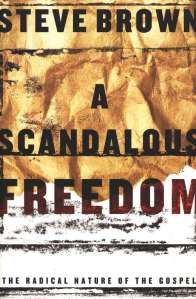
I have been listening to Steve Brown‘s Scandalous Freedom podcasts over the past couple weeks.

For those not familiar with Steve, let me issue a warning: Don’t listen to him if you take yourself too seriously or think Christianity is about putting a stamp of approval on your goodness.  I guarantee that if you think that way Steve will offend you, so just save yourself some time and aggravation.

For those who think they can handle him, these messages coincide with Steve’s book of the same title, Scandalous Freedom.  In both the book and podcasts Steve challenges the idols and ideas that rob us of joy and enslave us.  He reminds us, in his masterfully colorful way, how the genuine gospel sets us free.

Here are link to the archived series, which can be listened to online or downloaded.

  1. Free Means Free
  2. Free…Really Free
  3. Freedom’s Power
  4. Some Gods Need Killin’
  5. Struggling with Truth
  6. The Real Deal
  7. The Perfection We Desire
  8. Give Up
  9. Be Still and Be Loved
  10. “The Church is a whore…
  11. The Good News of Cheap Grace
  12. The Masks We Wear
  13. The Power to Stop Pretending
  14. Masks and Gurus
  15. The Punishing Plagues of Putting People on Pedestals
  16. Guilt and Isolation
  17. The Enemies We Demonize
  18. Three Startling Statements
  19. The Humanity that Sets Us Free
  20. The Boldness We Fear
  21. The Way to Boldness
  22. Bring the Pain
  23. Kiss that Demon on the Lips
  24. The Failure We Foster
  25. The Law and Success
  26. The Path We Avoid
  27. Holding the Land
  28. The Fellowship of the Free

Legalism in Light of the Gospel

In light of the gospel, let me especially demolish the myth that legalism is a blunder that’s associated only with our initial salvation—with our positional justification in God’s eyes. Most believers realize we could never earn such salvation; we’ve come to accept that no one can work his way into God’s kingdom… .

But when it comes to our sanctification, suddenly we become legalists. In the matter of maturing in Christlikeness—and in continuing to please God and find favor with God and acceptance with God—we suppose it’s all about what we have to accomplish ourselves and all the rules and standards and values we need to adhere to. We seem to inherently assume that our performance is what will finally determine whether our relationship with God is good or bad: so much good behavior from us generates so much affection from God, or so much bad behavior from us generates so much anger from God.

We get the Christian life all backwards. It subtly becomes all about us and what we do (which leads to slavery) instead of being all about Jesus and what he’s done (which leads to freedom). We may not articulate all this theologically, but it sure comes out in the way we live.

By their behavior, legalists essentially are saying this: “I live the Christian life by the rules—rules that I establish for myself as well as those I expect others to abide by.” They develop specific requirements of behavior beyond what the Bible teaches, and they make observance of those requirements the means by which they judge the acceptability of others in the church.

We’ve all become pretty adept at establishing these rules and standards that we find personally achievable. Legalism therefore provides us with a way to avoid acknowledging our deficiencies and our inabilities. That’s enough right there to make it attractive to us. But it’s also appealing to us in how it puffs us up, giving us the illusion … that we can do it—we can generate our own meaning, our own purpose, our own security, and all our other inmost needs. It’s what Michael Horton pinpoints as “the default setting of the human heart: the religion of self-salvation.”

It’s all so attractive because it’s all about us. Legalism feeds our natural pride. While abiding by our self-established standards and rules, we think pretty highly of ourselves …. And what’s especially fine about being in charge of our situation (though we wouldn’t admit it) is that it’s a way to avoid Jesus.

~ Tullian Tchividjian, from Jesus + Nothing = Everything

Gospel Greater Than Conservatism & Liberalism

The gospel is neither conservative nor liberal; and at the same time the gospel is both liberal and conservative.  This causes a lot of confusion to folks both inside and outside of the Church.

On the one hand, the gospel is conservative because it declares that there is such a thing as right and wrong, and that there are benefits from choosing right and consequences that accompany wrong.   Each person is responsible for his or her own actions and attitudes.  These are very conservative principles.

On the other hand, the gospel is the free gift that is given to those who have not earned it and cannot afford it.  In fact, we are told the gospel is the riches of Christ redistributed to those who admit their spiritual poverty.  Isaiah says it is like being invited to a party, but the only ones who can come are those who cannot pay, or who are humble enough to admit whatever riches they think they might have are not valid currency.  (Isaiah 55.1-2) These seem to be very liberal ideas and images.

Both are true. Equally true. Both are essential. Leave out one side or the other and you create a “different gospel” – which, as Paul says, is really no gospel at all.  In fact, Paul tells us that anyone trying to pass a counterfeit gospel should be ( and will be) anathema – repeatedly destroyed over and over for all eternity.  (Galatians 1.6-9)

I would suggest, even insist, that both Conservatism and Liberalism are false worldviews and offer counterfeit gospels.  The gospel is not a compromise of liberalism and conservatism, nor is it merely a middle way. The gospel is the expression of God’s very nature and plan.  It is therefore, THE Truth, because God himself – and God alone – is Truth.  And it is eternal Truth because God, who is Truth, is eternally God.

What both Conservatives and Liberals have done, at least those who operate as if these philosophies are the supreme ideologies, is to carve off portions of the Truth that meet their personal preferences at the expense of the valid point of the other.  Both begin with as a reduction of the gospel  Each then proceeds to build their respective worldview upon these faulty foundations of a corrupted gospel.

We begin to escape the confusion when we recognize our own propensity toward either Conservatism or Liberalism, at the expense of the other.  We begin to overcome our limitations when we recognize the whole gospel alone is the Truth, and then commit to a lifelong pursuit of excavating the depths and complexities of the gospel, while at the same time venturing to live out all the implications of the gospel in every aspect of our lives.

Whether theologically or politically, conservatism and liberalism are impotent to effect real, enduring, or godly change. But the gospel, undiluted and undistorted,  is the power of God. (1 Corinthians 1.20-25)