Two Sides of Holiness

east-knox-reflections

Jerry Bridges offered a powerful insight and challenge to Christians about the nature and focus of the Christian life:

“Scripture speaks of both a holiness which we have in Christ before God, and a holiness which we are to strive after. God has made provision for us to live holy, but He has also given us definite responsibilities to pursue holiness. Only as we accept our responsibility and appropriate God’s provisions will we make any progress in our pursuit of holiness.”

Race & the Church RVA: The Church’s Commission

The third gathering of Race and the Church in Richmond, Virginia took place on Saturday May 14.  Featured speaker Leonce Crump addressed the diverse crowd on the subject of The Church’s Commission.

Leonce Crump’s bio, from the Race and the Church RVA web page:

Originally from Louisiana and raised Catholic, Léonce began following Jesus at age 16. Always an athlete and a talker, Léonce outran his first mall security guard (and pregnant mother) at age 3, and spent most of his grade school years talking with his principals on the subject of public speaking during class. He has been in ordained ministry for 9 years, is a graduate of the University of Oklahoma; and holds Masters degrees in Criminal Justice, with a focus on Case Law, from the University of Tennessee, Missional Leadership from the now defunct Resurgence Theological Training Center, an; is currently finishing his Masters of Divinity at Reformed Theological Seminary.

At Oklahoma he was an All-American wrestler and played a short while on the Sooner football team. He experienced an extended time of rebellion and running from God during college, but after 22 months of living as though he were not a Christian he surrendered to Jesus and ultimately to God’s calling into ministry. After college Léonce competed to make the world team in wrestling, played professional football for the New Orleans Saints and coached collegiate wrestling.

Prior to planting his present church, Léonce had served in 3 churches, starting and leading 3 college and young adult ministries. In 2006 he felt called to plant a church and settled on the under-served area of downtown Atlanta; and in early 2008 he and his wife began the process of planting Renovation Church, in partnership with  Acts 29 and Perimeter Church.

A prodigious reader and engaging speaker, Léonce regularly speaks and preaches across the country at conferences and churches of all denominations. Léonce enjoys boxing and MMA, studying theology, history, leadership, church structure and poetry. He likes Soul music, jazz/standards, and Bossaniva. He also loves to lift, keep up with wrestling, football, and rugby, playing with his kids, hanging with the homeless dudes.

To view the first two gatherings of Race and the Church RVA:

Race & the Church RVA: Why Do We All Look the Same?

The second gathering of Race and the Church in Richmond, Virginia took place on Saturday morning March 12. The theme was: Why Do We All Look the Same? A Cultural & Theological Analysis of Underlying Church Dynamics; featuring speaker Dr. Alexander Jun.

Alexander Jun is a professor at Azusa Pacific University, a TED Talk speaker, and author. He has published extensively on issues of post-secondary access for historically underrepresented students in under-served areas. Jun is also a respected Ruling Elder in the Presbyterian Church in America.

To view the message from the first gathering, with featured speaker Sean Lucas, click: Race and the Church: Telling the Truth.

I Pledge My Life to Jesus & the Gospel

Stanied Glass Pathway

I pledge my life to Jesus and the Gospel. I want Jesus not to be just part of my life or something that makes me feel good, but to be the very center – controlling everything. I want only the knowledge of the love of God. I want to know Christ.

I want no desire, idol, or sinful way of dealing with hurt to control any part of my life no matter how small. I put away from myself the love of money, power, comfort, and success. I count everything rubbish.

I bind myself to Christ as bond-servant for life. I want no master other than Christ. I purpose to own nothing. I surrender to Jesus my family, my friends, my ministry, my ideas, my possessions, and my future.

I commit myself to submission to others and a willingness to learn from all kinds of Christians. I commit myself to speak only your words, not my own. I commit myself to speak the truth in love to others.

I want to love people. I want to lay down my life for others, especially those closest to me, as God gives us grace. I want to love people by telling them about Jesus.

I understand that this will mean suffering in my life, that I will join in the sufferings of Christ. But that I always want to be dying, so that I can always be living in Christ.

~ Paul Miller

4 Questions to Help Know Right From Wrong

fork-in-the-Road

Jerry Bridges, in his contemporary classic Pursuit of Holiness, writes: “Years ago a friend gave me what he called his ‘Formula: How to Know Right from Wrong.’ The formula asks four questions based on three verses in 1 Corinthians:

1. ‘”Everything is permissible for me” – but not everything is beneficial’ (1 Corinthians 6.12). Question 1: Is it helpful – physically, spiritually, and mentally?

2. ‘”Everything is permissible for me” – but I will not be mastered by anything’ (1 Corinthians 6.12). Question 2: Does it bring me under its power?

3. ‘Therefore, if what I eat causes my brother to fall into sin, I will never eat meat again, so that I will not cause him to fall’ (1 Corinthians 8.13). Question 3: Does it hurt others?

4. ‘So whether you eat or drink or whatever you do, do it all for the glory of God’ (1 Corinthians 10.31). Question 4: Does it glorify God?”

Jesus Outside the Lines

This afternoon I started reading Scott Sauls‘ refreshing new book, Jesus Outside the Lines: A Way Forward for Those Who Are Tired of Taking Sides. It seems timely – at least for me.

I for one am growing weary of a culture in which increasingly polemic debates seem never ending.  And while I was at first skeptical of the phrase, considering it a bit exaggerated and overblown, I am more-and-more inclined to agree that the United States is appropriately labeled a “post-truth society” – where what matters are not the facts, but rather striking a blow for your political side. That’s what it seems to me, as I read and watch the news regarding the Riots of Ferguson, Missouri, the RFRA in Indiana, among other items.

There is truth. There is wisdom. And what’s more, there are effective ways of finding the wisdom without sacrificing truth.That’s what I long for.  I want to engage in intelligent discussion, both with those with whom I agree and with those with whom I do not agree.  I want to understand, so I can process things from perspectives I may not presently possess. I want to be heard, without being demonized as either a bigot or a half-hearted traitor.  I want to align myself to truth and wisdom, and I want to see truth and wisdom win the day.  I get that most things are more complex than we may want to make them.  I get that we can act wrongly even in those times when we are in the right.  But call me naive, or utopian, but that is what I want.

That is what Scott Sauls advocates in these pages.  Having not yet finished the book, I cannot say that everything Sauls writes will be as music to my ears.  But I can say is, having read a couple of related interviews, what Sauls endeavors to do resonates with my sensibilities.

It is not compromise I desire, but something transcendent: I want to remember that God is truth, for his truth to reign. I want for God’s people to be the champions for the good of all humanity – which is, after all, created after God’s image.  And I want these truths and values brought wisely, winsomely, and effectively into the Public Square.  The fact that some – maybe many – don’t want these ideas in the Public Square is no reason to stop taking them there.  And the fact that some seem to despise these ideas is no excuse for Christians to act in a manner unworthy of the Gospel, as we engage those who oppose and even hate us.

So far, Scott Sauls is not disappointing.

Related articles:

Desiring Truth

An Evening Walk (Besnard)

by Wesley Hurd

At the end of one of his films, Deconstructing Harry, writer/actor Woody Allen delivers a movie-ending confession that offers a perverted coherence to the film:

“All people know the truth. Our lives consist of how we choose to distort it.”

For believers, though, desiring truth – undistorted – is central to the process and experience of our salvation. Nothing is more fundamental in our striving for sanctification – our striving to be good as God is good – than our embracing the truth at every level at which it confronts us.

One of the most common names for the presence of God in our lives is the Spirit of Truth. He is the author and source of all that is valuable, good, pure, and true. It follows, then, that believers in the true Gospel – a work the Spirit of Truth authors in our hearts – will seek what is true. Our commitment to living according to what is true is a “litmus test” for whether we are authentically interested in knowing God and learning to love what He loves – truth, justice, and mercy. Are we interested in knowing God? Then, in the end, we will be open to following the truth wherever it leads us. This will be a lifelong process for us, however, because, like our distant ancestors Adam and Eve, we are more inclined to hide from truth than to seek it or to embrace its consequences. Our fallen, darkened hearts do not naturally respond well to truth, especially when it surprises and inconveniences us, when believing and acting upon the truth costs us something.

In his gospel narrative (John 18.28ff), the Apostle John portrays a powerful scene in which Jesus and his captor, Pontius Pilate, engage in a profound exchange over this issue of truth. Their conversation shows two levels at which truth confronts all humans. Both levels can potentially reflect a person’s moral disposition, but the second level proves to be spiritually crucial. Let me explain.

The first level of discovering truth involves whether or not a person believes truth exists at all in a practical and philosophical sense. Is there truth? If so, how do I know it? How can I be confident in what appears to me to be true? In the John passage, Pilate interrogates Jesus and his accusers, attempting to ascertain the true circumstances that led to Jesus’ arrest. At this level of truth seeking, Pilate assumes the truth can be known and assessed. His inquiry proves he believes truth is objectively available and can be sought and found. Having received adequate firsthand testimony, Pilate determines that Jesus is innocent of the allegations against him. The truth made itself plain to Pilate. Pilate then attempts political maneuvers to free Jesus, but he fails when Jesus’ accusers threaten anarchy that would put Pilate himself in political jeopardy.

Yet Jesus intrigues Pilate, who engages Jesus further, asking Him questions that lead Jesus to claim, “For this I have been born…to bear witness to the truth. Every one who is of the truth hears My voice.” Now the second level of our relationship to truth appears. Once we believe we know what is true, are we willing to embrace it and to act accordingly? Pilate was not willing. His reply to Jesus, “What is truth?”, enables Pilate to keep the conversation at the philosophical level rather than going to the second level of personal, existential response.

Jesus identified himself with the vital truths about a person’s relationship to God and eternal destiny. Jesus spoke the truth about God — who He is, what His will is, and how human creatures can align themselves with those truths. Jesus was concerned not only about the factual truthfulness of what one believes (truth at level one), but also about the deeply personal moral posture of one’s heart toward factual truthfulness. Does one’s heart lean toward or away from letting the truth have its way in one’s thought, choices, and behavior? For example, I can know and agree with the theological truthfulness of man’s sin and fallenness, while simultaneously refusing to allow its factual truthfulness to penetrate my personal conscience and thereby own the truth of my guilt and need for repentance.

Continue reading

How to Preach the Gospel to Yourself

Preaching Gospel to Self

Paul, in Colossians 2.6, instructs us: “So then, just as you received Christ Jesus as Lord, continue to live your lives in him…”  Simple words, but powerfully practical when unpacked.

How did we “receive” Jesus?  By faith and repentance – or by repentance and faith.  We are not quite sure which comes first, but perhaps that does not matter.  It may be that the order is different with different people. What matters is that genuine conversion involves both of these elements: Repentance of our sin and of all our desire and attempts to save ourselves through our good behavior; Faith in the gospel – the good news – of what Jesus has done on our behalf, and what is offered to us in him.

If these are the two elements by which we received Jesus then, according to the Apostle’s instruction, these are the two elements that should be characteristic of our day-to-day life in Jesus.  The old Puritan Thomas Watson once wisely noted: “Faith and repentance are the two wings by which we fly toward heaven.”  In other words, faith and repentance are not only the instruments by which the journey of salvation is initiated, these are the practices by which we travel.  These are the ingredients of spiritual growth leading to maturity.

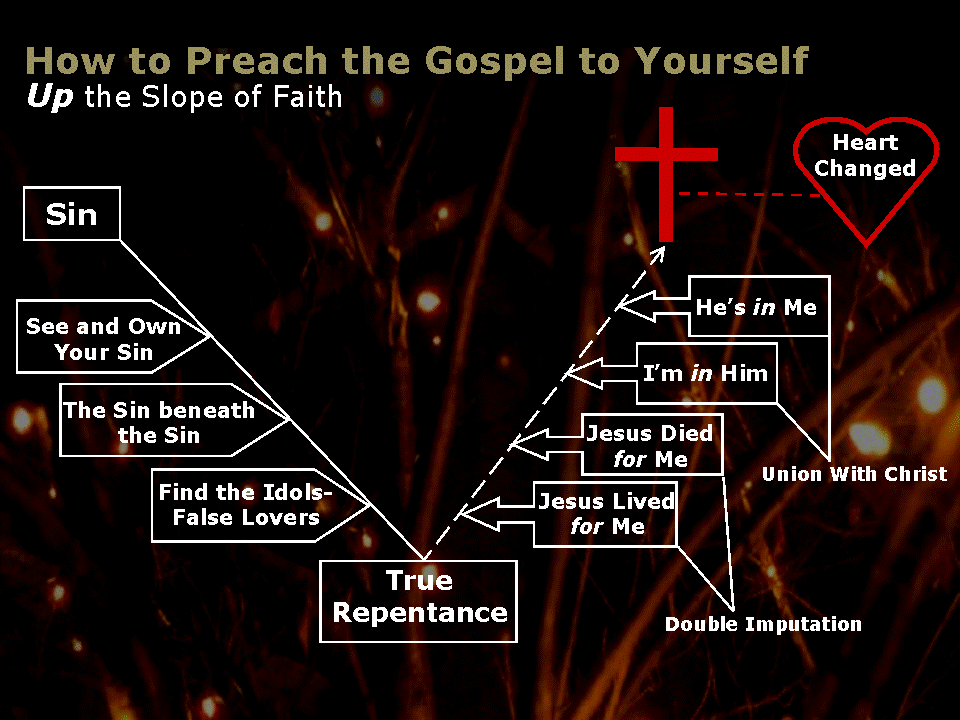
The chart above reflects both faith and repentance, and provides a tool to help us be able to “preach the gospel to ourselves”.

It reminds us that when recognize sin in our lives, our response should not be to simply resolve to “stop it”. We need to discern its source.  In other words, the sin we see, the sin which shows itself in our behavior (and in our attitudes), has deeper roots and causes.  So, like an explorer commissioned to trace the a great river to discover its tributaries and its origin, we are called upon to discover what “root sins” are tributaries of our behavior, and ultimately what idols are the original source.  Once discovered – or even while in the process of discovery – “putting sin to death” requires that we confess it and repent of it.  All of it – the sinful behaviors, the attitudes that lead to it, and the idols that source it.  Growth in grace is greater than mere moral reform.  Growth in grace is a work of the Spirit upon the heart which eventually and inevitably leads to a change in behavior.

Yet growth in grace does not come by confession and repentance alone.  Such may lead to behavior change, if we feel guilty enough and desire to change. But that is not growth in grace.  Growth in grace requires that we believe what grace gives; that we ponder what is true, and good, and beautiful: chiefly among such things is the gospel, the good news of what God promises – and does – when we trust  in Jesus.  (Philippians 4.8)   Reminded of the truths of the gospel, our hearts change; they turn toward God, causing us to hunger to grow more like him, and enabling us to rely more on his promise that what he began he will complete.  (Philippians 1.6)

This is the spiritual discipline of preaching the gospel to ourselves.

Gospel Greater Than God’s Law

Niagara at Night

Preaching through Paul’s Letter to the Galatians, I have received quite a bit of feedback – more than I receive during most series I have done.  Much to the relief of my thin skin, I have received no criticism (to date).  Most of the comments have been appreciative, either for the reminder of things that we need to remember, or for clarity on matters previously not understood.  (Either way, this is music to any ministers ears!)  The rest are questions – good questions; well-intentioned questions – concerning the role of our obedience. One godly man, a man I respect and enjoy, offered concerns about the possibility of people “hearing” cheap grace, knowing neither I nor our church believes grace is ever cheap.

These interactions have reminded me of what Martyn Lloyd-Jones wrote regarding the possible charge of anti-nomianism:

If your presentation of the Gospel does not expose it to the charge of Anti-nomianism you are probably not putting it correctly.

(NOTE: Anti-nomianism means “against law” or “anti-law.  It is a $20 word for someone who sees no use or present value for God’s law or commands in the Christian Life.)

This semi-famous saying is excerpted from Lloyd-Jones commentary on Romans.  Lloyd-Jones’ insights are so well expressed that they are worth revisiting even now and again.  Below are his thoughts from Romans 3 (which include the above statement):

A very good way of testing any view that you may hold is this one: Is this view humbling to me, glorifying to God? If it is, it is probably right. You won’t go far wrong if whatever view you are holding is glorifying to God, humbling to man. But if your view seems to glorify you and to query God, well (there’s no need to argue or to go into details) it’s wrong. It’s a very good universal rule– that!

My last word of all is, again, a word primarily to preachers – indeed it’s a word to everybody in the sense that if ever you are putting the Gospel to another person, you’ve got a very good test whether you are preaching the Gospel in the right way. What’s that? Well, let me put it like this to you: If your presentation of the Gospel does not expose it to the charge of Antinomianism you are probably not putting it correctly.

What do I mean by that? Just this: The Gospel, you see, comes as this free gift of God – irrespective of what man does.

Now, the moment you say a thing like that, you are liable to provoke somebody to say: “Well, if that is so it doesn’t matter what I do.”

The Apostle takes up that argument more than once in this great epistle. “What then,” he says at the beginning of chapter 6, “shall we do evil – commit sin – that grace might abound?” He’s just been saying: “where sin abounded grace does much more abound.” “Very well,” says someone. “This is a marvelous doctrine, this ‘Go and get drunk, do what you like the grace of God will put you right.’” Anti-nomianism.

Now, this doctrine of the Scriptures – this justification by faith only, this free grace of God in salvation – is always exposed to that charge of Anti-nomianism. Paul was charged with it. He said, “You know, some people say that’s what I’m preaching.” Paul’s preaching was charged with Anti-nomianism…So I say, it is a very good test of preaching.

You see – what is not evangelical preaching is this: It’s the kind of preaching that says to people, “Now, if you live a good life; if you don’t commit certain sins; and if you do good to others; and if you become a church member and attend regularly and are busy and active you will be a fine Christian and you’ll go to Heaven. That’s the opposite of Evangelical preaching – and it isn’t exposed to the charge of Anti-nomianism because…it is telling men to save themselves by their good works…And it’s not the Gospel – because the Gospel always exposes itself to this misunderstanding from the standpoint of Anti-nomianism.

So, let all of us test our preaching, our conversation, our talk to others about the Gospel by that particular test…If you don’t make people say things like that sometimes, if you’re not misunderstood and slanderously reported from the standpoint of Anti-nomianism, it’s because you don’t believe the Gospel truly, and you don’t preach it truly.

Spiritual Chrysalis

Chrysalis

In preparation for  this past Sunday message from Galatians, I again marveled at the insight and passion of Martin Luther concerning our Union with Christ:

“So far as justification is concerned, Christ and I must be so closely attached that He lives in me and I in Him. What a marvelous way of speaking!

Because He lives in me, whatever grace, righteousness, life, peace, and salvation there is in me is all Christ’s; nevertheless, it is mine as well, by the cementing and attachment that are through faith, by which we become as one body in the Spirit.

Since Christ lives in me, grace, righteousness, life, and eternal salvation must be present with Him; and the Law, sin, and death must be absent. Indeed, the Law must be crucified, devoured, and abolished by the Law—and sin by sin, death by death, the devil by the devil.

In this way Paul seeks to withdraw us completely from ourselves, from the Law, and from works, and to transplant us into Christ and faith in Christ, so that in the area of justification we look only at grace, and separate it far from the Law and from works, which belong far away…

But faith must be taught correctly, namely, that by it you are so cemented to Christ that He and you are as one person, which cannot be separated but remains attached to Him forever and declares: ‘I am as Christ.’

And Christ, in turn, says: ‘I am as that sinner who is attached to Me, and I to him. For by faith we are joined together into one flesh and one bone.’

Thus Ephesians 5.30 says: ‘We are members of the body of Christ, of His flesh and of His bones,’ in such a way that this faith couples Christ and me more intimately than a husband is coupled to his wife.”

~ from Luther’s Works, Vol. 26: Lectures on Galatians, 1535, Chapters 1-4

5 Obedience Killing Lies

Colorful Confusion

No doubt in my mind, it is one of the more difficult aspects of living in line with the gospel. Is it about grace, or is it about obedience?  If I say “both” – which I do – then how does this not add a requirement of works to the gospel requirement of faith alone for our justification/salvation?  If I say obedience is not necessary to our salvation – which I also say – then are we not very close to the precipice of anti-nomianism (lawlessness)?  No wonder people scratch their heads, and then revert back to patterns learned or to personal instinct – both of which are often wrong.

To avoid confusion, I answered “Yes” to both grace and obedience for a reason.  Let me clarify.

I must say that our obedience is not necessary to our salvation, because we are incapable of perfect obedience – and perfect obedience is what the Law demands.  To add any measure of obedience to our justification would be to minimize the law and deny the gospel at the same time.  Christ became like us, and lived in perfect obedience to his Father, and then died in our place, because we are not and cannot be perfectly obedient.  And it we are not perfectly obedient, we are not obedient.  But by faith, we are counted as righteous – credited with Jesus’ righteousness as if it were our very own.  But part of what we must believe, as part of that faith is that we are disobedient.  In a real sense the admission of being disobedient is requisite to be saved. How then could we say that obedience is required for salvation?

On the other hand, God does demand obedience – and he is worthy of our total obedience.  But two things occur here, in some ways simultaneously.  First, the demand for what we do not and cannot do highlights our brokenness and our dependence upon grace – the grace of a savior.  The demand, coupled with our lack of obedience, drives us to either despair or to the cross. Those driven to the cross find, not condemnation, but forgiveness and love, through unmerited grace extended to us by God, because of Jesus.  This breaking, because we become aware of our disobedience, is a necessary step toward healing and wholeness.  But second, God’s demands are not a mere bait and switch. When he commands obedience, he means it.  Inability it no excuse.  He commands because obedience not only pleases him, we find that his ways are the ways the work, that lead us to the greatest joy.  In short, we find in both obedience and our failures to obey that God’s commands are really a tremendous gift of his love.

While I hope the reader will see the dichotomy – the two distinct tracks – I also hope all will be able to see how these two tracks work together.  Obedience cannot be required for salvation, because it denies both our reality and the necessity of the gospel.  But in walking with God, obedience is expected – though we fail, and are reminded of our continual need of grace – but it is expected, demanded, because through obedience we are able to bring joy to both God and ourselves.  Failure, or disobedience as a Christian does not cause the forfeiture of our salvation; but as Job discovered, we can forfeit the grace of joy that would otherwise be ours – and rob God of the joy that we would give to him.  But if that drives us back to the cross, we find grace anew, and we are renewed in faith, strength, to experience the joy that comes through gospel-prompted obedience.

Because this can be such a dizzying subject, I was appreciative when I recently read a short piece by Brad Watson, titled 5 Obedience Killing Lies.  Watson rightly notes:

Our ability to quit and become sidetracked is great.

I believe we get sidetracked by the confusion of the place of obedience, as well as by many other things that creep into our consciousness that hinder our pursuit of obedience.  Watson focuses on the more practical issues, rather than the confusion of the relationship of Law vs. Grace.  As he says in his article:

Our hearts are constantly being attacked by lies that keep us from persevering in faith. These five lies are particularly successful. They are deceptive and effective in killing our conviction to follow Jesus and trust in his work.

Continue reading

Hurt People Hurt People

There is an old expression that has long stuck in my mind: “Hurt people, hurt people.”  In other words, those who are hurting often lash out in some way and hurt others around them; and those who lash out are often themselves hurting on the inside.  Sometimes the offending individual is self-aware, but often the hurt person who is hurting others is neither conscious of their own pain nor of how they are effecting others. It is a viscious cycle.

In this video, Derwin Gray, pastor of Transformation Church in the Charlotte area, and former Indianapolis Colt & Carolina Panther Defensive Back, touches on this very issue. The gospel addresses this issue, freeing the one who has been hurt from hurting others, and freeing those who are being hurt to understand and forgive.

Gospel Wakefulness

One of the more helpful works I have read concerning gospel-centered Christianity is Jared Wilson‘s Gospel Wakefulness.  Perhaps most insightful to me was Jared’s point that gospel-centeredness can be explained but cannot be taught.  In other words, it requires a grace of the holy spirit.  I do not think this realization moves gospel-centeredness into a neo-gnostic or higher life kind of category.  It simply is the realization that it is God who must work in us in our sanctification.  Thus the phrase Jared Wilson uses is Gospel Wakefulness.

In this video, Jared Wilson explain what Gospel-Wakefulness is.   This is not a short video, by any measure.  But it is worth taking the time – whether in one sitting, or in a series of starts-and-stops.

In the Cross

Orange Cross (La Croix)

In the Cross is salvation, in the Cross is life, in the Cross is protection from our enemies, in the Cross is infusion of heavenly sweetness, in the Cross is strength of mind,  in the Cross is joy of spirit, in the Cross is the height of virtue, in the Cross is perfection of sanctity. There is no salvation of the soul, nor hope of everlasting life, but in the Cross.

~ Thomas á Kempis, The Imitation of Christ