It was theirs for the taking. So Moses, at God’s prompting, sent a dozen spies into the Canaan to explore the land God promised to give to Israel. But God never promised Moses that taking the land would be easy. Canaan was filled with powerful people and fortified cities. Ten of the spies weighed the risk and decided it wasn’t worth it. Two, however, Joshua & Caleb, were men of courage, faith, and faithfulness. God had promised them that land. God had instructed them to take it. “Let’s roll” they said. “We should go take posession of the land. We can do it.” (Numbers 13)
You may be in a similar situation. You may not have thought about it this way, but that is the scenario facing everyone selcted to serve on the missions committee of thier church.
God the Son has issued a mandate for world evangelization. (Matthew 28.18-20) He intends to claim the hearts and lives of men & women, boys & girls, from every Tribe on earth. He has promised to supply the power. (Acts 1.8) He has guaranteed ultimate success. Still, the task ahead is not easy. The faithful will experience all kinds of obstacles and opposition. And just like Joshua & Caleb, some of that opposition will come from inside the camp, from those who are commissioned to partner with you, but who are too timid to carry out the mission. Completion will take courage, commitment, and sacrifice. It requires faithfulness.
So yo are a Joshua or a Caleb. You are on the missions committee, and you are determined to take the lands. You are just not sure exactly how to go about it. It’s a big job. What does it entail? Where do you begin?
It is important to remember that all Christians are called to the advancement of the Gospel to all Nations. This task is not the responsibility of a select few who serve, whether you volunteered or you were appointed by their church, as a missions committee. Missions is not one ministry among many in the church. Mission, along with worship, is the essence of Being the church. And every church member has a role, whether they are Go-ers, Senders, and/or Mobilizers.
The task of the missions committee is to facilitate the work of global missions in the church through leadership, evaluation, administration, and delegation of the various tasks associated with cross cultural ministry.
The following list is an overview of the roles of the mission ministry. It takes into consideration mission ministry strengths identified by mission mobilization network ACMC, but I have consolidated them into more manageable categories. A healthy missions ministry will include every category. However, no church can be equally great at all possible functions within each category.
Strategy
Every church must have a clear strategy that recognizes its responsibility to participate in the completion of the Great Commission, and the specific ways it will participate to accomplish that task. Simple mission involvement, while good, is not an adequate objective.
Mobilization is active involvement toward accomplishing the remaining task of the Great Commission.
There are various roles (i.e. Go-ers, Senders, Mobilizers), various levels of readiness, and different callings among church members. In other words, it is rare that someone will be called and prepared for career missions without having initially taken short term mission trips. On the other hand, most who go on short term trips will never be called to career missions. Appropriate entry and preparation levels need to be offered. And church members should be encouraged and expected to discern his/her own role in the task of reaching the Nations.
Mobilization means getting increasing numbers of people to actively carry out their distinct role. Mobiolization means equipping them to do so.
Mobilization includes: Short Term Cross Cultural trips; Encouraging Tent-making; Adoption of Unreached Peoples; Training Candidates; Strategic Partnerships; Prayer; and Ministry to Internationals.
Care
Missionary Care focuses on caring for the missionaries, both on the field and while at home on Home Missionary Assignment, or HMA. (NOTE: This used to be referred to as Furlough). It also applies to caring for those who are in preparation for career mission.
This is one area I anticipate our church, Walnut Hill PCA, should excel in as we grow in our missions ministry. One of the great strengths of our church – perhaps the greatest strength – is the way the people love one another. Missionary Care is simply an extension of that love. And this practical love is part of our mission. Paraphrasing Francis Schaeffer: “The way we love one another is a demonstration of the Gospel we proclaim.” (John 13.34-35)
Practical means of Missionary Care includes: Caring for Tangible, Emotional, and Spiritual Needs; Communication with Missionaries; Holistic Prayer; Funding & Support; Visiting Missionaries on the Field.
Education
Education is teaching people about God’s heart for the Nations and about the Great Commission. It keeps people informed about what God is doing around the world. It is the reminder of the remaining task. And it is the equipping of each church member to carry out his/her particular roles.
Means of Education include: Missions Conferences/Festivals; Classes & Seminars; Publications; Hands-on Experiences; Training & Preparation for Short-term and/or career missions.
The Scope of Missions Education should include the whole church. Intentional attention should be given to Children, and to Teens, who are preparing to make life decisions. But most adults also benefit from missions education.
Administration
Administration is dealing with all the behind-the-scenes details of missions, and management of this ministry. This is an important aspect of Mobilizing. And each of the above categories requires some level of administration.
Pertaining to the missions committee, Administration includes: Policy Development; Job Descriptions for committee members, and others who serve specific functions (i.e. Missions Conference Planner); Communications with Missionaries; Missions Budget Preparation and Management; and Vetting & Selection of Missionaries to be supported.
The task of taking the Nations for Christ through missions may seem like a battle agianst giants. But remember, you are not doing it alone. If each church plays its part there will be a great army advancing the Kingdom of God’s Grace. There are more than 600 Evangelical churches in the world for every Unreached People Group. If every church – if even a significant minority of those churches – gears up for the task, missions experts tell us that the completion of the Great Commission can very definitely be accomplished in this generation!
Pray that God would give you the spirit of Joshua & Caleb. They recognized the strength of their opposition and the difficult battles ahead of them. But they also knew that God would empower them to do whatever he called them to do.
Missions is not the ultimate goal of the church. Worship is. Missions exists because worship doesn’t. Worship is ultimate, not missions, because God is ultimate, not man. When this age is over, and the countless millions of the redeemed fall on their faces before the throne of God, missions will be no more. It is a temporary necessity. But worship abides forever.
Worship, therefore, is the fuel and goal of missions. It’s the goal of missions because in missions we simply aim to bring the nations into the white hot enjoyment of God’s glory. The goal of missions is the gladness of the peoples in the greatness of God. “The Lord reigns; let the earth rejoice; let the many coastlands be glad!” (Psalm 97.1). “Let the peoples praise thee, O God; let all the peoples praise thee! Let the nations be glad and sing for joy!” (Psalm 67.3-4).
But worship is also the fuel of missions. Passion for God in worship precedes the offer of God in preaching. You can’t commend what you don’t cherish. Missionaries will never call out, “Let the nations be glad!”, who cannot say from the heart, “I rejoice in the Lord…I will be glad and exult in thee, I will sing praise to thy name, O Most High” (Psalm 104.34; 9.2). Missions begins and ends in worship.
If the pursuit of God’s glory is not ordered above the pursuit of man’s good in the affections of the heart and the priorities of the church, man will not be well served and God will not be duly honored. I am not pleading for a diminishing of missions but for a magnifying of God. When the flame of worship burns with the heat of God’s true worth, the light of missions will shine to the most remote peoples on earth. And I long for that day to come!
Where passion for God is weak, zeal for missions will be weak. Churches that are not centered on the exaltation of the majesty and beauty of God will scarcely kindle a fervent desire to “declare his glory among the nations” (Psalm 96.3). Even outsiders feel the disparity between the boldness of our claims upon the nations and the blandness of our engagement with God.
Albert Einstein’s Indictment
For example, Charles Misner, a scientific specialist in general relativity theory, expressed Albert Einstein‘s skepticism over the church with words that should waken us to the shallowness of our experience with God in worship.
“The design of the universe…is very magnificent and shouldn’t be taken for granted. In fact, I believe that is why Einstein had so little use for organized religion, although he strikes me as a basically very religious man. He must have looked at what the preacher said about God and felt that they were blaspheming. He had seen much more majesty than they had every imagined, and they were just not talking about the real thing. My guess is that he simply felt that religions he’d run across did not have proper respect…for the author of the universe.”
The charge of blasphemy is loaded. The point is to pack a wallop behind the charge that in our worship services God simply doesn’t come through for who he is. He is unwittingly belittled. For those who are stunned by the indescribable magnitude of what God has made, not to mention the infinite greatness of the One who made it, the steady diet on Sunday morning of practical “how to’s” and psychological soothing and relational therapy and tactical planning seem dramatically out of touch with Reality–the God of overwhelming greatness.
It is possible to be distracted from God in trying to serve God. Martha-like , we neglect the one thing needful, and soon begin to present God as busy and fretful. A.W. Tozer warned us about this:
“We commonly represent God as a busy, eager, somewhat frustrated Father hurrying about seeking help to carry out His benevolent plan to bring peace and salvation to the world. … Too many missionary appeals are based upon this fancied frustration of Almighty God.”
Scientists know that light travels at the speed of 5.87 trillion miles in a year. They also know that the galaxy of which our solar system is a part is about 100,000 light-years in diameter–about five hundred eighty seven thousand trillion miles. It is one of about a million such galaxies in the optical range of our most powerful telescopes. In our galaxy there are about 100 billion stars. The sun is one of them, a modest star burning at about 6,000 degrees Centigrade on the surface, and traveling in an orbit at 155 miles per second, which means it will take about 200 million years to complete a revolution around the galaxy.
Scientists know these things and are awed by them. And they say, “If there is a personal God, as the Christians say, who spoke this universe into being, then there is a certain respect and reverence and wonder and dread that would have to come through when we talk about him and when we worship him.”
We who believe the Bible know this even better than the scientists because we have heard something even more amazing:
“To whom then will you compare me, that I should be like him?” says the Holy One. Lift up your eyes on high and see who created these (stars)? He who brings out their host by number, calling them all by name by the greatness of his might, and because he is strong in power not one is missing. (Isaiah 40.25-26)
Every one of the billions of stars in the universe is there by God’s specific appointment. He knows their number. And, most astonishing of all, he knows them by name. They do his bidding as his personal agents. When we feel the weight of this grandeur in the heavens, we have only touched the hem of his garment. “Lo, these are but the outskirts of his ways! And how small a whisper do we hear of him” (Job 26.14). That is why we cry ‘Be exalted, O God, Above the heavens!’ (Psalm 57.5). God is the absolute reality that everyone in the universe must come to terms with. Everything depends utterly on his will. All other realities compare to him like a raindrop compares to the ocean, or like an anthill compares to Mt. Everest. To ignore him or belittle him is unintelligible and suicidal folly. How shall one ever be the emissary of this great God who has not trembled before him with joyful wonder?
The Second Greatest Activity in the World
The most crucial issue in missions is the centrality of God in the life of the church. Where people are not stunned by the greatness of God, how can they be sent with the ringing message, “Great is the Lord and greatly to be praised; he is to be feared above all gods!” (Psalm 96.4)? Missions is not first and ultimate: God is. And these are not just words. This truth is the lifeblood of missionary inspiration and endurance. William Carey, the father of modern missions, who set sail for India from England in 1793, expressed the connection:
“When I left England, my hope of India’s conversion was very strong; but amongst so many obstacles, it would die, unless upheld by God. Well, I have God, and His Word is true. Though the superstitions of the heathen were a thousand times stronger than they are, and the example of the Europeans a thousand times worse; though I were deserted by all and persecuted by all, yet my faith, fixed on the sure Word, would rise above all obstructions and overcome every trial. God’s cause will triumph.”
Carey and thousands like him have been moved by the vision of a great and triumphant God. That vision must come first. Savoring it in worship precedes spreading it in missions. All of history is moving toward one great goal, the white-hot worship of God and his Son among all the peoples of the earth. Missions is not that goal. It is the means. And for that reason it is the second greatest human activity in the world.
God’s Passion for God Is the Foundation for Ours
One of the things God uses to make this truth take hold of a person and a church is the stunning realization that it is also true for God himself. Missions is not God’s ultimate goal, worship is. And when this sinks into a person’s heart everything changes. The world is often turned on its head. And everything looks different–including the missionary enterprise.
The ultimate foundation for our passion to see God glorified is his own passion to be glorified. God is central and supreme in his own affections. There are no rivals for the supremacy of God’s glory in his own heart. God is not an idolater. He does not disobey the first and great commandment. With all his heart and soul and strength and mind he delights in the glory of his manifold perfections. The most passionate heart for God in all the universe is God’s heart.
This truth, more than any other I know, seals the conviction that worship is the fuel and goal of missions. The deepest reason why our passion for God should fuel missions is that God’s passion for God fuels missions. Missions is the overflow of our delight in God because missions is the overflow of God’s delight in being God. And the deepest reason why worship is the goal in missions is that worship is God’s goal. We are confirmed in this goal by the Biblical record of God’s relentless pursuit of praise among the nations. “Praise the Lord, all nations! Extol him, all peoples!” (Psalm 117.1). If it is God’s goal it must be our goal.
The Chief End of God Is to Glorify God and Enjoy Himself For Ever
All my years of preaching and teaching on the supremacy of God in the heart of God have proved that this truth hits most people like a truck laden with unknown fruit. If they survive the impact, they discover that it is the most luscious fruit on the planet. I have unpacked this truth with lengthy arguments in other places. So here I will just give a brief overview of the Biblical basis. What I am claiming is that the answer to the first question of the Westminster Catechism is the same when asked concerning God as it is when asked concerning man. Question: “What is the chief end of man?” Answer: “The chief end of man is to glorify God and enjoy him for ever.” Question: “What is the chief end of God?” Answer: “The chief end of God is to glorify God and enjoy himself for ever.”
Another way to say it is simply, God is righteous. The opposite of righteousness is to value and enjoy what is not truly valuable or rewarding. This is why people are called unrighteous in Romans 1.18. They suppress the truth of God’s value and exchange God for created things. So they belittle God and discredit his worth. Righteousness is the opposite. It means recognizing true value for what it is and esteeming it and enjoying it in proportion to its true worth. The unrighteous in 2 Thessalonians 2.10 perish because they refuse to love the truth. The righteous, then, are those who welcome a love for the truth. Righteousness is recognizing and welcoming and loving and upholding what is truly valuable. God is righteous. This means that he recognizes, welcomes, loves and upholds with infinite jealousy and energy what is infinitely valuable, namely, the worth of God. God’s righteousness passion and delight is to display and uphold his infinitely valuable glory. This is not a vague theological conjecture. It flows inevitably from dozens of Biblical texts that show God in the relentless pursuit of praise and honor from creation to consummation.
Probably no text in the Bible reveals the passion of God for his own glory more clearly and bluntly than Isaiah 48.9-11 where God says,
“For my name’s sake I defer my anger, for the sake of my praise I restrain it for you, that I may not cut you off. Behold, I have refined you, but not like silver; I have tried you in the furnace of affliction. For my own sake, for my own sake, I do it, for how should my name be profaned? My glory I will not give to another.”
I have found that for many people these words come like six hammer blows to a man-centered way of looking at the world:
For my name’s sake! For the sake of my praise! For my own sake! For my own sake! How should my name be profaned? My glory I will not give to another!
What this text hammers home to us is the centrality of God in his own affections. The most passionate heart for the glorification of God is God’s heart. God’s ultimate goal is to uphold and display the glory of his name.
“For the Sake of His Name among All the Nations
Paul makes crystal clear in Romans 1.5 that his mission and calling are for the name of Christ among all the nations: “We have received grace and apostleship to bring about the obedience of faith for the sake of his name among all nations.”
The apostle John described the motive of early Christian missionaries in the same way. He wrote to tell one of his churches that they should send out Christian brothers in a manner “worthy of God.” And the reason he gives is that “they have gone out for the sake of his name, taking nothing from the Gentiles.” ( 3 John 6-7).
John Stott comments on these two texts (Romans 1:5; 3 John 7):
“They knew that God had superexalted Jesus, enthroning him at his right hand and bestowing upon him the highest rank, in order that every tongue should confess his lordship. They longed that Jesus should receive the honor due his name.”
This longing is not a dream but a certainty. at the bottom of all our hope, when everything else has given way, we stand on this great reality: the everlasting, all- sufficient God is infinitely, unwaveringly, and eternally committed to the glory of his great and holy name. For the sake of his fame among the nations he will act. His name will not be profaned forever. The mission of the church will be victorious. He will vindicate his people and his cause in all the earth.
The absence of [David] Brainerd‘s passion for God is the great cause of missionary weakness in the churches. This was Andrew Murray‘s judgement a hundred years ago:
“As we seek to find out why, with such millions of Christians, the real army of God that is fighting the hosts of darkness is so small, the only answer is–lack of heart. The enthusiasm of the kingdom is missing. And that is because there is so little enthusiasm for the King.”
The zeal of the church for the glory of her King will not rise until pastors and mission leaders and seminary teachers make much more of the King. When the glory of God himself saturates our preaching and teaching and conversation and writings, and when he predominates above our talk of methods and strategies and psychological buzz words and cultural trends, then the people might begin to feel that he is the central reality of their lives and that the spread of his glory is more important than all their possessions and all their plans.
The Call of God
God is calling us above all else to be the kind of people whose theme and passion is the supremacy of God in all of life. No one will be able to rise to the magnificence of the missionary cause who does not feel the magnificence of Christ. There will be no big world vision without a big God. There will be no passion to draw others into our worship where there is no passion for worship.
God is pursuing with omnipotent passion a worldwide purpose of gathering joyful worshipers for himself from every tribe and tongue and people and nation. He has an inexhaustible enthusiasm for the supremacy of his name among the nations. Therefore let us bring our affections into line with his, and, for the sake of his name, let us renounce the quest for worldly comforts, and join his global purpose. If we do this, God’s omnipotent commitment to his name will be over us like a banner, and we will not lose, in spite of many tribulations (Acts 9.16; Romans 8.35-39). Missions is not the ultimate goal of the church. Worship is. Missions exists because worship doesn’t. The Great Commission is first to delight yourself in the Lord (Psalm 37.4) . And then to declare, “Let the nations be glad and sing for joy!” (Psalm 67.4). In this way God will be glorified from beginning to end and worship will empower the missionary enterprise till the coming of the Lord.
Great and wonderful are your deeds, O Lord God the Almighty! Just and true are your ways, O King of the ages! Who shall not fear and glorify your name, O Lord? For you alone are holy. All nations shall come and worship you, for your judgments have been revealed. –Revelation 15.3-4
While in many ways this should be a simple question to answer, experience has taught me that many people are confused about what the Gsopel is. Most agree that the Gospel is something good. But they are confused about what particularly defines the Gospel.
Some see the Gospel as merely that message necessary to receive salvation, but have no idea it has a huge impact on how we live our lives even after becomming Christians. Some associate it with a style of music often found in a rural church. Some view at is as a synonym for “Truth”. Others simply think of the whole Bible, or at least the New Testament, as being the Gospel.
While the latter statement is true in a sense, there is a particular message that runs throughout the Bible that is most properly seen as the Gospel; and by which the entirely of Scripture can be said to be Gospel. This message is at times more detectable than at other times. It may be said to be like a stream that runs both above and under ground. Even when it is not obvious, if you look closely its presence can be seen.
Getting the Gospel right is essential to a healthy and vibrant spiritual life. Many problems experienced by Christians in their spiritual and emotional lives, and in evangelsim and mission, can be traced to a misunderstanding or masapplication of the Gospel. That’s why I want to take every opportunity to clearly declare and define the Gospel.
John Piper succinctly explains this vital message in this brief video. (It is well worth the few minutes.)
As a kid I watched Bob Newhart nearly every Saturday night. In fact, because of him I briefly thought it might be cool to become a psychologist, and do counseling for a living. But that idea soon faded. After further thought I wondered if it would be something I was particularly suited to do. So how ironic is it that, as a pastor, a fair portion of my time is spent in counseling?
While counseling can be very, very rewarding, when those I work with seem to make progress, at other times it can be very frustrating. I wonder if I am helping at all. My nature is to assume there is something I am missing, some insight I am overlooking, some sage advice I am failing to offer.
So, I was excited when I ran across this video of Bob Newhart counseling a client. He shows me how to be clear and focused when addressing a persons issue, and how to be direct in his counsel. Watch and learn:
While this sketch is funny, and does represent how some pastors and church leaders occasionally feel, David Powlinson, of CCCF, offers some poignant insight about the difference between Bob Newharts methods and the objective we should embrace in the church.
That the resurrection is an essential aspect of Christianity seems to me to be a ‘no brainer’. But recently I had a dialogue with an individual who does not share this view. As I have thought about that dialogue I have come to realize that this person is not entirely wrong, though still, I think, confused.
Let me explain.
The resurrection is necessary to Christianity. Without the resurrection we would have no assurance that the death of Christ satisfied the justice of God. We would have no way of knowing if Christ’s death paid the price of the debt of our sin or not. We would not know if he was a mere man or not. Therefore, we would live, at best, with a presumptive hope, but no faith, no actual trust, that we had been reconciled to God.
Actually, had Jesus not been raised from the tomb we would have serious reason to doubt anything positive had happend at all, since Jesus predicted his own resurrection. (See Matthew 12.40-41 & Luke 11.29-32). Had he not raisen, he would have been shown to have been wrong. And as good as he may have been otherwise, had he been wrong about this he would not have been perfect. In fact, he would have himself been guilty of sin by making claims about himself – and about God – that just were not true. (That’s called blasphemy.) And if he had sinned, even in this one instance, he could not have been God. And if Jesus is not God, and was in fact himself a sinner, he could not reconcile us to God. He would not even have been able to reconcile himself to God!
So, without ther Resurrection there is no Gospel.
The resurrection is so essential to the Christian Faith that the Apostle Paul wrote:
Clearly the Resurrection is an aspect of the Gospel essential to Christianity.
Why, then, you may ask, did I say that the person who does not consider the Resurrection to be an essential part of Christianity is “not entirely wrong”?
What that person sees, I suspect, is the beauty of the life and teaching of Christ. Even if the resurrection had not occured, the life Jesus lived, and the life that lives in conformity to his teaching, is beautiful. That is somethng I have to concede. And in that sense what some might call Christianity, even without the resurrection, has value.
The Christian Gospel is not only the promise of forgiven sin, but also the promise of the power to grow to become more Christ-like. In other words the Gospel includes the power, subsequent to being forgiven, to live a more and more beautiul life. These truths are like two lanes of the same highway.
Sadly, it seems too many who call themselves Christians are willing to embrace the saving grace of the Gospel, but fail to take seriously – who don’t even really desire to adorn themselves with – the beauty of a life lived in accordance with the model & teaching of Jesus. And I suspect that glaring absence is what leads some to embrace, what I will call, a Gospel-less Christianity.
If some are willing to accept that Christianity can be salvation apart from a correspondng holiness, I suppose it is not diificult to understand why others would assume it OK to accept morality without a corresponding redemption to also be Christianity. Both have simply divided the highway.
But that is as far as I am capable of going with this thought. Because beautiful or not, Paul is right, Christianity without the resurrection is futile. It is a mere fragment, and not Christianity. Christianity is the whole revelation of Christ. It is the whole Gospel, or it becomes something entirely different. To pick out bits and pieces is inauthentic, even if well-intentioned.
Let me illustrate it this way: If my house is disassembled for some reason, and someone attempts to rebuild it using materials from the orignal, yet does not use all the material, and build it according to the same design, it is not my house any longer. It may have many of the same pieces, but it is not the same thing.
Likewise, a Christianity rooted in the moral principals and example of Christ, but that does not include the redemption accomplished by Christ through his death and resurrection, may look nice, but it is not Christianity.
The resurrectionis essential.
But while I was thinking about this, something struck me. What Paul is emphasizing in 1 Corinthians 15 is not only the resurrection of Christ, but the promise of the resurrection to come. It is the promise of our resurrection! In fact, it could be, should be, said, that our future resurrection is an essential element to Christianity.
“Even though we are now in faith, the heart is always ready to boast itself before God and say: ‘After all, I have preached the law, and lived so well and done so much that surely He will take this into account ‘.
We even want to haggle with God to make Him regard our life, but it cannot be done. With men you may boast: ‘I have done the best I could… If anything is lacking, I will still try to make recompense.’ But when you come before God, leave all that boasting at home. Remember to appeal from justice into grace.
But let anybody try this and he will see and experience how exceedingly hard and bitter a thing it is for a man who, all his life, has been marred and has worked righteousness to pull himself out of it with all his heart, to rise up through faith in the one mediator.
I myself have been preaching and cultivating it through reading and writing for almost twenty years and still feel the old clinging dirt of wanting to deal so with God that I may contribute something so that He will give me His grace in exchange for my holiness. Still I cannot get it into my head that I should surrender myself completely to sheer grace.
Yet I know that this is what I should and must do.”
I’ve been reading – and re-reading – through Proverbs the past several days. I have no specific aim in doing this. I have just sensed I am lacking wisdom and perspective.
Billy Graham has said that, in addition to whatever else he was reading at the time, it was his pattern to read five Psalms and one chapter of Proverbs each day. Then, at the beginning of each new month, he would begin again reading through the Psalms and Proverbs. According to Graham: Psalms “teach me how to get along with God;” Proverbs “teach me how to get along with my fellow man.”
Worship is an oft-misunderstood term. Many Christians think of worship as entertainment which is meant to please them. But worship is meant to focus on God, not on us.
If we examine closely the practice of worship in the Old & New Testaments we find that worship is first of all an offering of praise to God. That’s why we come together for the worship service. Who are we serving? We are serving the God who is “the Lord seated on a throne, high and exalted”. (Isaiah 6:1) He is the One worthy of our worship.
Of course, when we truly worship God, when we understand Who we are worshipping; when we offer him our best, we may very well enjoy the experience. Like Isaiah, we may experience his healing touch, freeing us from the bondage to our sins, soothing the aches and pains in our bodies, and comforting us about the emotional scars from our broken and strained relationships. These are the effects of simply living in a fallen world. Who would not enjoy such soothing? Other times we are simply awed, and left breathless, by the glimpses we experience of God’s glory.
But we must keep in mind that the process God uses to bring healing may not always be comfortable. He often exposes our sin, just as he did to Isaiah. (Isaiah 6.5-8) In fact, as Jacob experienced, the healing God brings may at times leave new scars. But these scars are marks and reminders of God’s grace – a grace that is far better than the absence of scars. So it is important to remeber that when we experience God in worship we can enjoy his presence even if we feel discomfort.
Worship is about God – offering him the glory due him. But it is not as if we gain nothing in the experience. By his very nature and purpose God is changing us, transforming us to become more like we are intended to be. Experiencing worship is part of that process.
Outreach and evangelism are among the most important responsibilites the Christian has to his/her community. They are also perhaps the most intimidating.
A friend of mine, who is not a pastor, took over the the outreach ministry of his church. He was aware at the outset that this ministry was in need of an ovehaul. During the ‘heydays’ in this congregation most of the growth occured through transfers from neighboring churches experiencing turbualnt times. The church had never really cultivated a healthy outreach/evangelism ministry. And recently this church had itself just emerged from a prolonged period of conflict. Consequently, little effort had been made in a few years to reach out to the community. Mere survival and self-preservation had been the prevailing mindset. But the dust having settled, many in the church had been developing a renewed interest in their missional responsibility.
One of the first things my friend did was to take an informal survey of other members of the congregation. What he found was somewhat unexpected. Many of the members expressed a genuine willingness to reach out to the community. This part was as he suspected. But what surprised him was the nearly universal sense of inadequacy that the church members felt. They would be willing – even anxious – to reach out to their neighbors. They just didn’t think they knew how. So they had never taken any initiative.
I don’t think this is an uncommon problem. I remember my own experience. As a Junior at the University of Tennessee the director of Athlete’s in Action, Doug Pollock, was mentoring me. He suggested it was time I learned to do evangelism. The idea of actually introducing others to a vital relationship with Jesus was exciting. But it was also overwhelming. Consequently I was paralyzed by the thought. (I learned, by coercion – which I don’t recommend. Eventually, though, I faced my fears and began more freely sharing my faith – with varying effectivenss.)
I also remember reading about the amazing beginnings of the Calvary Chapel movement. In the early days the founder of the movement, Chuck Smith, faced a congregation laced with fear of evangelism. He recognized this as a very common issue in most churches, and for most Christians. He also thought about the approach most pastors – including himself – employed to combat the paralysis: Guilt. But as he re-diagnosed the problem a different solution came to mind. He realized that the primary problem most people experienced was not a lack of desire, but a lack of confidence. Guilt would not remedy this problem, only compound it. Instead he realized that outreach needed to be modeled and taught. Smith believed that when the people grew in confidence that they would neither dishonor God nor destroy friendships in the process, evangelism would become natural and common. And he was right!
KEY CONCEPTS
Two key concepts to remember concerning evangelism are Intellectual and Incarnational.
Intellectual deals with the content of the faith, an awareness of people (including ones self), and to some degree an understanding of the methods employed. (Methods may not be the best word, because it seems to connote a formula. That is not my intention. But I’ll elaborate on methods in another post, which I hope will bring some clarity.) All of these things are important for effective evangelsim. It will likely take the average person a little work to develop a competent grasp of these things. But while the old saying is true: “nothing worth doing is easy”, these things are not as complicated as many seem to think.
Incarnation means “in the flesh”. It is used uniquely of the person and ministry of Christ. But it is also applies appropriately, I believe, to the followers of Christ who are commissioned to carry on his work on earth. Jesus himself said: “As the Father has sent me, I am sending you.” (John 20.21)
Jesus’ statement requires us to ask oursleves: “Just how did the Father send Jesus?” When we understand the answer to that question we have a picture of what Jesus intends for his followers, his church. And without trying to oversimplify the doctrine of the Incarnation, we must understand that fundamentally it means the Father sent Jesus “in the flesh”. (See Philippians 2.5-8, John 1.14). Or as Eugene Peterson wonderfully puts it: “The Word became flesh and blood and moved into the neighborhood.”
While it is important to recognize that Christ is unique in his Incarnation, and that there are aspects that cannot be replicated, it is also important to recognize that he has conferred an incarnational mandate upon his followers. We are commissioned to live and proclaim our faith in our neighborhoods. Media may provide some helpful tools in the work of evangelism, but it is no substitute for living out our faith in the midst of both other believers and non-believers. To do what Jesus commissioned us to do, to act as Jesus acted, we must “move out into the neighborhood”. We cannot stay behind the fortress-like doors of the church and simply invite select people to visit us there.
OBSTACLES
The two “I’s” – Intellect & Incarnation – are import, inseparable, and inconvertible. Understanding these concepts is a good start. But we also need to be aware that there are obstacles that need to be addressed if we want to experience frutiful evangelism, and have effective outreach from our churches
In the couse of subsequent posts, I will address six common obstacles that hinder Christians, and churches, from effectively
We’ve seen it coming. It has become more iminent with each turn of the calendar page. But somehow, perhaps naively, I had hoped it would never arrive. But at the 218th General Assembly of the Presbyterian Church USA (not to be confused with the PCA) commissioners voted to strike the language from their constitution that reflects the Biblical prescritions regarding sexuality. Now both sex outside the bonds of marriage and homosexuality are officially acceptable practices within the PCUSA. (see article.)
I don’t want to be prudish, nor the guardian of some past Victorian era. My dismay is at the sheer rejection of Biblical authority. I am hardpressed to understand how any group can call itself a Christian church, yet blatently disregard God’s Word.
I am also a bit peeved because most of the country makes no distinction between the PCUSA and the PCA, of which I am a member. To most people, and especially in the part of the country where I live, a Presbyterian is a Presbyterian. Their action will tarnish the image of our church.
I am reticent to say this, but I think the time has come for the Christians to abandon the PCUSA. If you are a member in the PCUSA it is time you asked the leadership in your congregation where they stand. If the church wants to stand on Biblical authority, then you need to urge them to leave the denomination – join those who are joining the EPC. If your church will not start the process of leaving, then I think it’s time for you to leave that church. Why? Because if you are a Christian, your church has left you. And more important, the PCUSA has left Jesus.
As a Presbyterian minister I am keenly familiar with committees. While committees are a familiar staple in churches of almost any flavor, we Presbyterians especially like to have everything done ‘decently and in order’. This makes the committee structure seem almost inherently appealing to our ecclesiastical DNA. But to be honest, from time to time I find myself asking “Why do we need committees?” Are there not any other options?
PORTRAIT of a COMMITTEE
Let me sketch a synical picture:
The old cliche’ seems all too true: “A committee is a group of people who take hours just to keep minutes.”
Let’s be honest. In most churches, some seem to equate frequent meetings with effective ministry. Yet, in those same churches, others avoid serving on committees just so they don’t have to go to meetings. True?
The typical committee will gather on occasion to discuss some particular matter. (Frequency of meetings vary, and is seems to be decided by how much the chairperson likes to attend meetings. Food to be consumed during the meeting is optional.) Usually the meeting officially opens with some perfunctory prayer (not real worship or intercession), and is followed by a lot of chatter.
Committee members are not often experts about the subject they are discussing, nor necessarily even students of the related issues. Nevertheless, there rarely seems to be any lack of opinions.
There has to be a better way.
What if, in a particular church, each ministry simply had a director? A director would be someone with a growing knowledge (expertise?) and who senses a passion for, and even a calling to, a particular ministry or work. What if such a person were the one to set the direction & pace? Would we still need to have committees?
OBJECTIONS
I know there are objections to such a notion. Among them might be:
1. People would not have a voice. They would feel no ownership, and therefore might not participate or support a ministry.
2. There is a need for a shared work load.
I’ve heard both, so let me take a moment to address these concerns.
1. People would not have a voice, and might not participate or support the ministry.
I suspect that this is probably true in some cases. If the leadership of the church (in Presbyterian cirlces meaning the Session, or Elders) appointed a person or persons, but did not open it up to anyone who wanted to volunteer, there may be some objections. But where this is true I think it reflects a more fundamental problem than the presence or absence of a committee structure.
What does such an attitude say about the people and their respect for the leadership of the church? In such situations, it seems to me, there is at least one of three issues undermining the overall health of the church: 1) the leadership may have a history of being inept; 2) more common, the people in the church have a seriously deficient view of the role of leadership; 3) and worst of all, people are sinfully rejecting the God-ordained leadership of the church.
The presence of any one of these conditions undermines the possibility of an effective ministry. And these conditions reflect a far more serious problem than the lack of a committee, or even the lack of a ministry. If leadership is rejected because of incompetence or a history of unqualified leaders, then the church must ask itslef why such leaders were ever elected, or allowed to be appointed, in the first place. If people are rejecting and rebelling against a qualified leadership that God has put in place in that church, then ultimately the people are acting against God himself. In either case the church has sin that needs to be addressed. No structure will compensate.
Now, let’s assume that the problem is the unwillingness of the people – or the unwillingness of a visible small group of people – to follow the direction of godly leadership. Do we really want to establish (or perpetuate) a committee system just to appease people in their sin? (NOTE: I am not saying that having a committee structure is sinful, just asking if appeasement is sufficient reason to operate that way.)
2. There is need for a shared workload.
This is a very valid point. Most ministry is too cumbersome to be accomplished alone. This is especially true when the leader is employed in another vocation. He/she has responsibilities to honor God through work in that field, and responsibilites to those who work with him/her at that business. On top of that there are family priorities, not to mention service to the community.
Time is a precious commodity – and a limited one. I suspect that is why so many Americans are willing to simply write a check. More money we can often find, but time is a little scarce.
Because of time limitations it would be difficult for most people to lead every aspect of a multi-facted ministry. It would be even more difficult to develop the level of expertise in each area that would facilitate effecitveness. The work load needs to be shared.
TEAM APPROACH vs. COMMITTEES
To me the TEAM approach seems to be a much better idea than traditional committees. Committees may be very helpful when reviewing the work of someone or something. Different perspectives can enhance understanding and perceptions. But this is not the same thing as getting something accomplished.
Teams are composed of a group of individuals with a shared commitment and shared goals. Each member of any team has a specific position to play, a particular responsibility. The whole team depends upon each person to perform his/her job to be effective. This requires that each person becomes an ‘expert’ or advanced ‘student’ of their respective position.
Each team may have one person who is the organizational leader, like a coach or captain. (This would be the Director I mentioned earlier.) But it takes every person on the team to know what they need to do and how to do it to succeed. When each person does their job the team “wins”.
Now, what if we applied more TEAM concept than traditional committees to the ministries of our churches? A few things come to mind:
1. Effectiveness
Team members would be clear about what they were attempting to do, and how their efforts were contributing to the success of the whole; and ultimately to the advancement of God’s Kingdom. No one would be on the team without a specific responsibility. This is not always the case in the traditional committee structure. Many times a committee is composed of a represntative sample from the congregation merely so every part of the church has a voice. People do not always have specific ongoing spheres of responsibility. They have no particular area where they provide informed insight, only opinions. Meetings can get bogged down trying to come to some consensus of opinion, rather than experienceing the synergy that occurs when each member performs a vital part.
2. Retention
The lack of clear responsibility and ineffectiveness are perhaps the two primary reasons people decline to serve on committees. No one wants to put in time and effort if they are unsure of what they are trying to accomplish, or if they see no accomplishment for their labors. But if members have clear job descriptions and see thier work contributing to something bigger than themsleves, I suspect fewer people would resign from the various ministries of the church.
3. Unity
There is less room for division or conflict when each member knows his/her role and the role of the others. And if conflict does arise it will be much easier for all to recognize the source. Either, 1) someone is not doing his/her job, thus causing stress to other team members; or 2) someone is overstepping thier bounds, disrespecting or even hindering another team member is his/her responsibility. (Should such a thing happen Matthew 18 & Galatians 6.1-2 can be applied to bring about reconciliation.)
4. Community
These teams provide an opportunity to develop relationships. A shared task binds people together. This would have to be intentional. Team members are not only interdependent, but can offer themselves into voluntary accountability, much as is generally expected in small groups. (Roberta Hestenes has written a short booklet about this called, Turning Committees Into Communities.)
Conclusion
Maybe it is merely a matter of semantics. Maybe we simply need to raise the standard bar for our committees, rather than reinvent our structures. But It seems to me that moving more toward this approach would produce more effectiveness in the work of the Kingdom. Maybe even more than that, as I look at some of the possible outcomes of such an approach, it might be an opportunity to better reflect the Kingdom within our churches.
Christianity Today has published an interesting interview with Tim Keller of Redeemer Church in New York City titled, Tim Keller Reasons With America. If you have enjoyed Keller’s writing or teaching you may appreciate the insight behind his philosophy and ministry. Or, if you are one who may be a little curious about this guy who is so frequently cited and quoted in Evangelical cirlces, this interview might be a good introduction.
On another front, from Justin Taylor, at Between Two Worlds, I have learned that Keller has a new book due out in October. The new book, The Prodigal God, will describe and define Christianity in light of the parable of the Prodigal Son. Having heard Keller teach on this topic, it should be radically profound. I am looking forward to the read.
“The gospel shows us that our spiritual problem lies not only in failing to obey God, but also in relying on our obedience to make us fully acceptable to God, ourselves and others.
Every kind of character flaw comes from this natural impulse to be our own savior through our performance and achievement. On the one hand, proud and disdainful personalities come from basing your identity on your performance and thinking you are succeeding. But on the other hand, discouraged and self-loathing personalities also come from basing your identity on your performance and thinking you are failing.
Belief in the gospel is not just the way to enter the kingdom of God; it is the way to address every obstacle and grow in every aspect. The gospel is not just the “ABCs” but the “A-to-Z” of the Christian life.
The gospel is the way that anything is renewed and transformed by Christ — whether a heart, a relationship, a church, or a community. All our problems come from a lack of orientation to the gospel. Put positively, the gospel transforms our hearts, our thinking and our approach to absolutely everything.”
Last week I became rightfully angry at one of my children. (I won’t say which one.) But in my anger I sinned against him. (Okay, the ‘him’ narrows it down some.) I had neglected the counsel of King David, who wrote: “In your anger do not sin.” (Psalm 4:4) In my reprimand I was way too harsh.
A few moments later I went back and apologized. While remaining firm about his offense, I told him my offense was even worse and asked for his forgiveness.
Things are normal now.
I am sure I am not the only parent who has crossed this line. In fact we all do. And we may wonder what the lingering effect will be on our child, and on our relationship…
At such times we need to remind oursleves of the hope of the Gospel.
I appreciate C.J. Mahaney and, right now in particular, a very brief message of his I stumbled across this week titled: The Gospel + Parental Sin. C.J. discusses our moments of failure as parents, and how the Gospel relates.
If you, like me, ever cross the line as a parent, I recommend taking the time to hear what C.J. has to say. (Run time = 2:39)


 “Even though we are now in faith, the heart is always ready to boast itself before God and say: ‘After all, I have preached the law, and lived so well and done so much that surely He will take this into account ‘.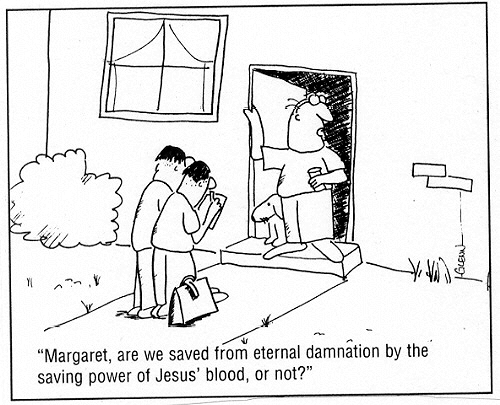


 Outreach and evangelism are among the most important responsibilites the Christian has to his/her community. They are also perhaps the most intimidating.
  We’ve seen it coming. It has become more iminent with each turn of the calendar page. But somehow, perhaps naively, I had hoped it would never arrive. But at the 218th General Assembly of the


 Last week I became rightfully angry at one of my children. (I won’t say which one.) But in my anger I sinned against him. (Okay, the ‘him’ narrows it down some.) I had neglected the counsel of King David, who wrote: “In your anger do not sin.” (
 GRACE & PEACE