Author: Dennis Griffith

  • Work of Prayer

    Prayer is work.  To be effective in prayer takes discipline and diligence, both of which are necessary ingredients in any successful endeavor.  If we suggest prayer is not work then I think we deceive people, and perhaps ourselves.  We may enjoy praying, as we might our jobs, but it is work nevertheless.

    But prayer also works.  I don’t mean this as a simple cliche.  I have in mind the power and effectiveness that results from the labor of prayer. 

    I was reminded of this a few weeks ago when I passed by an adult bookstore semingly too close to a local elementary school.

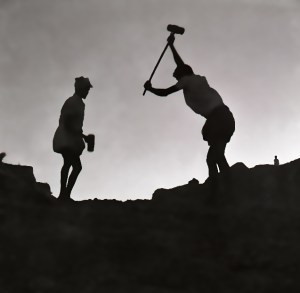
    I wondered: How much effort would it take for one person to clean out an adult bookstore, or a seedy bar, and turn it into something useful and beneficial?  How much actual labor?  One would have to go in and discard all the inventory. That would certainly be hours and hours of work, to haul that stuff to a rented dumpster or the back of a pick-up truck.  If someone was undertaking this project on his spare time, it is reasonable that this initial phase alone could take days, or even spread out over a few weeks.  Then would come the need to clean up (which might even come first).  Everything would need to be scrubbed down and sanitized.  I imagine that would be several more hours, at least.  Then comes the fix-up, when painting and other details are put in place…

    You get the idea.  To make a dent, even in a small facilty, would take hours and hours of backbreaking work.  Obviously, the time and energy would be cut down if others help in this project. 

    It strikes me that effective intercessory prayer is like that. 

    Let me explain:

    God, in his sovereignty and providence, has placed his people (the Church) in particular places at particular times in history in order that we might be living expressions of the Kingdom of God. Our goal should not be to merely carve out a niche within our neighborhoods but the transformation of the whole community where God has placed us. (See Jeremiah 29.7)  To be satisfied with having a safe place within the community seems to me like just cleaning out one room in that adult bookstore and leaving the rest in tact.

    Such transformation takes time and diligent effort.  But little by little things change and can shape up. However, it is God who does the heavy lifting for what would be back-breaking work for us. In many cases this work would be impossible for us.

    Our work is to be diligent in prayer, focused and clear about what we see needing to be accomplished in a particualr place, or in a specific life.  We are not always certain about the amount of work that really needs to be done, or how much time it might take; and we may not find those things out until the work is underway. Change takes time, but it comes.  And if we are assisted by others who partner with us in intercession, the job is a little easier, and more enjoyable.

    Prayer is the work we do.  And prayer works.
  • Mundane is Glorious

    Mark Altrogge is a name some may recognize as the author of such worship songs as I Stand in Awe and I’m Forever Grateful.  Most probably won’t recognize the name or the songs.  Mark is also a pastor in Western Pennsylvania, affiliated with the Sovereign Grace Ministries network.

    Mark has written a recent post, Mundane is Glorious, that touches on something the Lord is – and has been – teaching me.  I’m a slow learner. But Mark’s post is encouraging.  It helps me deal with my glaring lack of greatness.  He reminds me that it is not greatness that necessarily honors God, but faithfulness:

    [God is] no more glorified by the pastor preaching to thousands than he is by the Mom trying to get her one-year-old to eat his Gerber peas for the hundredth time.

    [God is] no more blessed by the man who leads thousands in worship than by the dad who runs a high lift all day, plays catch with his kids after dinner, and falls asleep reading a Bible story to his kids before bed.

    If you ever wrestle with wonder about how God can, and does, view a life that is common, ordinary, and seemingly unremarkable, check out Mark’s post.  It is is a refreshing, and godly, perspective.

  • Prayer at the Plate

    The World Series begins tonight, and I’ve been thinking about prayer. What do those things have in common?  Perhaps not much. But consider:

    We all like home runs. We like to watch them. And if we are playing, we like to hit them.  But if a player goes to the plate trying to hit a home run with every swing, he will usually strike out and end up on the bench.  Effectiveness is found in making contact, and usually hitting a lot of singles that add up to runs.  

    I think this is where baseball and prayer might connect. 

    In prayer we also like the home runs – those things that are so amazing that we stand in awe when we see God at work and our prayers answered.  Even if we are not the one who offered the prayer, we like to watch and hear stories of others who had prayers answered in a BIG way.  We seem to admire those who are gifted for prayer, and may even be a little envious.  But the fact is, when we pray most of the time we will not hit homers.  Many times the situation does not even call for it. Yet faithful singles add up.  If we understand this we are less prone to get frustrated or disappointed.  And occasionally a surge of power will amaze us.

    By the way: Go Phillies!!

  • Prayer: A Way to Take Your Spiritual Pulse

    We may judge the state of our hearts by the earnestness of our prayers.  You cannot make a rich man beg like a poor man; you cannot make a man that is full cry for food like one that is hungry.  No more will a man who has a good opinion of himself cry for mercy like one who feels that he is poor and needy.

    The symptoms of spiritual decline are like those which attend the decay of bodily health. It genreally commences with a loss of appetite and a disrelish for spiritual food: prayer, reading the Scriptures and devotional books. Whenever you perceive these symptoms, be alarmed, for your spiritual health is in danger. Apply immediately to the Great Physician for a cure.

    The best means of keeping near to God is the [prayer] closet. Here the battle is won or lost.

    If a man begins to be impatient because his prayers for any blessings are not answered, it is a certain proof that a self-righteous dependence on his own merits prevails in his heart to a great extent; for the language of impatience is: “I deserve the blessing; I had a right to expect that it would be bestowed, and it ought to have been bestowed ‘ere this.” 

    It is evident that a man who feels that he deserves nothing will never be impatient because he receives nothing; but will say: “I have nothing to complain of, I receive as much as I deserve.” 

    Again, when a man wonders, or thinks it strange, that he does not receive a blessing for which he has prayed, it shows he relies on his own merits. The language of such feeling is: “It is very strange that I, who have prayed so well and so long, and had so much reason to expect a blessing, do not receive it.” 

    Persons who feel truly humble, on the contrary, are surprised, not when blessings are withheld, but when they are bestowed.  It appears very strange and wonderful to them that God should bestow any favors on creatures so unworthy as themselves, or pay any regard to prayers so polluted as their own. 

    This is the temper to which every person must be brought before God will answer his prayers.

    ***

    This is a reflection from Dr. Edward Payson, 19th Century Evangelical from Portland Maine. 

    While Payson is largely unknown today, during the first half of the 19th Century he was among the most well known in America, and was referred to as ‘Praying Payson from Portland Maine’.  Payson’s writings, though a couple hundred years old, are refreshing, and contemporary in both thought and style. There is none of the stilted language often associated with writers from previous centuries. 

    I plan to add more of Payson’s reflections in the weeks and months ahead.

  • Sharing the Father’s Welcome

    Tim Keller’s new book, The Prodigal God: Recovering the Heart of the Christian Faith, will be released in a few weeks, on October 31. In the book Keller presents a powerful expression of the gospel, rooted in the parable of the Prodigal Son.  Having heard Keller teach from this parable, I am looking forward to the written form.

    But Keller’s insights were not developed in a vacuum.  They were cultivated by careful and thoughtful study and prayer. They were built upon a foundation of those who had walked before him, like Edwards and Chalmers. And they were influenced by the wisdom of those who invested in him. Among them, Dr. Ed Clowney, former president of Westminster Seminary, whom Keller credits in the Introduction of this upcoming book as having provided the inspiration: 

    Many excellent studies have been written on this Biblical text over the last several years, but the foundation for my understanding of it was a sermon I heard preached over thirty years ago by Dr. Edmund P. Clowney. Listening to that sermon changed the way I understood Christianity. I almost felt I had discovered the secret heart of Christianity.  (Click: article.)

    Crossway Books has made available Clowney’s sermon, Sharing the Father’s Welcome.  I hope it not only whets you appetite for Keller’s upcoming book, but that it opens your eyes to see how high and wide and long and deep is the love of God for we, his children.

    (NOTE: My thanks to Justin Taylor of Between Two Worlds for tipping me off about this.)

  • Frontline Prayer


     Jack Miller, in his book Outgrowing the Ingrown Church, makes a distinction between two types of prayer meetings: Maintenance and Frontline. Miller confesses to having led both kinds in churches he  pastored. 

    Here is how Miller describes each:

    The Maintenance meeting was largely designed to maintain the the existing life and ministry of our congregation. Believers came to be edified by a Bible study that took up most of the hour and to pray for the internal needs of the church.  Expectancy seemed to be at a low ebb among the attenders, evidenced by the fact that none of us bothered to keep a record of prayers offered and answered. I also do not think that Christians came to this prayer meeting expecting to meet God in a life-changing encounter.”

    “…The conception and format were designed more to preserve the status quo…” 

    In other words, Miller is saying that people came to the meeting, perhaps out of a sense of duty, and perhaps a sincere priority. They may have acknowledged that God was present because, afterall, God said he would be. But they were not in any way effected because of God’s presence. And the prayers offered were probably from the sick list, and for some generic “blessing” on various ministries and programs.

    On the other hand,

    “By contrast, people came to the Frontline prayer meeting to be changed. They discovered what Augustine had emphasized, that man’s chief need is to fellowship with God, to find fulfillment in Him, and to experience the abiding presence of Jesus. (Psalm 27.4; Psalm 36.7-9; John 14.18-23; John 15.1-10)  So they came to be changed, and they were changed because Jesus kept his promise to be wherever two or three gather in his name. (Matthew 18.19-20)  From him they received grace to confess and forsake their sins, to be touched with his compassion for the lost, and to go forth to ‘put feet on their prayers’ through witnessing by words and deeds of love.”

    “…The Frontline prayer assembly has a revolutionary purpose.  The prayer of those who attend it is summarized in the words: ‘Thy Kingdom Come’.  Their spirit imparted desire is to see the power of God’s kingdom revealed and to see the social segregation of the ‘turned-in’ church replaced by a welcoming community of faith and love.

    Having spent most of his pastoral ministry leading the maintenance oriented church, and despearate to experience the presence of God, Miller “began to pray for the Spirit’s presence… with almost everything I did.  I especially began to pray with shameless boldness for his working in our prayer meeting.  I asked God to give us His Spirit that we would know how to pray, that our hearts would be surrendered to His missionary will, and that we would leave the prayer meeting freed of guilt and fear and ready to witness fearlessly for Christ.”

    Frequently Miller asked God to visit the church and equip the people with three things:

    1. His self-forgetting love for others.

    2. his wisdom for praying specifically and intelligently

    3. His boldness for prayer and risk-taking witness.

    Miller says a Frontline Prayer Meeting itself becomes an expression of kingdom power when the following conditions are met:

    1. Faith/Expectancy

    A minimum of two or three believers gathered together to devote themsleves to prayer and confidently claim Jesus’ promise to be present with them. (Matthew 18.20; Acts 1.13-14; Acts 2.42)

    2. Oneness of Purpose

    A seeking of “agreement” (Matthew 18.19) or “one-mindedness” (Acts 1.14; Acts 2.1; Acts 4.24; Romans 15.5-6) on key subjects for prayer.

    3. Authority

    A humble but bold claiming of the authority of Jesus’ name in making requests of the Father. (Matthew 18.20; John 15.16; John 16.24)

    4. Commitment

    A surrender to the will of Christ as revealed in the Great Commission, and a willingness to take “risks” in obeying that will.  (Acts 1-4)

    As our church, Walnut Hill Prebyterian, ventures into 40 Days of Prayer, on our journey toward becoming a House of Prayer, we would be wise to learn from Jack Miller’s insight and experience.

    Lord, be gracious to us, and shine your face upon us.”

  • Becoming a House of Prayer

    Jesus said:

    My house shall be called a House of Prayer for all Nations.”

    It is my dream for our church, Walnut Hill Presbyterian, to become a House of Prayer.  That dream is shared by the Elders of the church, and by several members. 

    Don’t get me wrong. Walnut Hill is, in many respects, a praying church.  We have a number of faithful & powerful prayer warriors among our number.  Wednesday evenings were set apart for a service of prayer long before I arrived on the scene a little over a year ago.  And each Saturday morning the Elders meet at the church at 7:30am to pray for our members and our community. (This is another practice that was already in place before I returned to Tennessee.) 

    I don’t know how one would gauge such a thing, but I suspect that Walnut Hill would rank among the upper percentiles for prayer among churches in the USA.

    But still, that is not what I am hoping for.  It is not the same thing.  There is a difference between a praying church and a House of Prayer. In fact, Cheryl Sacks, in her book The Prayer Saturated Church, lists several differences:

    1. A church that prays may have a limited number of people involved in a prayer ministry; A House of Prayer involves the entire congregation.

    2. In a praying church there may be little, or even no, regular emphasis from the pulpit about the ministry of prayer; A House of Prayer regualarly teaches and emphasizes the priority of prayer from the pulpit.

    3. In a praying church very little training is offered to people to prepare them for prayer. It may be assumed that prayer is easy, and people already know how to pray.  In a House of Prayer it is recognized that prayer can be hard work, and many people feel inadequate about their prayer life. Therefore classes, seminars, and other opportunities for prayer and training in prayer are offered.

    4. In a praying church it may be that only a few leaders attend prayer meetings, with no regular commitment. In a House of Prayer ALL leaders, and staff, have a burden for prayer, and have made it a priority in their lives to participate in the prayer meetings.

    5. In praying churches groups or committees open with prayer as an item on the docket or agenda. In a House of Prayer groups spend time praying together, pray at regular or spontanious times throughout the meeting, and set times of prayer in addition to regular meetings. 

    6. In a church that has a prayer ministry, there may still be something that is lacking in the atmosphere because prayer may be feeble. In a House of Prayer there is a fresh flowing of the presence of the Holy Spirit that permeates the atmosphere of the church. 

    7. In churches that pray members have the freedom to pray; In a House of Prayer there is a natural flow of prayer going on throughout the church.

    8 In a church that prays, having a ministry staff person is not recognized as a viable part of the church staff. In a House of Prayer a prayer coordinator is an essential member of the staff, and may even be a paid staff member.

    These are just some of the distinctions. Some are subtle, while others are glaring, differences.  (Click to read Slacks actual and complete list: God’s Standard.)

    Another difference between a church that prays and a House of Prayer is the focus and substance of the prayers offered.  Jack Miller, in his book Outgrowing the Ingrown Church, makes the distinction between two types of prayer meetings: Maintenance or Frontline. Miller confesses to having led both kinds in churches he had pastored.  I will offer more insight about what Miller says about these in another post, but here is the essence of each: 

    Maintenace prayer meetings focus on perpetuating the status quo. Prayers are offered with little expectancy, and usually from the hosptial list and for some generic ‘blessing’ on the ministries and programs of the church.

    Particiapnts in the Frontline prayer meetings expect to encounter God, and to be changed as a result of that encounter.  The prayers offered are specific expressions of “Thy Kingdom come. They Will be done…”  In other words, the purpose is, by God’s grace and power, to advance Christ’s Kingdom. 

    There are a number of reasons why many churches are not as effecive in prayer as they might hope to be.  Chief among these reasons are probably:

    1. Prayer is hard work.

    2. People don’t know how to pray.

    You might be surprised that I suggest people don’t know how to pray.  But you shouldn’t be.  This disciples, who were mentored by Jesus, didn’t know how. That’s why thay asked: “Lord, teach us to pray.” (Luke 11.1)   Apparently effective prayer is something that needs to be learned. It takes work.

    We want to take some steps toward becoming a House of Prayer. 

    Beginning Sunday October 5, Walnut Hill Church will participate in 40 Days of Prayer. During these next eight weeks we will coordinate our Sunday School classes with our morning messages; and we will encourage one another to make prayer a more focused part of our daily lives.

    While effective prayer will always be hard work, to alleviate some of the practical difficulties that often hinder people from getting started we will: 1) supply church members with some tools to assist them in prayer; 2) introduce new opportunites to pray for our neighbors and community through PrayerWalking. (If this is a new concept to you, click: Practical PrayerWalking, to read a brief introduction by WayMakers.  Also click on What is PrayerWalking? and How to PrayerWalk on the WayMakers page.)  

    If you are a part of the Walnut HIll family, we ask that you join us on this journey.  Whether you are part of Walnut Hill or just someone who stumbled on this page, we ask that you pray for us: that God, by his grace, and for his glory, would transform us into a House of Prayer.

  • Valley of Vision


    My friend David Zavadil has begun posting the beautiful prayers from The Valley of Vision, a collection of Puritan prayers & devotions.  Inspired by his example I want to do the same thing. 

    I don’t plan to make this a regular practice, but one prayer, the one giving the title to the book, has always been particularly moving to me.  I also think it is appropriate, both spiritually and geographically, for Walnut Hill, the church I serve as pastor.  Take a moment to read and reflect.  And I invite you to pray this for our church:

    Lord, High and Holy, Meek and Lowly, You have brought me to the valley of vision, where I live in the depths but see you in the heights; hemmed in by mountains of sin I behold your glory.

    Let me learn by paradox: that the way down is the way up, that to be low is to be high, that the broken heart is the healed heart, that the contrite spirit is the rejoicing spirit, that the repenting soul is the victorious soul, that to have nothing is to posess all, that to bear the Cross is to wear the crown, that to give is to receive, that the valley is the place of vision.

    Lord, in the daytime stars can be seen from the deepest wells, and the deeper the wells the brighter your stars shine; Let me find your light in my darkness, your life in my death, your joy in my sorrow, your grace in my sin, your riches in my poverty, your glory in my valley. 

  • Pastors & REAL People

    My friend Nathan Lewis has written a profoundly heartfelt, insightful post titled: Why So Many Pastors Don’t Get Close to Church Members.

    Nathan is an excellent writer, and has a broad spectrum of interests, so that he has written a good post is no surprise.  But the theme he dares to address treads into sensitive territory: the relationships between church members and pastors.  And this post will be beneficial to those in both categories.

    It is important for pastors because he expresses the pains and vulnerabilities that all pastors – and their families – have to live with.  There is a sort of catharsis in knowing that someone understands.  While not wishing the pain on anyone else, it is nice to know you are not alone -and that it is not just you!

    But I think it would also be beneficial for the average church member to read Nathan’s post, and consider his reflections.  Why? Because I don’t think most church members have any idea about this dynamic; this tension that pastors, and their families, have to live with.  I think it would be helpful if you understood.  It might answer some questions you have about the way your pastor, or former pastors, have related to you.  It might give you some insight about the psyche of your pastor and his wife.  At the very least it will help you to know how to pray for your pastor.

    Like Nathan, I have always chosen to befriend instead of keeping a distance. And like Nathan I have experienced the pain of rejection that accompanies the departure of a friend.  Still, I cannot imagine functioning any other way.

    Whether you are a pastor or a REAL person, take a moment to read Nathan’s post.

  • 10 Practical Preparations for Hearing the Word of God on Sunday Mornings

    1. Pray that God would give you a good and honest heart.
    The heart we need is a work of God. That’s why we pray for it. Ezekiel 36:26, “I will give you a new heart.” Jeremiah 24:7, “I will give them a heart to know Me.” Let’s pray, “O Lord, give me a heart for you. Give me a good and honest heart. Give me a soft and receptive heart. Give me a humble and meek heart. Give me an fruitful heart.”

    2. Meditate on the Word of God.
    Psalm 34:8, “O taste and see that the LORD is good.” On Saturday night read some delicious portion of your Bible with a view to stirring up hunger for God. This is the appetizer for Sunday morning’s meal.

    3. Purify your mind by turning away from worldly entertainment.

    James 12:1, “Putting aside all filthiness and all that remains of wickedness, in humility receive the word implanted, which is able to save your souls.” It is astonishing  how many Christians watch banal, empty, silly, trivial, titillating, suggestive, immodest TV shows. This makes us small, weak & worldly, and inauthentic in worship. Instead, turn off the television on Saturday night and read something true and great and beautiful and pure and honorable and excellent and worthy of praise (Philippians 4:8). Your heart will unshrivel and be able to feel greatness again.

    4. Trust in the truth that you already have.
    The hearing of the word of God that fails during trial has no root (Luke 8:13). What is the root we need? It is trust. Jeremiah 17:7-8 says, “Blessed is the man who trusts in the LORD and whose trust is the LORD. For he will be like a tree planted by the water, that extends its roots by a stream.” Trusting in the truth you already have is the best way to prepare yourself to receive more.

    5. Rest long enough Saturday night to be alert and hopeful Sunday morning.
    1 Corinthians 6:12, “All things are lawful for me, but I will not be enslaved by anything.” I am not laying down any law here. I am saying there are Saturday night ways that ruin Sunday morning worship. Don’t be enslaved by them. Without sufficient sleep, our minds are dull, our emotions are flat, our proneness to depression is higher, and our fuses are short. So decide when you must get up on Sunday in order to have time to eat, get dressed, pray and meditate on the Word, prepare the family, and travel to church; and then compute backward eight hours and be sure that you are in bed 15 minutes before that. Read your Bible in bed and fall asleep with the Word of God in your mind.                                                                                                                                   

    NOTE: Parents, teach teenagers that Saturday is NOT the night to stay out late with friends. If there is a special late night, make it Friday. It is a terrible thing to teach children that worship is so optional that it doesn’t matter if you are exhausted when you come.

    6. Forebear one another Sunday morning without grumbling and criticism.
    Psalm 106:25, “They grumbled in their tents; they did not listen to the voice of the LORD.” Sunday morning grumbling and controversy and quarreling can ruin a worship service for a family. When there is something you are angry about or some conflict that you genuinely think needs to be talked about, forebear. Of course if you are clearly the problem and need to apologize, do it as quickly as you can (Matthew 5:23-24). But if you are fuming because of children or spouse delinquency, forebear – that is, be slow to anger and quick to listen (James 1:19). In worship open yourself to God’s exposing the log in your own eye. It may be that all of you will be humbled and chastened so that no conflict is necessary.

    7. Be meek and teachable when you come.
    James 12:1 “In meekness receive the word implanted, which is able to save your souls.” Meekness and teachability are not gullibility. You have your Bible and you have your brain. Use them. But if we come with a chip on our shoulder and a suspicion of the preaching week after week, we will not hear the Word of God. Meekness is a humble openness to God’s truth with a longing to be changed by it.

    8. Be still as you enter the room and focus your mind’s attention and heart’s affection on God.
    Psalm 46:10, “Be still, and know that I am God.” As we enter the sanctuary, let us come on the lookout for God and leave on the lookout for people. Come with a quiet passion to seek God and his power. We will not be an unfriendly church if we are aggressive in our pursuit of God during the prelude and aggressive in our pursuit of visitors during the postlude.

    9. Think earnestly about what is sung and prayed and preached.
    1 Corinthians 14:20, “Brethren, do not be children in your thinking; yet in evil be infants, but in your thinking be mature”. So Paul says to Timothy, “Think over what I say, for the Lord will give you understanding in everything” (2 Timothy 2:7). Anything worth hearing is worth thinking about. If you would take heed how you hear, think about what you hear.

    10. Desire the Truth of God’s Word more than you desire riches or food.
    1 Peter 2:2 “Like newborn babies, desire the pure milk of the word, so that by it you may grow in respect to salvation.” As you sit quietly and pray and meditate on the text and the songs, remind yourself of what Psalm 19:10-11 says about the Words of God “More to be desired are they than gold, even much fine gold; sweeter also than honey and drippings of the honeycomb.

    *Taken from John Piper’s Taste & See.

  • Making the Most of Worship

    Worship is the most important activity that a believer participates in during any given week.  My purpose is not so much to make that case in this post as it is to offer some suggestions about how we might get the most out of the worship experience. 

    In short, like anything else worth doing, it takes some preparations. 

    The following suggestions, taken from Reverend Joseph “Skip” Ryan, former pastor of Park Cities Presbyterian Church in Dallas, Texas, are some that I’ve found particularly helpful:

    1. RECOGNIZE:  Corporate worship grows out of personal worship.  Therefore, the most fundamental preparation for Sunday worship is that which flows from presenting yourself as a living sacrifice to God (Romans 12:1-2) and having a broken and contrite heart (Psalm 51:1-10).

    DO:  Ask God for a heart of worship and brokenness each day.

    2. RECOGNIZE:  You cannot expect to rush into church after an exhausting Saturday night and “be worshipful.”  A late Saturday night may be necessary and fun, but if you always get less sleep than you need and are tired in church, can you be alert and attentive to the majesty and presence of the Lord?

    DO: Get a good night’s sleep before Sunday worship.

    3. RECOGNIZE:  You must have a fertile heart Sunday morning.

    DO:  Spend time alone with the Lord Sunday morning before coming to church (Psalm 5:3).

    4. RECOGNIZE:  You cannot prepare adequately just before worship if you are late.  If you are parking the car, you have missed the beginning of worship.

    DO:  Plan to be in your seat at least five minutes before the service starts.

    5. RECOGNIZE:  God is in our presence when we gather for worship; He constitutes us as a worshipping assembly (Hebrews 12:23).

    DO:  Come, conscious that God is present.

    6. RECOGNIZE:  There is a healthy balance between greeting friends and being quiet before the service starts.

    DO:  Be quiet before worship, pray or read a psalm, the prayer at the top of the program, the responsive reading or a creed.

    7. RECOGNIZE:  Worship centers around the Word read, preached, and heard, for the Word is God’s living voice speaking His will to us.

    DO:  Listen carefully to the Word read and preached; give the sermon full attention; pray to learn from it.

    8. RECOGNIZE:  Worship is much more than hearing a sermon.  The first half of the service is not “window dressing” or a warm-up for a message.

    DO:  Concentrate on the meaning of each part of the worship as it occurs.

    9. RECOGNIZE:  Worship also centers around the Sacraments – ordinances instituted by Christ for the benefit of the believers.

    DO:  Participate in the Sacraments:  Baptism – reaffirm and “improve upon” your own baptism.  Communion – attend and expect Christ to minister to you.

    10. RECOGNIZE:  Worship should change us.

    DO:  During the minute of silence following the benediction, resolve to do one concrete thing on the basis of your worship (Romans 12:2).

  • Tips That Change the Taste of Worship

      As a pastor I have come to understand that some people have difficulty concentrating throughout the Sunday message.  Sometimes it’s just me people can’t follow. But sometimes it is them.  It may be a short attentioon span, external distractions, or just the overwhelming wealth of insight being offered. (That last one is my favorite.) 

    If you’ve ever found yourself to be one that occasionally experiences this problem, let me offer a few practical tips. These are far from perfect, and certainly not exhaustive, but I think they are helpful:

    1. Write It Down

    Many educators will tell you to write things down because it helps you focus and remember.  Often, after writing something down, you’ll find you don’t even need to go back to your notes to recall what you wrote. 

    I find it interesting that in Deuteronomy 17.18 we learn that every time a new king was installed in Israel he was to write the entire Law of God out by hand. He had to write it himself. He could not delegate it to anyone else.  He could not dictate to his secretary.  But taking pen in hand, the new king had to transcribe the whole thing himself.  The expected result, we learn in v. 19, was that the new king would revere the Lord and follow the law carefully.  I suspect that what is also true, but has no need to be stated, is that the king will remember the Law. 

    2. Pray It In

    When you hear something that strikes you, if the Lord impresses something on you, during the course of the message, stop and pray right then.  Whether it is something that challenges you, encourages you, or even convicts you, ask the Lord to apply it to your life right then.  (This is also true during other parts of the service.  You may be struck by somethng in a hymn, or during a prayer. Pray it in.)

    A church service is supposede to be more relational than academic.  The Lord promises his presence among his people.  It should be a time of interaction between you and God.  As he speaks to you, deal with it at that moment.

    3. Give It Out

    After you write it down and pray it in, don’t neglect to give it out. Tell someone about it. If you are married, share your insight with you spouse on the way home: “Honey, do you know what struck me today?” 

    When you give it out it becomes part of your life.  Your insight may also prove benficial to the one you share it with.  And giving it out also promotes unity, a oneness, because you are opening up and sharing what God is doing in your heart and life.   

    4. Move Around

    No, I don’t mean you should get up in the middle of the message.  I mean, don’t always sit in the same place. 

    While the first three are pretty simple, and probably will not receive much negative response, this  suggestion poses some risks. It may not only seem strange, but the very notion violates some long standing personal traditions.  I’m convinced that whole sanctuaries were built around some people – probably built while they were sitting in one particular spot! God have mercy on the visitor who sits in what he/she consider to be “MY” place.

    But this suggestion is not as silly as it may at first seem. 

    Studies have shown a direct correlation between academic success levels and where a student sits in the classroom. (I usually sat in the back, which probably says a lot.)  Perhpas it could also have some effect spiritually.

    Now, I am not suggesting that those who sit up front are actually more spiritually mature than those in the back.  Spirituality has nothing to do with geographic location.  But there is an attitude that can creep in. Sitting in the same spot, week after week, year after year, things can become a little stale. 

    Moving around every once in a while offers a new, refreshing perspective.  You see things from a different angle, which seems to stimulate the attention span. You are surrounded by different people, which not only creates a different worship environment, it is also a great way to expand unity within the church.

    It’s amazing, but sitting in a different place almost makes it seem like a whole different church, regardless of the size of the sanctuary. 

    So move around, and mix it up.

  • Wheting Our Apetite for Worship

    Worship does not satisfy our hunger for God – it whets our appetite… Our need for God is not taken care of by engaging in  worship – it deepens… It overfloows the hour and permeates the week…

    – Eugene Petereson

  • Pigs & Politics? Plee-aze, No More!


    Let’s get some perspective.  I am chagrinned to see the current state of our election process.  Not enough substance, and too much knit-pickey junior highish rhetoric.  The most recent example of it this week being the accusations that Barrack Obama dissed Sarah Palin by calling her a pig.  I’m not an Obama supporter, but I don’t think so.

    I saw the video of Obama’s speech in Lebanon, VA, where he said: “You can put lipstick on a pig, but it’s still a pig”, and really thought nothing of his comments. It was obvious that he was trying, yet again, to link John McCain with George W. Bush.  That’s fair game. To read anything else into it says more about the listener than the speaker.

    But I will admit, when I saw it a second time, after people started making a big deal out of his “Pig in Lipstick” anaology, I did notice something.  The crowd seemed to infer something that Obama did not seem to intend.  Obama appears to have quickly recognized what they were reacting too. He may have even been somewhat amused by their reaction.  But all he did was finish his thought.  No slam. No sexist implications. Just politics. 

    While I expect nothing of substance from the media, I am disappointed with the two campaigns.

    The McCain people should have simply ignored it.  Perhaps more appropriate, Sarah Palin should have risen above it all, and released a statement that Obama was not talking about her.  I realize that this would have then become a missed opportuity at keeping the Obama people off their game. But that’s precisely the problem that causes me disappointment.  Both campaigns are treating this campaign like a game – a childish game.  And the presidency is not a game.

    My disappointment in Obama is because of his response to the accusations.  I understand what it is like to be misunderstood, to have your words twisted and applied in a way that they were never intended. It is very frustrating. I understand that there are people out there just looking to take offense, and willfully look for every opportunity to do so.  And I believe, in this case, Obama has fallen to just that trap.  However, his response was shrill, and, I think, weak.  Rather than recognizing that even his own supporters inferred something, and then disarmingly and firmly reiterating his intended point, Obama moved back into the junior high level himself.  With a feaux bravado, he declared: “Enough!  I’ll not have another election stolen…” 

    Mr. Obama, no election has been stolen. Recent elections have simply been lost. 

    Why do I write about this? Well, because I’m praying for both of these guys who are running for president. And I’m praying for our country.  I’d like to see that these guys are taking seriously the problems and challenges facing the people they hope to lead.  It’s time that they get back to thinking and acting like grown-ups.  It’s time they act like leaders.

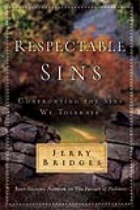
  • Respectable Sins

    One of the books on my bedside table is Respectable Sins, by Jerry Bridges.  The subtitle of the book is: Confronting the Sins We Tolerate. The theme becomes self explanatory. 

    In his preface Bridges explains the motive behind the book:

    “The motivation for this book stems from a growing conviction that those of us whom I call conservative evangelicals may have become so preoccupied with some of the major sins of society around us that we have lost sight of the need to deal with our own more “refined” or subtle sins.”

    I think Bridges is correct.  The whole notion of sin seems to have been lost on our society, and confused in our churches. 

    Conservatives often lament the absence of any sense of, or concern about, sin reflected in our society.  In this glaring absence in our collective cultural conscience we have seen the arrival of government sanctioned killing through abortion and euthanasia; the crumbling of the family due to divorce, rampant pornography, and the redefining of it to embrace homosexuality as an acceptable norm; and a widespread apathy toward God. Those who speak out about such matters are right to be concerned.  The problem is that while we talk about those things that are infecting others, we are failing to address the very real sin in our own lives.  And we are therefore seen to be hypocrites – and probably rightly so.

    Jesus instructed his followers to “first take the plank out of you own eye, then worry about the speck in the eye of another.”  I am not suggesting that those sins that are freely expressed in our society are minor specks.  They are not. They are serious.  And I am convinced that if we heed Jesus’s perscriptive counsel we will again experience the moral authority to speak. 

    More serious than even the loss of our moral authority, many Evangelicals are confused about how we relate to God.  We have become disconnected from our own need of the Gospel, and our need of it every day. We fail to see the subtle, yet serious, ways we function as “unbelievers” and tolerate cancerous sin in our own hearts and relationships.  In fact, as the title of Bridges’ book suggests, we have not merely tolerated these things, but have functionally elevated them to a level of respectability.

    Recognizing our sin, despite how it may seem, is not an entirely ugly proposition.  It is important to our spiritual vitality.  And makes practical sense. 

    Let me explain it this way: We should be at least as concerned about our spiritual vitality as we are about our computers. 

    I regularly receive updates from McAfee, and I run a scan on my computer at least a few times a week. Why? Because I have experienced the slow down, the unresponsiveness, and even a crash when I failed to have my computer checked for viruses that can infect it.  Once McAfee has performed a scan, if it has identified any potential threats I am able to deal with it. I either delete it, or in some cases quarantine the file. But either way, my computer functions much better because I have taken the time to perform this taks.

    Sin in our lives, even that which seems minor, infects our hearts, our perceptions, our relationships, even our productivity.   We need to “scan” our hearts and lives regularly to see if there is anything there that may cause problems down the road. (This is what the Psalmist is advocating in Psalm 139)  Once we determine if there is anything there we can deal with it accordingly. In taking the appropriate precaustions we prevent problems because we are more able to keep things from spreading over and infecting other areas of our lives.

    Despite what you may suspect due to my ranting thus far, this book is actually very positive, practical, and encouraging. 

    In chapters 1-4 Bridges does a wonderful job explaining the Gospel, its practical importance, and its important practicality.

    Chapter 5 discusses the Power of the Holy Spirit, and expalins how the Spirit is at work in the Gospel.

    Chapter 6, titled: Directions for Dealing with Sins, serves as a practical preface to the rest of the book.  This chapter alone would be worth the price of the book, because it shows us how we can practice preaching the Gospel to ourselves. 

    Chapters 7-20 deal with specific “acceptable” and “respectable” sins.  I have deeply appreciated Bridges’ talent for defining words of our Christian jargon that have at times confused me, or words that I’ve generally understood yet was still somewhat fuzzy about.  This understanding has been helpful in identifying some of the sin I carry around in my heart, and how it expresses itself in my life and in relationships..

    The final chapter, chapter 21, simply asks the question: Where Do We Go from Here?

    Each chapter is short and easily readable.  My intention is to read a few chapters a week over the next month or two so that I can digest Bridges’ insight, and deal with my own heart.  I may even journal my insights here on my blog. I haven’t decided yet.

    But one thing I have decided to do. My friend, David Zavadil, has been working through this book and posting his observations on his blog, By His Grace.  Whether I develop my own posts or not, I will join the discussion David has started. I invite you to join me over there.