Author: Dennis Griffith

  • I Asked the Lord to Grow in Grace

    This song comes from a beautiful poem by John Newton.  It is a powerful reminder to me about God’s grace and how God works.

    Like Newton in the opening lines of this poem, I often ask God to grow me in grace and faith and the fruits of his Spirit.

    I asked the Lord that I might grow
    In faith, and love, and every grace;
    Might more of His salvation know,
    And seek, more earnestly, His face.

    And like Newton expresses in the third stanza, in my mind this is something noble and therefore should be experienced mystically, gently and painlessly:

    I hoped that in some favored hour,
    At once He’d answer my request;
    And by His love’s constraining pow’r,
    Subdue my sins, and give me rest.

    Spiritual growth is easy, right? It should be automatic. Like sleeping, or breathing.  Certainly it should be no more difficult than eating, or learning to ride a bike or drive…

    (more…)

  • Fear, Worry, and Our Sovereign God

    In preparation for a message on Psalm 27, I began reading Ed Welch‘s book, Running Scared.  Penetrating. Convicting.  Comforting.  All of those words are appropriate, at least for me.  For as I have aged I have come to see how fear, often very subtle, effects my thought, actions, and reactions.  My fears may not show, but they are very present.  I have to regularly identify them and subject them to the Gospel.

    Perhaps this does not seem to be a topic for you. You may feel you have no fears.  For a long time I would have said similarly of myself – not that I had no fear, but few fears.  But I learned differently about myself.

    Interestingly, not long ago I was watching a rerun of the film First Knight, with Sean Connery & Richard Gere, set in King Arthur’s Camelot.  In one scene I overheard an interesting conversation between Connery’s Arthur and Gere’s Lancelot.  Arthur mused:

    “A man who fears nothing is a man who loves nothing; and if you love nothing, what joy is there in your life?”

    This was not the turning point in my thinking. But I did find it an interesting illustration of what I had learned. And while I do not think that it is necessarily a universally true, I do think it is a question worth pondering.

    It may not be universally true because one who loves God with all of his heart, mind, and strength, loves what is good and yet should fear little.  After all, “Perfect love casts out fear.” (1 John 4.18)   But then, which of us loves perfectly?

    But I do think, in a sense, Arthur’s statement is widely, if not universally, true.  There are many who mistake apathy for peace.  It may be that some do not fear because they do not love; And they do not love because they fear fear.  I know that is a dizzying statement. But think of it as the opposite of Franklin Roosevelt’s famous words: “There is nothing to fear but fear itself.”  What if people do fear fear?  If one knows that love is often risky, and fears fear enough, could that person not repress love because of fear?

    OK. Enough philosophizing… In short, I suspect there must be a reason God says 300+ times in the Scripture: “Do not fear.”  There must be a reason that this is the most frequently repeated command in the Bible.  My suspicion is it is because fear is a near universal component of our personalities in this fallen world. And we would be wise to recognize both our fears and their effects on our hearts and lives.

    Above is a video preview of Running Scared, featuring the author, Ed Welch.  His insights and application of God’s Word to our plight are freeing.

  • Lingering Guilt & Insulting God’s Integrity

    What do you do with the person who says: “I’ve asked God to forgive me, but I still feel guilty?”

    A noted writer (R.C. Sproul, I think) was asked [this] once.  [His reply:] “Well,  if You still feel guilty, then pray to God again, but this time don’t ask Him to forgive you for the sin that is haunting you. Rather ask Him to forgive you for insulting His integrity by refusing to accept His forgiveness. Who are you to refuse to forgive yourself when God has forgiven you…it is often a very difficult thing to accept the grace of God. Our human arrogance makes us want to atone for our own sins to make it up to God with works of super-righteousness”.

    ~ Steve Brown

  • What If We Omitted Gospel, Community, or Mission?

    The refrain from an old song says: “Two out of three ain’t bad.”  But would this be true for a church, or a Christian, who incorporates 2 out of 3 of the core values: Gospel, Community, Mission?

    Consider these thoughts, framed as a mathematical equation:

    Gospel + Community – Mission

    If we have a Gospel Community, without the mission or ‘sent’ aspect in our DNA, then we become a church that is all about ourselves.  We may love the gospel, and love that the good news has impacted our minds, and even desire to live that out with other people like us.  But living as ‘sent ones’ to our neighborhood seems too difficult.  When this happens a Christian ghetto surrounds the church, and an “us vs them” mentality is created.  This misses the entire point of the “go” in Christ’s great commission. (Matthew 28.17-21)

    Such communities of believers are often very good at living as gospel families.  They take care of each other well: they provide for one anothers’ needs, and they draw very close to one another. But the lack of  engagement with the world, and and absence of multiplication,  is  vividly evident.  Sometimes such an inward focus is even worn as a badge of honor, since it may be believed by our isolation we are not being ‘polluted’ by the world.

    Such communities usually have a heavy emphasis on bible studies, men’s groups, women’s group, children’s programs, etc.  The groups will usually have an “open invitation” to those on the outside. But because they don’t believe they are “sent” to their community, they rarely see disciples made of the un-churched people around them.   Numerical growth typically comes from like-minded people moving into their area, or through having children, or stealing the members from other churches that may offer fewer activities or which may be going through some turbulent times.  Rarely will they be faced with the general public pushing into the Kingdom, because they never engage general public with the gospel message outside the walls of their church building.

    The overall goal is usually to prompt a great understanding of the Word and theology, but it is often intellectually gluttonous and missionally starved… because the reason for the Word and theology is to drive us to glorify God and show us our role in God’s redemptive drama.  If it’s not being used towards that end then it’s being misused.

    (more…)

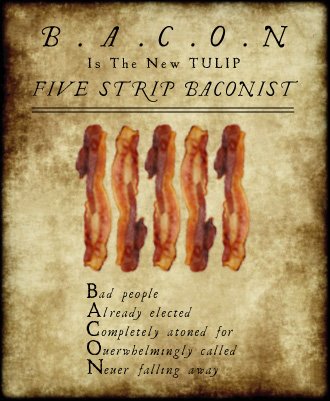
  • 5 Strip Baconist

    Are you among those people who find the 5 Points of Calvinism difficult to swallow?  Perhaps you might find some bacon  a little more tasteful than a TULIP.  No, it’s not Kosher, but it is orthodox and Biblical:

    • Bad people
    • Already elected
    • Completely atoned for
    • Overwhelmingly called
    • Never falling away
  • Broken-Down House: Living Productively in a World Gone Bad

    I began reading Paul Tripp’s Broken Down House earlier this week. I had read it before, or rather I should say I skimmed it before, but did not take the time to allow Tripp’s poignant insights to resonate in my soul.  I raced through it last time, getting the general gist, but not digesting much in the way of spiritual nourishment.  That’s a mistake I am carefully avoiding this time through.

    In Broken Down House Tripp uses the analogy of a home in serious disrepair as a reflection of our life in this world.  In the video above he introduces the themes he writes about.

  • Take a Repentance Tri-p

    On a few occasions I have posted some thoughts and things about the concept of Tri-Perspectivalism.  Tri-Perspectivalism (or, as some call it, Tri-P) is a fancy word for the simple concept of looking at our spiritual lives, and the ministry of our churches, from three distinct perspectives.  Introduced by John Frame and Vern Poythress’ monumental work on the nature of knowledge, known as perspectivalism, the concept of Tri-P simply reminds us that Jesus perfectly embodies God’s authority, compassion, and wisdom, and expresses these through his offices of prophet, priest, and king, respectively. Guys like Dick Kauffman, David Fairchild, and Drew Goodmanson, among others, have provided significant insight about how Tri-P can be – and should be – applied to build well-balanced and gospel-centered ministry teams and congregations

    I like the way a guy named Will Little summarizes the perspectives reflected by each office:

    • Prophets enjoy studying the Word of God, protecting sound doctrine, and preaching/teaching others about God with influential passion and enormous vision.
    • Priests appreciate and understand the needs of people, counsel them toward the Gospel, and get intimately involved with caring for the church and those around it.
    • Kings love to plan, organize, and implement systems in order to get things done on time (and within budget).

    Will recently composed an article for The Resurgence, titled Triperspectival Repentance, where he warns about some dangers of misapplying this concept, particularly agianst the notion of using Tri-P as a personality or temperment label, like a DISC or Myers-Briggs; and where he explores how we can deepen (if that is the right word) our experience and expressions of repentance when we see ourselves – or rather when we see Jesus more fully – though the lenses of Tri-P.

    Little points out how misuse of Tri-P can easily feed the commonly held counterfeit gospel of Moralistic Therapeutic Deism that is plaguing the contemporary church:

    • Morality: The Prophet’s Idol.

    In their flesh, prophets preach graceless rule-following, or stale doctrine, for the purpose of good behavior and/or right belief.  They will themselves be prone to derive identity and joy from success at (and control over) their personal legalisms rather than in those of God, our ultimate authority.

    • Therapy: The Priest’s Idol.

    Apart from the Spirit, priests will preach the value of emotional stability and felt needs being met over truth being proclaimed. They will miss Christ’s gospel and fall into liberalism as they derive identity and joy from counseling, serving, and caring for people, rather than the person and work of God, the Wonderful Counselor.

    • Deism: The King’s Idol.

    Kings are prone cast vision for numbers, systems, and goals. When detached from the gospel these things are often for the purpose of success rather than or more than for resting in the King of kings. King-types will succumb to deriving identity and joy from getting things done, as if God were a distant deity who isn’t involved in getting things done on our behalf.  (See Psalm 127.1)

    Martin Luther, in the first premise of his 95 Theses, observed:

    “When our Lord and Master Jesus Christ said, ‘Repent’ (Mt. 4:17), he willed the entire life of believers to be one of repentance.” 

    With this in mind, Little points out that ultimately, repentance is God’s work of changing us to focus on God, rather than on our measly attempts at performing, whether theologizing, rule-following, serving people, or getting things done. As we focus on God, we can deepen our lives of repentance by perceiving him more completely than we do now.

    • Prophets easily perceive God as the Word of God, fulfilled and embodied in Jesus as the perfect voice, vision, and revelation of God. Prophets can repent by meditating on God the Father and God the Holy Spirit, resting in the most powerful prophet, and by seeing Jesus as our perfect King and priest.
    • Priests easily perceive God as the Wonderful Counselor, working intimately as the Holy Spirit as the perfect servant of God. Priests can repent by meditating on God the Father and God the Son, resting in the most compassionate priest, and by seeing Jesus as our perfect prophet and King.
    • Kings easily perceive God as the King of kings, ruling and reigning with the authority of a perfect Father who plans, organizes, implements, and manages the universe. Kings can repent by meditating on God the Son and God the Holy Spirit, resting in the most organized King, and by seeing Jesus as our perfect prophet and priest.

    Little concludes with wonderful application:

    Too often, we reduce TriP into three buckets, give ourselves a 20-50-30 percentage breakdown (or whatever) and then work to improve our scores to try and be more like Jesus. But remember, “It is God who works in you, both to will and to work for his good pleasure.” (Phil. 2:13) If we focus on ourselves, we miss the whole point. We can instead see our gaps in the three buckets as opportunities to repent and perceive Jesus’ whole gospel, loving in deed and in truth (1 John 3:18), resting in the God who saves us and shapes us to image him as he sees fit.

  • Our Universal Need

    “Just so you know, the need for repentance, redemption, and forgiveness is universal. I don’t care if you are a liberal or a conservative, a religious fanatic or a militant atheist, a ‘spiritual’/’religious’ person or someone who runs from all that. It doesn’t matter to me if you listen to Billy Graham or follow Camus – you are in need.  No one in the human race is exempt.  Its in our DNA…

    When we finally acknowledge our need for forgiveness and come to God in repentance, we find true power; for we now have nothing to hide or protect, we don’t care what people say or think about us, we are willing to speak truth gently, and we are enabled to speak with tremendous, supernatural power.”

    ~ Steve Brown, from Three Free Sins

    NOTE: Watch a preview video and listen to Tullian Tchividjian interview Steve Brown about Thee Free Sins: here

  • Recommended Reading: Holy Spirit

    The Holy Spirit has garnered a few nicknames through the ages. Among the more appropriate and familiar:

    • The Shy member of the Trinity
    • The Forgotten member of the Trinity

    When considering the person of the Holy Spirit, there are few things that are vital to remember:

    • The Holy Spirit is a person, a “He” not an “It”.
    • As the Third Person if the Trinity, the Holy Spirit is fully God, and equal with God the Father and God the Son (Jesus) in glory, honor, and power; and equally worthy to receive worship.

    The Holy Spirit functions in specific ways:

    • Regeneration – giving life to those who are spiritually dead.
    • Salvation (Justification) – the Holy Spirit grants both faith and repentance as gifts of grace. Through these, and these alone, is man justified.
    • Sanctification – “For those whom God justifies he also sanctifies. ” In other words, there is no one who is “saved” who is not also “sanctified”.  Sanctification is both definite and an ongoing process.  In work of sanctification Believers are expected to “cooperate” with the Holy Spirit, employing the means of grace. These actions we engage in are not magical, nor automatic, as if anyone who does them will automatically grow in grace. But they are effective.  The Holy Spirit works grace in us through these means.  We normally see a corresponding maturity in those who regularly and rightly make use of the means of grace, while we see little to no change in those who are lax.  But the one constant dynamic is that the Holy Spirit grants both faith and repentance to the believer for sanctification just as he does for justification.  In other words, the Christian life consists of continual repentance and renewed belief in the gospel.
    • The Holy Spirit cultivates the Fruit of the Spirit in believers.
    • The Holy Spirit bestows Spiritual Gifts upon all who believe, for the use in participating and the building up of the local body – The Church – which together advances the Kingdom of God.

    Here are some suggested readings to grow in our understanding of the Person & Work of the Holy Spirit:

  • Embracing the Brokenness of Your Church

    This post by Tim Locke of Grace Community Church in Bridgewter NJ so captures the truth of a much needed lesson, I post it here below.

    ***

    Embracing the Broken Church!

    “I don’t feel comfortable inviting people to our church,” he said. “Why not?” I asked. “Our music isn’t upbeat enough, our people don’t sing out and the whole thing falls flat. Our people aren’t friendly. We don’t have a dynamic kid’s program. We aren’t very community-oriented.” He didn’t say all this but he and others have shared these concerns with me and other pastors that I hang with.

    More and more people are leaving their small, limited churches to attend large, super-sized, mega-churches. And if they don’t leave, they spend their time comparing their church with others and complaining about what they want but don’t have.

    Sometimes a parishioner gets a dash of spirituality and pushes the church to change. Maybe they fight to see the worship changed, maybe get a new minister, maybe a new program. Eventually they’ll probably end up leaving, but at least they can take the spiritual high ground and say things like, “Well I tried to get the church to change but they just weren’t interested.” So they leave after writing “Ichabod” over the door posts of the church (1 Samuel 4.21).

    (more…)
  • Gospel-centered Foundation

    Tom Wood and Scott Thomas explain the essence and importance of being truly gospel-centered:

    We are persuaded that the gospel must be the central foundation for effective, God-honoring biblical [leadership].  It is imperative, therefore, that we know what the gospel is and how it informs our practices. Terms like justification, adoption, sanctification, and sin are often clearly defined in several historical church documents, creeds, and confessions of the church. But there are surprisingly few classical definitions of the gospel.

    There is a reason for this.  Some have attempted to distill the deep truths of the gospel in terms of laws (the “Four Spiritual Laws, for example) or have tried to visually illustrate the message by means of a bridge.  Others summarize the main points with headings like: God, Sin, Christ, and Faith, or by giving the high points of the story arc of the Bible.  This approach communicates the gospel through movements in redemptive history and is often summarized by creation, sin, and redemption, or by creation, fall, redemption, and restoration.

    In truth, the gospel is more of a story than a simple definition.  In order to really grasp the gospel message, you have to immerse yourself in the narratives of the Bible, because transforming faith is more than just a statement that we accept; it is something that connects with both our minds and our hearts. It is a true story, rich with drama, action, and eternal significance.

    This passage is excerpted from their excellent book, Gospel Coach.

  • Recovering the Grand Cosmic Significance

    “We need to recover the grand, cosmic significance of Jesus’ saving activity that moves the gospel out of the narrow realm of self-preoccupation. One of the marvelous things about the gospel is that He has saved us so that we can be a part of His redeeming activity. The gospel, properly understood, is much broader than our concerns for personal survival, security, significance, success, or even self-centered sanctification. It presents us with a plunderer, and it bids us to throw ourselves away in the pursuit of this new world order.”

    ~ Bob Heppe

  • How to Spend a Day With God

    Richard Baxter wrote:

    A holy life is inclined to be made easier when we know the usual sequence and method of our duties – with everything falling into its proper place.

    In other words, our souls flourish most vibrantly when there is a natural rythm to our lives.  These rythms include our daily and weekly routines and practices, as well as the more occasional. Among the more occasional is just getting away from everything and spending a day with the Lord.  Such times of retreat are vital to the renewal of our hearts, especially if our daily lives are packed with a variety of stresses and/or conflicts. 

    But what about the regular days? What about times when you cannot get away?  How do we honor God and find refreshment on such ordinary days? How can each ordinary day be of use toward our spiritual renewal?

    I am indebted to Baxter for some practical directions about how to spend a day with God without having to go on spiritual retreat. I have adapted his suggestions below:

    • Sleep

    Measure the time of your sleep appropriately so that you do not waste your precious morning hours sluggishly in your bed. Let the time of your sleep be matched to your health and labour, and not to slothful pleasure.

    • First Thoughts

    Let God have your first awaking thoughts; lift up your hearts to Him reverently and thankfully for the rest enjoyed the night before and cast yourself upon Him for the day which follows.

    Discipline yourself so consistently to this that your conscience may check you when other more common thoughts begin to intrude. Think of the mercy of a night’s rest and of how many that have spent that night in Hell; how many in prison; how many in cold, hard lodgings; how many suffering from agonizing pains and sickness, weary of their beds and of their lives.

    Think of how many souls were that night called from their bodies terrifyingly to appear before God and think how quickly days and nights are rolling on! How speedily your last night and day will come! Observe that which is lacking in the preparedness of your soul for such a time and seek it without delay.

    • Prayer

    Let prayer by yourself alone (or with your partner) take place before any work of the day.

    • Family Worship

    Let family worship be performed consistently and at a time when it is most likely for the family to be free of interruptions.

    • Ultimate Purpose

    Remember your ultimate purpose (which is to gloify God by enjoying Him), and when you set yourself to your day’s work or approach any activity in the world, let “HOLINESS TO THE LORD” be written upon your hearts in all that you do.

    Do no activity which you cannot entitle God to, and truly say that he is the one who set you about it, and do nothing in the world for any other ultimate purpose than to please, glorify and enjoy Him.

    “Whatever you do, do all to the glory of God.”  ~ 1 Corinthians 10.31

    • Diligence in Your Calling

    Follow the tasks of your calling carefully and diligently.

    Thus:

    (a) You will show that you are not sluggish and a servant to your flesh (which seeks comfort, amusement, and ease), and you will further the putting to death of all the fleshly lusts and desires that are fed by ease and idleness.

    (b) You will keep out idle thoughts from your mind, that swarm in the minds of idle persons.

    (c) You will not lose precious time, something that idle persons are daily guilty of.

    (d) You will be proving obedient to God, when the slothful are in constant sins of omission.

    (e) You may have more time to spend in holy duties if you follow your occupation diligently. Idle persons have no time for praying and reading because they lose time by loitering at their work.

    (f) You may expect God’s blessing and comfortable provision for both yourself and your families.

    (g) it may also encourage the health of your body which will increase its competence for the service of your soul.

    • Temptations and Things That Corrupt

    Be thoroughly acquainted with your temptations and the things that may corrupt you – and watch against them all day long. You should watch especially the most dangerous of the things that corrupt, and those temptations that either your company or business will unavoidably lay before you.

    Watch against the master sins of unbelief: hypocrisy, selfishness, pride, flesh pleasing and the excessive love of earthly things. Take care against being drawn into earthly mindedness and excessive cares, or covetous designs for rising in the world, under the pretence of diligence in your calling.

    If you are to trade or deal with others, be vigilant against selfishness and all that smacks of injustice or uncharitableness. In all your dealings with others, watch against the temptation of empty and idle talking. Watch also against those persons who would tempt you to anger. Maintain that modesty and cleanness of speech that the laws of purity require. If you converse with flatterers, be on your guard against swelling pride.

    If you converse with those that despise and injure you, strengthen yourself against impatient, revengeful pride.

    At first these things will be very difficult, while sin has any strength in you.  But once you have grasped a continual awareness of the poisonous danger of any one of these sins, your heart will readily and easily avoid them.

    • Meditation

    When alone in your occupations, improve the time in practical and beneficial meditations. Meditate upon the infinite goodness and perfections of God; Christ and redemption; Heaven and how unworthy you are of going there and yet at the same time how awesome God’s love to you.  Remind yourself of the gospel in its various aspects.

    • The Only Motive

    Whatever you are doing, in company or alone, do it all to the glory of God (1 Corinthians 10.31). Otherwise, it is unacceptable to God.

    • Redeeming The Time

    Place a high value upon your time. Be more careful of not losing time than you would of losing your money. Do not let worthless recreations, television, idle talk, unprofitable company, or sleep rob you of your precious time.

    Be more careful to escape that person, action or course of life that would rob you of your time than you would be to escape thieves and robbers.

    Make sure that you are not merely never idle, but rather that you are using your time in the most profitable way that you can and do not prefer a less profitable way before one of greater profit.

    • Eating and Drinking

    Eat and drink with moderation, and thankfulness for health, not for unprofitable pleasure. Never please your appetite in food or drink when it is prone to be detrimental to your health.

    Remember the sin of Sodom: “Look, this was the guilt of your sister Sodom: She and her daughter had pride, excess of food and prosperous ease…” ~ Ezekiel 16.49.

    The Apostle Paul wept when he mentioned those “whose end is destruction, whose god is their belly, and whose glory is in their shame – who set their minds on earthly things, being enemies to the cross of Christ” ~ Philippians 3.18-19.  So then, do not live according to the flesh lest you die (Romans 8.13).

    • Prevailing Sins

    If any temptation prevails against you and you fall into any sins in addition to habitual failures, immediately lament it and confess it to God; repent quickly whatever the cost. It will certainly cost you more if you continue in sin and remain unrepentant.

    Do not make light of your habitual failures, but confess them and daily strive against them, taking care not to aggravate them by unrepentance and contempt.

    • Relationships

    Remember every day the special duties of various relationships: whether as husbands, wives, children, employers, supervisors, employees, pastors, church members, magistrates, citizens.

    Remember every relationship has its special duty and its advantage for the doing of some good. God requires your faithfulness in this matter as well as in any other duty.

    • Closing the Day

    Before returning to sleep, it is wise and necessary to review the actions and mercies of the day past, so that you may be thankful for all the special mercies and humbled for all your sins.

    This is necessary in order that you might renew your repentance as well as your resolve for obedience, and in order that you may examine yourself to see whether your soul grew better or worse, whether sin goes down and grace goes up and whether you are better prepared for suffering, death and eternity.

    May these directions be engraven upon your mind and be made the daily practice of your life.  If sincerely adhered to, these will be conducive to the holiness, fruitfulness, and peace in your life.

  • Two Contents, Two Realities

    Francis Schaeffer said: “there are four things which are absolutely necessary if we as Christians are going to meet the need of our age and the overwhelming pressure we are increasingly facing.” These four things are two contents and two realities:

    The First Content: Sound Doctrine 

    The Second Content: Honest Answers to Honest Questions 

    The First Reality: True Spirituality

    The Second Reality: The Beauty of Human Relationships

    Each link above will take you the substance of the respective  Contents and Realities. I am convinced they are worth consideration.  Why? Because I believe Schaeffer was right when he wrote:

    [W]hen there are the two contents and the two realities, we will begin to see something profound happen in our generation.