Author: Dennis Griffith

  • Kingdom of God is BIGGER Than Your Political Party

    A week has passed since the 2012 Presidential Election, and many (who voted like me) are still licking their wounds and awaiting armageddon.  OK. That may be a bit too strong, but that is what it has at times seemed like to speak with those who (like me) did not support the re-election of Barrack Obama.

    I understand the disappointment, and even the concerns. But what troubles me, more than anything else, is when I hear Christians demonizing other people, especially other Christians,  just because they voted for Obama.  I do not want to minimize the passions. I just want us to regain our perspective.

    Here is a penetrating question posed by one writer:

    If I feel more of a kindred solidarity with those who share my politics but not my faith than I feel with those who share my faith but not my politics, what does it say about me?

    I find that question, which I read in piece by Scott Sauls in Redeemer City to City, to be an excellent perspective-shaping querry.

    Sauls goes on, and profoundly answers his own question:

    “… It suggests that I have sold out to Rome. I have rendered to God what belongs to Caesar, and to Caesar what belongs to God.”

    Maybe you can’t bring yourself to agree with Sauls’ specific conclusion. But I hope you will find his prevailing premise resonates with you, as it does with me.  In short, if you find yourself more akin with folks who share your political persuasions than you do those who share your faith foundations, something is amiss.

    So, if either of the following describes you:

    • You are struggling with resentment about the results of our recent election, or when you find yourself in the midst of people who voted for Obama
    • You are so elated that you find it difficult to refrain from gloating and you feel twinges of subtle delight for any opportunity you get to rub Obama’s re-election in the face of your more conservative colleagues

    … let me encourage you to consider Sauls’ whole article: To My Elated & Despairing Post-Election Friends.

    Here is what I have been reminding myself for the past week: God says, “I have set my King on Zion, my holy hill.” (Psalm 2.6)  That’s all I really need to know.

    The Kingdom of Heaven is bigger than a political party.

  • Sailboat Spirituality

    Do you sometimes have difficulty understanding or remembering who does what in our Spiritual maturation? We get that it is God who must make us alive to believe (regeneration), and that he gives us the gift of faith to believe, which leads to salvation (justification).  But then what?  Surely there is something we must do.  What about spiritual disciplines? But then, how does grace work? What does the Holy Spirit do?

    I love the imagery Jared Wilson offers in his excellent book Gospel-Wakefulness:

    As long as we are thinking of achieving the fruit of the Spirit by our own efforts to be more fruitful and joyful, we may be working in their direction, but we’re getting there by the sweat of our brow.  We’ve embraced rowboat spirituality.   But think of the obedient work of the Christian life like a sailboat.  There are lots of things to do on a sailboat. Sailors don’t just sit there – at least, not for too long.  There are lots of working parts on a sailboat and lots of things to pay attention to. But none of those things make the boat go.  The boat doesn’t go unless the wind catches the sail.

    What we are picturing here is the work of the Spiritual Disciplines in conformity with the law of God found in Scriptures, not as the means of propulsion, but as the means of setting the conditions for Spiritual fertility. In obedience, we till the soil of our hearts so that they are more receptive for the planting and growth of the Word in our lives.  We obey both in response to the Spirit’s awakening us and in order to raise the sail for the Spirit’s movement.

    “If we live by the Spirit, let us also walk by the Spirit.” ~ Galatians 5.25

  • The Awakened Sinner

    O my forgetful soul, Awake from thy wandering dream; turn from chasing vanities, look inward, forward, upward, view thyself, reflect upon thyself,  who and what thou art, why here, what thou must soon be.  Thou art a creature of God, formed and furnished by him, lodged in a body like a shepherd in his tent; Dost thou not desire to know God’s ways?

    O God, Thou injured, neglected, provoked Benefactor, when I think upon your greatness and your goodness  I am ashamed at my insensibility, I blush to lift up my face, for I have foolishly erred.  Shall I go on neglecting you, when every one of thy rational creatures should love thee, and take every care to please thee?

    I confess that thou hast not been in all my thoughts, that the knowledge of you as the goal of my being has been strangely overlooked, that I have rarely seriously considered my heart-need.  But although my mind is perplexed and divided, and my nature perverse, yet my secret dispositions still desire you.

    Let me not delay to come to thee; Break the fatal enchantment that binds my evil affections, and bring me to a happy mind that rests in thee, for thou hast made me and canst not forget me.

    Let thy Spirit teach me the vital lessons of Christ, for I am slow to learn…

    …And hear thou my broken cries.

    ~ adapted from Valley of Vision

  • Recommended Reading: Marriage

    Here are a handful of recommended readings about Marriage:

  • Killing Me Softly: Putting Sin to Death

    In Colossians 3.5, the Apostle Paul commands:

    Put to death, therefore, whatever belongs to your earthly nature: sexual immorality, impurity, lust, evil desires and greed, which is idolatry.

    Based on the language Paul uses it is clear that sin is in our hearts, and it will not just go away on its own.  We need to take an active role and kill it within ourselves, like any other form of heart disease – or like weeds from a garden.  And this list is suggestive, not exhaustive – a starting point, not a few last details.

    In other words, we have a need to die to sin while we grow in grace.

    But just how do we actually do this?

    Puritan John Owen offered these profoundly helpful insights in his book, The Holy Spirit,

    Determine that you will, everyday and in every duty abolish and destroy this ruling principle of sin.  it will not die unless it is gradually and constantly weakened.  Spare it, and it heals its wounds and recovers its strength.  Negligence allows sin to regain such power that we may never recover our former state as long as we live.

    We are continually to watch out for the rising up of this ruling principle of sin and immediately subdue it.  This is to be done in all that we are and do.  We are to be watchful in our behaviour to others, watchful when we are alone, watchful when in trouble or joy.  We are to be particularly watchful in the use of our pleasure times and in temptations.

    Determine that you will no longer serve sin  (Rom. 6:6).  See it as the worst service of which a rational creature is capable.  If you serve sin it will bring you to a dreadful end.  Determine that though sin remains in you, yet you will not serve it.  Remember, if the ‘old ma’ is not crucified with Christ, you are still a servant of sin, whatever you might think of yourself.

    Realise that it is no easy task to mortify sin.  Sin is a powerful and dreadful enemy.  There is no living thing that will not do everything in its power to save its life.  So sin also will fight to save its life.  If sin is not diligently hunted down and dealt with by holy violence, it will escape all our attempts at killing it.  It is a great mistake to think that we can at any time rest from this duty.  The ruling principle of sin to be slain is in us, and so has hold of all our faculties.  Sin cannot be killed without a sense of pain and trouble.  So Christ compared it to ‘cutting of the right hand’ and ‘plucking out the right eye’.  The battle is not against any particular lust but against all sinful lusts which war against the soul.

    Mortification arising from convictions of the law leads only to dealing with particular sins, and always proves fruitless.  True mortifying of sin deals with the entire body of sin.  It goes tot the heart of the matter and lays the axe to the root of the tree.  This is the mortification which the Holy Spirit drives the believer to do.

    Mortification of particular sins arises from a guilty conscience.  But mortification arising from gospel principles deals with the whole body of sin in its opposition to the renewing of the image of God in us.

  • I Have a Shelter

    This seems like an appropriate song for the first Sunday after Hurricane Sandy.

  • Brokeness, Contrition, and Repentance = Marks of a Growing Christian

    “So Repentance begins with an attitude of brokenness over our sin. But true repentance will be followed by an earnest desire and a sincere effort to put away  the sin we are repenting of – to put on the Christlike virtues that we see missing in our lives. These efforts often seem to be characterized by failure as much as by success. But the frequent failures should bring us back to a broken and contrite heart that mourns over our sin. Brokenness, contrition, and repentance are all marks of a growing Christian, a person who is experiencing the work of the Spirit in being transformed gradually more into the image of God’s Son.”

    ~ Jerry Bridges, The Transforming Power of the Gospel

  • Fighting the Sin in Our Hearts

    In Colossians 3, the Apostle Paul commands us:

    Put to death therefore what is earthly in you:sexual immorality, impurity, passion, evil desire, and covetousness, which is idolatry. (v. 5)

    His list should not be seen as exhaustive, but rather suggestive.  There are many other things that could be included in this list – things which are mentioned in many other passages throughout the Old and New Testaments.

    But while Paul’s list here may not be complete, his message is clear:  “Put your sin to death!”

    For those who cling to the notion that once we are secured in the grace of Jesus that we have little or no need to give serious and ongoing thought to our sin and the lingering effects it has upon us – that all we need to do is look at the positives of the promises of the gospel – Paul’s words provide a much needed corrective.

    Certainly, the promises of the gospel give us a tremendous status. But there is still much to be done; much we need to be doing.  The gospel gives us the confidence that no matter what we may find when we look deep into the recesses of our own hearts, we will never be forsaken.  Whatever we may find in the dark and dank depths of our souls, it is no surprise to God.  He already knows. And he is the one who is encouraging us to take a look for ourselves. God, our Father, does this with the reassuring promise that no matter what we find he will not love us any less.

    Still, easier said than done.

    I appreciate the work Jonathan Dodson has done to  develop the concept of Fight Clubs to help us put our sin to death.   Dodson bases Fight Clubs on three essential principles:

    1. Know Your Sin

    Look for the sinful patterns in your life and trace them to the “identity of the moment” that you are looking to for worth and/or meaning (good person, faithful parent, creative artist, successful entrepreneur, etc.).   For instance, your sin could be sulking and your false identity could be victim

    2. Fight Your Sin

    Once you know your sin/identity issue, you can begin to fight it.

    There are two primary ways God calls us to fight our sin.

    First, confess your sin to God and ask for his forgiveness for your God-belittling desires and decisions. (1 John 1.9)  Follow your confession to God with confession to community so you can experience healing and encouragement of the church.  (James 5.16)

    Second, encourage one another to take sin seriously, to “put sin to death”. (Romans 8.13 & Colossians 3.5) Don’t let identity-twisting sin just roll off your back. Get tenacious about glorifying and enjoying God!

    In short, you could summarize it this way:

    • Confess your sin (to God and one another)
    • Get serious about fighting for true joy

    3. Trust Your Savior

    Trusting our Savior for gospel identity instead of an identity-of-the-moment is the most difficult and important part of being a disciple.

    Robert Murray McCheyene said:

    “For every look at sin, look ten times at Christ.”

    How does Christ offer you a better identity than the false identity?

    Dodson writes:

    If my sin was sulking and my identity was victim, 2 Peter 1.3 reminds me that my identity is godly, a partaker of the divine nature. I was sulking in ungodliness because I thought I deserved better circumstances. I felt weak. Peter reminds us that we have “divine power granted to us for life and godliness.”

    This scripture reminded me of my identity — godly — but it does not stop there.

    It also offers us a Savior to trust, a counter-promise of divine power necessary to live a godly life, not a sulking life. What a relief! Our identity is godly, and our promise is divine power!

    So, again, in short:

    • Find your Gospel counter-Identity
    • Trust your Biblical Promise
  • Looking Heaven-ward

    “There are two methods which the Lord graciously adopts, in order to draw our heart away from this present world:

    • The first is by setting before it the attractiveness and stability of “things above:”
    • The second is, by faithfully declaring the evanescent [temporary] and shakable nature of ‘things of earth.’

    … Now it is much better to be drawn by the joys of heaven than driven by the sorrows of earth.

    The believer should not wait to be shaken out of the present things…There is no difficulty in giving up the world when we have, by faith, laid hold of Christ: the difficulty then would be to hold it.”

    ~adapted from C.H. Macintosh, Notes on Genesis (1879)

  • Gospel by Dylan

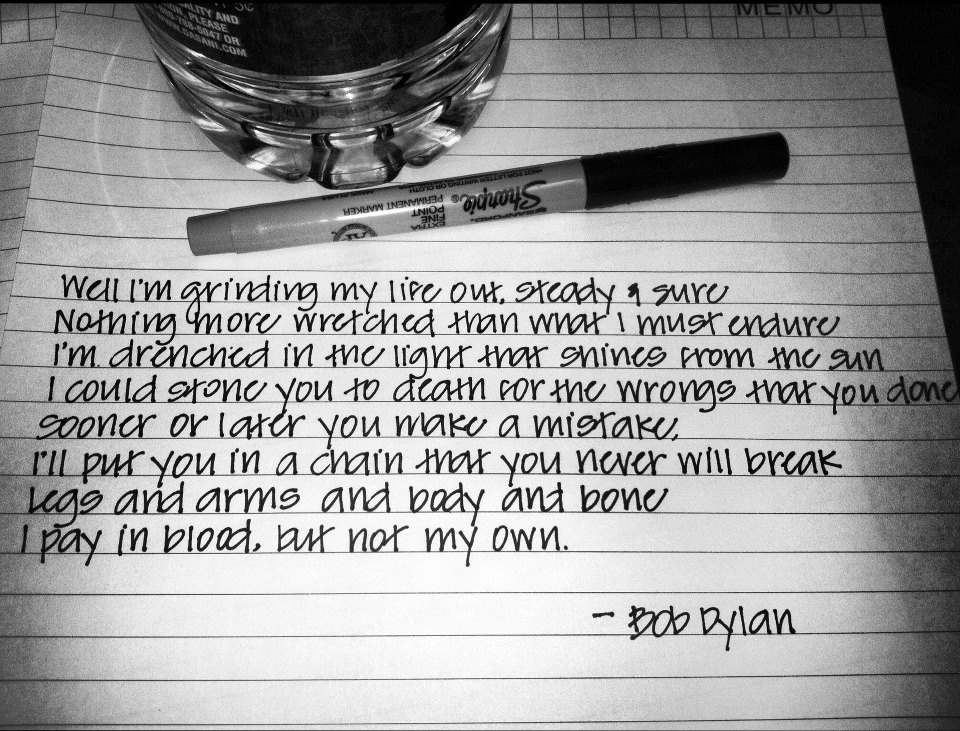
    While Dylan’s lyric may at first seem bleak, in the end he captures the essence of the Gospel.  We do deserve to be put in “a chain that you can never break; legs and arms and body and bone”.  And without the shedding of blood there is no forgiveness of sin.  (Hebrews 9.22) But if we are in Christ, the blood that is paid is not our own.

  • The True & Better

    In this brief video, Tim Keller shows us how Jesus can be seen throughout the familiar narratives of the Old Testament.  This is not an exercise like Where’s Waldo? , where you scour a picture to see if you can find the hidden face.  Nor is this mere metaphor.  This is God’s intended revelation of his grace that was to come.  Each instance is a typology in which, through real life historical figures and events, there is a foreshadowing of the life, work, and/or character of the promised Messiah.  This is why Jesus said to his disciples along the Emmaus Road: “All the Scriptures speak of me.”  (See Luke 24.25-27)

  • 4 Tips That Change the Taste of the Sermon

    As a pastor I have come to understand that some people have difficulty concentrating throughout the Sunday message.  Sometimes it’s just me people have trouble following. But sometimes it is something within them.  It may be a short attention span. It may be external distractions.  Or maybe it is the overwhelming wealth of insight being offered throughout the message that leaves some still pondering the previous point when the next gem is thrown at them.  (That last one is my favorite.)

    If you’ve ever found yourself to be one who even occasionally experiences a problem concentrating throughout the sermon, let me offer a few practical tips. These are far from perfect, and certainly not exhaustive. But still, I think you will find they are helpful:

    1. Write It Down

    Many educators will tell you to write things down because it helps you focus and remember.  Often, after writing something down, you’ll find you don’t even need to go back to your notes to recall what you wrote.

    I find it interesting that in Deuteronomy 17.18 we learn that every time a new king was installed in Israel he was to write the entire Law of God out by hand. He had to write it himself. He could not delegate it to anyone else.  He could not dictate to his secretary.  But taking pen in hand, the new king had to transcribe the whole thing himself.  The expected result, we learn in v. 19, was that the new king would revere the Lord and follow the law carefully.  I suspect that what is also true, but has no need to be stated, is that the king would remember the Law.

    2. Pray It In

    When you hear something that strikes you, if the Lord impresses something on you, during the course of the message, stop and pray right then.  Whether it is something that challenges you, encourages you, or even convicts you, ask the Lord right then to apply it to your life.  (This is also true during other parts of the service.  You may be struck by something in a hymn, or during a prayer.  Pray it in.)

    A church service is supposed to be more relational than academic.  The Lord promises his presence among his people.  It should be a time of interaction between you and God.  As he speaks to you, deal with it at that moment.

    3. Give It Out

    After you write it down and pray it in, don’t neglect to give it out. Tell someone about it. If you are married, share your insight with you spouse on the way home: “Honey, do you know what struck me today?”

    When you give it out it becomes part of your life.  Your insight may also prove beneficial to the one you share it with.  And giving it out also promotes unity, a oneness, because you are opening up and sharing what God is doing in your heart and life.

    4. Move Around

    No, I don’t mean you should get up in the middle of the message.  I mean, don’t always sit in the same place.

    While the first three are pretty simple, and probably will not receive much of a negative response, this  suggestion poses some risks. It may not only seem strange, but the very notion violates some long standing personal traditions.  I’m convinced that whole sanctuaries must have been built around some people – probably built while they were sitting in one particular spot! Construction crews just worked around them.  God have mercy on the visitor who sits in what he/she consider to be ”MY” place.

    But this suggestion is not as silly as it may at first seem.

    Studies have shown a direct correlation between academic success levels and where a student sits in the classroom. (I usually sat in the back, which probably says a lot.)  Perhaps it could also have some effect spiritually.

    Now, I am not suggesting that those who sit up front are actually more spiritually mature than those in the back.  Spirituality has nothing to do with geographic location.  But there is an attitude that can creep in. Sitting in the same spot, week after week, year after year, things can become a little stale.

    Moving around every once in a while offers a new, refreshing perspective.  You see things from a different angle, which seems to stimulate the attention span. You are surrounded by different people, which not only creates a different worship environment, it is also a great way to expand unity within the church.

    It’s amazing, but sitting in a different place almost makes it seem like a whole different church, regardless of the size of the sanctuary.  So move around, and mix it up.

    Anyway, these are a few of my simple suggestions. Let me know if you try any of them out, and how they worked out for you.


  • Too Much Religion

    Eugene Peterson, in the Introduction to the book of Hebrews in his book The Message, writes:

    “It seems odd to have to say so, but too much religion is a bad thing. We can’t get too much of God, can’t get too much faith and obedience, can’t get too much love and worship. But religion – the well intentioned efforts we make to ‘get it all together’ for God – can very well get in the way of what God is doing for us. The main & central action is everywhere, and always what God has done, is doing and will do for us. Jesus is the revelation of that action”.

  • The Gospel Is…

    Gospel means “good news.” The good news is: you are more sinful and flawed than you ever dared believe yet you can be more accepted and loved than you ever dared hope at the same time because Jesus Christ lived and died in your place. As the apostle Paul said, “God made him who had no sin to be sin for us, so that in him we might become the righteousness of God.”

    That is the simple formulation of the gospel. More thoroughly we could say that the whole Bible is the gospel. It is a book about the God who rescues people from their moral and spiritual rebellion against him. The teaching of the Bible, the gospel, can be summarized under four heads: God, Man, Jesus Christ, and Our Response.

    Firstly, the gospel teaches that God is our creator. Thus he has the right to rule and command us as he does in his law. God is also holy, that is, he is absolutely pure morally, and he hates and punishes rebellion on the part of his creatures. He is more holy than anyone would ever imagine.

    Secondly, the gospel teaches us about human beings. We are creatures made by God and for God. We were originally created to live in relationship with God and we were morally pure. But because our first parents rebelled against God (just as we also all have done), human beings are now cut off from relationship with God and are subject to his condemnation. We are more sinful than we ever dared believe.

    Thirdly, the gospel teaches us what Jesus Christ has done for sinners like us. He became a man and lived a life of perfect obedience to God’s law, and then died as a sacrifice in our place under the judgment of God. He was raised from the dead and now reigns in heaven. The condemnation that he suffered takes away the necessity that we suffer judgment for our own sins- “God made him who had no sin to be sin for us.” The righteous life he lived is credited to us, not because we are actually righteous, but because of God’s mercy and grace- “in him we might become the righteousness of God.”

    Fourthly, the gospel teaches us how to respond to the good news. We turn away from our rebellion and put our trust in Jesus Christ. Despairing of our own worthiness to stand before God, we believe the promise that those who trust in Jesus Christ will be forgiven and declared righteous. Those who put their faith in Jesus Christ are accepted as loved sons and daughters of God, and God sends his Spirit to live in them.

    Counterfeit Gospels

    Martin Luther said that a sinner trying to believe the gospel was like a drunk man trying to ride a horse; he will always be falling off on one side or the other. The two errors that the sides of the horse represent are 1) legalism or moralism and 2) pragmatism or relativism or antinomianism.

    Moralism is the view that a person is made acceptable to God through his own attainments. Moralists are usually very religious, and often very conservative in their religion. Legalism tends to stress truth without grace. Moralists are usually very rules oriented, and depending on their success in keeping the rules they will be either arrogantly self-righteous or depressed and morose. If they go to Jesus for forgiveness, it is just to ask him to fill in the gaps they have left in their own religious performance. For the moralist, the cross is not the only basis for acceptance by God, but is an adjunct to our performance.

    Pragmatists are often irreligious, or prefer more liberal religion. They tend to stress grace over truth, assuming everyone is accepted by God and that we each have to decide what we think is true for us. Often relativists will talk about God’s love, but since they do not see them selves as deeply sinful people, God’s love for them costs him nothing. For them the cross is not the necessary condition of our acceptance by God.

    The gospel holds out to us a whole new system of approach to God. It rejects our attempts to justify ourselves before God, to be our own saviors and lords. It rejects both our pragmatic presumption and our religious attempts to earn our way into God’s favor. It destroys the perception that Christianity is just an invitation to become more religious. The gospel will not let us think Jesus is just a coach to help us get stronger where we are weak. To be a Christian is to turn from self-justification of all sorts and to rely exclusively on Jesus’ record for a relationship with God.

    Christians and non-Christians both stumble over the two counterfeits of the gospel. Many Churches are deeply moralistic or deeply relativistic. Christians who understand the gospel very clearly still look like the drunk man on the horse, as the desire to justify ourselves and trust in our own performance continually reappears.

    The gospel tells the pragmatist that he is more flawed and sinful than he ever dared believe. The gospel tells the moralist that he is more loved and accepted than he ever dared hope.