Living Missionally in the Mountain Empire

In this video Tim Keller offers some insights about ministry in areas that still largely hold to traditional conservative values.

This is helpful to me because the place where I live and serve is still largely characterized this way.

While I embrace a missional mindset, how our church lives that out in East Tennessee and Southwest Virginia will look very different from how Keller lives it out in Manhattan and others live it out in places like San Francisco or Seattle.

3 Ways

There is a difference between the Gospel and being good.  But I am not sure the average person understands this – neither in the church nor outside the doors.  In this short video Tim Keller explains the difference between:

  • Gospel
  • Moralism
  • Irreligion

Impressions of The Shack


Inquiring Minds Want to Know: What do you make of The Shack?

To be quite honest, I do not know what to make of the book, The Shack.  My impression is that the author, William P. Young, made a noble attempt to explain some of the more difficult questions about God, and did so in an engaging narrative.  At the same time, he crossed over some cherished ground in a manner that leaves him open to charges of heresey.

Is Young alone in this?

No. C.S. Lewis, among others, trod this path long before Young. 

So what do I think?

I think I am thankful for keener minds than mine.

In particular, I was intrigued with Tim Keller’s analysis of The Shack. Keller makes it clear that he was not offering a review, only some impressions. Still his comments are worth considering:

At the heart of the book is a noble effort — to help modern people understand why God allows suffering, using a narrative form. The argument Young makes at various parts of the book is this. First, this world’s evil and suffering is the result of our abuse of free will. Second, God has not prevented evil in order to accomplish some glorious, greater good that humans cannot now understand. Third, when we stay bitter at God for a particular tragedy we put ourselves in the seat of the ‘Judge of the world and God’, and we are unqualified for such a job. Fourth, we must get an ‘eternal perspective’ and see all God’s people in joy in his presence forever. (The father in the story is given a vision of his deceased daughter living in the joy of Christ’s presence, and it heals his grief.) This is all rather standard, orthodox, pastoral theology (though it’s a bit too heavy on the ‘free-will defense’).  It is so accessible to readers because of its narrative form. I have heard many reports of semi-believers and non-believers claiming that this book gave them an answer to their biggest objections to faith in God.

However…

Keller’s “However” needs to be considered. To read Keller’s post click: The Shack – Impressions.

Is “Missional” Just “Evangelistic”?

In his book The Present Future, Reggie McNeal reveals the contrasts in the different ways leaders can think about the church and its ministry. McNeal reveals the different paradigms that pastors can have as they fulfill their ministry in the church.  Being missional is first a shift in thinking about the nature of the church. Once a missional understanding is adopted, the way we do church begins to change.

  1. A missional church stresses community transformation over growing the church.
  2. A missional church strives to turn members into missionaries over turning members into ministers. 
  3. A missional church focuses on recovering Christian mission over doing church better.

In the above video, Tim Keller also offers some insights about the missional church. Keller explains why this label – Missional – is not just new slang for being Evangelistic.

For those who want to explore a little more, let me suggest reading Timothy Corwin’s blog post Being Missional: Is There Really a Difference?  Tim is pastor of The Rock Church of Saint Louis, and has written several thoughtful pieces about the missional church.

Keller on Being Salt & Light

Working through the Sermon on the Mount on Sunday mornings, a few weeks ago I preached from Matthew 5.13-16, the Salt & Light passage. What I explained to our congregation is that, after instrucitng us about what our attitude ought to be as citizens of the Kingdom, Jesus goes on to reveal the Influence he expects his people to have on the communites where we live, and on the world around us.

In this video Tim Keller offers his thoughts about being Salt & Light.

Theology for Life

As a pastor from a confessional denomination one of the more difficult tasks I regularly – even constantly – encounter is helping people past a distatse for doctrine. 

I understand why so many are so often hesitant to embrace any system of doctrine.  “Doctrine divides” is a commen lament. And, regretably, it is often an accurate one.  I see many who are at odds with others over secondary principles.  Another issue is that sometimes those who are the strongest proponents of sound theology carry rather “ugly” attitudes.  Looking at life, and the church, with a singular perspective (as opposed to tri-perspectival) some assume that mere apprehension and submission to a system of doctrine is the only thing that matters.  As one of my old pastors often said: “Their theology is dead right – but mostly dead.” 

Of course there are other reasons to be considered. 

The historical influence of the Second Great Awakening continues to infect large portions of the American church.  One of the most significant effects is that many Christians, and a number of church traditions, are flarly anti-intellectual.  Their faith is almost entirely “feelings” built aroud a few simple theological propositions.

And maybe the biggest hurdle is that developing a comprehensive understanding of a system of theology is, simply, hard work.  Like learning anything, it is challenging and takes time and study. 

Whatever the reasons for hesitancy, I maintain it is still important.  In this brief video Tim Keller affirms the benefits of sound doctrine. In fact he asserts, I believe correctly, that everyone already lives out their theology…

If this so, it would seem important to think it all through.

Graceful Break-in

“The Bible’s purpose is not so much to show you how to live a good life. The Bible’s purpose is to show you how God’s grace breaks into your life against your will and saves you from the sin and brokenness otherwise you would never be able to overcome…”

-Tim Keller

3 Short Books I Wish Everyone in My Church Would Read

I read a fair amount.  I have been accused, and probably rightly so, of unrealistically pushing books and other reading materials on people who don’t read quite as much; who don’t have the time to read as much; who don’t get “paid” to read as much (as I, in part, am).  But there are ideas and expressions I have benefited from, that I am not sure I can adequately convey, and I like to share them with others. I like to hear how others are struck by the same insights, when the authors’ words are not colored by my thoughts.

I know that I will never get everyone in my church to read all the things I’d like them to read.  But there are three very short books that I have begun to encourage people to read:


The Prodigal God by Tim Keller

This book is subtitled: “Recovering the Heart of the Christian Faith”.    
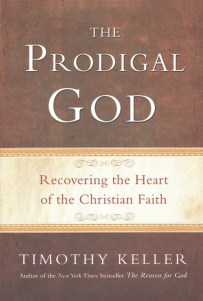
Cover Prodigal God

Keller elaborates on the well known story of the Prodigal Son, and offers a not-so-often recognized perspective:  The story is not about a wild son who receives mercy and grace from his benevolent father.  This is a story about two sons. In fact, this is a story about a Father who had two very different sons. It is THE story of God the Father and how people relate to Him in two different ways.

Each son is a reflection of the respective ways people relate to God.   

The younger son is the picture of all who go astray from God and his Law and, having been broken, recognize the emptiness and hopelessness of life apart from the Father.  When awakened to their desperate situation they find a grace and relationship with the Father that is ovewhelming.

The older son is the picture of all who try to relate to God, and please God, by being good; by following all the rules.  This is a picture of religious people, of many Conservative Christians. Yet in their own goodness there is an evident lack of heartfelt fondness for the Father, a lack of joy, obvious to all except for them.

In this book Keller helps us to discern our own tendencies in our relation to God.  Using this story Keller helps us see with keener insight that the ONLY way to have a relationship with God the Father is by recognizing that we are all in need and by being recipients of His compassion, grace, and generosity.  Keller shows us that at the end of the story there is only one son, one type of person, still alienated from the Father. It is not the one who seems to have been the most egregious.  It is the one who seems the most righteous.

Keller has also noted: “Our churches are full of Older Brother types… Is it any wonder, then, that the Younger Brother-types don’t want to come home (come to church)?”

OUCH!! 

The Prodigal God is only 133 pages – and the pages are double-spaced.
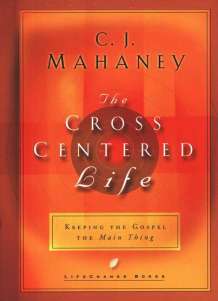
 Cover Cross Centered Life

The Cross-Centered Life by C.J. Mahaney

In this 85 page, pocket sized, book Mahaney helps the reader to keep the Gospel at the center of our lives. He helps us to recognize various subtle substitutes that lead us from the Cross, but ultimatley are of little or no help in strengthening the soul. 

Mahaney uses a plethora of annecdotes and illustrations to convey the simple, yet often forgotten and neglected, essential truth: The Gospel is the power to give and to transform life.  Understanding how we can appropriate the present benefits of the Cross is key to vibrant spirituality and joy.


The Dangerous Duty of Delight by John Piper

 I am a long-time fan of Piper’s writing. Nevertheless, I confess, for a long time I refused to read this simple book. I guess I thought this pocket sized 84 page primer of his contemporary classic, Desiring God, was beneath me. After all, I’ve read the BIG book – several times!  But I was wrong.Cover Dangerous Duty
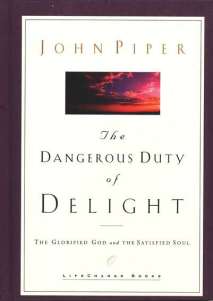
In this little book Piper conveys the essence of the Christian life: To glorify God by enjoying him forever.  It is a great introduction to what Piper calls Christian Hedonism. 

Christian Hedonism may sound like an oxymoron, and even inappropriate, to those who do not undertand what is behind Piper’s message.  But I am convinced that what he espouses is thoroughly Biblical.  It is the recognition that we are created to have a relationship with God; that we are commanded to take delight in God (i.e. Psalm 37.4); and that we are all prone to sell out the ultimate joy we can have in life, in God, for the cheap thrills and pleasures we find elsewhere. 

While I still hope everyone will read Desiring God, this little book, Dangerous Duty, serves as a great introduction that will both lay a groundwork of understanding and whet the appetite for the whole feast found in Desiring God.

You can check out a sample of Dangerous Duty or the entirety of Desiring God online. Just click the highlighted titles.

Characteristics of a Missional Church

As our church begins to explore what it means to be a missional church, it might be helpful to hear the insights of one of the most effective practitioners and proponents of the missional approach to ministry.  In the above video Tim Keller, of Redeemer Church in Manhattan, explains some of the key characteristics of a missional church.

Some might ask: What’s the difference between a Missional Church and an Evangelistic Church? Is this just a new label? 

The answer to the latter question is “No. It’s not just a label.”  It is a different way of thinking about the church. Rooted in the understanding that God is himself on mission (missio dei) a missional church seeks to become engaged in God’s mission in the very place(s) God has sovereignly placed the church and the church members. 

Reggie McNeal, in his book, The Present Future, provides some insights about the differences between a Missional Church and an Evangelistic Church that will help answer the former question. McNeal says a missional church stresses:  

> community transformation over growing the church

> turning members into missionaries over turning members into ministers

> recovering Christian mission over doing church better

Sharing the Father’s Welcome

Tim Keller’s new book, The Prodigal God: Recovering the Heart of the Christian Faith, will be released in a few weeks, on October 31. In the book Keller presents a powerful expression of the gospel, rooted in the parable of the Prodigal Son.  Having heard Keller teach from this parable, I am looking forward to the written form.

But Keller’s insights were not developed in a vacuum.  They were cultivated by careful and thoughtful study and prayer. They were built upon a foundation of those who had walked before him, like Edwards and Chalmers. And they were influenced by the wisdom of those who invested in him. Among them, Dr. Ed Clowney, former president of Westminster Seminary, whom Keller credits in the Introduction of this upcoming book as having provided the inspiration: 

Many excellent studies have been written on this Biblical text over the last several years, but the foundation for my understanding of it was a sermon I heard preached over thirty years ago by Dr. Edmund P. Clowney. Listening to that sermon changed the way I understood Christianity. I almost felt I had discovered the secret heart of Christianity.  (Click: article.)

Crossway Books has made available Clowney’s sermon, Sharing the Father’s Welcome.  I hope it not only whets you appetite for Keller’s upcoming book, but that it opens your eyes to see how high and wide and long and deep is the love of God for we, his children.

(NOTE: My thanks to Justin Taylor of Between Two Worlds for tipping me off about this.)

Keller Kiosk

 Christianity Today has published an interesting interview with Tim Keller of Redeemer Church in New York City titled, Tim Keller Reasons With America.  If you have enjoyed Keller’s writing or teaching you may appreciate the insight behind his philosophy and ministry.  Or, if you are one who may be a little curious about this guy who is so frequently cited and quoted in Evangelical cirlces, this interview might be a good introduction.

On another front, from Justin Taylor, at Between Two Worlds, I have learned that Keller has a new book due out in October.  The new book, The Prodigal God, will describe and define Christianity in light of the parable of the Prodigal Son.  Having heard Keller teach on this topic, it should be radically profound. I am looking forward to the read.

The A-to-Z of the Christian Life

“The gospel shows us that our spiritual problem lies not only in failing to obey God, but also in relying on our obedience to make us fully acceptable to God, ourselves and others.

Every kind of character flaw comes from this natural impulse to be our own savior through our performance and achievement. On the one hand, proud and disdainful personalities come from basing your identity on your performance and thinking you are succeeding. But on the other hand, discouraged and self-loathing personalities also come from basing your identity on your performance and thinking you are failing.

Belief in the gospel is not just the way to enter the kingdom of God; it is the way to address every obstacle and grow in every aspect. The gospel is not just the “ABCs” but the “A-to-Z” of the Christian life.

The gospel is the way that anything is renewed and transformed by Christ — whether a heart, a relationship, a church, or a community. All our problems come from a lack of orientation to the gospel. Put positively, the gospel transforms our hearts, our thinking and our approach to absolutely everything.”

– Timothy Keller

Share this:

Studies in 1 John: Compassion Among Brothers

   In my study through 1 John I had to pause and go back over one verse this week. 


Having preached from 1 John 3:11-18 last week, and John’s assertion that Christians are to be characterized by love for one another if Christ is in actuality alive in them,  I am struck by v. 17:


“If anyone has material possessions and sees his brother in need but has no pity on him, how can the love of God be in him?” 


Together, with John exhortation in the next verse: “…let us not love with words or tongue but with actions and in truth”; these verses not only reflect the heart of God, they express a mandate for a more holistic ministry. 


Clearly John has in mind here a demonstration of compassion that is to be practiced between Christians.  It was not John’s purpose at this point to discuss the broader scope.  But his narrower focus here in no way mitigates the Christians responsibility to express mercy to all people, Christian or not, as a reflection of God’s grace. 


Consider Paul’s counsel from Galatians 6:10:


“Therefore, as we have opportunity, let us do good to all people, especially to those who belong to the family of believers.”


Paul’s emphasis to do good, “especially” to other Christians, is consistent with John’s focus. But Paul gives a more expanded view of the heart of God.  Still, Paul shares John’s sentiment, that while we ought to show compassion to all people, how much more ought we do so for other Believers!


I am convinced and convicted that this – holistic ministry – has long been an area of neglect for many (most?) conservative Evangelicals.  So I feel compelled to go back to those two verses to preach from them. 


As I prepared this week several old books came off my shelf that proved helpful.  I thought I’d post them for anyone interested in pursuing the God-given, ministry of compassion that John urges us to undertake in v. 17-18


The Tragedy of American Compassion by Marvin Olasky

Rich Christians in an Age of Hunger by Ron Sider

Charity and It’s Fruits by Jonathan Edwards

The Micah Mandate by George Grant

Ministries of Mercy by Tim Keller

Restorers of Hope by Amy Sherman

Churches Than Make a Difference by Ron Sider, et. al.


And finally, anyone interested in seeing how ministry of compassion is practically & effectively being implemented across America will do well to visit Christian Community Development Association.  This is a wonderful network of holistic practitioners.