Ways of Grace

We will never find God unless he first seeks us, but we should remember that he can do so in very different ways.  Sometimes, God jumps on us dramatically, as he does with the younger son, and we have a sharp sense of his love.  Sometimes he quietly and patiently argues with us even though we continue to turn away, as in the case of the older son.

How can you tell if he is working on you now? If you begin to sense your lostness and finding yourself wanting to escape it, you should realize that that desire is not something you could have generated on your own.  Such a process requires Help, and if it is happening it is a good indication that he is even now on your side.

~ Tim Keller, from The Prodigal God

Kingdom-Centered Prayer

Tim Keller writes:

Throughout the Old and New Testaments and church history, every spiritual awakening was founded on corporate, prevailing, intensive kingdom-centered prayer.  We cannot create spiritual renewal by ourselves, but we can “prepare the altar” and ask God to send his Holy Spirit to change our hearts, our churches, and our communities.

Read Tim’s tremendous article: Kingdom-Centered Prayer., from Redeemer City to City

Disinfecting Ourselves of Spiritual Malware

In his masterful work, Institutes of the Christian Religion, John Calvin observed:

“Man’s nature, so to speak, is a perpetual factory of idols.”

That may seem to be a peculiar notion. Some will, no doubt, simply chalk it up to “O, that Calvin guy had a lot of strange ideas”.  Some, being a bit more charitable, may concede that this might be true of man in his fallen nature, but certainly no longer the case once we have been made new creations through faith in Jesus Christ.  Some may go even a little further, admitting that sometimes Christians do struggle with issues akin to idolatry, such as lust and pornography, love of money or materialism,  or co-dependency and fear of man.

But Tim Keller, in his book Counterfeit Gods, goes even further and deeper:

We think that idols are bad things, but that is almost never the case.  The greater the good, the more likely we are to expect that it can satisfy our deepest needs and hopes. Anything can serve as a counterfeit God, especially the very best things in life.

What is an idol? It is anything more important to you than God, anything that absorbs your heart and imagination more than God, anything you seek to give you what only God can give.

A counterfeit God is anything so central and essential to your life that, should you lose it, your life would feel hardly worth living. An idol has such a controlling position in your heart that you can spend most of your passion and energy, your emotional and financial resources, on it without a second thought…

If anything becomes more fundamental than God to your happiness, meaning in life, and identity, then it is an idol.

While Keller clearly states that idols are often the good things in our lives, I have found that many people, godly people, may accept this as truth yet still fail to recognize the idols that drive and shape them. They get caught up by phrases such as “more important that God”.  To their minds, nothing is more important to them than God. And while in many cases I have no question that this is true of them when it comes to their professional faith (the faith they profess, and actually intellectually believe), they are unaware of the idols that influence them and their functional faith (the faith that effects the moment by moment emotions).

It is somewhat like a malware virus I have had on my computer on a few occasions.  Once the virus infects the computer it automatically blocks any attempts to identify the problem.  In fact, every attempt to clean it out only serves to further strengthen and entrench the virus.  Likewise, in some people I have encountered such a powerful block that any attempts to identify the spiritual malware – the idols –  is met with a greater resolve that they are not infected.  This  especially seems to be the case when the malware is something good, something very good, something even godly, such as a powerful desire for church growth, evangelism, doctrinal purity, etc.  Malware in such guise seems to almost always shut down any suggestion that these are problems.

Continue reading

The Advent of Humility

The following article, by Tim Keller, first appeared in the December 2008 edition of Christianity Today Magazine.  In this article Keller explains why the Advent of Jesus gives us reason to stop concentrating on ourselves.

***

Innumerable Christmas devotionals point out the humble circumstances of Jesus’ birth—among shepherds, in a crude stable, with a feed trough for a bassinet. When Jesus himself tried to summarize why people should take up the yoke of following him, he said it was because he was meek and humble (Matt. 11.29). Seldom, however, do we explore the full implications of how Jesus’ radical humility shapes the way we live our lives every day.

Humility is crucial for Christians. We can only receive Christ through meekness and humility (Matt. 5.3, 5; Matt 18.3-4). Jesus humbled himself and was exalted by God (Phil. 2:8-9); therefore joy and power through humility is the very dynamic of the Christian life (Luke 14.11; 18.14; 1 Peter 5.5).

The teaching seems simple and obvious. The problem is that it takes great humility to understand humility, and even more to resist the pride that comes so naturally with even a discussion of the subject.

We are on slippery ground because humility cannot be attained directly. Once we become aware of the poison of pride, we begin to notice it all around us. We hear it in the sarcastic, snarky voices in newspaper columns and weblogs. We see it in civic, cultural, and business leaders who never admit weakness or failure. We see it in our neighbors and some friends with their jealousy, self-pity, and boasting.

And so we vow not to talk or act like that. If we then notice “a humble turn of mind” in ourselves, we immediately become smug—but that is pride in our humility. If we catch ourselves doing that we will be particularly impressed with how nuanced and subtle we have become. Humility is so shy. If you begin talking about it, it leaves. To even ask the question, “Am I humble?” is to not be so. Examining your own heart, even for pride, often leads to being proud about your diligence and circumspection.

Christian humility is not thinking less of yourself; it is thinking of yourself less, as C. S. Lewis so memorably said. It is to be no longer always noticing yourself and how you are doing and how you are being treated. It is “blessed self-forgetfulness.”

Humility is a byproduct of belief in the gospel of Christ. In the gospel, we have a confidence not based in our performance but in the love of God in Christ (Romans 3.22-24). This frees us from having to always be looking at ourselves. Our sin was so great, nothing less than the death of Jesus could save us. He had to die for us. But his love for us was so great, Jesus was glad to die for us. Continue reading

Deconstructing the Twin Enemies of the Gospel

Perhaps the two of the most effective enemies of the gospel within the Church in North America are the twins: Moralism and Legalism. While there are other enemies at work, such as Relativism and Licentiousness, these are far more obvious in their opposition to the gospel.  Moralism and Legalism, however, are so potent, especially among conservatives, because they stealthily fly under the radar.  In fact, they are such subversives that they are often embraced as if they are part of the gospel, or at least partners with it.

Here is something Tim Keller offers to combat these sneaky, deadly foes:

Some claim that to constantly be striking a ‘note of grace, grace, grace’ in our sermons is not helpful in our culture today.

The objection goes like this: “Surely Phariseeism and moralism is not a problem in our culture today. Rather, our problem is license and antinomianism. People lack a sense of right or wrong. It is ‘carrying coal to Newcastle’ to talk about grace all the time to postmodern people.”

But I don’t believe that’s the case. Unless you point to the ‘good news’ of grace, people won’t even be able to bear the ‘bad news’ of God’s judgment. Also, unless you critique moralism, many irreligious people won’t know the difference between moralism and what you’re offering.

The way to get antinomians to move away from lawlessness is to distinguish the gospel from legalism. Why? Because modern and post-modern people have been rejecting Christianity for years thinking that it was indistinguishable from moralism. Non-Christians will always automatically hear gospel presentations as appeals to become moral and religious, unless in your preaching you use the good news of grace to deconstruct legalism. Only if you show them there’s a difference–that what they really rejected wasn’t real Christianity at all–will they even begin to consider Christianity.

Traditional Conservative & Missional Values

One of the fundamental principles of being missional is contextualization.  In short, contextualization simply means to take into consideration the context where one lives and serves.

With all the noteriety that missional practitioners serving in clearly post-Christian areas have gained, it seems some, desiring to follow the example of these leaders, all too readily foresake the principle of contextualization. 

It is understandable to want to copy the methods and messages of Tim Keller or Mark Driscoll, among others.  No doubt there is much to be learned from these guys.  But the temptation to copy is really a trap that will lead most of us to ineffectiveness.  Those guys serve in New York and Seattle, respectively. What is needed to serve in those contexts is vastly different than what may be needed in Nashville, Birmingham, or small towns like where I live – Bristol, TN/VA.  Principles should be benchmarked and translated, not copied.  All effective ministry is local.

In the above video Tim Keller offers some helpful thoughts about advancing the gospel in different social contexts.

Practical Importance of Doctrine

If there was one thing I could impart to the members of our church, or to other pastors, it would be an appreciation for the practical importance of doctrine.  I think it was R.C. Sproul who pointed out: “We are all theologians… the question is whether we are good theologians.”

Sprouls’ point is valid.  Everything we think, feel, and do is rooted in what we think about God.  Some may not give this conscious attention. Some even repress it or deny it, but then this a-theism is what they think or feel about God, and these folks will act accordingly.

I suppose that many are turned off by the very idea of doctrine because it has been abused so frequently. I imagine others have been guilty of taking these awesome truths and boring folks with them – something I am sure I share a guilt in.  But the inadequacies of a teacher should not turn people away from seeking to know God better by knowing about God, any more than a bad meal or a bad cook should make people turn away from food.

In this brief video, pastor/theologian Tim Keller offers a few simple insights about the practical importance of doctrine.  Even if you are a skeptic, give what Tim says at least a few moments thought.

Hellacious Discussions

I am coming to the dance late, but it appears the party is not yet over. So late may not be too late.  What party? Well, the  “Hell-acious” party that has been going on in the blogosphere.

Apparently the debate was kicked off by Rob Bell and his new book titled: Love Wins.  Apparently the video promoting the book leans a little too close to affirming Universalism.  Having watched it, I can see why there is some concern.

There is little I will add to this discussion, other than to affirm that the Bible is clear about Hell being an actual place.  Any notions that the reality of Hell somehow diminishes Grace or is a stain on God’s character are just uninformed and/or thoughtless.  More than that, such theories are not rooted in Scripture.  Thus we can assume they originate from the pit of… well, you know…

Some notables responding to Bell were:

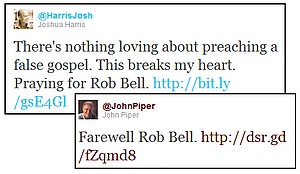
John Piper & Josh Harris on Twitter:

Kevin DeYoung

Justin Taylor

Tim Keller also republished a post titled The Importance of Hell

  1. Hell is Important Because Jesus taught on it more than all other Biblical authors put together.
  2. Hell is Important because it shows how infinitely dependent we are on God for everything.
  3. Hell is Important because it unveils the seriousness and danger living life for yourself.
  4. The Doctrine of Hell is Important because it is the only way to know how much Jesus loved us and how much he did for us.

John Armstrong chimed in on the debate, and suggested that some of the responses were just knee jerk reactions.  Armstrong advocates waiting for the book to come out before developing any conclusions about Rob Bell.  Caution and charity is almost always good counsel.

But, while this discussion is still in vogue, I thought I would direct those interested to a few other resources.  In particular 9 Marks Sept-Oct ’10 e-Journal was devoted to it.  Click: Remembering the Awful Reality.   Two articles from that edition I find worth consideration are summarized below:

How Does Hell Glorify God? by James Hamilton.

  • Hell shows that God keeps his word.
  • Hell shows God’s infinite worth.
  • Hell demonstrates God’s power to subdue all who rebel against him.
  • Hell shows how unspeakably merciful God is to those who trust him.
  • Hell upholds the reality of love by visiting justice against those who reject God, who is love.
  • Hell vindicates all who suffered to hear or proclaim the truth of God’s Word.
  • Hell shows the enormity of what Jesus accomplished when he died to save all who would trust him from the what they (we) deserved. If there were no hell, there would be no need for the Cross.

Why is Hell Integral to the Gospel? by Greg Gilbert

  1. Hell shows us how heinous our sin really is.
  2. Hell shows us how unimpeachably just God really is.
  3. Hell shows us how horrific the cross really was, and how great God’s grace really is.
  4. Hell focuses our minds on the task of proclaiming the gospel.

One final word.  This is not a one sided discussion.  Many are picking up where Bell left off – or where they think he left off.  Wherever Bell will come out on this issue, some folks are running with their own half-baked theories… they are running fast like bats out of… well you know.

Pure Puritan

What is your view of the Puritans?  If you are like many people you may not think much of them.

Tim Keller maintains that the Puritans offer us great practical insights. In an article for CCEF, titled Puritan Resources for Biblical Counseling, Keller elaborates on these insights:

  1. The Puritans were committed to the functional authority of the Scripture. For them it was the comprehensive manual for dealing with all problems of the heart.
  2. The Puritans developed a sophisticated and sensitive system of diagnosis for personal problems, distinguishing a variety of physical, spiritual, tempermental and demonic causes.
  3. The Puritans developed a remarkable balance in their treatment because they were not invested in any one ‘personality theory’ other than biblical teaching about the heart.
  4. The Puritans were realistic about difficulties of the Christian life, especially conflicts with remaining, indwelling sin.
  5. The Puritans looked not just at behavior but at underlying root motives and desires. Man is a worshipper; all problems grow out of ‘sinful imagination’ or idol manufacturing.
  6. The Puritans considered the essential spiritual remedy to be belief in the gospel, used in both repentance and the development of proper self-understanding.

Reading the Puritans is not always easy. But thanks to Banner of Truth Trust there are number of Puritan materials offered in revised editions. Many of them are abridged. Most, if not all of them, are translated into more contemporary English. Check out Puritan Paperbacks. These are rich resources for spiritual formation.

Counterfeit Gods

In his reletively recent book, Counterfeit Gods, Tim Keller explains what a counterfeit god is and describes how to make one – as we are so prone to do:

A counterfeit god is anything so central and essential to your life that, should you lose it, your life would feel hardly worth living.  And idol has such a controlling position in your heart that you can spend most of your passion and energy, your emotional and financial resources, on it without a second thought.  It can be family and children, or career and making money, or achievement and critical acclaim, or saving “face” and social standing.  It can be a romantic relationship, peer approval, competence and skill, secure and comfortable circumstances, your beauty or your brains, a great political or social cause, your morality and virtue, or even sucess in the  Christian ministry.

Keller also asserts:

When your meaning in life is to fix someone else’s life, we may call it “codependency” but it is really idolatry.  An idol is whatever you look at and say, in your heart of hearts, “If I have that, then I’ll feel significant and secure.”  Introduction, p. xviii)

I greatly apprecialte Keller delving into this subject. While few people are likely to identify themselves as Idolotors, it is an affliction that plagues us all.  

John Calvin was correct when he declared: “Our hearts are little idol factories”.  Understanding how we each make our individual idols, and identifying how they influence our actions and thoughts, is a major step toward diplacing them.

Gospel-Centered Church

Gospel-centeredness is a vital strategic principle for ministry in the 21st (and the 1st!) century. I do not simply mean by ‘gospel-centered’ that ministry is to be doctrinally orthodox. Of course it must certainly be that. I am speaking more specifically.

(1.) The gospel is “I am accepted through Christ, therefore I obey” while every other religion operates on the principle of “I obey, therefore I am accepted.”

(2.) Martin Luther’s fundamental insight was that this latter principle, the principle of ‘religion’ is the deep default mode of the human heart. The heart continues to work in that way even after conversion to Christ. Though we recognize and embrace the principle of the gospel, our hearts will always be trying to return to the mode of self-salvation, which leads to much spiritual deadness, pride and strife, and ministry ineffectiveness.

(3.) We must communicate the gospel clearly – not a click toward legalism and not a click toward license. Legalism/moralism is truth without grace (which is not real truth); relativism is grace without truth (which is not real grace). To the degree a ministry fails to do justice to both, it simply loses life-changing power.

Text: Acts 15:1-25

Here we see Paul, in the middle of a church-planting career, going to Jerusalem for a big theological debate. Now, why do that? Surely we ministers need to be about the work of evangelism, not going in for theological discussions! But Paul makes no bifurcation here. Chapter 15 is down the middle of Paul’s mission! It’s clarifying the gospel itself.

(1) The cause of the debate is that the earliest Gentile converts to Christianity had already become Jewish culturally. That is, many of them were “God-fearers” who had been circumcised and/or abided by the clean laws and the Mosaic legislation.

(2) Then Paul began bringing in real pagans or God-fearers who had not become culturally Jewish. And he was not demanding that, when they became Christians, that they had to adopt Jewish cultural patterns.

(3) Then a group arose (15:1) saying, “unless you are circumcised according to the custom taught by Moses, you cannot be saved”. They had taken cultural norms and promoted them to be matters of virtue and spiritual merit. When they did that, they lost grasp on the gospel of grace and slid into ‘religion’.

(4) The Council on the one hand in Peter, got hold of one end of the stick: v.6-11 No! We believe it is through the grace of our Lord Jesus that we [Jews] are saved, just as they are.”

(5) But, wouldn’t you know it – James gets a hold of the other end of the stick. He agrees with Peter, but rightly asserts that Gentile Christians, though free from any requirements as to salvation, are not free to live as they like as members of a Christian community. They are obliged to live in love and to respect the scruples of culturally different Jewish brethren. So they are ordered (we tend to miss this) to live in such a way that does not offend or distress their brethren who are culturally different. (They are not to eat raw meat, they are to abide by Levitical marriage laws, and so on.) There could hardly be a better case study of the old Luther – proverb that expresses the balance of the gospel. We are “saved by faith alone, but not by faith that is alone.” We are not saved by how we behave, but once we are saved we behave in love.

So “religion” just drains the spiritual life out of a church. But you can “fall off the horse” on the other side too. You can miss the gospel not only through legalism but through relativism. When God is whoever you want to make him, and right and wrong are whatever you want to make them – you have also drained the spiritual life out of a church. If God is preached as simply a demanding, angry God or if he is preached as simply an all-loving God who never demands anything – in either case the listeners will not be transformed. They may be frightened or inspired or soothed, but they will not have their lives changed at the root, because they are not hearing the gospel. The gospel shows us that God is far more holy and absolute than the moralists’ god, because he could not be satisfied by our moral efforts, even the best! On the other hand the gospel shows us that God is far more loving and gracious than the relativists’ god. They say that God (if he exists) just loves everyone no matter what they do. The true God of the gospel had to suffer and die to save us, while the god of the relativist pays no price to love us.

The gospel produces a unique blend of humility and boldness/joy in the convert. If you preach just a demanding God, the listener will have “low self-esteem”; if you preach just an all-loving God, the listener will have higher self-esteem. But the gospel produces something beyond both of those. The gospel says: I am so lost Jesus had to die to save me. But I am so loved that Jesus was glad to die to save me. That changes the very basis of my identity – it transforms me from the root.

I can’t tell you how important this is in all mission and ministry. Unless you distinguish the gospel from both religion and irreligion – from both traditional moralism and liberal relativism – then newcomers in your services will automatically think you are simply calling them to be good and nice people. They will be bored. But when, as here in Acts 15, the gospel is communicated in its unique, counter-intuitive balance of truth and love, then listeners will be surprised. Most people today try to place the church somewhere along a spectrum from “liberal” to “conservative” – from the relativistic to the moralistic. But when they see a church filled with people who insist on the truth, but without a shred of superiority or self-righteousness – this simply explodes their categories. To them, people who have the truth are not gracious, people who are gracious and accepting say “who knows what is the truth?” Christians are enormously bold to tell the truth, but without a shred of superiority, because you are sinner saved by grace. This balance of boldness and utter humility, truth and love – is not somewhere in the middle between legalistic fundamentalism and relativistic liberalism. It is actually off the charts.

Paul knew that ‘getting the gospel straight’ – not falling off into either legalism on the one hand or license on the other – is absolutely critical to the mission of the church. The secret of ministry power is getting the gospel clear. To be even slightly off to one side or another, loses tons of spiritual power. And people don’t get really converted. Legalistic churches reform people’s behavior through social coercion, but the people stay radically insecure and hyper-critical. They don’t achieve the new inner peace that the grace of God brings. The more relativistic churches give members some self-esteem and the veneer of peace but in the end that is superficial too. The result, Archibald Alexander said, is like trying to put a signet ring on the wax to seal a letter, but without any heat! Either the ring will affect the surface of the wax only or break it into pieces. You need heat to permanently change the wax into the likeness of the ring. So without the Holy Spirit working through the gospel, radically humbling and radically exalting us and changing them from the inside out, the religion either of the hard or soft variety will not avail.

Conclusion: Who is sufficient for these things? Not me! But fortunately, Jesus is the great church planter! He said, “I will plant my church, and the gates of hell will not prevail against it!” (Matthew 16) and “Therefore, go to every ethnic group and bring them to be my followers.” (Matthew 28). It’s a good thing he is really the church planter–or we’d have no hope. But since he is the church planter, we have all the hope in the world!

Continue reading

God’s Workmanship

One of the glories of Christianity is the assurance that we are God’s workmanship, created in Christ Jesus to do good works, which God prepared in advance for us to do” (Ephesians 2.10). 

This statement by Paul that we are “created” does not simply refer to our physical formation, as God has, of course, created all human beings (see Genesis1.26-27). Rather, Paul is talking about being “created in Christ.” It means that every person who believes in Christ does so because she or he is the object of a process of God’s “spiritual creation.”
 
The word workmanship is very important; it is the Greek word poema from which we get our word “poem.” It means that every believer is essentially a work of art – God’s art!
 
Consider how artists work, whether they are writers, musicians, painters, sculptors, etc. They labor long and hard and with the utmost care and detailed attention. Sometimes they do very little, only a stroke here or there. Other times they make massive changes. But always they seek to bring the raw material into line with an artistic vision. Thus Paul is telling us that God labors over all believers throughout our entire lives, intervening and guiding and shaping us to bring us into line with a vision he has for us. This is mentioned also in Ephesians 2.10 -“created to… good works,  which God prepared in advance for us to do.” Thus, God has a particular set of “good works” for us to do, for which he prepares us our whole lives.
 
Looking at Our Lives
  
It is therefore of utmost importance to look back on our lives and see everything that has happened through this grid, namely that:
  • God has been at work through the various influences of our lives – “created in Christ.” All of our experiences and troubles and our family and friends must be seen as the instruments of an artist used to mold and shape us. He has been at work all of our lives!
  • God has been at work to make us something beautiful – “workmanship.” God is out to make our beings something great—to give us characters of love, joy, peace, patience, kindness, integrity, humility and self-control.
  • God has been at work to make us something useful – “good works… prepared beforehand.” God is also out to make our doings something great – to make us helpful and able to serve others in special ways.
Paul uses this “doctrine of workmanship” like a pair of spectacles through which to view his entire life.
 
First, in Galatians 1.13-23, he shows us that he now sees God at work throughout his whole life (“God, who set me apart from birth and called me,” v.15).
 
Secondly, he now sees that God used the gospel to make him something beautiful. He had been a fanatically intense person who felt superior in his self-righteousness and only criticized others (“intensely I persecuted… extremely zealous for the traditions,” v.14). But God humbled him and showed him he was nothing apart from undeserved grace (“called me by his grace and was pleased to reveal his Son in me”) so that now he loves to lead people to praise and thanks (“they praised God because of me,” v.24). 
 
Thirdly, he realizes that though his obsessive study of the Bible and theology (“the traditions”) was originally motivated by self-righteousness and the need to feel superior, he was now, as a Christian, uniquely equipped to be a preacher, teacher and evangelist (“so that I might preach him among the Gentiles”). His scholarship and knowledge of the Bible enabled him to bridge the gap between Christianity and various pagan philosophies and religions.

-Taken from Tim Keller’s A Gospel Changed Life