Re-Gridding the Christian Life

Measures

Not long ago, while a friend of mine was preaching in my place at Walnut HIll Church, I had somewhat of an epiphany.  I understood something that had been nagging at me for a long, long time, but that I had never before been able to express – even to myself.  I realized: We have it all wrong. We are using the wrong standard to measure our spiritual lives.  We need a new grid.

Too often, I am afraid, we gauge the Christian Life through a grid of Good vs. Bad, or of Right vs. Wrong.  The more serious of us may see that both ought to be wedded together.  But I am convinced that, while both of these grids have some value, the real grid that God fundamentally calls us to use is Humble vs. Proud.

Good vs. Bad gauges our behavior.   Right vs. Wrong evaluates our doctrine, or our Worldview.  But Humble vs. Proud reflects our heart – and that is where everything must begin. If we get that out of whack, everything else will be too.

God opposes the proud but He gives grace to the humble.”

3 Responses to Sin

Howl of Indifference

“When we as Christians sin, we can react in one of three ways:

1) We can become hardened to our sin. 

2) We can sink into utter despair and say, ‘Its all over.’  I’ve known Christians who have spent twenty years despairing over one sin….

[T]he only right course of action for us as Christians is to…

3) become increasingly sensitive to our sin, but also increasingly to know the forgiveness that is ours on the basis of the blood of Christ – to have the assurance that, if Jesus died for me when I was a sinner before my salvation, how much more He must love me now!” 

-Francis Schaeffer, The Finished Work of Christ.

Looking at Lent With a New Lense

calendar

My friend Nathan Lewis has published a post that I think would be beneficial for some who do not come from a church background that observes the litugical calendar.  

One of the primary emphases of the Season of Lent is repentace.  On the ecclesiastical calendar it is a time when Christians are encouraged to fast, sacrifice, and to recognize how easily we are prone to become dependent upon things rather than on God.  It is intended to be a time of reflection and renewed commitment to dependence upon the Lord.  But in non-litugical circles Lent is ignored, if not even scoffed about.  Contemporary Evangelicals often point to the deadness of ritualistic practice, and  eschew it altogether.

I am not part of a litugical tradition. Nor am I necessarily encouraging anyone to embrace litugical practices. (Though I recognize the substance and number of posts this week might give some a reason to question that assertion.)  But I do wonder if there might be some benefits “normal” Believers might be able to glean from our litugical side of the Family of God.  Maybe there are some things that we can consider that would break us out of our own dull routines.  It seems possible that we may be able to engage in some practices without them inherently leading to ritualistic deadness.

That’s the idea Nathan takes on in his post. He poses the question: “I can repent 365 days a year, so who needs Lent?” Then he wrestles with some of the common objections to Lent, and offers some insights about how we might benefit from a different kind of reflection during these next several weeks.

To read Nathan’s post click: Lent 2009.

Respectable Sins

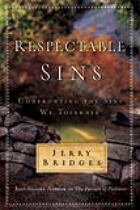
One of the books on my bedside table is Respectable Sins, by Jerry Bridges.  The subtitle of the book is: Confronting the Sins We Tolerate. The theme becomes self explanatory. 

In his preface Bridges explains the motive behind the book:

“The motivation for this book stems from a growing conviction that those of us whom I call conservative evangelicals may have become so preoccupied with some of the major sins of society around us that we have lost sight of the need to deal with our own more “refined” or subtle sins.”

I think Bridges is correct.  The whole notion of sin seems to have been lost on our society, and confused in our churches. 

Conservatives often lament the absence of any sense of, or concern about, sin reflected in our society.  In this glaring absence in our collective cultural conscience we have seen the arrival of government sanctioned killing through abortion and euthanasia; the crumbling of the family due to divorce, rampant pornography, and the redefining of it to embrace homosexuality as an acceptable norm; and a widespread apathy toward God. Those who speak out about such matters are right to be concerned.  The problem is that while we talk about those things that are infecting others, we are failing to address the very real sin in our own lives.  And we are therefore seen to be hypocrites – and probably rightly so.

Jesus instructed his followers to “first take the plank out of you own eye, then worry about the speck in the eye of another.”  I am not suggesting that those sins that are freely expressed in our society are minor specks.  They are not. They are serious.  And I am convinced that if we heed Jesus’s perscriptive counsel we will again experience the moral authority to speak. 

More serious than even the loss of our moral authority, many Evangelicals are confused about how we relate to God.  We have become disconnected from our own need of the Gospel, and our need of it every day. We fail to see the subtle, yet serious, ways we function as “unbelievers” and tolerate cancerous sin in our own hearts and relationships.  In fact, as the title of Bridges’ book suggests, we have not merely tolerated these things, but have functionally elevated them to a level of respectability.

Recognizing our sin, despite how it may seem, is not an entirely ugly proposition.  It is important to our spiritual vitality.  And makes practical sense. 

Let me explain it this way: We should be at least as concerned about our spiritual vitality as we are about our computers. 

I regularly receive updates from McAfee, and I run a scan on my computer at least a few times a week. Why? Because I have experienced the slow down, the unresponsiveness, and even a crash when I failed to have my computer checked for viruses that can infect it.  Once McAfee has performed a scan, if it has identified any potential threats I am able to deal with it. I either delete it, or in some cases quarantine the file. But either way, my computer functions much better because I have taken the time to perform this taks.

Sin in our lives, even that which seems minor, infects our hearts, our perceptions, our relationships, even our productivity.   We need to “scan” our hearts and lives regularly to see if there is anything there that may cause problems down the road. (This is what the Psalmist is advocating in Psalm 139)  Once we determine if there is anything there we can deal with it accordingly. In taking the appropriate precaustions we prevent problems because we are more able to keep things from spreading over and infecting other areas of our lives.

Despite what you may suspect due to my ranting thus far, this book is actually very positive, practical, and encouraging. 

In chapters 1-4 Bridges does a wonderful job explaining the Gospel, its practical importance, and its important practicality.

Chapter 5 discusses the Power of the Holy Spirit, and expalins how the Spirit is at work in the Gospel.

Chapter 6, titled: Directions for Dealing with Sins, serves as a practical preface to the rest of the book.  This chapter alone would be worth the price of the book, because it shows us how we can practice preaching the Gospel to ourselves. 

Chapters 7-20 deal with specific “acceptable” and “respectable” sins.  I have deeply appreciated Bridges’ talent for defining words of our Christian jargon that have at times confused me, or words that I’ve generally understood yet was still somewhat fuzzy about.  This understanding has been helpful in identifying some of the sin I carry around in my heart, and how it expresses itself in my life and in relationships..

The final chapter, chapter 21, simply asks the question: Where Do We Go from Here?

Each chapter is short and easily readable.  My intention is to read a few chapters a week over the next month or two so that I can digest Bridges’ insight, and deal with my own heart.  I may even journal my insights here on my blog. I haven’t decided yet.

But one thing I have decided to do. My friend, David Zavadil, has been working through this book and posting his observations on his blog, By His Grace.  Whether I develop my own posts or not, I will join the discussion David has started. I invite you to join me over there.

I Want to Walk Free, But I Still Hear the Chains Rattling

As a pastor I frequently encourage people to embrace the Gospel. It is not just to unbelievers that I present that challenge, but to believers as well – even to some who have been Christians for decades. 

We all need to grow in grace, and live by grace day by day. But as easy as it sounds, I sometimes have to stop and realize that it may be far easier to say than it is to live out. Many people – many good people – struggle with how to let go of our propensity toward legalism and embrace the freedom found in Christ.

For that reason I find the following article by Richard Pratt, of Reformed Theological Seminary & Third Millenium Ministries, to be particularly pertinent. And it is as entertaining as it is insightful – at least, I think so.

The story behind it, as I understand, is that Pratt had been encouraged by fellow RTS prof, Steve Brown (Old While Guy), to write a book about the experience of freedom found in the Christian life.  “I Want to Walk Free, But Still hear the Chains Rattling” is Pratt’s response to Brown’s prodding.

Continue reading

Easy Chairs & Hard Words – Part 4

by Douglas Wilson

We join a conservation in progress; it is between a young theological questioner who grew up in a typical Evangelical church, and an older pastor from a historical theological tradition.  

 ***** 

Pastor Spenser shifted easily in his seat while I carefully thought over my next question. “Some of my friends at my church have figured out that I have been coming to see you,” I said.  

Pastor Spenser nodded, and waited.  

“Naturally,” I said, “they are somewhat concerned.”  

“Naturally. About what?”  

“Well, they say that Christians who believe in the exhaustive sovereignty of God are setting themselves up.”  

“For…?”  

“For the temptation which says that because God controls everything, then the way I live doesn’t really matter.”  

“I see. In other words, if I am elect, then my sins won’t damn me, and if I am not, then all the good works in the world won’t save me. Is that it?”  

“Yes. That is exactly it. If the whole thing was settled before the world began, then why bother? My friends know that there are true Christians who believe this, but they think that, because of this theology, these Christians will tend to become careless about how they live.”  

“Why should we take responsibility for our actions after we have embraced a theology which cuts the nerve of personal responsibility?”  

“Right. If God controls everything, then what room is there for personal holiness?”  

Pastor Spenser thought for a moment. “The problem is not with your friends’ concern for personal holiness. That is admirable. All Christians should set their faces against carnal living on the part of professing Christians. But it does no good to oppose carnal living with carnal reasoning.”  

“What do you mean?”  

“When someone is whooping it up down at the bars, or sleeping with their girlfriend, why do we say it is sin?”  

“Is this a trick question?”  

Pastor Spenser grinned. “You might say that. Why do we call such things sin?”  

“Because the Bible does.”  

“Exactly. So this carnal living we have been talking about is a lifestyle that is not in submission to the clear teaching of the Word of God.”  

“Well, sure. But I still don’t see where you are going with this.”  

“Now if carnal living is a lifestyle that does not submit to God’s Word, then how should we define carnal reasoning?” 

“The same way, I suppose?”  

“Right. It is not enough to submit what we do externally to God; we must also submit the way we think. Your friends are trying to defend God’s standards for living by abandoning His standards for thinking. It cannot be successful.”  

“Is there a passage where this point is clear?”  

“Yes, in Philippians. Chapter 2, verses 12 and 13.”  

I turned to Philippians and read. “Therefore, my beloved, as you have always obeyed, not as in my presence only, but now much more in my absence, work out your own salvation with fear and trembling; for it is God who works in you both to will and to do for His good pleasure.” I looked up.  

“What does the passage say God is doing?” Pastor Spenser asked.  

I looked down again. “It says that He is working in the Philippians, both in willing and doing, and that the result is His good pleasure.”  

“And what would carnal reasoning do with that?”  

“Well, the response would be that if God is doing the willing, and if God is doing the doing, and the result is whatever He wants, then there is no reason for me to put myself out. It is going to happen anyway.”  

“Right. The reasoning says that if God is going to do the work, then why should I have to?”  

I nodded, and Pastor Spenser went on.  

“But what application of this truth does Paul command the Philippians to obey?”  

I looked at the passage again. “He tells them to work out their own salvation, with fear and trembling.” I glanced down further. “And in the next verse he goes on to specific ethical instruction – to avoid murmuring and disputing.”  

I sat and thought for a moment. “But my friends would say that the application they are making is obvious – common sense.”  

“Well, it certainly is common. But is it biblical?”  

“Why do so many Christians fall for this line of reasoning then? It seems like a trap that is extremely easy to fall into.”  

“Well, yes, it easy to fall into. But it is also easy to drink too much, not watch your tongue, lust after women, and so forth. And these are things which the church recognizes as sin, and warns the people against. But carnal reasoning is also easy, and almost no one warns the people.”  

“Why not?”  

“Sheep are hungry because shepherds don’t feed them. Shepherds don’t feed them because shepherds don’t have food.” Pastor Spenser leaned forward in his seat. “The shepherds don’t have food because they don’t study their Bibles.”  

“You think it is obvious in the Word?”  

“Certainly. When the apostle Paul magnified the prerogatives of the sovereign God, he fully anticipated the response of carnal reasoning.” Pastor Spenser leaned back, closed his eyes, and quoted, “You will say to me then, ‘Why does He still find fault? For who has resisted His will?’” A modern pastor, in the unlikely event that someone asked him this, would say that it was a good question, and that he wrestles with it often himself. Paul tells the questioner to shut up and sit down. ‘But indeed, O man, who are you to reply against God?’”  

“Paul doesn’t answer the question then?”  

Pastor Spenser opened his eyes. “Oh, he does. It just isn’t the answer carnal reason wants.”  

“So what is the answer?”  

“The answer is God – the same answer that is given at the end of the book of Job. Carnal reason doesn’t see a real answer there either. But believe me, it is a real answer. The answer is the ground of reality; the answer is God.”  

“What happens at the end of the book of Job?”  

“The questions raised in the book are conducive to carnal reason; indeed, even non-Christians are attracted to the first part of the book of Job. As they would put it, ‘It addresses the human condition.’ But then, at the end of the book, God comes in, with glory and thunder. And do you know what? He doesn’t answer any of the impertinent questions; rather, He poses some sobering questions of His own. ‘Who is this who darkens counsel by words without knowledge? Now prepare yourself like a man; I will question you, and you shall answer Me.’”  

I nodded. “And He asks where Job was when the universe was created.”  

“The question is not irrelevant. It is the heart of the matter. Discussions of God’s sovereignty and human responsibility very rarely display any understanding at all of Who the Creator is.”  

“But my friends would say that you are making God responsible for evil, and that they are concerned to protect God’s honor and glory.”  

Pastor Spenser looked at me intently. “It is true that the affirmation of God’s total control over all things causes some to blaspheme. But your friends need not be concerned for God’s glory; man’s slanders and blasphemies do not touch Him. Such slanderers are pelting the sun with wadded-up balls of tissue paper.”  

“They are stumbling over something though.”  

“They stumble, being disobedient to the word, to which they also were appointed.”  

“Now, see? Why do you have to put these things so strongly? Doesn’t that cause people to react to what you are teaching? They were appointed to stumble?”  

“That wasn’t my choice of words. I was quoting 1 Peter 2:8.”  

“Oh. Oops.”  

“Your friends are concerned that God be seen as good. But seen as good by whom? Those who believe the Word of God will know that God is light and in Him is no darkness at all. Of course He is good – by definition. And those who do not believe the Word of God will persist in thinking that there is a tribunal or court somewhere in which God will one day be arraigned. On the day of judgment, their folly will be apparent to all – even to them.”  

“So how do we bring this back to the original point?”  

“The original point was the concern that the doctrine of God’s sovereignty would be made into a cushion for sin. My answer to this is that we must, in all things, recognize God as God. We must do so in how we live holy lives, but we must also do so in why we live holy lives. We are to live in a holy way because God has commanded it.”  

“But you would also say that what God has commanded the believer He has also given the believer.”  

“Well, certainly.”  

“I honestly see why carnal reason has a problem with this.”  

“And I honestly see why carnal men want to lust after beautiful women. But what does the Bible say?”  

“What do you mean?”  

“What is the greatest commandment?”  

“That we love God.”  

“And what is the first fruit of the Spirit?”  

“Love.” I said. “I see.”  

“What do you see?” Pastor Spenser asked.  

“This takes us back to Philippians. We are commanded to work out what God works in.”  

“Right.” he said. “Nothing less.”

***

This is Part 4 in a series of 6 posts titled Easy Chairs & Hard Words.

What is Worship?

This post is an interview with Joseph F. “Skip” Ryan, former pastor of Park Cities Presbyterian Church in Dallas, Texas, and Trinity Presbyterian Church in Charlottesville, Virginia.  This interview first appeared in RTS Ministry in Summer 1990; and later in Reformed Worship

Q  In your opinion, what constitutes worship?

A   Most importantly, I think that the presence of God constitutes worship. It is not a human endeavor, but one that is inspired by the presence of the Lord himself. When people gather for worship, it is fundamentally an assembling of God’s people, the fellowship of the Holy Spirit. And God is the most important person present. Frequently, during the invocation I will say things that will help people remember that.

The primary activity during worship is listening to the speaking of the Lord, not only in the proclamation of the Word, but in the hymns and other elements of the worship service. We don’t just hear God through his Word; the whole environment speaks of his presence.

God’s presence is the beginning point for biblical worship; in the Old Testament, where God is present, there worship takes place. Dignity and awe and solemnity are very appropriate in his presence. There are times in worship when we should be struck dumb, when clapping hands and shouting would be inappropriate., because at times we need to be silent before the Lord.

The assembly of God’s people is the place of God’s worship – not the building. In the prayer of invocation we are calling upon the Lord to be among His people, to do as He has promised and constitute us as a worship assembly of his people.

Q  You have said there are some inadequate models of worship. What are they?  

A   First, worship is not simply instruction. We should not see the worship service only in terms of the sermon, which is accompanied by a few frills like the offering and some hymns. To avoid this tendency, we sometimes rearrange the order of our service so the sermon is not the climax of worship.

Second, worship is not a training center. The worship service is not the time to train the congregation in evangelism, visitation, or discipleship. The emphasis in worship is on being, not doing. We are not coming to learn how to do something; we are coming to learn that we are the Lord’s people and that our primary purpose is to glorify and enjoy him forever.

Third, the worship service is not simply for fellowship. Surely fellowship takes place in worship, but the primary reason for being there is not horizontal; it is vertical. If the strongest feeling you have after a worship service is that you have been in the presence of other people, then you have not been in the presence of the Lord.

The purpose of worship is also not evangelism. Gearing a worship service primarily to the unchurched, in my opinion, is not worship. It may be an evangelism meeting, which is good, but it is not worship. Dr. Edmund Clowney talks of “doxological evangelism,” which means that as we praise and worship God, other people are drawn to him and are converted. It is true; I have seen people become Christians in our morning worship service – not because we directed the service evangelistically, but because they sensed a reality that they had never experienced before.

Finally, we should not see the worship service as vision-building time for the church. Using the worship service to promote the new building or new programs will cause you to end up with something less than worship.

Q  You advocate providing opportunities for people to participate in worship, not merely watch. How is this done?

 A   First, there needs to be a balance between form and freedom (or spontaneity), between structure and liturgy, between formality and informality. I think we should use all the liturgical forms – creeds, liturgical prayers, and responsive readings – particularly the Psalms. But a worship service should also have pockets of spontaneity – usually in the form of music, sharing, or praying. These are the freedom within the form, and through them, we encourage people to be involved.

Ours is not an informal, spontaneous, new-fangled worship service. It is a blend of formality and informality, liturgy, and spontaneity. But the key is not to calculate some blend. The key is to focus on the presence of the Lord Jesus and let those who have gathered worship in spirit and in truth. This means they must really worship and not just play at it.

In our service, the beginning of worship may be rather formal, with a responsive call to worship – perhaps a Psalm – then a prayer of invocation, a hymn, and a creed. We then, however, move into a period of informal singing, flashing Scripture songs on the wall. We encourage hand clapping here, with a joyful kind of singing.

Other pockets of spontaneity may take place in the form of sharing or praying. Sometimes we have a straightforward pastoral prayer, sometimes we ask specific people to pray, sometimes the elders come forward and pray. Also, during our communion service, people must come and get the elements instead of waiting for the elements to come to them. Since we celebrate the Lord’s Supper frequently (about twenty-five times a year), this is a wonderful way of helping people participate.

Q  Where do you feel that contemporary elements like drama fit in a worship service?

A  I think the worship service is drama, and we participate in it. I try to work that out in worship by moving around; I start out behind the Lord’s table, move to the front for another part of the service, then later move to the pulpit to preach. Also, I think we should use all the beautiful instrumentation we can. We use a piano, flutes, violins, drums and guitars. The Psalms give us many examples of the music and drama of worship.

Celebrating the Lord’s Supper is also part of the drama of worship; the Lord’s Supper is the demonstration – the drama – of the gospel. I think pastors should make much more of the rightful place of the dramatic portrayal of the Lord’s Supper than we do.

We derive spiritual benefit from the Lord’s Supper, but it is mediated through the dramatic portrayal of the Lord’s death. Some of the liturgies – Episcopal, Anglican, or Reformed – can help us here; we should use them, or create our own biblically-centered ones, and exhibit more wonder at what we are doing in the Lord’s Supper.

Q  What do you think our biggest failure is in worship today?  

A     I think we are trying to cram too many agendas into one hour of worship. We are trying to instruct, train, fellowship, evangelize, build vision, and give out all the announcements to keep the church running for a week – all in one hour. We allow many things to formulate our objectives for worship rather than focusing on the main goal of leading people into the presence of God.

Another failure is our tendency to imitate other churches’ models of worship without due regard for the unique way in which the Lord may be leading our church to worship. There is too much stress on specific types or models of worship and too little stress on entering into the presence of God.

Q  Do you think congregations should be better educated about worship?  

A  Yes, but I do not think that means more sermons about worship, unless that subject comes up naturally as a pastor preaches through the Bible. I think pastors need to instruct their people while in the process of worship. Sometimes when our folks are half asleep during the first hymn, I’ll stop it halfway through and lightly suggest we try again with our eyes open and our voices raised, reminding them we are singing to the Lord of all the universe.

Q  If a church wants to get serious about worship, what should the congregation do?  

A    Visit other churches where they are doing things differently and get ideas. Don’t imitate them slavishly, but do see what is applicable to your situation. The pastor should ask the session or council for freedom to experiment with the worship service to make it better. Also, the pastor needs to make sure he is worshiping as he leads the people; if he is, the people will catch it. Think through the service-the rhythm of worship, the elements, the flow, the content, the structure.  Pastor, don’t be overly chatty like a talk show host. Don’t talk about yourself; talk about the Lord. Lead people to the Lord. Call upon them to think about what they are saying and about the Scripture they are reading.

Q  What have you found to be the greatest benefit in your approach to worship?  

A     People come to worship really wounded and needy from the battles of the world. There must be a place in the midst of the battle where they can find the Sabbath presence of the Lord. If church becomes just another meeting, if there is no reality in the worship service, then we are asking people simply to come to another teaching session.

One Sunday, a very old man approached me after the service. He shook my hand and introduced himself. He looked me in the eye and said, “Young man, I have my own church, and I probably won’t come back here. But I want you to know something. I have not worshiped like that for twenty-five years.” He had tears in his eyes.

Balance of Truth

True Christianity consists of a proper mixture of fear of God, and of hope in his mercy; and wherever either of these is entirely wanting, there can be no true Faith. God has joined these things, and we ought by no means to put them asunder.   

He cannot take pleasure in those who fear him with a slavish fear, without hoping in his mercy, because they seem to consider him a cruel and tyrannical being, who has no mercy or goodness in his nature. And, besides, they implicitly charge him with falsehood, by refusing to believe and hope in his invitations and offers of mercy. 

On the other hand, he cannot be pleased with those who pretend to hope in his mercy without fearing him. For they insult him by supposing there is nothing in him which ought to be feared. And in addition to this, they make him a liar, by disbelieving his awful threatenings denounced against sinners, and call in question his authority, by refusing to obey him.  

Those only who both fear him and hope in his mercy, give him the honor that is due to his name.   

Edward Payson, D.D. 1783-1827

Desiring God

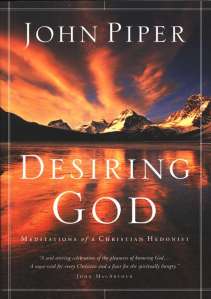
If you are not already familiar with his work, I want to introduce you to John Piper. In particular I commend his book Desiring GodDesiring God

This book is a modern day classic. And in my mind it an almost indespensible aid to  gaining a Biblical perspective of the Glory of God.  Well, indespensible might be a bit of an overstatement.  But, it is a book I have read and re-read many, many times, always coming away with new insights and delight.

When I first read Desiring God it resonated with me like few other books ever have. I don’t want to say it shaped my thinking at that time. Rather I think it confirmed it.  I always knew there had to be away of enjoying life and honoring God.  Piper opens the door to show us how!

Piper thoroughly saturates his writing with exposition of Scripture, and brings together two aspects of life that are sadly not often enough paired together: Our Joy and God’s Glory.  By reuniting these perspectives Piper expresses far better than I could even dream of doing what what it means to live according to our primary purpose as Christians.  And because he expressed it so well, he has subsequently shaped much of how I express this important aspect of the Gospel. 

The link I provided above is to the e-book – the entire book online.  But there are also a number of other outstanding resources available at Desiring God Ministries.

I suggest reading through and thinking about at least the Introduction: How I Became a Christian Hedonist. (I know that whole concept may be shocking at first, but it will make perfect sense once you read the Intro.)  Then look over the chapter titles.

If you are hungry to grow in both your relationship with God and how a Christian lives, you won’t be disappointed.