Sabbath Rest: The Above All Commandment

Like many people, I get easily wearied by many of the Sabbath debates. What can you do? What can’t you do?  While not unimportant, these questions miss the point.

Jesus told us:

“Sabbath was made for man, not man for the Sabbath.” (Mark 2.27)

In other words, Sabbath is a gift made or established by God for us. True, it is for God’s glory, and is therefore to be kept holy. (Exodus 20.8) But we must remember that our greatest good is wrapped up in God’s glory.  And as John Piper reminds us: “God is most glorified when we are most satisfied in him.”

God gave us the gift of the Sabbath as a means that we might be satisfied in him and thereby glorify him.

Sadly, the debate seems to revolve around polarized positions, with contemporary Pharisees on the one side and supposed free spirited antinomians on the other.  The Pharisee says: “Do”, or mostly “Don’t Do”.  The antinomian (which means “against Law”) holds to the notion that he can do as he pleases, and has no obligation.  The one squeezes the life out of the gift. The other, perhaps unwittingly, responds to God’s gift by saying: “No Thanks”.

In an article from Christianity Today magazine, Kevin Emmert winsomely makes a case for Sabbath observation.  Emmert rightly describes it as a spiritual discipline of resting.  And he acknowledges that this notion somehow seems antithetical to both our spiritual growth and God’s glory:

It is difficult, and ironic, to imagine rest as the most transformative element in the Christian life. For evangelicals especially, transformation and sanctification are closely linked to activity. We appropriately begin with the idea that our works do not merit justification (being declared righteous by God). We can do nothing to earn our salvation. But most of us imagine we must play an active role in our sanctification, the ongoing process of becoming more like Christ. Sanctification, we assume, involves work and effort on our part.

This is good news to evangelical ears. We like activities. We conduct Bible studies, participate in small groups, and attend prayer meetings. We engage in worship services and outreach. We like inspirational books that teach us how to become better Christians. We have a sense of duty that compels us to evangelize and demonstrate Christ’s love to those around us. Indeed, these activities are good and find their foundation in biblical teachings.

And this is precisely why we find it so difficult to imagine rest as the most transformative feature of the Christian life.

Yet Emmert convincingly contends that this discipline, perhaps more than any other, and certainly no less than any other, provides the greatest spiritual benefits:

Why is the Sabbath so important? After all, it’s a command to do nothing; it requires no activity or effort. And that may be precisely the point.

This “above all” command encourages us to trust in God in a way that no other activity can. So much more could be accomplished by adding another day of labor, but the Sabbath requires us to trust that God will provide for all our needs and that he will continue to manage the world without our help. The Sabbath is a practical reminder that we are completely dependent on God.

It is when we realize our complete dependence upon God that we experience how great a thing it is to have the right to call him “Father”.

Check out Emmert’s short article: The Above All Commandment

Deeper Into the Gospel

Reflecting on Colossians 1.6, Tullian Tchividjian, in his book Jesus + Nothing = Everything, offers this poignant perspective about the present practicality of the gospel:

The gospel represents both the nature of Christian growth and the basis for it.  Whatever progress we make in our Christian lives – whatever going onward, whatever pressing forward – the direction will always be deeper into the gospel, not apart from it, not aside from it. Growth in the Christian life is the process of receiving Christ’s “It is finished” into new and deeper parts of our being every day, and it happens as the Holy Spirit daily carries God’s good word of justification into our regions of unbelief – what one writer calls our “un-evangelized territories”.

How I wish – and pray – more people would realize this.  Too many pulpits – conservative and heterodox alike – proclaim alternatives to the gospel – counterfeit gospels, really.  They do this because it sells.  The masses are in need of a remedy only an increasing application of the gospel is able to supply, but they clamor for placebos – spiritual sugar pills.

May I always be mindful of Paul’s words:

  • I resolve to know nothing among you except Jesus Christ and him crucified. (1 Corinthians 2.2)
  • But even if we or an angel from heaven should preach a gospel other than the one we preached to you, let him be eternally condemned! (Galatians 1.8)

The Old Man and the Flesh

by Robin Boisvert

What actually changes when one becomes a Christian?  Confusion about this is common, especially when we realize that we continue to struggle with sin and temptation even after conversion.  Paul tells us in Galatians that we have a war that goes on within us after conversion: “For the desires of the flesh are against the Spirit, and the desires of the Spirit are against the flesh, for these are opposed to each other, to keep you from doing the things you want to do. ” (Galatians 5.17)   In this short essay Robin Boisvert helps bring some clarity.  ~ WDG

***

Some of the terms which the apostle Paul uses in discussing the believer’s relationship to sin can cause confusion. I’m speaking of terms such as “old man,” “new man,” “body of sin,” “flesh,” and others. These can be difficult to understand. Add to this the variations which modern translators have given these words and the subject can appear daunting.

We know a profound change has occurred in the life of the believer through conversion, but just how has the believer changed?

For we know that our old self was crucified with him so that the body of sin might be done away with, that we should no longer be slaves to sin — because anyone who has died has been freed from sin. (Romans 6.6-7, emphasis added)

Let’s begin by trying to define our terms. “Old man” (as it is translated in the King James Version and American Standard Version) is equivalent to “old self”  (NIV, NASV).  This term refers to the unregenerate life we lived before we were converted. As John R.W. Stott has written, the old self “denotes not our old unregenerate nature [flesh], but our old unregenerate life. Not my lower self, but my former self. So what was crucified with Christ was not a part of me called my ‘old nature’, but the whole of me as I was before I was converted.”1  John Murray’s definition concurs:

“‘Old man’ is a designation of the person in his unity as dominated by the flesh and sin.”2

It’s important for us to see that the believer is not at the same time an “old self” and a “new self,” alternately dominated and directed by one or the other. We are indebted again to Murray’s insight:

The old man is the unregenerate man; the new man is the regenerate man created in Christ Jesus unto good works. It is no more feasible to call the believer a new man and an old man, than it is to call him a regenerate man and an unregenerate.  And neither is it warranted to speak of the believer as having in him the old man and the new man. 3

Thus, terms like “old man,” “old self,” “unregenerate life,” and “former self” are synonymous, all referring to the entity that was crucified with Christ.

Notice two significant grammatical features of the passage from Romans 6 cited above. First, the verb is used in the past tense: “our old self  crucified…” The crucifixion of the old self is a finished fact. Second, the verb is also passive in voice, meaning that the subject (our old self) is being acted upon. In other words, the crucifixion of the old self is not something we must do, but something that is done to us.

Another important concept in the biblical doctrine of sanctification has traditionally been designated by the word “flesh” (King James Version). The New International Version uses “sinful nature.” According to Stott, “flesh” refers to a “lower” nature, that part of our being inclined toward rebellion against God. This is that part of you that wants to pass on a juicy bit of gossip; that urges you to take a second look at the  immodest images on the television screen. “Whatever we may call this tendency [“indwelling sin,” 4 “remnants of corruption,”5 “vestiges of sin,”6 or “my sinful nature”7]  we must remember that even after we have been regenerated we still have such sinful impulses, and must still fight against them as long as we live.” 8

In Romans 6.6 Paul calls our sinful nature (i.e. flesh) the “body of sin.” He says our old self was crucified with Christ so that this “body of sin might be done away with…” To be “done away with” here means to be put out of action, rendered powerless. It does not mean to be annihilated, gone without a trace. But our sinful nature’s mastery over us has been broken.

Some, not understanding the distinction between the “old self” and the “sinful nature” have gotten Romans 6.6 confused with Galatians 5.24, which also speaks of crucifixion and the believer. Consider two translations of this verse:

  •  Those who belong to Christ Jesus have crucified the sinful nature with its passions and desires. (Galatians 5.24 NIV)
  •  And they that are Christ’s have crucified the flesh with the affections and lusts. (Galatians 5.24 KJV)

Though helpless to take anything but a passive stance in regard to the old self (Romans 6.6), we do have an active part to play, as the Galatians learned, in the subjugation of the flesh. Stott sums this up with characteristic clarity:

 First, we have been crucified with Christ; but then we not only have decisively crucified (i.e. repudiated) the flesh with its passions and desires, but we take up our cross daily  and follow Christ to crucifixion (Luke 9.23). The first is a legal death, a death to the penalty of sin; the second is a moral death, a death to the power of sin. The first belongs to the past, and is unique and unrepeatable: I died (in Christ) to sin once. The second belongs to the present, and is continuous and repeatable: I die (like Christ) to self daily. It is with the first of these two that Romans 6 is concerned. 9

And Galatians 5 is concerned with the second.

So the old self has been dealt with. In its place we have been given a new self: “Therefore, if anyone is in Christ, he is a new creation; the old has gone, the new has come!” (2 Corinthians 5.17). And while our sinful nature (the flesh, indwelling sin, etc.) is still very much with us, its dominion over us has ended.

Continue reading

Mirror, Mirror on the Wall

In the Preface to Joe Thorn‘s book, Note to Self, Sam Storms penned a paragraph that strikes at the heart of the difference between those with a vital Chrisian faith, and those who show little if any hint of actually being a follower of Jesus Christ.  Here is what Storms says about the functional place of Scripture in the life of a Believer:

Merely affirming the Bible is inspired accomplishes very little.  Asserting it’s authority isn’t much better.  The inspiration and authority of the Scriptures are of value to us only so far as we change our beliefs to conform to its principles and alter our behavior to coincide with its imperatives.  The Bible is meant to govern our lives, to fashion our choices, to challenge our cherished traditions, and ultimately make us more like Jesus.

The question for each of us, then, is whether the Bible actually functions in this way.

  • Do we submit to its dictates?
  • Do we put our confidence in its promises?
  • Do we stop living in a certain way in response to its counsel?
  • Do we embrace particular truths on its authority?
  • Do we set aside traditional practices that conflict with its instruction?

In other words, for the Bible to be of value to us it must actually function to shape how we think, feel, and act, as well as what we believe, value, and teach.

I think Storms nails it here; hits it square on its head.

A number of dialogues I have recently had broached the subject of the differences of maturity levels between professing Christians. What Storms addresses is one of the most vital dynamics that explain the differences.  In fact, since we who believe have all been given the same Spirit, perhaps the differences in the way we approach and apprehend the Scripture may be THE most important explanation for such differences.

Some see the Scriptures as they are to be seen, as a revelation of what is good and a mirror to show us what needs addressing in our lives, which in turn drives us to the Cross, where the power of transformation rests.  Here they find the promises of God to be true: He is making us beautiful, to become a Bride for the King.

Others also see the Scriptures as a mirror. But, for these folks, this mirror is more like the one used by that witch in the story Snow White, who declared: “Mirror, mirror on the wall, who is the fairest one of all?”  All she wanted was to hear how good she was; how much better she was than others. Sadly some people look to the mirror of Scripture only willing to see whatever appears to validate them.  Failing to see, by the mirror, the ugly-fying effects of sin in their hearts and lives, they see no real need to return to the Cross.  Thus they seem to never be changed.  They never become truly beautiful.

Who Does What?

Reading Jerry Bridges’ book Discipline of Grace, especially chapter 6, prompted me to think about the importance of understanding “Who does What?” in our salvation.

Here are a few observations that I hope will provide some clarification:

  • Many are frustrated to unfortunate degree because they do not understand that sanctification is a process.
  • Many are spiritually stunted because they do not realize spiritual growth and maturity is a process in which we must actively and intentionally participate.
  • Many people just assume that, now that they are “New Creations”, Christ-likeness will inevitably emerge from within them whether they do anything or not.
  • But spiritual growthis not automatic.  God calls us to cooperate with his grace, by actively engaging in the Means of Grace (Word, Sacraments, Prayer), responding to the Spirit by his grace.
  • The confusion seems to be rooted in misunderstanding the differences and the relationship between justification (conversion) and sanctification (growth). 
  • While it is true that we can do nothing to bring about our justification, our new birth, any more than we can do anything to bring about our physical birth; it is not true that we can do nothing, or should do nothing to cultivate healthy spiritual growth.  Just as in our physical growth, where we develop in accord with our God-given DNA in no small part through healthy eating and activity, we grow spiritually by God-given grace AND healthy activity (i.e. Means of Grace, Obedience, Active Mission and Spiritual Disciplines).

Spiritual Formation Beyond Decency

We must stop using the fact that we cannot earn grace (whether for justification of for sanctification) as an excuse for not energetically seekng to receive grace.  Having been found by God, we then become seekers of ever-fuller life in him. Grace is opposes to earning, not effort.  The realities of Christian spiritual formation are that we will not be transformed “into his likeness” by more information, or by infusions, inspirations, or ministrations alone. Though all of these have an important place, they never suffice, and reliance upon them alone explains the now-common failure of committed Christians to rise much above a certain level of decency.

~ Dallas Willard, in The Great Omission

Christ-likeness: The Purpose of God for His People

by John R.W. Stott

I remember very vividly, some years ago, that the question which perplexed me as a younger Christian (and some of my friends as well) was this: what is God’s purpose for His people? Granted that we have been converted, granted that we have been saved and received new life in Jesus Christ, what comes next? Of course, we knew the famous statement of the Westminster Shorter Catechism: that man’s chief end is to glorify God and to enjoy Him forever: we knew that, and we believed it. We also toyed with some briefer statements, like one of only five words – love God, love your neighbour. But somehow neither of these, nor some others that we could mention, seemed wholly satisfactory. So I want to share with you where my mind has come to rest as I approach the end of my pilgrimage on earth and it is – God wants His people to become like Christ. Christlikeness is the will of God for the people of God.

So if that is true, I am proposing the following:

  • First to lay down the biblical basis for the call to Christ-likeness;
  • Secondly, to give some New Testament examples of this;
  • Thirdly, to draw some practical conclusions.

And it all relates to becoming like Christ.

So first is the biblical basis for the call to Christlikeness. This basis is not a single text: the basis is more substantial than can be encapsulated in a single text. The basis consists rather of three texts which we would do well to hold together in our Christian thinking and living:

Lets look at these three briefly.

Romans 8.29 reads that God has predestined His people to be conformed to the image of His Son: that is, to become like Jesus. We all know that when Adam fell he lost much – though not all – of the divine image in which he had been created. But God has restored it in Christ. Conformity to the image of God means to become like Jesus: Christlikeness is the eternal predestinating purpose of God.

My second text is 2 Corinthians 3.18: ‘And we all, with unveiled face, beholding the glory of the Lord, are being changed into his likeness, from one degree of glory to another; for this comes from the Lord who is the Spirit.’ So it is by the indwelling Spirit Himself that we are being changed from glory to glory – it is a magnificent vision.

In this second stage of becoming like Christ, you will notice that the perspective has changed from the past to the present, from God’s eternal predestination to His present transformation of us by the Holy Spirit. It has changed from God’s eternal purpose to make us like Christ, to His historical work by His Holy Spirit to transform us into the image of Jesus.

That brings me to my third text: 1 John 3.2. ‘Beloved, we are God’s children now and it does not yet appear what we shall be but we know that when he appears, we will be like him, for we shall see him as he is.’ We don’t know in any detail what we shall be in the last day, but we do know that we will be like Christ. There is really no need for us to know any more than this. We are content with the glorious truth that we will be with Christ, like Christ, for ever.

Here are three perspectives – past, present and future. All of them are pointing in the same direction: there is God’s eternal purpose, we have been predestined; there is God’s historical purpose, we are being changed, transformed by the Holy Spirit; and there is God’s final or eschatalogical purpose, we will be like Him, for we shall see Him as He is. All three, the eternal, the historical and the eschatalogical, combine towards the same end of Christlikeness. This, I suggest, is the purpose of God for the people of God. That is the biblical basis for becoming like Christ: it is the purpose of God for the people of God.

***

NOTE: The above address was the last message John Stott gave at the Keswick Convention. This address was given in Summer 2007

My Spiritual EKG

“How are you doing, Spiritually?” That is an important question.

The Great Physician, by both direct and indirect statements in his Word, repeatedly encourages us to examine our hearts. But while many may be  aware that it ought to be our regular practice to take a Spiritual pulse, I suspect that relatively few know how to read the gauges even if they try. Consequently, if we are not certain what we are looking for, it follows that we are not always quite sure how to answer our opening question. So, it seems, the typical response we might give, even to those who may genuinely care, is an awful lot like the responses we give to the stranger on the street, or the hotel clerk we see each morning on vacation, when they ask “How are you today?” “Fine, thanks. And you?” But this is too important a question to simply perpetuate the standard reflex response.

I have benefited from regularly asking myself 10 Questions I learned from Don Whitney and his short but helpful book: 10 Questions to Diagnose Your Spiritual Health. Asking myself these questions, or considering observations people have offered about me as they relate to these questions, serves as a good spiritual check-up.

Each of the 10 Questions below is a link to an excerpt of respective chapters from Whitney’s book:

  1. Are you more thirsty for God than ever before?
  2. Are you more and more loving?
  3. Are you more sensitive to and aware of God than ever before?
  4. Are you governed more and more by God’s Word?
  5. Are you concerned more and more with the physical and spiritual needs of others?
  6. Are you more and more concerned with the Church and the Kingdom of God?
  7. Are the disciplines of the Christian life more and more important to you?
  8. Are you more and more aware of your sin?
  9. Are you more and more willing to forgive others?
  10. Are you thinking more and more of heaven and of being with the Lord Jesus?

Organic Church

You will observe that I am not merely exhorting you “to go to church.” “Going to church” is in any case good. But what I am exhorting you to do is go to your own church – to give your presence and active religious participation to every stated meeting for worship of the institution as an institution. Thus you will do your part to give to the institution an organic religious life, and you will draw out from the organic religious life of the institution a support and inspiration for your own personal religious life which you can get nowhere else, and which you can cannot afford to miss – if, that is, you have a care to your religious quickening and growth. To be an active member of a living religious body is the condition of healthy religious functioning.

B.B. Warfield

I Want Change

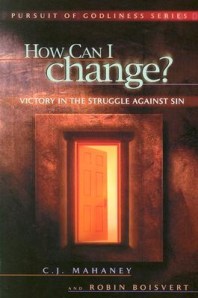
Change is inevitable, but it is not always pleasant.  But perhaps even less pleasant than unexpected change is the lack of change when it is desired and needed – particularly change in ourselves and in our spiritual development.  The questions are common: How Can I Change? When Will I Change? 

C.J. Mahaney & Robin Boisvert have written a helpful little book that addresses these very questions.  Here is an excperpt from the Foreword:

“In a day when quick solutions to longstanding problems are too easily offered, we wish to recommend the old paths, having found them tried and true. There is no short course to Christian maturity. There is no cross-less way to follow Christ, no instant secret to the Christian life. But like distance running, if the way of the cross is not easy, neither is it complicated. God presents us with a pathway that is narrow yet straight. He makes his ways plain to those who are sincerely interested in following him, and he will show himself strong on behalf of all whose hearts are fully his.

Although our vigorous effort is required, all growth is by his grace. With that wonderful truth as our starting block, let us press on toward the mark, each confident that ‘he who began a good work in you will carry it on to completion until the day of Christ Jesus.’ (Philippians 1:6).”

Thanks to Sovereign Grace Ministrires, this little book is available in .pdf for FREE.  Click on the Chapter Titles to read or download:

Introduction

  1. Caught in the Gap Trap
  2. Where It All Begins
  3. United With Christ
  4. The Battle Against Sin
  5. Tools of the Trade – Part 1
  6. Tools of the Trade – Part 2
  7. Living for That Final Day

Appendices

  • Appendix A – Different Roads to Holiness
  • Appendix B – The Old Man and the Flesh 

Growth in Grace


by Archibald Alexander

The following essay by Archibald Alexander, first president of Princeton Theological Seminary, is a masterpiece integrating sound doctrine, practice, and personal experience. I have appreciated Archibald Alexander’s insights for more than a decade now, perhaps none more than this classic. Christians in this generation would find great refreshment if only we would, at least occasionally, drink from the fountain that springs from the writings of Alexander and others of his day.   – WDG

***

WHEN there is no growth, there is no life. We have taken it for granted that among the regenerate, at the moment of their conversion, there is a difference in the vigour of the principle of spiritual life, analogous to what we observe in the natural world; and no doubt the analogy holds as it relates to growth. As some children who were weak and sickly in the first days of their existence become healthy and strong, and greatly outgrow others who commenced life with far greater advantages, so it is with the ‘new man’. Some who enter on the spiritual life with a weak and wavering faith, by the blessing of God on a diligent use of means, far outstrip others who in the beginning were greatly before them.

It is often observed that there are professors who never appear to grow, but rather decline perpetually, until they become in spirit and conduct entirely conformed to the world, from whence they professed to come out. The result in regard to them is one of two things; they either retain their standing in the Church and become dead formalists, ‘having a name to live while they are dead’—‘a form of godliness, while they deny the power thereof’—or they renounce their profession and abandon their connection with the Church, and openly take their stand with the enemies of Christ, and not infrequently go beyond them all in daring impiety. Of all such we may confidently say, ‘They were not of us, or undoubtedly they would have continued with us.’ But of such I mean not now to speak further, as the case of back-sliders will be considered hereafter.

That growth in grace is gradual and progressive is very evident from Scripture; as in all those passages where believers are exhorted to mortify sin and crucify the flesh, and to increase and abound in all the exercises of piety and good works. One text on this subject will be sufficient: ‘Grow in grace and in the knowledge of our Lord and Saviour Jesus Christ.’ (2 Peter 3.18) And this passage furnishes us with information as to the origin and nature of this growth. It is knowledge, even the knowledge of our Lord and Saviour Jesus Christ. Just so far as any soul increases in spiritual knowledge, in the same degree it grows in grace. Persons may advance rapidly in other kinds of knowledge, and yet make no advances in piety, but the contrary. They may even have their minds filled with correct theoretical knowledge of divine truth, and yet its effect may not be to humble, but to ‘puff up’. Many an accurate and profound theologian has lived and died without a ray of saving light. The natural man, however gifted with talent or enriched with speculative knowledge, has no spiritual discernment. After all his acquisitions, he is destitute of the knowledge of Jesus Christ. But it should not be forgotten that divine illumination is not independent of the Word, but accompanies it. Those Christians, therefore, who are most diligent in attending upon the Word in public and private, will be most likely to make progress in piety.

Continue reading

Benefitting in the Benefactor

Sinclair Ferguson offers this wise insight about the gospel-centered life:

“…we must never separate the benefits (regeneration, justification, sanctification) from the Benefactor (Jesus Christ). The Christians who are most focused on their own spirituality may give the impression of being the most spiritual … but from the New Testament’s point of view, those who have almost forgotten about their own spirtuality because their focus is so exclusively on their union with Jesus Christ and what He has accomplished are those who are growing and exhibiting fruitfulness. Historically speaking, whenever the piety of a particular group is focused on OUR spirituality that piety will eventually exhaust itself on its own resources. Only where our piety forgets about ourself and focuses on Jesus Christ will our piety nourished by the ongoing resources the Spirit brings to us from the source of all true piety, our Lord Jesus Christ.”

Ecstasy & Delight

Ecstasy and delight are essential to the believer’s soul and they promote sanctification.

We were not meant to live without spiritual exhilaration, and the Christian who goes for a long time without the experience of heart-warming will soon find himself tempted to have his emotions satisfied from earthly things and not, as he ought, from the Spirit of God. The soul is so constituted that it craves fulfillment from things outside itself and will embrace earthly joys for satisfaction when it cannot reach spiritual ones…

The believer is in spiritual danger if he allows himself to go for any length of time without tasting the love of Christ and savoring the felt comforts of a Savior’s presence. When Christ ceases to fill the heart with satisfaction, our souls will go in silent search of other lovers…

By the enjoyment of the love of Christ in the heart of a believer, we mean an experience of the “love of God shed abroad in our hearts by the Holy Ghost which is given to us” (Romans 5.5)… because the Lord has made himself accessible to us in the means of grace, it is our duty and privilege to seek this experience from Him in these means till we are made the joyful partakers of it.

– John Flavel (1630-1691)

More Like Jesus

Aqua

“To become more like Jesus is to feel increasingly unable to do life, increasingly wary of your heart. Paradoxically, you get holier while you are feeling less holy. The very thing you were trying to escape – your inability – opens the door to prayer and then grace.”

 – Paul Miller, A Praying Life