Dr. Os Guinness speaks to Acton Institute, a message titled: The Power of the Gospel No Matter How Dark the Times. This message, though long, is powerful, and is related to a post I published earlier this week titled: Culture Shaping Power of the Church.
Os Guinness
Culture Shaping Power of the Church

Os Guinness, in his excellent book, Renaissance, concerning the church in midst of the present challenges unprecedented in Western Culture, notes the culture changing and culture shaping power of the gospel, when the gospel is both declared by God’s People and is actively shaping God’s People. When many of our churches are caving in pursuit of “relevance”, which is hoped will cause people to “like” the church, so we can keep our numbers up, I think Guinness offers a both prophetic and strategic word:
What we have here in the teaching of Jesus and the Scriptures, and amplified in Augustine, is the very heart of the secret of the culture-shaping power of the gospel in the church. When the church goes to either of two extremes, and is so “in the world” that it is of the world and worldly, or so “not of the world” that it is otherworldly and might as well be out of the world altogether, it is powerless and utterly irrelevant. But when the church, through its faithfulness and its discernment of the times, lives truly “in” but “not of” the world, and is therefore the City of God engaging the City of Man, it touches off the secret of its culture-shaping power. For the intellectual and social tension of being “in” but “not of” the world provides the engagement-with-the-critical-distance that is the source of the church’s culture-shaping power.
In short, the decisive power is always God’s, through his Word and Spirit. But on her side the church contributes three distinct human factors to the equation: engagement, discernment, and refusal.
First, the church is called to engage and to stay engaged, to be faithful and obedient in that it puts aside all other preferences of its own and engages purposefully with the world as the Lord commands.
Second, the church is called to discern, to exercise its spiritual and cultural discernment of the best and worst of the world of its day, in order to see clearly where it is to be “in” and where it is to be “not of” that world.
Third, the church is called to refuse, a grand refusal to conform to or comply with anything and everything in the world that is against the way of Jesus and his kingdom.
Christian’s Cultural Assessment Toolbox
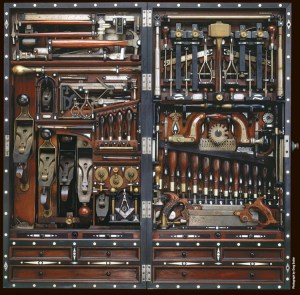
Here’s an astute observation from Os Guinness:
“Christians simply haven’t developed Christian tools of analysis to examine culture properly. Or rather, the tools the church once had have grown rusty or been mislaid. What often happens is that Christians wake up to some incident or issue and suddenly realize they need to analyze what’s going on. Then, having no tools of their own, they lean across and borrow the tools nearest them.
They don’t realize that, in their haste, they are borrowing not an isolated tool but a whole philosophical toolbox laden with tools which have their own particular bias to every problem (a Trojan horse in the toolbox, if you like). The toolbox may be Freudian, Hindu or Marxist. Occasionally, the toolbox is right-wing; more often today it is liberal or left-wing (the former mainly in North America, the latter mainly in Europe). Rarely – and this is all that matters to us – is it consistently or coherently Christian.
When Christians use tools for analysis (or bandy certain terms of description) which have non-Christian assumptions embedded within them, these tools (and terms) eventually act back on them like wearing someone else’s glasses or walking in someone else’s shoes. The tools shape the user. Their recent failure to think critically about culture has made Christians uniquely susceptible to this.”
Thinking Christianly

Thinking Christianly is not simply thinking by Christians, nor is it thinking by Christians about Christian things, nor is it thinking by Christians about or in order to develop a ‘Christian line’. Thinking Christianly is thinking by Christians about anything at all in a profoundly Christian way. Where their minds are so informed and influenced by the truth of God in terms of their principles, perspectives, and presuppositions that they begin to see as God sees, though it will be in an imperfect way.
 GRACE & PEACE