Devotional for the New Year: The Good News We Almost Forgot

Good News

For anyone looking for a good devotional book to use in the new year, whether for personal or family, I would recommend Kevin DeYoung‘s The Good News We Almost Forgot.  Insightfully written, this book follows the pattern of the Heidelberg Catechism, quite possibly the most devotional of all historic catechisms.  As the Heidelberg has been broken into 52 units by the Dutch church, one for each Lord’s Day of the year, so DeYoung has penned 52 short, two to three page, chapters, each digging into the truths of the respective catechism questions for that week, and then winsomely applying the truths to day to day life.  This book helps the readers go deeper while at the same time broadening the scope of the historic faith.

Love Wins… Does Anyone Lose – Part 2

Now that the advanced copies of the book have been sent out, people have had opportunity to read it and reflect.

Kevin DeYoung has thoughtfully analyzed Rob Bell’s Love Wins and published his observations and concerns in a compelling review.  DeYoung’s opening paragraph offers a summary of Bell’s premise:

Love Wins, by mega-church pastor Rob Bell, is, as the subtitle suggests, “a book about heaven, hell, and the fate of every person who ever lived.” Here’s the gist: Hell is what we create for ourselves when we reject God’s love. Hell is both a present reality for those who resist God and a future reality for those who die unready for God’s love. Hell is what we make of heaven when we cannot accept the good news of God’s forgiveness and mercy. But hell is not forever. God will have his way. How can his good purposes fail? Every sinner will turn to God and realize he has already been reconciled to God, in this life or in the next. There will be no eternal conscious torment. God says no to injustice in the age to come, but he does not pour out wrath (we bring the temporary suffering upon ourselves), and he certainly does not punish for eternity. In the end, love wins.

I am not sure what the allure of Bell’s thesis is.  Oh, I understand why it appeals to some who are not Christians.  What perplexes me is why some – maybe many – who consider themselves Christ followers are intrigued with this notion of Universalism that has been debunked repeatedly by every expression of Christ’s Church for nearly 1500 years.   Could it be that we, in our feigned wisdom, imagine we might out-do God in compassion?

It is unusual for me to publish critical posts, and very unusual for me to harp on a trendy issue through repeated posts.  But I do so because I see the intrigue this book has stirred, even among some I know.  As a pastor I would urge folks not to even bother reading it.  There are so many great things out there to feed our minds and our souls, why should we choose warmed over heresy?  What spiritual benefit do you imagine you might gain?

But should you be among those who succumb to the temptation… please also read DeYoung’s review.

NOTE: This review is also available in .pdf.

Click: God is Still Holy and What You Learned in Sunday School is Still True

Hellacious Discussions

I am coming to the dance late, but it appears the party is not yet over. So late may not be too late.  What party? Well, the  “Hell-acious” party that has been going on in the blogosphere.

Apparently the debate was kicked off by Rob Bell and his new book titled: Love Wins.  Apparently the video promoting the book leans a little too close to affirming Universalism.  Having watched it, I can see why there is some concern.

There is little I will add to this discussion, other than to affirm that the Bible is clear about Hell being an actual place.  Any notions that the reality of Hell somehow diminishes Grace or is a stain on God’s character are just uninformed and/or thoughtless.  More than that, such theories are not rooted in Scripture.  Thus we can assume they originate from the pit of… well, you know…

Some notables responding to Bell were:

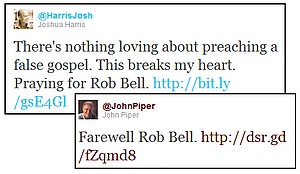
John Piper & Josh Harris on Twitter:

Kevin DeYoung

Justin Taylor

Tim Keller also republished a post titled The Importance of Hell

  1. Hell is Important Because Jesus taught on it more than all other Biblical authors put together.
  2. Hell is Important because it shows how infinitely dependent we are on God for everything.
  3. Hell is Important because it unveils the seriousness and danger living life for yourself.
  4. The Doctrine of Hell is Important because it is the only way to know how much Jesus loved us and how much he did for us.

John Armstrong chimed in on the debate, and suggested that some of the responses were just knee jerk reactions.  Armstrong advocates waiting for the book to come out before developing any conclusions about Rob Bell.  Caution and charity is almost always good counsel.

But, while this discussion is still in vogue, I thought I would direct those interested to a few other resources.  In particular 9 Marks Sept-Oct ’10 e-Journal was devoted to it.  Click: Remembering the Awful Reality.   Two articles from that edition I find worth consideration are summarized below:

How Does Hell Glorify God? by James Hamilton.

  • Hell shows that God keeps his word.
  • Hell shows God’s infinite worth.
  • Hell demonstrates God’s power to subdue all who rebel against him.
  • Hell shows how unspeakably merciful God is to those who trust him.
  • Hell upholds the reality of love by visiting justice against those who reject God, who is love.
  • Hell vindicates all who suffered to hear or proclaim the truth of God’s Word.
  • Hell shows the enormity of what Jesus accomplished when he died to save all who would trust him from the what they (we) deserved. If there were no hell, there would be no need for the Cross.

Why is Hell Integral to the Gospel? by Greg Gilbert

  1. Hell shows us how heinous our sin really is.
  2. Hell shows us how unimpeachably just God really is.
  3. Hell shows us how horrific the cross really was, and how great God’s grace really is.
  4. Hell focuses our minds on the task of proclaiming the gospel.

One final word.  This is not a one sided discussion.  Many are picking up where Bell left off – or where they think he left off.  Wherever Bell will come out on this issue, some folks are running with their own half-baked theories… they are running fast like bats out of… well you know.

Bible in 6 Minutes

Is there a particular theme that runs through the whole Bible?  No doubt there are many stories and lessons, but is there a central message by which we can connect all else?

Dane Ortland asked several pastors and scholars if they could summarize the Bible in one sentence. Here are some notable responses:

John Frame:

God glorifies himself in the redemption of sinners.

Kent Hughes:

God is redeeming his creation by bringing it under the lordship of Jesus Christ.

Tom Schreiner:

God reigns over all things for his glory, but we will only enjoy his saving reign in the new heavens and the new earth if we repent and believe in the gospel of Jesus Christ, who is the crucified and risen Lord and who gave himself on the cross for our salvation.

Mark Dever:

God has made promises to bring His people to Himself and He is fulfilling them all through Christ.

Kevin DeYoung:

A holy God sends his righteous Son to die for unrighteous sinners so we can be holy and live happily with God forever.

And, finally, my favorite…

Ray Ortlund:

The Lover of our souls won’t let the romance die, but is rekindling it forever.

In the above video Bible scholar D.A. Carson provides a concise, comprehensive, and comprehensible, summary of the theme that permeates the entire Bible.

No Need to Reinvent the Church

Let me just say it straight, up front: I see no need to reinvent the church. What I do see is the need for God’s People to act more faithfully as Christ’s Church.

I like what Kevin DeYoung has to say in the Introduction to his book, The Good News We Almost Forgot:

No doubt the church in the West has many new things to learn. But for the most part, everything we need to learn is what we’ve already forgotten. The chief theological task now facing the Western church is not to reinvent or to be relevant but to remember. We must remember the old, old, story. We must remember the faith once delivered to the saints. We must remember the truths that spark reformation, revival, and regeneration.

So, again, despite the assertions of the Emergents and Seekers and cutting-edge tweekers, I see no need to reinvent the church. God is still at work, just as he has been at work through the ages.

We would, however, be wise to remember what the Reformers of the 16th Century pointed out:

The Church is constantly in need of reforming itself to become more conformed to Scripture.

To do this we  need to be aware of:

  • What God says in Scripture His Church is to be
  • What God has done through history to build His Church

But while I do not believe we need to reinvent the church, I do believe we must always contextualize the ministry of our congregations to be relevant to the cultures where we live; and to be relevant to any cultures in which we may minister.

Consider what missiologist Lesslie Newbigin observed:

If the gospel is to be understood… if it is to be received as something which communicates the Truth about the real human situation, if it is as we say “to make sense”, it has to be communicated in the language of those to whom it is addressed and it has to be clothed in symbols which are meaningful to them.  Those to whom it is addressed must be able to say: “Yes, I see.”

The desire for Relevance does not necessarily change or minimize the Truths of our Faith.  Instead it is an attempt to express and communicate the historic Biblical Truths in ways that are meaningful and applicable to contemporary and changing contexts.

In other words, we want to embrace and embody the historic Christian faith in ways that are relevant to the culture(s) in which we live & minister.

Just as a missionary going to a foreign country would be expected to adopt the language, dress, and appropriate customs & mannerisms of that culture, so we ought to be sensitive to our culture (and various sub-cultures). We use our freedom in Christ to adjust & adopt appropriate forms that will enable us to speak clearly to the people of the glory of Christ, and of the eternal truth of the gospel.

But while we must be contextual, we must be contextual without negating or neglecting  the foundations laid by our forefathers in the Faith.

This is what the LORD says: “Stand at the crossroads and look; ask for the ancient paths, ask where the good way is, and walk in it, and you will find rest for your souls. But you said, ‘We will not walk in it.’   – Jeremiah 6.16

Do not move an ancient boundary stone set up by your forefathers.   – Proverbs 22.28

Here are some practical principles:

  • I affirm God has worked through His church throughout history, and that the church is God’s primary mission agency.  Much wisdom has been gained through the ages, and we are wise to learn from those who have come before us.
  • Therefore we must be committed to doing ministry & theology, with intentional continuity with the Historic Christian Faith, under the authority of God’s Word.
  • At the same time, we must seek to be sensitive to our culture and contextualize our ministry accordingly. We must also be careful not to fall into the traps of syncretism or cultural accommodation, or any other practice that compromises the gospel of Jesus Christ.
  • Relevance also means that we should be sensitive to specific (sometimes unique) issues facing our contemporary culture(s), and the context in which we live and serve, and to speak prophetically to those issues in accordance with faithful Biblical theology.

In short, we are informed by the past, and we should be connected to our heritage, but we must be a living community of learners, willing to adapt and change in order to be both more faithful to Christ and more effective for the sake of His Kingdom.

And rather than reinventing, and becoming like the Emergents, we can adopt convergence.  Convergence means that we take the best practices and resources of the past and integrate them with contemporary expressions in the context of our community.

This is, in large part, what it means to be Missional. And being missional does not require reinventing, just a little recovering and a little sensitivity and a lot of application.

Practical Difference Makers

One of the vows folks are required to affirm if they are to become a member of our church – or a member of any church in the PCA, for that matter – is:

Do you promise to support the Church in its worship and work to the best of you ability?

This seems simple enough. I don’t recall anyone ever hesitating on that one.  In fact I don’t recall anyone even asking a question for clarification. But, how does one actually DO that? How does one support the worship and the work of the church?

In the closing message of NEXT 2010, Kevin DeYoung offered a list of suggestions for the conference participants to become “difference makers” in their local church:

• Find a good local church.
• Get involved.
• Become a member.
• Stay there as long as you can.
• Put away thoughts of a revolution for a while.
• Join the plodding visionaries.
• Go to church this Sunday and worship in Spirit and truth.
• Be patient with your leaders.
• Rejoice when the gospel is faithfully proclaimed.
• Bear with those who hurt you.
• Give people the benefit of the doubt.
• Say “hi” to the teenager that no one notices.
• Welcome the old ladies with the blue hair and the young men with tattoos.
• Volunteer for the nursery.
• Attend the congregational meeting.
• Bring your fried chicken to the potluck like everybody else.
• Invite a friend.
• Take a new couple out for coffee.
• Give to the Christmas offering.
• Sing like you mean it.
• Be thankful someone vacuumed the carpet for you.
• Enjoy the Sundays that “click.”
• Pray extra hard on the Sundays that don’t.
• And in all of this, do not despise the days and weeks and years of small things (Zechariah 4:8–10).

Seems so simple, doesn’t it?  But I can tell you if even a handful of people adopted these things in a local congregation the difference would be noticeable.  As a pastor, I would be thrilled.