
Gospel
Scandalous Freedom

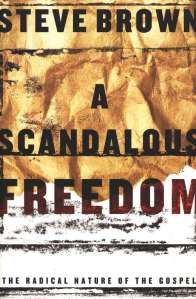
I have been listening to Steve Brown‘s Scandalous Freedom podcasts over the past couple weeks.
For those not familiar with Steve, let me issue a warning: Don’t listen to him if you take yourself too seriously or think Christianity is about putting a stamp of approval on your goodness. I guarantee that if you think that way Steve will offend you, so just save yourself some time and aggravation.
For those who think they can handle him, these messages coincide with Steve’s book of the same title, Scandalous Freedom. In both the book and podcasts Steve challenges the idols and ideas that rob us of joy and enslave us. He reminds us, in his masterfully colorful way, how the genuine gospel sets us free.
Here are link to the archived series, which can be listened to online or downloaded.
- Free Means Free
- Free…Really Free
- Freedom’s Power
- Some Gods Need Killin’
- Struggling with Truth
- The Real Deal
- The Perfection We Desire
- Give Up
- Be Still and Be Loved
- “The Church is a whore…
- The Good News of Cheap Grace
- The Masks We Wear
- The Power to Stop Pretending
- Masks and Gurus
- The Punishing Plagues of Putting People on Pedestals
- Guilt and Isolation
- The Enemies We Demonize
- Three Startling Statements
- The Humanity that Sets Us Free
- The Boldness We Fear
- The Way to Boldness
- Bring the Pain
- Kiss that Demon on the Lips
- The Failure We Foster
- The Law and Success
- The Path We Avoid
- Holding the Land
- The Fellowship of the Free
The Advent of Humility

The following article, by Tim Keller, first appeared in the December 2008 edition of Christianity Today Magazine. In this article Keller explains why the Advent of Jesus gives us reason to stop concentrating on ourselves.
***
Innumerable Christmas devotionals point out the humble circumstances of Jesus’ birth—among shepherds, in a crude stable, with a feed trough for a bassinet. When Jesus himself tried to summarize why people should take up the yoke of following him, he said it was because he was meek and humble (Matt. 11.29). Seldom, however, do we explore the full implications of how Jesus’ radical humility shapes the way we live our lives every day.
Humility is crucial for Christians. We can only receive Christ through meekness and humility (Matt. 5.3, 5; Matt 18.3-4). Jesus humbled himself and was exalted by God (Phil. 2:8-9); therefore joy and power through humility is the very dynamic of the Christian life (Luke 14.11; 18.14; 1 Peter 5.5).
The teaching seems simple and obvious. The problem is that it takes great humility to understand humility, and even more to resist the pride that comes so naturally with even a discussion of the subject.
We are on slippery ground because humility cannot be attained directly. Once we become aware of the poison of pride, we begin to notice it all around us. We hear it in the sarcastic, snarky voices in newspaper columns and weblogs. We see it in civic, cultural, and business leaders who never admit weakness or failure. We see it in our neighbors and some friends with their jealousy, self-pity, and boasting.
And so we vow not to talk or act like that. If we then notice “a humble turn of mind” in ourselves, we immediately become smug—but that is pride in our humility. If we catch ourselves doing that we will be particularly impressed with how nuanced and subtle we have become. Humility is so shy. If you begin talking about it, it leaves. To even ask the question, “Am I humble?” is to not be so. Examining your own heart, even for pride, often leads to being proud about your diligence and circumspection.
Christian humility is not thinking less of yourself; it is thinking of yourself less, as C. S. Lewis so memorably said. It is to be no longer always noticing yourself and how you are doing and how you are being treated. It is “blessed self-forgetfulness.”
Humility is a byproduct of belief in the gospel of Christ. In the gospel, we have a confidence not based in our performance but in the love of God in Christ (Romans 3.22-24). This frees us from having to always be looking at ourselves. Our sin was so great, nothing less than the death of Jesus could save us. He had to die for us. But his love for us was so great, Jesus was glad to die for us. Continue reading
Gospel from Mars Hill

The gospel is like a multifaceted jewel. Descriptions of it vary but the substance is never altered. Our appreciation for it’s beauty is enhanced by viewing it from it’s different aspects. We also see things fresh through the eyes of others, as we understand what they are seeing. For that reason I value whenever I encounter a rich and faithful explanation of the gospel.
The following explanation comes from Mars Hill Church in Seattle:
“Now I would remind you, brothers, of the gospel I preached to you, which you received, in which you stand, and by which you are being saved, if you hold fast to the word I preached to you—unless you believed in vain. For I delivered to you as of first importance what I also received: that Christ died for our sins in accordance with the Scriptures, that he was buried, that he was raised on the third day in accordance with the Scriptures . . .” ~ 1 Corinthians 15.1–4
What is the Gospel?
The word gospel simply means “good news.” The central message of the Bible is the gospel, or good news, about the person and work of Jesus Christ. In 1 Corinthians 15.1–4, Paul provides the most succinct summary of the gospel: the man Jesus is also God, or Christ, and died on a cross in our place, paying the penalty for our sins; three days later He rose to conquer sin and death and give the gift of salvation to all who believe in Him alone for eternal life.
The great reformer Martin Luther rightly said that, as sinners, we are prone to pursue a relationship with God in one of two ways. The first is religion/spirituality and the second is the gospel. The two are antithetical in every way.
- Religion says that if we obey God He will love us.
- The gospel says that it is because God has loved us through Jesus that we can obey.
- Religion says that the world is filled with good people and bad people.
- The gospel says that the world is filled with bad people who are either repentant or unrepentant.
- Religion says that you should trust in what you do as a good moral person.
- The gospel says that you should trust in the perfectly sinless life of Jesus because He alone is the only good and truly moral person who will ever live.
- The goal of religion is to get from God such things as health, wealth, insight, power, and control.
- The goal of the gospel is not the gifts God gives, but rather God as the gift given to us by grace.
- Religion is about what I have to do.
- The gospel is about what I get to do.
- Religion sees hardship in life as punishment from God.
- The gospel sees hardship in life as sanctifying affliction that reminds us of Jesus’ sufferings and is used by God in love to make us more like Jesus.
- Religion is about me.
- The gospel is about Jesus.
- Religion leads to an uncertainty about my standing before God because I never know if I have done enough to please God.
- The gospel leads to a certainty about my standing before God because of the finished work of Jesus on my behalf on the cross.
- Religion ends in either pride (because I think I am better than other people) or despair (because I continually fall short of God’s commands).
- The gospel ends in humble and confident joy because of the power of Jesus at work for me, in me, through me, and sometimes in spite of me.
This is the gospel.
Moralism Trap

To reach people in our day, the gospel will have to be distinguished from moralism, because moralism is what most people outside the church think Christianity is all about – rules and standards and behavior and cleaning yourself up. Millions of people, both inside and outside the church, believe that the essential message of Christianity is: “If you behave, then you belong.” From a human standpoint, that’s why most people reject Christianity.
Gospel Greater Than Conservatism & Liberalism

The gospel is neither conservative nor liberal; and at the same time the gospel is both liberal and conservative. This causes a lot of confusion to folks both inside and outside of the Church.
On the one hand, the gospel is conservative because it declares that there is such a thing as right and wrong, and that there are benefits from choosing right and consequences that accompany wrong. Each person is responsible for his or her own actions and attitudes. These are very conservative principles.
On the other hand, the gospel is the free gift that is given to those who have not earned it and cannot afford it. In fact, we are told the gospel is the riches of Christ redistributed to those who admit their spiritual poverty. Isaiah says it is like being invited to a party, but the only ones who can come are those who cannot pay, or who are humble enough to admit whatever riches they think they might have are not valid currency. (Isaiah 55.1-2) These seem to be very liberal ideas and images.
Both are true. Equally true. Both are essential. Leave out one side or the other and you create a “different gospel” – which, as Paul says, is really no gospel at all. In fact, Paul tells us that anyone trying to pass a counterfeit gospel should be ( and will be) anathema – repeatedly destroyed over and over for all eternity. (Galatians 1.6-9)
I would suggest, even insist, that both Conservatism and Liberalism are false worldviews and offer counterfeit gospels. The gospel is not a compromise of liberalism and conservatism, nor is it merely a middle way. The gospel is the expression of God’s very nature and plan. It is therefore, THE Truth, because God himself – and God alone – is Truth. And it is eternal Truth because God, who is Truth, is eternally God.
What both Conservatives and Liberals have done, at least those who operate as if these philosophies are the supreme ideologies, is to carve off portions of the Truth that meet their personal preferences at the expense of the valid point of the other. Both begin with as a reduction of the gospel Each then proceeds to build their respective worldview upon these faulty foundations of a corrupted gospel.
We begin to escape the confusion when we recognize our own propensity toward either Conservatism or Liberalism, at the expense of the other. We begin to overcome our limitations when we recognize the whole gospel alone is the Truth, and then commit to a lifelong pursuit of excavating the depths and complexities of the gospel, while at the same time venturing to live out all the implications of the gospel in every aspect of our lives.
Whether theologically or politically, conservatism and liberalism are impotent to effect real, enduring, or godly change. But the gospel, undiluted and undistorted, is the power of God. (1 Corinthians 1.20-25)
Portrait of a Recovering Pharisee

by Nancy Scott
When Sally first heard the gospel at age eleven, she understood immediately that God’s grace is what saves us. She already knew her heart was full of evil and that she had nothing to bring to God. It made perfect sense that God would have to do the saving, if any saving was to be done. The solution of Jesus’ death on the cross was perfect, and she understood that He had died in her place.
The Bible church where Sally began her pilgrimage strongly taught the concept of grace. She learned that grace meant “undeserved favor.” Grace was getting something you didn’t deserve, whereas mercy was NOT getting what you did deserve. The gospel addressed both of these areas of life in the provision of Jesus’ death on the cross. So she fully understood that she came to Christ because God was reaching deep into her soul to regenerate her and to bring her to an awareness of her need and of His provision for her salvation. She entered the path to the kingdom on her knees, got up, and took off running.
By the time Sally was seventeen, life was not as clear-cut as it had been at the tender age of eleven. She had understood what it meant to be saved by grace; now she began wondering what it meant to live there. She began to struggle with the difficult choices of life and a tension in her desires to do the right thing. When she went to her Bible teachers for advice, they told her that God had given her all the resources she needed to live a victorious Christian life, and she only needed to avail herself of the Spirit of God who now lived inside her. If she tapped into His power, He would grant her the ability–and the desire she lacked–to do the right thing. The Bible teachers asked Sally if she did her daily devotions, and they recommended some helpful Bible studies. These things, they said, would help unleash the Spirit’s power to work in her life.
Sally took off running again. She dove into her daily devotions with renewed vigor, and even though she wasn’t a morning person, she began to get up an hour earlier. Sally was so grateful that God had given her this extra measure of grace to be so dedicated to him at such a young age. Things seemed to improve for a while.
Then something slowly changed. The excitement began to wear off, and Sally suspected that her non-Christian friends were having more fun than she. She indulged with them every now and then, only to feel tremendously guilty and to make a renewed commitment to God with each failure. The longer this pattern went on, the more confused Sally became. Why wasn’t God unleashing His Spirit inside her for victory anymore, even when she carried out all her spiritual practices and dedication? Why was the evil around her becoming more attractive instead of less attractive? Was it normal for her to find herself rededicating her life to God so routinely? Was this what it meant to live by grace?
The Old Man and the Flesh

What actually changes when one becomes a Christian? Confusion about this is common, especially when we realize that we continue to struggle with sin and temptation even after conversion. Paul tells us in Galatians that we have a war that goes on within us after conversion: “For the desires of the flesh are against the Spirit, and the desires of the Spirit are against the flesh, for these are opposed to each other, to keep you from doing the things you want to do. ” (Galatians 5.17) In this short essay Robin Boisvert helps bring some clarity. ~ WDG
***
Some of the terms which the apostle Paul uses in discussing the believer’s relationship to sin can cause confusion. I’m speaking of terms such as “old man,” “new man,” “body of sin,” “flesh,” and others. These can be difficult to understand. Add to this the variations which modern translators have given these words and the subject can appear daunting.
We know a profound change has occurred in the life of the believer through conversion, but just how has the believer changed?
For we know that our old self was crucified with him so that the body of sin might be done away with, that we should no longer be slaves to sin — because anyone who has died has been freed from sin. (Romans 6.6-7, emphasis added)
Let’s begin by trying to define our terms. “Old man” (as it is translated in the King James Version and American Standard Version) is equivalent to “old self” (NIV, NASV). This term refers to the unregenerate life we lived before we were converted. As John R.W. Stott has written, the old self “denotes not our old unregenerate nature [flesh], but our old unregenerate life. Not my lower self, but my former self. So what was crucified with Christ was not a part of me called my ‘old nature’, but the whole of me as I was before I was converted.”1 John Murray’s definition concurs:
“‘Old man’ is a designation of the person in his unity as dominated by the flesh and sin.”2
It’s important for us to see that the believer is not at the same time an “old self” and a “new self,” alternately dominated and directed by one or the other. We are indebted again to Murray’s insight:
The old man is the unregenerate man; the new man is the regenerate man created in Christ Jesus unto good works. It is no more feasible to call the believer a new man and an old man, than it is to call him a regenerate man and an unregenerate. And neither is it warranted to speak of the believer as having in him the old man and the new man. 3
Thus, terms like “old man,” “old self,” “unregenerate life,” and “former self” are synonymous, all referring to the entity that was crucified with Christ.
Notice two significant grammatical features of the passage from Romans 6 cited above. First, the verb is used in the past tense: “our old self crucified…” The crucifixion of the old self is a finished fact. Second, the verb is also passive in voice, meaning that the subject (our old self) is being acted upon. In other words, the crucifixion of the old self is not something we must do, but something that is done to us.
Another important concept in the biblical doctrine of sanctification has traditionally been designated by the word “flesh” (King James Version). The New International Version uses “sinful nature.” According to Stott, “flesh” refers to a “lower” nature, that part of our being inclined toward rebellion against God. This is that part of you that wants to pass on a juicy bit of gossip; that urges you to take a second look at the immodest images on the television screen. “Whatever we may call this tendency [“indwelling sin,” 4 “remnants of corruption,”5 “vestiges of sin,”6 or “my sinful nature”7] we must remember that even after we have been regenerated we still have such sinful impulses, and must still fight against them as long as we live.” 8
In Romans 6.6 Paul calls our sinful nature (i.e. flesh) the “body of sin.” He says our old self was crucified with Christ so that this “body of sin might be done away with…” To be “done away with” here means to be put out of action, rendered powerless. It does not mean to be annihilated, gone without a trace. But our sinful nature’s mastery over us has been broken.
Some, not understanding the distinction between the “old self” and the “sinful nature” have gotten Romans 6.6 confused with Galatians 5.24, which also speaks of crucifixion and the believer. Consider two translations of this verse:
-
Those who belong to Christ Jesus have crucified the sinful nature with its passions and desires. (Galatians 5.24 NIV)
-
And they that are Christ’s have crucified the flesh with the affections and lusts. (Galatians 5.24 KJV)
Though helpless to take anything but a passive stance in regard to the old self (Romans 6.6), we do have an active part to play, as the Galatians learned, in the subjugation of the flesh. Stott sums this up with characteristic clarity:
First, we have been crucified with Christ; but then we not only have decisively crucified (i.e. repudiated) the flesh with its passions and desires, but we take up our cross daily and follow Christ to crucifixion (Luke 9.23). The first is a legal death, a death to the penalty of sin; the second is a moral death, a death to the power of sin. The first belongs to the past, and is unique and unrepeatable: I died (in Christ) to sin once. The second belongs to the present, and is continuous and repeatable: I die (like Christ) to self daily. It is with the first of these two that Romans 6 is concerned. 9
And Galatians 5 is concerned with the second.
So the old self has been dealt with. In its place we have been given a new self: “Therefore, if anyone is in Christ, he is a new creation; the old has gone, the new has come!” (2 Corinthians 5.17). And while our sinful nature (the flesh, indwelling sin, etc.) is still very much with us, its dominion over us has ended.
Gospel Centrality & Insanity

If you think about it, Paul makes a rather peculiar declaration when he asserts: “I am not ashamed of the gospel…”. (Romans 1.16) Usually I don’t give these words much thought. But with a little reflection I find myself asking questions like:
- Who suggested Paul was ashamed?
- What Christians are ashamed of the gospel?
- What does it look like for someone be ashamed of the gospel?
As one who is committed to gospel-centrality for both my ministry and my life, I want to be able to share Paul’s steadfastness. And I do. But I also understand the temptations to waver. There are times I ask myself what I am doing? I wonder if we should add something more to the arsenal. Is gospel fidelity enough?
What are we doing when we commit to gospel-centered preaching and teaching in the face of non-apparent results? Every chance we get we hold up Jesus Christ as preeminent and precious, we exult in his glorious excellencies, and we present the gospel boldly, clearly, and with unction. Still nary a crack in the surface of reception. It is like preaching, as they say, to a brick wall.
Should we switch things up? Try another tack? Testable non-results is one of the reasons so many churches tuck the gospel behind fog and lasers or adjust their teaching to the 7 Steps busywork of moralistic therapeutic deism. I mean, isn’t the definition of insanity doing the same thing over and over again and expecting different results?
Jared Wilson asks, wrestles with, and ultimately answers these vital questions in an excellent short post titled: Gospel Centrality and Insanity.
I appreciate Jared’s candor. And I commend his thoughts to anyone who may sometimes struggle with temptations to look for something other than or in addtion to the gospel to procalim – to others, or to ourselves. Let’s remind ourselves, and one another, that it is the Gospel that is the “power of God for salvation to everyone who believes…” (Romans 1.16)
Appropriating the Justifying Work of Christ
Only a fraction of the present body of professing Christians are solidly appropriating the justifying work of Christ in their lives.
Many have so light an apprehension of God’s holiness and of the extent and guilt of their sin, that consciously they see little need for justification. Below the surface, however, they are deeply guilt-ridden and insecure. Many others have a theoretical commitment to this doctrine, but in their day-to-day existence they rely on their sanctification for justification….drawing their assurance of acceptance with God from their sincerity…their recent religious performance or the relative infrequency of their conscious, willful disobedience.
Few start each day with a thoroughgoing stand upon Luther’s platform: you are accepted, looking outward in faith and claiming the wholly alien righteousness of Christ as the only ground for acceptance, relaxing in that quality of trust which will produce increasing sanctification as faith is active in love and gratitude.

~ Richard Lovelace, Dynamics of Spiritual Life
Expressing the Gospel in Less Than 30 Seconds
Jerry Bridges communicates the gospel accurately and clearly in less than 30 seconds.
Effect of Coming Empty Handed

“As we come to Christ…empty-handed, claiming no merit of our own, but clinging by faith to His blood and righteousness, we are justified. We pass immediately from a state of condemnation and spiritual death to a state of pardon, acceptance, and the sure hope of eternal life. Our sins are blotted out, and we are “clothed” with the righteousness of Jesus Christ.
In our standing before God, we will never be more righteous, even in heaven, than we were the day we trusted Christ, or we are now.
Obviously in our daily experience we fall far short of the perfect righteousness God requires. But because He has imputed to us the perfect righteousness of His Son, He now sees us as being just as righteous as Christ Himself,”
Gospel, Moralism, and Irreligion
Power of the Unaltered Gospel
“Liberalism says that the gospel won’t work unless the message is changed. Some evangelicals say that the gospel won’t work unless the method is changed. But biblical Christianity believes that the gospel will work, and that God has given us both the message and the method.”

 GRACE & PEACE