Resources for Racial Reconciliation

Since February is designated as Black History Month in the USA, I wanted to take the opportunity to post something that might be helpful in the ongoing discussions about Racial Divides and Racial Reconciliation.

Racial tension and racial division are major issues in our culture – and, sadly, still issues in the American Church. This is not a new problem. Racism was also a problem in the Early Church. But since it is still an issue, Paul’s words to the church in Ephesus are relevant for us today:

“Remember that you were at that time separated from Christ, alienated from the commonwealth of Israel and strangers to the covenants of promise, having no hope and without God in the world. But now in Christ Jesus you who once were far off have been brought near by the blood of Christ. For he himself is our peace, who has made us both one and has broken down in his flesh the dividing wall of hostility.” (Ephesians 2:12-14)

Whether one sees racial division as a “gospel issue” or not, racism and racial division are inarguably Kingdom issues. And these are issues that the Gospel – and only the Gospel – can resolve. Only the Gospel has the power to make us one in Christ, regardless of race or culture. 

Therefore, as tensions linger, and even at times intensify, the Church has the ability – and therefore the responsibility – to show that only Jesus has the power to break down the dividing walls of hostility and bring Shalom – true and lasting peace. In a culture that often, and increasingly, views faith in Jesus to be irrelevant and unhelpful, we have an opportunity to be “Salt & Light” by actively pursuing peace and friendship between all races and cultures in our communities. (Matthew 5.9Matthew 5.13-16)

Racial reconciliation is not the goal of a gospel-centered church and life, but it is clear from Scripture that it is a beautiful fruit of it.“ ~ Jarvis Williams

A Biblical worldview responds to every circumstance with love, empathy, and understanding even of those different from us, instead of letting popular culture and news soundbites define our attitudes and beliefs. When we listen to more voices, sometimes especially some that sound different from our own, God often reveals to us some of the blind spots in our own hearts.

What does this mean for God’s People, living in our present time and culture? As those who are part of God’s “Royal Priesthood” (1 Peter 2.9) we must be committed to mercy and justice. (see Micah 6.8) As those who have been the recipients of God’s mercy and grace, we are to those who now demonstrate and extend the grace and mercy we have received. (1 Peter 2.10; 1 Timothy 1.16) And grace changes everything! The gospel frees us, compels us, and empowers us to seek justice and reconciliation in the midst of brokenness. This is gospel work – work that, as Christians, we must be committed to doing together, even as we learn, lament, repent, and – by faith – move forward. But “to do justice” and “to do mercy” requires both humility and understanding.

With the hope of moving forward toward better understanding, I have compiled a list of Racial Reconciliation resources. This is in no way an exhaustive list, but these resources are among those I have found helpful. Some are from my own denomination, the Presbyterian Church in America, others from the broader Evangelical church. Some of these resources may resonate more than others; and some even express viewpoints that I cannot entirely endorse. Nevertheless, there is benefit from listening to a broad range of voices and seeing from a variety of perspectives.

Listen & Watch

Articles

Books

Voices

NOTE: Over time I will add to these lists. So I hope you will bookmark this page, and make use of it both now and in the future.


Authentic Church: Road to a Re-newed Reality

Celtic Transformation

I have been mulling on something the late Francis Schaeffer said:

“There are four things which are absolutely necessary if we as Christians are going to meet the need of our age and the overwhelming pressure we are increasingly facing.”

No doubt that the Church, in our culture as well as other cultures, faces increasing and overwhelming pressure.  Pressure to cave. Pressure to capitulate. Pressure to compromise.  These pressures come from both  subtle and overt threats from the culture and from the government, as George Orwell predicted in his classic 1984.  Perhaps even more devastating is the subversive seductive pressure. The craving of the church to be “relevant”, to fit in, to be liked, so people will come in great numbers, so we can be considered successful, has seemingly replaced a commitment to faithfulness and fruitfulness.  This mindset seems in line with Aldous Huxley‘s “nightmarish vision of the future” in his opus Brave New World.  And while there is certainly nothing wrong with a desire to be liked, nor to see our churches full, these consuming desires are antithetical to the teachings of Jesus, and consequently, I fear, resulting in an increasingly impotent Church.

So what are Schaeffer’s four things?

Schaeffer labeled them Two Contents and Two Realities.

Continue reading

Is This Why We Don’t Engage Our Neighbors?

The Conversation (Brooklyn Art Project)

Here is a challenging perspective and good instruction from Leon Brown, church planter and pastor at Crown & Joy Presbyterian Church in South Richmond, Virginia:

“I fear that one of the reasons we don’t know how to engage non-Christians to talk about Jesus is because we’ve forgotten how to have regular conversations. If the conversation is not about the Bible, a child’s education, church, other forms of ministry, or the occasional sporting event, we don’t have a paradigm for much else. If this is you, here’s a remedy. Spend more time in public places and listen to the discussions that are occurring around you. You’ll begin to notice what’s important to people. Grow in your understanding of those things. Even consider how the word of God speaks to those situations. After some time, it’ll be easier to have ‘common grace’ conversations, and you’ll be prepared to share the word in a natural manner, as the scriptures speak to many, many things.”

Culturally Literate Evangelism

Abstract Modern Landscape

Jonathan Dodson offers an astute assessment of the cultural landscape and some practical suggestions about how this effects the way we as Christians ought to engage in evangelistic efforts.  What Dodson offers refelcts the best of contextual ministry: The message should not change, but understanding those to whom we are speaking, knowing their needs and desires, shapes the way we present the message of the gospel.  ~ WDG

***

Cultural shifts have resulted in the collapse of Christendom, an official or unofficial relationship people have with their country and its civil religion. In America, moral views typically associated with Christianity have been replaced by more progressive views associated with libertarianism on marriage, sexuality, and gender.

In addition to loosening the American moral fabric, the collapse of Christendom has left behind a rubble of theological understanding. As the dust settles, we can no longer assume that people know what words like Christ, sin, faith, and God mean. For many, these words may no longer carry their original biblical meaning. We need to become culturally literate in order to be evangelistically fluent. If we don’t, the gospel gets lost in translation.

In secular culture people may actually hear us saying teacher for Christ, bad deeds for sin, wishful thinking for faith, or moldable deity for God. Today, it is a mistake to assume theological literacy. If we are to move forward, the Church must develop its ability to listen to new questions people are asking and learn how to translate the gospel into words and concepts that speak to the heart.

The Need for Cultural Literacy

Consider the need for cultural literacy in this story. A church planter in my city planted little wire signs in grassy medians around the city that read “RepentAustin.org.” I’ll admit it’s a pretty gutsy and confrontational tactic, but Jesus did call people to “repent and believe.” Yet, as I thought about this evangelistic approach, a major objection came to mind. These signs did not take into account contemporary understandings associated with the word “repent.” They conjure up images of judgmental people, filled with hatred toward “sinners,” who self-righteously speak words of condemnation. Instead of intriguing people, it probably elicited disinterest and, perhaps, unduly promoted a distorted view of the Gospel.

What makes this way of presenting the Gospel distorted? First, it does not call attention to Jesus — it focuses on a person’s need to change before they even get to hear about Jesus and what He has done. Second, there are strong cultural memories associated with the word, especially in the South, that are connected with a return to good, moral living — again, a response that has nothing to do with Jesus and what he has done. Many youths, when they hear the word “repent,” associate it with things like: stop listening to secular music, stop sleeping with your girlfriend, and start going to Church. This kind of repentance does not involve turning away from trusting in yourself to trust the Savior. It is simply a switch in lifestyles, secular to Christian. You can alter your behavior without altering your savior.

People adopt the trappings of faith—the religious habits, attempts at moral living, even a new Christianized culture that entails wearing a purity ring and listening to Christian music. But this cultural repentance is not a true turning to Christ; it is a turning to Christianity, to a religious subculture.

Slowing Down to Understand

To be effective in our new cultural landscape, we will have to slow down long enough to understand what people hear and how they speak in order to communicate the gospel in intelligible ways. This involves listening to what people think in order to communicate meaningfully what God thinks. This doesn’t require a PhD in Bible or theology. It requires love: sacrificing our time, tweaking our crammed schedules, putting away our canned responses, and actually conversing with people.

People don’t just need to hear a thirty-second gospel presentation. They need to understand why the Gospel is worth believing. To do this, we must learn their language and know their stories. We need to become “culturally literate in order to be gospel fluent, communicating the gospel in words and idioms that make sense to the people we talk to.

***

Jonathan Dodson (MDiv; ThM) serves as a pastor of City Life Church in Austin, Texas. He is the author of Gospel-Centered Discipleship, The Unbelievable Gospel, andRaised? Twitter: @Jonathan_Dodson

Why Do People Find the Gospel Unbelieveable?

Why do people find the gospel unbelievable?  That’s the question Jonathan Dodson askes.

There is a sense in which people find the gospel unbelievable because it is incredibly good news that boggles the imagination.  And yet I suspect that it is probably not this that makes much evangelistic desire and effort unfruitful.

Dodson offers his thoughts, which have to do with both the substance and the presentation.  Give him a couple minutes, and consider if what he suggests has any merit.

Honest Answer to Honest Questions, and Open Dialogue Wherever Possible

Dialog & Discuss

Boyce College professor, Denny Burk, has posted an interesting warning about a common tactic employed by some with theological agendas – especially those with liberalizing theological agendas.  His post is titled:  Should Churches “Dialogue” About Sexuality?

Having read through it a couple of times I find myself appreciating Burk’s concern.  Burk notes that many a subtle debate may begin with a seemingly reasonable appeal:

“…with the liberals calling for more dialogue about the issue.”

Then, citing conservative writer Rod Dreher:

Ah, the old “conversation starter” or “dialogue” trick. Any time you see a progressive member of your church try this, you must understand that this is the wedge that they will use to pry the orthodox out. The “conversation” will be one-sided, and will not end until the orthodox have surrendered or left, because the progressives will never, ever take “no” for an answer.

While I am not one who is overly concerned about debate, or about being drawn into compromised theology, I have seen this tactic employed.  (For the sake of fairness, I must admit that I have seen the technique attempted by both those on the theological left, and by some on the far right.  It just seems that those on the far right are more likely to quckly show their hand, their agenda.)  So I agree with Burk, we need to be mindful of this, and encourage the people in our churches– or at least our church leaders – to be mindful of this ploy.

However, what Burk is addressing is not the biggest challenge to the church I serve.  Our congregation is pretty well rooted in sound theology and conservatism.  (NOTE: These are not always the same thing, especially when the conservatism is more political than theological.)  For most of our members it is not difficult to get them to accept the authority of God’s Word on any particular subject.  Our  commitment to deep, rich, historic, orthodoxy is one of the primary reasons they are part of the church.  And while we have many who are doing inspiring works throughout our community, it is far more a concern whether we can get some of the others to love and engage their neighbors – most of whom are likely to differ with us on any number of social issues – than it is whether they will be susceptible to trendy Spirits of the Age.

So while I appreciate Burk’s wisdom, I believe we also need to prepare people to “dialogue”.

Dialogue is how we engage people, without requiring that they agree with us as a precondition of  being welcome in our church or wanted as a friend.  Dialogue is one way we are able to express and cultivate love for our neighbors.  Dialogue may be the only way for some to hear what God has to say about a particular subject, as we appropriately bring our understanding of the Word into the conversations. Dialogue about issues in which we (at least) initially differ may be the means by which some hear the gospel for the first time – as the gospel does apply in some manner to all matters.

No doubt some readers will be uncomfortable with my call to dialogue with unbelievers and with theological compromisers (- which usually qualifies them as unbelievers).  But I am convinced that somewhere, somehow, we need to cultivate environments that encourage dialogue – and we must do this for the sake of the gospel.

I don’t feel alone in this thought. It is what Francis Schaeffer called for a couple generations ago.  In his Two Contents, Two Realities, the second content was: Honest Answers to Honest Questions.

I agree that we must be wise, and that there are times when conversation should be cut off – such as when it is apparent that the “dialogue” is not honest but rather a cloak over a subversive agenda. This is what Burk has in view, and so it is why I appreciate his thoughts.  But, just so there is no mistaking Burk’s counsel as an invitation for Evangelicals to hide out in the fortress of the church, I also feel compelled to contend for genuine dialogue, since it is the only way we will have opportunity to hear Honest Questions from our culture to which we may offer Honest Answers from God’s Word.

Ministering to Missing Millennials

Long Road

Why are Millennials walking away from our churches? Why are a number of our own kids walking out the doors?  Why does the church seem impotent to change the direction of this rising tide?

While my wife and I are blessed to have all of our kids active in church, including our two college aged sons, who live six hours away, these are not unimportant questions to me.  I feel the blow every time I hear of the child of a friend, or church member, walking away.  They do not usually walk away angry.  Perhaps it might be better if they did.  All too often they walk away indifferent.  The faith of their fathers makes little difference to their lives – or so they feel.

There is no lack of suggestions. Most of those I hear involve, in one way or another, changing the church to meet the demands of the consumers the church desires to attract, or win back.  It works for McDonald’s, so why not the church?  But while there are things that the church can and should do better, the problem with suggestions toward such radical change is that it mistakes the mission of the church.  The church does not exist to cater to consumers.  The church should certainly not create consumers – though for the better part of the past couple generations that is exactly what we have done.  And now we are paying the price.  “Have it your way…” worked for Burger King. But the same message has left the church impotent to reach the present rising generation.

So how do we reach those who no longer see the value of the church?  That is a complex question.  But one thing we ought to do before deciding any course of action is to listen to some from this generation who have not left the church, and yet who love their peers.

A recent article I read titled Why the Church Isn’t Reaching My Un-churched Friends offers a refreshingly honest and thoughtful perspective.  Written by a twenty-something young lady from Louisville, Kentucky, she offers some candid critiques of both the cultural dilemma and the foolish things some – many – churches are trying in response.  Her criticisms are sharp, but not unnecessarily hurtful.  Her solutions: Authenticity. Christ.

While I do not propose to have the definitive answers, her suggestions are a great place to start.

10 Questions to Ask at a Christmas Gathering

We Wish You a Merry Christmas

Do you have any Chrstmas gatherings to attend this holiday season?  My thanks to Don Whitney for suggesting the following questions to spruce up the conversation, especially at church:

  1. What’s the best thing that’s happened to you since last Christmas?
  2. What was your best Christmas ever? Why?
  3. What’s the most meaningful Christmas gift you’ve ever received?
  4. What was the most appreciated Christmas gift you’ve ever given?
  5. What was your favorite Christmas tradition as a child?
  6. What is your favorite Christmas tradition now?
  7. What do you do to try to keep Christ in Christmas?
  8. Why do you think people started celebrating the birth of Jesus?
  9. Do you think the birth of Jesus deserves such a nearly worldwide celebration?
  10. Why do you think Jesus came to earth?

The Missional Puritan: On Mission With God

Hey, this Missional thing is nothing new!  Listen to what the old English Puritan, John Owen, wrote in the 17th Century:

God has work to do in this world; and to desert it because of its difficulties and entanglements, is to cast off His authority. It is not enough that we be just, that we be righteous, and walk with God in holiness; but we must also serve our generation, as David did before he fell asleep. God has a work to do; and not to help Him is to oppose Him.

Missional may be a relatively new term coined to challenge an apathetic or directionless church, but it is not new.  It is the living out our biblical mandate.  God has work to do in this world – and in this community.  If we are in Christ we are enlisted to be as seeds scattered wherever our Sovereign God determines to send us, to take root and bless our generation.  (See Jeremiah 29.4-7)

Pay Attention!

In his book, Joy Unspeakable, Martyn Lloyd-Jones notes:

Pay attention!

I am certain that the world outside is not going to pay much attention to all the organized efforts of the Christian church.  The one thing she will pay attention to is a body of people filled with the spirit of rejoicing.  That is how Christianity conquered the ancient world. It was this amazing joy of these people.  Even when you threw them into prison, or even to death, it did not matter, they went on rejoicing; rejoicing in tribulations.

Perhaps we would be wise to recover this attitude.  It seems to me, many of our contemporaries spend too much energy griping about the world, and about lessened stature in the estimation of the culture.  But if we recover the joy that should be an inherent attribute of our faith,  perhaps we can regain our effectiveness as redeeming and preserving agents in this world.

The Un-Churched Next Door

It has been an encouraging trend.  After several months during which we observed a score of painful defections from our church, the past few months have seen a rebound.  We have been blessed to see a number of new folks join our fellowship. Among them are a handful of mature transplants, Christians new to our area, who bring with them a measure of much appreciated stability. But maybe even more exciting is the number of those who had been previously un-churched.  These folks add something refreshing.  They are a reminder of an important aspect of what we are about – or at least what we should be about as the church of Jesus Christ in our community.  I want us to be a church that sees growth primarily through conversion, and by assimilating the formerly un-churched and de-churched,  not growth by enticing the transient hoppers to come from whatever pews they are presently adorning.

I use the term “un-churched” intentionally.  I know it has been common in the past to refer to reaching the “lost” – something I agree is important.  I also realize that this shift to reach the “un-churched” has caused a bit of concern to some who fear that this is somehow a compromise of our evangelistic mandate. But this is no compromise.

Our forefathers in the Faith long asserted that “ordinarily there is no salvation apart from the church”.  The word “ordinarily” is important, because it admits that there are circumstances where men and women are legitimately regenerated and converted and yet, for whatever the reasons, are not a part of any visible expression of the Body of Christ.  But the word ordinarily also conveys that this situation ought to be highly unusual.  Implied in this expression is that whenever someone is not a part of a visible church, genuine Believer or not, there is reason to assume that they are not Christians. This is not judgment. It is simply a rational assumption based on evidence and what scripture declares to be the expected norm.

What I appreciate about this position is the simplicity.  Rather than attempting to discern which of the un-churched are Christians and which are among the “lost” – a task that is essentially near impossible, since I cannot see into each heart as God does –  instead assume all are in need of grace.  My role, and our role as the church, is simply to express the gospel to them through both Word & Deed, and encourage them to unite with some faithful congregation – hopefully many of them to ours.  In the region where we live (Appalachia), where most people make some profession of being a Christian, even if many have no idea of what that actually means, it certainly clarifies our mandate for outreach and evangelism.

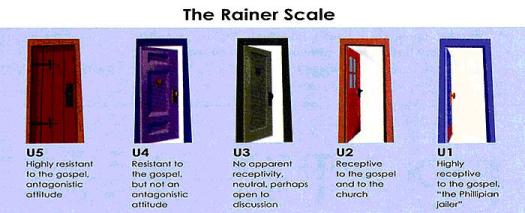
But with the number of un-churched friends we are now making, I am reminded of an important detail: Not all the un-churched are the same, and thus they should not all be treated exactly the same.  In other words there are distinctions between the un-churched, categories or levels of their un-churchedness.

Thom Rainer, in his book The Unchurched Next Door, reveals the findings of research by the Rainer Group that is both important and helpful.  Rainer observes that there are five categories, or five degrees, of un-churched:

Continue reading