Paul, the Apostle, wrote to the Church in Corinth:
The weapons of our warfare are not of the flesh but have divine power to destroy strongholds.We destroy arguments and every lofty opinion raised against the knowledge of God, and take every thought captive to obey Christ… (2 Corinthians 10.5)
Taking our thoughts “captive” simply means to be aware of what we are thinking, and exercising control over our thoughts by subordinating them to what God says; it is forming our opinions and convictions upon Scripture above any other sources of information. Even over our own experiences.
To the Romans Paul wrote similarly:
Do not be conformed to this world, but be transformed by the renewal of your mind, that by testing you may discern what is the will of God, what is good and acceptable and perfect. (Romans 12.2)
Again, Paul is asserting the importance of thinking biblically.
As a culture, we are thinking and talking politically and sociologically about justice, but not theologically or Biblically. Perhaps this is what we ought to expect of the culture. But it is also true of the American Church. It is true of the Church, largely, because we are not, and we have not been, talking about the issues in our churches. Consequently, church members, Christians who are inundated with the socio-politcal perspective from the daily news and common rhetoric don’t have a biblcial framework through which to filter, and talk about, these issues.
This panel discussion, from The Gospel Coalition 2015 Conference, consisting of panelists Tim Keller, Voddie Baucham, Thabiti Anyabwile, John Piper, and Miguel Núñez, is five years old, but it is compellingly applicable to our current cultural discussion.
Being part of one of the relatively few denominations that still ordains to church office only those who meet the Biblical criteria, I sometimes resonate with whoever the comedian or cartoon character was who was noted for saying: “Nobody understands me.” While that is a bit of an overstatement, as I do not stand alone, I do often find that there is need to explain myself; to defend the basis of our practice. This is especially true as it applies to restriction of the office of Elder to men only.
I am not a sexist. So I understand the raised eyebrows implicitly questioning if my church and I are somehow stuck in a time warp. I understand the perplexity when I have the audacity to declare that I believe, and our church believes, in the equality of men and women. If we truly believe in “equality” how can we continue with our traditional practices? I will get to that in a moment.
Compounding the misunderstanding, I am afraid, are those who share our same practice, but have an entirely different attitude behind it. Some even within our denomination. Those to whom I refer are those who embrace a position of patriarchy. (I often refer to these folks as the “He Men Women Haters Club”.) Often such people refer to their position as “Biblical Patriarchy”, but aside from a few anecdotal illustrations they find in the Bible (usually devoid of appropriate context) I would suggest there is little to nothing Biblical about their position. Nevertheless, I find that, because of our practices, many people see little difference between our views and and the patriarchy proponents.
Part of the reason for this misunderstanding is that many people seem to have bought into the premise that there are only two views on the subject: Patriarchal or Egalitarian. In short, Patriarchy is the view that men are created to and commanded to rule. Egalitarianism is the view that not only are men and women equal, they are essentially the same, and therefore interchangeable. While in no way endorsing patriarchy, I suspect the egalitarian view has contributed to the rise of gender confusion, though that is an entirely different subject, and outside the scope of my intent for this post. Nevertheless, if it were true that there are really only these two theoretical options, then it would be reasonable to judge someone on this issue bases upon how close to which he or she stands, or how close church practices stand, in proximity to either of these two poles.
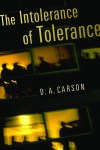
I recently finished reading D.A.Carson‘s excellent book, Intolerance of Tolerance. It was a long time coming, with several starts and stops and re-starts along the way, but in the end it was well worthwhile. The stops and starts were in no way reflective of the readability of the book. It had more to do with my time, and demands requiring the reading of other things. The book itself is a fascinating consideration of one of the most volatile foundations of our present cultural hostilities. At its essence, this book explores the radical difference of a very subtle shift in the definition and practice of the word tolerance. As Carson points out, the tolerance has traditionally been understood to mean:
“accepting the existence of different views”
-or-
“recognizing and respecting others’ right to beliefs and practices without necessarily agreeing or sympathizing with them”
Pretty basic stuff in a free and pluralistic society, right? It is this kind of understanding that causes a statement usually attributed to Voltaire to resonate with our sensibilities:
“I don’t agree with what you say, but I will defend to the death your right to say it.”
Carson notes that the newer, active, definition presently employed by the majority of our culture, or at least by the cultural elite and the ivory towers is slightly different:
“the accepting of different views”
Given just a simple glance, this newer definition seems to be just a shortened version of the more traditional understanding. But given adequate consideration we quickly see that there is a vast difference. Taken as is, this newer definition of tolerance assumes that all views are equal, equally valid, and should thus be equally embraced. That is what “accepting” a view is, as opposed to accepting that people have a right to hold a view. This “acceptance” is rooted in the postmodern notion that there is no truth; or at least that there is no true Truth; as Truth varies with individual experience. But this idea is absurd; and those who claim to hold to it are hypocritical.
First the absurdity. Certainly our experiences effect the way we perceive the world, and even the the way we experience the verifiable truths of this world. But the truths transcend mere experience. Green is green, whether I am color blind or not. Day is day; Summer is summer; 2 plus 2 is always four. I have heard it said that What I experience is my Reality, but Truth is what IS regardless of how I relate to it. Of course there are also complexities that effect the way we experience Truth, but Truth is … well, it just IS. And since Truth just IS, then it is not possible for ALL ideas to be equally valid. Sometimes we are just wrong. The fact that we have a right to be wrong in no way validates our wrongness.
Second, any attempt to embrace this new definition will inevitably lead to hypocrisy. For example, to maintain that all views are equally valid would require one to embrace the philosophies of the KKK and the Nazi’s. Any thinking person would obviously reject the core beliefs of these groups, as well as most of the the subsidiary views. And rightly so. Further, to assert that all views are in themselves equally valid would require a level of cognitive dissonance that allows the embracing of mutually exclusive views, as certainly there are many examples of conflicting beliefs. The reality is that no one is capable of living out what this new definition of tolerance demands. And those who claim to do so, in practice show their hypocrisy in their (right) rejection of some views (such as those of racists, etc.), and at the very least in their disdain for those who do not embrace their definition of tolerance.
Intolerance of Tolerance is a worthwhile read for anyone who wants to understand the roots of our present cultural hostilities. In the above video, Carson offers a lecture from the substance of the book. Also of interest may be an an article excerpted from the book, Contemporary Tolerance is Intrinsically Intolerant.
Apart from any printed guides I may use, I keep a manila folder in my study, where I pray, and usually I take it with me when I am traveling.
The first sheet in that folder is a list of people for whom I ought to pray regularly: they are bound up with me, with who I am. My wife heads the list, followed by my children and a number of relatives, followed in turn by a number of close friends in various parts of the world…
The second sheet in my folder lists short-range and intermediate-range concerns that will not remain there indefinitely. They include forthcoming responsibilities in ministry and various crises or opportunities that I have heard about, often among Christians I scarcely know. Either they are the sort of thing that will soon pass into history (like the project of writing this book!), or they concern people or situations too remote for me to remember indefinitely. In other words, the first sheet focuses on people for whom I pray constantly; the second includes people and situations for whom I may pray for a short or an extended period of time, but probably not indefinitely. . . .
The next item in my manila folder is the list of my advisees — the students for whom I am particularly responsible. This list includes some notes on their background, academic program, families, personal concerns and the like, and of course this list changes from year to year.
The rest of the folder is filled with letters — prayer letters, personal letters, occasionally independent notes with someone’s name at the top. These are filed in alphabetical order. When a new letter comes in, I highlight any matters in it that ought to be the subject of prayer, and then file it in the appropriate place in the folder. The letter it replaces is pulled out at the same time, with the result that the prayer folder is always up to date. I try to set aside time to intercede with God on behalf of the people and situations represented by these letters, taking the one on the top, then the next one, and the next one, and so forth, putting the top ones, as I finish with them, on the bottom of the pile. Thus although the list is alphabetized, on any day a different letter of the alphabet may confront me.
While these ideas are expressions of Don Carson’s practice, it is not difficult to see how they could easily be translated into our own situations.
Knowing scripture is vital. But it is not the essence of Christianity. That may sound surprising, but it really should not be. Knowing the Bible is foundational, even essential, to vibrant faith and life. But it is also possible to have great knowledge yet have little understanding. The essence of the Faith is not information but formation. It is understanding who God is, what he has done and is doing, and what he expects from you and me. It is, borrowing a good popular phrase, finding your place in God’s story and living it out in light of the gospel.
I started reading D.A. Carson’s The God Who Is There. This is a tremendous resource. Carson does a wonderful job in walking the reader through the narrative of the Bible, or what he calls “the Big Story of Scripture”. He touches on the major themes, comprehensively yet easily readable. And in doing this, Carson helps us understand the grand narrative of scripture, thus assisting and enabling us to more easily find our place in it.
As it so happened, in February 2009 Carson presented a 14-part seminar at Bethlehem Baptist Church in Minneapolis. The book was developed from those messages. And thanks to The Gospel Coalition, the MP3s and videos of the conference that closely correspond with the book are available for all 14 chapters:
Is there a particular theme that runs through the whole Bible? No doubt there are many stories and lessons, but is there a central message by which we can connect all else?
Dane Ortland asked several pastors and scholars if they could summarize the Bible in one sentence. Here are some notable responses:
God reigns over all things for his glory, but we will only enjoy his saving reign in the new heavens and the new earth if we repent and believe in the gospel of Jesus Christ, who is the crucified and risen Lord and who gave himself on the cross for our salvation.
The Lover of our souls won’t let the romance die, but is rekindling it forever.
In the above video Bible scholar D.A. Carson provides a concise, comprehensive, and comprehensible, summary of the theme that permeates the entire Bible.
Worship is the proper response of all moral, sentient beings to God, ascribing all honor and worth to their Creator-God precisely because he is worthy, delightfully so. This side of the Fall, human worship of God properly responds to the redemptive provisions that God has graciously made. While all true worship is God-centered, Christian worship is no less Christ-centered. Empowered by the Spirit and in line with the stipulations of the new covenant, it manifests itself in all our living, finding its impulse in the gospel, which restores our relationship with our Redeemer-God and therefore also with our fellow image-bearers, our co-worshippers. Such worship therefore manifests itself both in adoration and action, both in the individual believer and in corporate worship, which is worship offered up in the context of the body of believers, who strive to align all the forms of the devout ascription of all worth to God with the panoply of new covenant mandates and examples that bring to fulfillment the glories of antecedent revelation and anticipate the consummation.
What is God like? Describe to me the God you say you believe in.
In the first chapter of his best selling book, Crazy Love, Francis Chan challenges his readers to ponder who God is. “Who is it that you are praying to?” Chan wants us to ask. I really appreciate that challenge and that exercise because, quite frankly, I am not sure most people, even in our churches, can offer a substantial answer.
“The better we know God, the more we will want all of our existence to revolve around him, and we will see that the only goals and plans that really matter are those that are somehow tied to God himself, and to our eternity with him.”
How well do you know God?
While there is no substitute for Scripture, sometimes the insights of others can help us notice things that we might otherwise not see. Like a tourguide who has navigated a trail many times is able to point out things of importance, of beauty, and of danger, so is one who has walked with God and given himself to careful study of God.
I have found the following books are faithful to Scriptureand helpful in shaping my knowledge of God:
What a great God we have! Not only does he redeem us through the ignominious crucifixion of his much loved Son, but he sends us his Spirit to enable us to understand what he has done.
God has not arranged things so that the foolishness of the Gospel saves [only] those who have IQ’s in excess of 130. Where would that leave the rest of us? Nor does the foolishness of what is preached transform [only] the young, the beautiful, the extroverts, the educated, the wealthy, the healthy, the upright. Where would that leave the old, the ugly, the introverts, the illiterate, the poor, the sick, the perverse?
[On the other hand…] The gods of the rich are not gentle with those the rich dismiss as poor; the gods of the wise are not kind to those the wise reject as stupid; the gods of the social elite are not patient with outcasts.
Here is a helpful insight from D.A. Carson, in his book For the Love of God, that reminds us that while, as Christians, we are Justified and freely forgiven by God through Faith alone in Christ alone, we grow in Spiritual maturity by God’s grace AND our diligent faithfulness:
People do not drift toward holiness. Apart from grace-driven effort, people do not gravitate toward godliness, prayer, obedience to Scripture, faith, and delight in the Lord. We drift toward compromise and call it tolerance; we drift toward disobedience and call it freedom; we drift toward superstition and call it faith. We cherish the indiscipline of lost self-control and call it relaxation; we slouch toward prayerlessness and delude ourselves into thinking we have escaped legalism; we slide toward godlessness and convince ourselves we have been liberated.
A sobering reminder to avail ourselves in the means of grace.







 GRACE & PEACE