We Wish You a Merry X-mas

I knew better. I should have gone with my first instinct. But I didn’t.

Several Decembers ago I was summoned for jury duty in Walker County, Georgia.  Overhearing other prospective jurors engaged in various religious and low-level theological debates, I vowed to myself to remain quiet and not get involved in these discussions.  For most of the morning I kept to my plan.

Not long before lunch my opinion was solicited by the ring-leader of the discussion group – an un-schooled, self-proclaimed Baptist “preacher”.  Apparently he had taken note earleir in the day when a judge made mention that I was a Presbyterian minister. 

 “Do you believe in the doctine of Once-Saved-Always-Saved?”

Trying to minimize my words, I replied:

“I believe most of what you mean by that, though I am not comfortable calling it by that name.”

What do you mean?”, he asked.

“I believe the Bible teaches eternal security for the believer. I just think that describing the doctrine as you did a moment ago leaves an impression of cheap grace.”

I am not sure he understood what I was actually saying, but apparently he was satisfied. He even seemed to sense a kindred spirit. He nodded his head approvingly. 

Then he asked:

Why d’ya think so many people deny this doctrine?” 

Here is where I started down the wrong road:

“I suspect because people don’t bother to read the one source that defines doctrinal positions (- the Bible)”, I replied a little too flippantly and smuggly. 

Again, my answer apparently satisfied him. Again he nodded his approval.  Then he observed:

Yep. People are tryin’ to take God and his Word out of ev’ry-thang. It’s just like people tryin’ to take Christ out’a Christmas.  Santa Claus instead’a  Jesus.  And all these signs that say Merry X-mas…  They’re tryin’ to X-out Jesus.”

(Here is the height of my error. Having been lulled into feeling comfortable by the eager reception of my previous simplistic responses…)  I interjected:

“O, no. That is not x-ing out Jesus from Christmas. The letter “X” is the symbol of Christ, taken from the  Greek letter “Chi”, the first letter for Christ in Greek.”

Silence, followed by a shaking head instead of a nodding noggin. Finally, still shaking his head, he told me:

You are educated beyond usefulness

Then he walked away.

Like I said, I should have stuck with my original plan. I should have remained quiet, done my time, and gone home.  But since I didn’t, I guess I had it coming.

This old memory came to mind when I read a post by R.C. Sproul on the Ligonier blog: Why is X Used?  I am glad to have someone of Sproul’s stature covering my back. But two new questions come to mind:

  • What are the chances that guy will read Sproul’s post?
  • Where were you, R.C., on that day years ago?!

The Christ of Christmas

The WORD

In the beginning was the Word, and the Word was with God, and the Word was God. He was with God in the beginning.  Through him all things were made; without him nothing was made that has been made.  In him was life, and that life was the light of men.  The Word became flesh and made his dwelling among us.     – John 1.1-4, 14a

This Christ of Christmas shines down through the ages like a gem with many facets. Each facet (or Hebrew name) reveals a different aspect of His personality, love, and provision for humanity.

The name of the LORD is a strong tower; the righteous run to it and are safe. – Proverbs 18.10

ELOHIM

In the beginning God (Elohim) created the heaven and the earth.”    – Genesis 1.1

  • El = Mighty or Strong
  • Him = plural (Father, Son, Holy Spirit); Total Power and Might

This Christ of Christmas is the Creator, mighty and strong. he saw us in our mother’s womb. (Psalm 139) He createde us and has a special plan for every life.

JEHOVAH-ROHI

Jehovah my Shepherd (Psalm 23)

This Christ of Christmas is our Shepherd. He desires to lead us through paths of righteousness.

Jehovah-Rohi says:

I am the Good Shepherd. The good shepherd lays down his life for his sheep.”  – John 10.11

JEHOVAH – M’KADDESH

Jehovah who sanctifies. (Exodus 31.13)

Sanctify = Consecrate, dedicate.

This Christ of Christmas desires to set us apart to walk in holiness, because He is our God.  

It is God’s will that you should be sanctified.”   – 1 Thessalonians 4.3a

JEHOVAH – RAPHA

I am the Lord who heals you.” – Exodus 15.26

This Christ of Christmas is our healer; body soul, and spirit.

He himself took our infirmities, and carried away our diseases.”   – Matthew 8.16-17

JEHOVAH – NISSI

“The Lord our banner.” (Exodus 17.12b, 13, 15)

The Christ of Christmas is our banner (Victory)! Lift Him up.

But I, when I am lifted up from the earth, will draw all men to myself.”  – John 12.32

EL SHADDAI

“The One who  is more than enough.”

This Christ of Christmas is more than enough to meet our needs in every situation.  What seemingly impossible need can we bring Him?

Now to him who is able to do immeasurably more than all we ask or imagine, according to his power that is at work within us, to him be glory in the church and in Christ Jesus throughout all generations, for ever and ever! Amen   Ephesians 3.20-21

 JEHOVAH – TSIDKENU

Jehovah Our Righteousness  (Jeremiah 23.5-6)

This Christ of Christmas is our Righteousness.

God made him who had no sin to be sin for us, so that in him we might become the righteousness of God.”   – 2 Corithians 5.21

JEHOVAH JIREH

The Lord will Provide” a sacrifice – Genesis 22.13-14

This Christ of Christmas is our Lamb of Provision! All may partake of His free gift of eternal life.

Look, the Lamb of God, who takes away the sin of the world!”   – John 1.29

Let Us Bow Before Him! Continue reading

No Christmas Without Easter

Now is the time to sing, envision, enact, and retell a story of God coming unexpectedly in the worst of times as a baby born poor, born homeless, born to die that all human life might be transformed and dreams made real.

It’s God’s Good News — but only because we already know the story of Easter.

– John H. Westerhoff III, A Pilgrim People

In Defense of Christmas Day

christmas-time

There is considerable debate concerning the birth date of Jesus Christ.  Many suspect he was born in April or May. Others suggest, and even celebrate, a January birth. 

Traditionally, of course, we cling to the 25th of December. 

The earliest recorded celebration of Christmas was in the year 86AD. It was about 40 years later before Christmas became a regular custom of the church, and even then it was only in some parts of the world.

Some people feel that celebrating Christmas at all is a prostitution of the event, citing both commercialism & possible pagan influence as reasons. 

A Roman holiday, Saturnalia, was annually celebrated from December 17-24, a week long celebration to Saturn.  This celebration marked the coming increase of daylight, and the diminishing of winter. It was the anticipation of Spring.  The people exchanged gifts, closed down schools & government offices. All official functions virtually ceased. And there was an increase of partying. 

With the excesses in gift giving and the antics at many parties during this season of the year, it is not difficult to sympathize with those who suggest that Christmas is no more than an attempt to “Christianize” a pagan holiday.

But, despite those non-Christians who rationalize that Christmas was just an attempt to copy & “Christen” Saturnalia; and the arguments of faithful Christians who want to determine a date more feasible to the world,  I cannot bring myself to accept that, in fact, Jesus was not born on December 25.   While I cannot be certain, I choose to accept the traditional date. 

Here’s why:

In the late 19th Century historian Alfred Edersheim wrote The Life & Times of Jesus the Messiah. It is sorta the standard for studying the life of Christ.  In Appendix VII Edershim offers a very interesting hypothesis of why it is most likely that Jesus was born on December 25. 

Let me summarize his reasoning:

We know that on August 5, AD70 the Temple in Jerusalem was destroyed by the Roman General Titus.  At that time, Jewish history records, and Josephus confirms, a group of priests, the Jehoiarib, was serving at the Temple. 

Some background: If you look back into OT history you will find that David divided the priesthood into 24 groupings – or 24 Courses – with each group serving for about two weeks at a time in the Temple.  This particular group – Jehoiarib – was the first Course. And they were serving at the particular time the Temple was destroyed. 

If you trace the service of the various Courses back through time, when you come to October a year before Christ was likely to have been born, you will find the Division of Abijah serving the first week of October. 

Now, who do we know that would be serving in the Temple with the Division of Abijah? 

Check out Luke 1.

We find that a certain godly priest named Zechariah, who had a wife named Elizabeth – but no children – served the Temple with the Course of Abijah. 

While serving at that time the Lord visited Zechariah, declaring that he & his elderly, barren wife would have a child.  Zechariah laughed at the very thought, and was struck speechless as a sign of the promise.  I suspect you know the story: Elizabeth did conceive and gave birth to John the Baptist. 

From Luke we also know that John the Baptist was six months older than his cousin Jesus. 

Now, if you begin in early October, add nine months, then add six months to that, it brings us to mid to late December of the following year. 

It is very possible Jesus was born December 25. So it is historically & biblically appropriate to celebrate Christmas on the traditional date

Just something to think about; an interesting historical note…

If you are interested, check out Edersheim: On the Date of the Nativity of Our Lord.  It’s a short chapter.

A Christmas Quiz

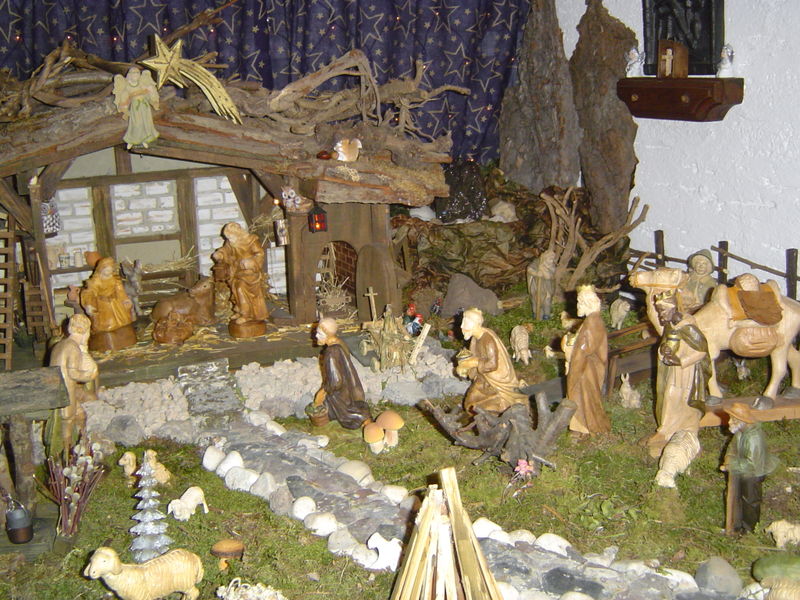
german-manger-scene

Test your knowledge of the Christmas Story using this quiz edited from LeadershipU & Probe Ministries.  A link to an answer key can be found at the bottom of the page. 

  1. Can you name the parents of Jesus?
  2. Where did Joseph and Mary live before they were married?
  3. What was the name of the angel who appeared to Mary?
  4. Where did Joseph and Mary live after their marriage?
  5. Where was Mary when the angel appeared to her?
  6. Whom did Mary visit immediately after Gabriel appeared to her?
  7. How far along in her pregnancy was Elizabeth when Gabriel appeared to Mary?
  8. How long did Mary stay with Elizabeth?
  9. Why didn’t Mary stay to celebrate the birth of John?
  10. How far along in her pregnancy was Mary when she broke the news to Joseph?
  11. Why were Joseph and Mary going to Bethlehem?
  12. Why did Mary accompany Joseph?
  13. What determined the city to which each Jew had to travel in order to be taxed?
  14. Who, then, would be in Bethlehem?
  15.  Why couldn’t Joseph and Mary find space in the inn?
  16. Who were the first people to come to see Jesus according to Scripture?
  17. What chorus did the angels sing to the shepherds?
  18. What sign did the angels tell the shepherds to look for?
  19. What was the manger?
  20. In what way do the meaning of the Hebrew term for Bethlehem and the sign given by the angels prepare us for Jesus’ later ministry?
  21. What are two reasons that Joseph and Mary took Jesus to Jerusalem?
  22. What are magi?
  23. How many wise men came to see Jesus?
  24. How many gifts did the wise men bring and to whom did they present their gifts?
  25. What was curious about the star?
  26. How did Herod use the star?
  27. Where were Jesus, Mary, and Joseph when the wise men reached them?
  28. How old was Jesus at this time?
  29. In what year was Jesus born?
  30. How long was Jesus in Egypt with His parents?
  31. How did Joseph and Mary finance the trip to Egypt?
  32. Where was Jesus raised upon His return to Israel?

 Click: Answer Key

A Christmas Reflection

Consider Mary’s response to the angel.

The angel has come to Mary and says: “Mary, you are going to give birth to the long-promised  Messiah.” This was a unique promise, and unrepeatable. There is something totally unique here: the birth of the eternal second Person of the Trinity into this world.

What was her response?

  • She could have rejected the idea and said, ‘I do not want it: I want to withdraw; I want to run’…
  • She could have said, ‘I now have the promises, so I will exert my force, my character, and my energy, to bring forth the promised thing’.

But what she did say is beautiful, it is wonderful. She says:

‘Behold, the bondmaid of the Lord; be it unto me according to thy Word.’   – Luke 1.38

There is an active passivity here. She took her own body, by choice, and put it into the hands of God to do the thing that he said he would do, and Jesus was born.  She gave herself to God…

This is a beautiful, exciting, personal expression of a relationship between a finite person and the God she loves.

~ Francis Schaeffer, from True Spirituality