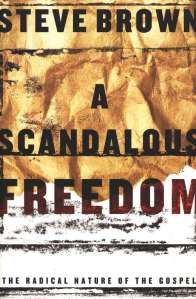
Scandalous Freedom

I have been listening to Steve Brown‘s Scandalous Freedom podcasts over the past couple weeks.

For those not familiar with Steve, let me issue a warning: Don’t listen to him if you take yourself too seriously or think Christianity is about putting a stamp of approval on your goodness.  I guarantee that if you think that way Steve will offend you, so just save yourself some time and aggravation.

For those who think they can handle him, these messages coincide with Steve’s book of the same title, Scandalous Freedom.  In both the book and podcasts Steve challenges the idols and ideas that rob us of joy and enslave us.  He reminds us, in his masterfully colorful way, how the genuine gospel sets us free.

Here are link to the archived series, which can be listened to online or downloaded.

  1. Free Means Free
  2. Free…Really Free
  3. Freedom’s Power
  4. Some Gods Need Killin’
  5. Struggling with Truth
  6. The Real Deal
  7. The Perfection We Desire
  8. Give Up
  9. Be Still and Be Loved
  10. “The Church is a whore…
  11. The Good News of Cheap Grace
  12. The Masks We Wear
  13. The Power to Stop Pretending
  14. Masks and Gurus
  15. The Punishing Plagues of Putting People on Pedestals
  16. Guilt and Isolation
  17. The Enemies We Demonize
  18. Three Startling Statements
  19. The Humanity that Sets Us Free
  20. The Boldness We Fear
  21. The Way to Boldness
  22. Bring the Pain
  23. Kiss that Demon on the Lips
  24. The Failure We Foster
  25. The Law and Success
  26. The Path We Avoid
  27. Holding the Land
  28. The Fellowship of the Free

Moralism Trap

To reach people in our day, the gospel will have to be distinguished from moralism, because moralism is what most people outside the church think Christianity is all about – rules and standards and behavior and cleaning yourself up.  Millions of people, both inside and outside the church, believe that the essential message of Christianity is: “If you behave, then you belong.”  From a human standpoint, that’s why most people reject Christianity.

~ Tullian Tchividjian, from Jesus + Nothing = Everything

Fundamentalists, Liberals, and Gospel-Centered Christianity

If you think about it, Fundamentalist and Liberal Christians have more on common with one another than either does with Gospel-centered Christianity.  While Fundamentalists and Liberals would seem to be very different from the other, almost even polar opposites, I am convinced this is true.  For both of those traditions tend to view the purpose of Christianity to be to make one a good person, or to validate a persons goodness.  Fundamentalist assume what makes one a “good” person is to keep the rules.  Liberal Christians, on the other hand, maintain that “good” people are never judgmental (except, perhaps, about judgmental people).  So both are in essence legalists.  At the center of their faith is the Law. The only thing to distinguishes them from one another is how they view and relate to the Law.  Both are driven by personal performance.

Gospel-centered Christianity, on the other hand, in line with the message of the Prophets and Apostles, and even Jesus himself, is not centered on the law nor driven by personal performance.  Gospel-centered Christianity is centered on the person of Jesus.  Unlike the other two traditions, Gospel-centered Christianity agrees with Jesus’ words: There are no good people – not when the standard is God’s holiness. (Mark 10.18)  Gospel-centered Christianity understands that Jesus, and what he has done on our behalf, is our only hope.  And Gospel-centered Christians take comfort, even delight, in that, because Jesus is the only hope and comfort we need.

Portrait of a Recovering Pharisee

by Nancy Scott     

When Sally first heard the gospel at age eleven, she understood immediately that God’s grace is what saves us. She already knew her heart was full of evil and that she had nothing to bring to God. It made perfect sense that God would have to do the saving, if any saving was to be done. The solution of Jesus’ death on the cross was perfect, and she understood that He had died in her place.

The Bible church where Sally began her pilgrimage strongly taught the concept of grace. She learned that grace meant “undeserved favor.” Grace was getting something you didn’t deserve, whereas mercy was NOT getting what you did deserve. The gospel addressed both of these areas of life in the provision of Jesus’ death on the cross. So she fully understood that she came to Christ because God was reaching deep into her soul to regenerate her and to bring her to an awareness of her need and of His provision for her salvation. She entered the path to the kingdom on her knees, got up, and took off running.

By the time Sally was seventeen, life was not as clear-cut as it had been at the tender age of eleven. She had understood what it meant to be saved by grace; now she began wondering what it meant to live there. She began to struggle with the difficult choices of life and a tension in her desires to do the right thing. When she went to her Bible teachers for advice, they told her that God had given her all the resources she needed to live a victorious Christian life, and she only needed to avail herself of the Spirit of God who now lived inside her. If she tapped into His power, He would grant her the ability–and the desire she lacked–to do the right thing. The Bible teachers asked Sally if she did her daily devotions, and they recommended some helpful Bible studies. These things, they said, would help unleash the Spirit’s power to work in her life.

Sally took off running again. She dove into her daily devotions with renewed vigor, and even though she wasn’t a morning person, she began to get up an hour earlier. Sally was so grateful that God had given her this extra measure of grace to be so dedicated to him at such a young age. Things seemed to improve for a while.

Then something slowly changed. The excitement began to wear off, and Sally suspected that her non-Christian friends were having more fun than she. She indulged with them every now and then, only to feel tremendously guilty and to make a renewed commitment to God with each failure. The longer this pattern went on, the more confused Sally became. Why wasn’t God unleashing His Spirit inside her for victory anymore, even when she carried out all her spiritual practices and dedication? Why was the evil around her becoming more attractive instead of less attractive? Was it normal for her to find herself rededicating her life to God so routinely? Was this what it meant to live by grace?

Continue reading

Deconstructing the Twin Enemies of the Gospel

Perhaps the two of the most effective enemies of the gospel within the Church in North America are the twins: Moralism and Legalism. While there are other enemies at work, such as Relativism and Licentiousness, these are far more obvious in their opposition to the gospel.  Moralism and Legalism, however, are so potent, especially among conservatives, because they stealthily fly under the radar.  In fact, they are such subversives that they are often embraced as if they are part of the gospel, or at least partners with it.

Here is something Tim Keller offers to combat these sneaky, deadly foes:

Some claim that to constantly be striking a ‘note of grace, grace, grace’ in our sermons is not helpful in our culture today.

The objection goes like this: “Surely Phariseeism and moralism is not a problem in our culture today. Rather, our problem is license and antinomianism. People lack a sense of right or wrong. It is ‘carrying coal to Newcastle’ to talk about grace all the time to postmodern people.”

But I don’t believe that’s the case. Unless you point to the ‘good news’ of grace, people won’t even be able to bear the ‘bad news’ of God’s judgment. Also, unless you critique moralism, many irreligious people won’t know the difference between moralism and what you’re offering.

The way to get antinomians to move away from lawlessness is to distinguish the gospel from legalism. Why? Because modern and post-modern people have been rejecting Christianity for years thinking that it was indistinguishable from moralism. Non-Christians will always automatically hear gospel presentations as appeals to become moral and religious, unless in your preaching you use the good news of grace to deconstruct legalism. Only if you show them there’s a difference–that what they really rejected wasn’t real Christianity at all–will they even begin to consider Christianity.

This Present Communion

“We are justified if we have accepted Christ as Savior.  But present communion with God requires continual bowing in both the intellect and the will.  Without bowing in the intellect, in thinking after God; without acting upon the finished work of Christ in my present life; and without bowing in the will in practice, as the waves of the present life break over me, there is no sufficient communion with God.  Without these things I am not in my place as the creature in a fallen and abnormal world.  These three things are absolutely necessary if there is to be real and sufficient communion with God in the present life.”

~Francis Schaeffer

Gospel-Centered Lives

From time to time I am asked by some in our church what I mean when I repeatedly declare that we are – and we must be – a Gospel-Centered Church. I think it may be the hyphen that confuses people.

To be “something”-centered is simply to focus on the relation an individual or a church has to a central value.  While there could be any number of things at the center of a persons or organizations values, in our case the point of emphasis is the Gospel (or the Cross).

As for what it means to be Gospel-centered, as an individual or as a church, I don’t think I could answer better than Joe Thorn did in a post titled: Gospel-Centered.  One of the things Joe points out is:

[T]he gospel-centered life is a life where a Christian experiences a growing personal reliance on the gospel that protects him from depending on his own religious performance and being seduced and overwhelmed by idols.

Can We Get Along Together?

One of my ecclesiastical/theological heroes, John Piper, came under a slew of criticism earlier this year for inviting “Purpose Diven” Rick Warren to be one of the speakers for the Desiring God 2010 Conference

I like the way Collin Hansen introduces the controversy, in his article, Piper, Warren, and the Perils of Movement Building:

You only thought junior high was over. But lately the evangelical blog world has been abuzz because John Piper invited Rick Warren to speak for his Desiring God National Conference… You see, a lot of folks who like John don’t like Rick. So now some of John’s friends aren’t sure they want to hang out with him anymore. They may not come to his party in Minneapolis. And they aren’t sure that you should either.

I’ll admit I was a little surprised when I heard about it. But I really gave it no thought, until these past few days.  There was nothing specific that compelled me to reconsider the issue. I stumbled upon a few articles that made reference to the matter. And as I began to think about it I wondered to myself: “What is the real problem here?”

Frankly, I see only possible benefits. I am no Warren proponent. But honestly, I find much admirable about the guy and his ministry. I may have concerns about some aspects of his ministry style, and I do have some theological differences with him. But then again, I have theological differences with many people I admire – Piper included.  Nevertheless I gain insights from many people in areas where I do agree. And I am challenged to think more deeply by thoughtful expressions with which I disagree. 

Some time ago I posted The Jesus Pledge, authored by my friend, Paul Miller. Those embracing that pledge declare a willingness to “learn from all types of Christians”.  That is something that I don’t think we Evangelicals do enough.  And it is something that Piper appears to be attempting to explore. At least that is the sense that I get from him in a video he did explaining and defending his reasons for inviting Warren to his party. (Click: Why Rick Warren?)

Two final thoughts:

First, do we implicitly endorse what someone from another Christian tradtion, or with a different ministry methodology, believes and practices simply by entering into conversation and fellowship?  I don’t think so.  Without such conversations, though, how would we become acquainted with anyone outside our own circles?  We can maintain our own convictions, even distinctions, without isolating ourselves from others.

Second, I wonder if there is a possibility of synthesizing Piper’s Christian Hedonism and Warren’s Purpose-Driven Life/Church.  I don’t know what that would look like, and I am not sure I would embrce it, but I know I would not ignore it.  In fact, I am intrigued by the possibility.

10 Dumbest Things Christians Do

There is a book out there with the title: The 10 Dumbest Things Christians Do. I feel compelled to pick up a book with a title like that. I want to see how many of these 10 dumb things I am guilty of doing.

I don’t know if the list the author, Mark Atteberry, compiled is right or not.  Are these the DUMBEST things Christians do? Some of us do so many dumb things, it is tough to tell which are the dumbest.  But I must concur. He is right. These are some stupid things many Evangelical Christians do:

  1. Slinging Mud on the Bride of Christ
  2. Winning People to Church Rather Than to Jesus
  3. Living Below the Level of Our Beliefs
  4. Speaking Above the Level of Our Knowledge
  5. Hopping From Church to Church
  6. Fighting Among Oursleves
  7. Missing Golden Opportunities
  8. Settling for Mediocrity
  9. Allowing Wolves to Live Among the Sheep
  10. Accepting the Unacceptable

3 Ways

There is a difference between the Gospel and being good.  But I am not sure the average person understands this – neither in the church nor outside the doors.  In this short video Tim Keller explains the difference between:

  • Gospel
  • Moralism
  • Irreligion

What’s Glenn Beck Doing at Liberty University?

It was with some bemusement that I took note of the speaker for Liberty University’s 2010 Commencement: Glenn Beck.  I am not sure what message was conveyed by this choice. One possibility seems commendable. Another possibility, I fear, may be a sad reflection of attitudes within and around contemporary American Evangelicalism.

Liberty University, long steeped in Baptistic Fundamentalism, maintained its commitment to the conservative politics held by founder Jerry Falwell while broadening its umbrella in recent years by making a transition to be more of an Evangelical institution.   I applaud them for this move.  Not only do I believe that Evangelicalism is  more Biblical than Fundamentalism, an Evangelical worldview is unquestionably more conducive to a comprehensive education. 

Glenn Beck, while controversial, is a voice in the Public Square not to be ignored. I don’t much buy into Beck’s conspiracy theories. And I categorically oppose his audacious and unqualified call for people to leave churches that promote ‘social justice’.  But I do not dismiss him, as some on the far Left are inclined to do – or, at least, wish they could do.  (i.e.: MSNBC)  In short, not only is Beck an intelligent and articulate pundit for cultural conservatism, he also freelyspeaks about God.  BUT Beck is a Mormon, not a Christian.  So the god he speaks about, therefore, is NOT the Triune God revealed in the Bible.

So what is a Mormon doing speaking at a Baptist graduation? Continue reading

Hume Offers Tiger Way Out of the Woods

I’ve been a fan of Brit Hume ever since, during my college years, I saw him as a panelist of a debate for the 1984 Presidential Election.  The panelist preceding Hume asked a question to one of the candidates, who then essentially filabustered – he talked in non-sensical circles until his time had elapsed.  In his turn Brit Hume followed up by asking the candidate: “My first question is, Why didn’t you answer the previous question?”  I liked that.

Hume’s directness has again stirred some controversy when last weekend he chimed in on the saga of Tiger Woods.  Boldly and with clarity he said something I had been thinking, essentially: “If Woods would turn his life to Christ he could experience forgiveness and restoration.”  (See clip above. Also watch as Hume explains his comments to Bill O’Reilly.)  

Justin Taylor, at Between Two Worlds, has posted some exerpts of interviews Hume has given over  the past few years that reveal a glimpse of the depths of  Hume’s faith.  (Click: Brit Hume, Tiger Woods, and Jesus Christ

Despite the flack he has received for his commentary, I don’t think this journalist will be backing down.

Ecstasy & Delight

Ecstasy and delight are essential to the believer’s soul and they promote sanctification.

We were not meant to live without spiritual exhilaration, and the Christian who goes for a long time without the experience of heart-warming will soon find himself tempted to have his emotions satisfied from earthly things and not, as he ought, from the Spirit of God. The soul is so constituted that it craves fulfillment from things outside itself and will embrace earthly joys for satisfaction when it cannot reach spiritual ones…

The believer is in spiritual danger if he allows himself to go for any length of time without tasting the love of Christ and savoring the felt comforts of a Savior’s presence. When Christ ceases to fill the heart with satisfaction, our souls will go in silent search of other lovers…

By the enjoyment of the love of Christ in the heart of a believer, we mean an experience of the “love of God shed abroad in our hearts by the Holy Ghost which is given to us” (Romans 5.5)… because the Lord has made himself accessible to us in the means of grace, it is our duty and privilege to seek this experience from Him in these means till we are made the joyful partakers of it.

– John Flavel (1630-1691)

Pretentious Piety


The more things have changed, some things have remained the same.  Such is the case for Christians in a typical church.

When Samuel Blair assumed the pulpit of Faggs Manor Presbyteran Church in 1740 he found a congregation in a spiritual condition not uncommon even in our day. Blair wrote that when he came to the church he found many good religious people who performed their religious obligation rather well. Yet they were, in his estimation, somewhat formal and unenthusiastic:

If they performed these duties pretty punctually in their seasons and, as they thought, with good meaning, out of conscience, and not just to obtain a name for religion among men, then they were ready to conclude that they were truly and sincerely religious. A very lamentable ignorance of the main essentials of true practical religion, and the doctrines nearly relating thereunto very generally prevailed.  The nature and necessity of the new birth was but litle known or thought of, the necessity of a conviction of sin and misery, by the Holy Spirit’s opening and applying the law to the conscience, in order to a saving closure with Christ, was hardly known at all to most.  It was thought, that if there was any need of a heart-distressing sight of the soul’s danger, and fear of divine wrath, it wa only needed for the grosser sort of sinners; and for any others to be deeply exercised this way (as might in some rare instances observable), this was generally looked upon to be a great evil and temptation that had befallen those persons.  The common names for such soul-concern were, melancholy, trouble of mind, or despair.  These terms were common, so far as I have been acquainted, indifferently used as synonymous; and trouble of mind was looked upon as a great evil, which all persons that made any sober profession and practice of religion ought carefully avoid.  …There was scarcely any suspicion at all, in general, of any danger of depending upon self-righteousness, and not upon the righteousness of Christ alone for salvation.  Papists [Roman Catholics) and Quakers would be readily acknowldeged guilty of this crime, but hardly any professed Presbyterian. The necessity of being first in Christ by a vital union, and in a justified state, before our religious services can be well pleasing and acceptable to God, was very little understood or thought of; but the common notion seemed to be, that if people were aiming to be in the way of duty as well as they could, at they imagined, there was no reason to be much afraid.

[Source: The Forming of an American Tradition: A Re-Examination of Colonial Presbyterianism, by Leonard J. Trinterud; Westminster Press, 1959; pp. 77-78]