If I had a favorite hymn from Red Mountain Music, this would probably be it. It reflects the common duality of our hearts, simultaneously Believing and Struggling to Believe; simultaneously Saints & Sinners. (See Mark 9.24) It reflects and explains the cause of Paul’s dimemma: Failing to do what he wanted to do, and doing what he hated. (Romans 7.15) It points us to the answer: Resting in the Grace & Power of Christ.
When God…

When God had mercy on us, when God revealed Jesus Christ to us as brother, when God won our hearts by God’s own love, our instruction in Christian love began at the same time. When God was merciful to us, we learned to be merciful with one another. When we received forgiveness instead of judgment, we too were made ready to forgive each other. What God did to us, we then owed to others. The more we received, the more we were able to give; and the more meager our love for one another, the less we were living by God’s mercy and love. Thus God taught us to encounter one another as God has encountered us in Christ. “Welcome one another, therefore, just as Christ has welcomed you, for the glory of God.” (Romans 15.7)
Schaeffer’s Theorem

Francis Schaeffer was a prophetic voice to Christianity for the latter half of the 20th Century. His treatises such as Mark of the Christian and Two Contents, Two Realities were excellent primers for Gospel-Centered & Missional Christianity long before either Gospel-Centered or Missional were coined terms.
The premise behind his philosophy has been has been summarized in this mathematical equation:
- Truth – Love = Ugliness
- Love – Truth = Compromise
How might this theorem, if lived out, effect the church? How could it impact your life?

Tough Questions From a Pre-Teen Girl

The following are answers to questions asked by a then-12 year old girl. This young lady had had a very, very difficult life, but was very bright and determined. At the time she wrote the note to me asking these questions, she had only recently come to live with her father – a godly man. Now twenty-something, she has grown into a beautiful and sharp young woman.
She has given her permission to use our correspondence for this post.
***
1. Why do people look so depressing, sad, and miserable when we pray?
This is a good question. There is no good reason to be sad & miserable when we pray, but I think you are right that sometimes we look that way.
I guess the reason is that people want to be reverent, or to be serious, when they approach our Holy God. This is a good thing, since the Bible calls us to “Fear the Lord”. (Deuteronomy 6:13; Proverbs 9:10) BUT, if Christians do not have joy as they pray, then they are forgetting that God loves us; that He is our Father, and wants us to come to him with joy & thanksgiving. We are unbalanced between Fearing God & Loving God.
2. Why does God choose some people, but not all, to spread His Word?
I am guessing that you have two questions combined here.
First, Why does God not call everyone to be a Christian? The answer is that everyone is to hear the call to follow Christ, but only those God chooses are able to become Christians. Why does he choose some but not others? We don’t know.
Second, Why are not all Christians called to spread his Word? The answer: All are called to spread his Word, by teaching and by our actions. Some are called to spread his Word to other countries. Some are called to spread his Word by preaching in the church. Some to spread it by teaching Sunday school. Others are called to spread it to their friends, neighbors, and family. Not everyone does it, but all are called to spread the Word somewhere & somehow.
3. Why did God flood the earth when not everybody was being bad?
Romans 3:10 and 3:23 tell us that there is no one who is good. This is difficult to hear, but it is true. It is also important to help understand my answer to your question.
If you read Genesis 6:5 it says “The Lord saw …man’s wickedness…” There was no one good on the earth, everyone was being bad. Romans 6:23 says: “The wages of sin is death.” This means that anyone & everyone who sins deserves death – in this case by drowning in a flood.
In Genesis 6:8-9 it says “Noah found favor in God’s eyes…” and “…he walked with God”. This does not mean that Noah was perfect, and that he was not doing bad – though he was better than most men. (Remember Romans 3:23 “All sinned… fall short of the glory of God.”) That he “found favor in the eyes of the Lord” means that God chose to love him even though he was a sinner. Genesis 6:9 says: “Noah was a righteous man”… this means that he believed in God, and trusted God for his salvation. Noah did not believe he was good enough, and knew he needed God’s grace. (Romans 1:17 tells us that righteousness comes by faith. Hebrews 11:6 says: “Without faith it is impossible to please God…”)
Now the great thing about this is that God does the same thing with us. You & I, and everyone else, are sinners. We may be better than many people, but we are still not perfect like God wants us to be.
But read Romans 5:6-8… Is that great or what?!!
The important thing, though, is to believe what God has provided for our salvation from his punishment. For Noah it was the Ark, but really it was a Savior. For us (and for Noah, too, really) it is Jesus – a person not a boat!
Read 1 John 5, and it shows the importance of believing & trusting in Jesus for our salvation and forgiveness of our sin.
(A guy named Fritz Ridenhour has written a cool book for teenagers, How to Be a Christian Without Being Religious. It is about all this Romans stuff. I have a copy if you want to borrow it from me.)
4. Why does God make some peoples’ lives worse than others?
This is a difficult question, and I am so sorry that you have had some very hard things happen in your life. But the best way I can answer this is in two ways.
First, sin is in this world and hurts people –both those who sin and those they sin against. It will continue to hurt people until Jesus returns to take us with Him. This does not mean that God does not love us or care for us, or that he will not protect us. He does, and He shows it all the time. But what he also does is remind us that someday soon he will take us where there is no sin.
Look at it this way, before your Dad had you with him, he loved you, and cared for you. He gave you some good times, even though some bad things were happening around you. But he also told you that he wanted you to live with him. Even before you got to live with him you had both good & bad times. You looked forward to when you could be with him, and this gave you hope. Now that you have moved in with him many of the bad things are away from you. God continues to give us this same type hope when he reminds us of heaven – except all bad things will be away from us in Heaven. Until then our lives will be mixed with good and bad.
Why are some worse than others? That I do not know. The book of Job is a good example of your question, but God does not totally answer it. God simply says we should trust him, because we know He is good.
Second, some of our hardships come from decisions we make. There are consequences to our actions. If you commit a crime, you may go to jail. If unmarried teenagers are sexually active a pregnancy may result.
But even the consequences to our own actions are not all bad. Hebrews 12:6 says: “The Lord disciplines those He loves.” And please read 1 Peter 1:3-9 for encouragement.
I Asked the Lord to Grow in Grace
This song comes from a beautiful poem by John Newton. It is a powerful reminder to me about God’s grace and how God works.
Like Newton in the opening lines of this poem, I often ask God to grow me in grace and faith and the fruits of his Spirit.
I asked the Lord that I might grow
In faith, and love, and every grace;
Might more of His salvation know,
And seek, more earnestly, His face.
And like Newton expresses in the third stanza, in my mind this is something noble and therefore should be experienced mystically, gently and painlessly:
I hoped that in some favored hour,
At once He’d answer my request;
And by His love’s constraining pow’r,
Subdue my sins, and give me rest.
Spiritual growth is easy, right? It should be automatic. Like sleeping, or breathing. Certainly it should be no more difficult than eating, or learning to ride a bike or drive…
Fear, Worry, and Our Sovereign God
In preparation for a message on Psalm 27, I began reading Ed Welch‘s book, Running Scared. Penetrating. Convicting. Comforting. All of those words are appropriate, at least for me. For as I have aged I have come to see how fear, often very subtle, effects my thought, actions, and reactions. My fears may not show, but they are very present. I have to regularly identify them and subject them to the Gospel.
Perhaps this does not seem to be a topic for you. You may feel you have no fears. For a long time I would have said similarly of myself – not that I had no fear, but few fears. But I learned differently about myself.
Interestingly, not long ago I was watching a rerun of the film First Knight, with Sean Connery & Richard Gere, set in King Arthur’s Camelot. In one scene I overheard an interesting conversation between Connery’s Arthur and Gere’s Lancelot. Arthur mused:
“A man who fears nothing is a man who loves nothing; and if you love nothing, what joy is there in your life?”
This was not the turning point in my thinking. But I did find it an interesting illustration of what I had learned. And while I do not think that it is necessarily a universally true, I do think it is a question worth pondering.
It may not be universally true because one who loves God with all of his heart, mind, and strength, loves what is good and yet should fear little. After all, “Perfect love casts out fear.” (1 John 4.18) But then, which of us loves perfectly?
But I do think, in a sense, Arthur’s statement is widely, if not universally, true. There are many who mistake apathy for peace. It may be that some do not fear because they do not love; And they do not love because they fear fear. I know that is a dizzying statement. But think of it as the opposite of Franklin Roosevelt’s famous words: “There is nothing to fear but fear itself.” What if people do fear fear? If one knows that love is often risky, and fears fear enough, could that person not repress love because of fear?
OK. Enough philosophizing… In short, I suspect there must be a reason God says 300+ times in the Scripture: “Do not fear.” There must be a reason that this is the most frequently repeated command in the Bible. My suspicion is it is because fear is a near universal component of our personalities in this fallen world. And we would be wise to recognize both our fears and their effects on our hearts and lives.
Above is a video preview of Running Scared, featuring the author, Ed Welch. His insights and application of God’s Word to our plight are freeing.

Lingering Guilt & Insulting God’s Integrity

What do you do with the person who says: “I’ve asked God to forgive me, but I still feel guilty?”
A noted writer (R.C. Sproul, I think) was asked [this] once. [His reply:] “Well, if You still feel guilty, then pray to God again, but this time don’t ask Him to forgive you for the sin that is haunting you. Rather ask Him to forgive you for insulting His integrity by refusing to accept His forgiveness. Who are you to refuse to forgive yourself when God has forgiven you…it is often a very difficult thing to accept the grace of God. Our human arrogance makes us want to atone for our own sins to make it up to God with works of super-righteousness”.
What If We Omitted Gospel, Community, or Mission?

The refrain from an old song says: “Two out of three ain’t bad.” But would this be true for a church, or a Christian, who incorporates 2 out of 3 of the core values: Gospel, Community, Mission?
Consider these thoughts, framed as a mathematical equation:
Gospel + Community – Mission
If we have a Gospel Community, without the mission or ‘sent’ aspect in our DNA, then we become a church that is all about ourselves. We may love the gospel, and love that the good news has impacted our minds, and even desire to live that out with other people like us. But living as ‘sent ones’ to our neighborhood seems too difficult. When this happens a Christian ghetto surrounds the church, and an “us vs them” mentality is created. This misses the entire point of the “go” in Christ’s great commission. (Matthew 28.17-21)
Such communities of believers are often very good at living as gospel families. They take care of each other well: they provide for one anothers’ needs, and they draw very close to one another. But the lack of engagement with the world, and and absence of multiplication, is vividly evident. Sometimes such an inward focus is even worn as a badge of honor, since it may be believed by our isolation we are not being ‘polluted’ by the world.
Such communities usually have a heavy emphasis on bible studies, men’s groups, women’s group, children’s programs, etc. The groups will usually have an “open invitation” to those on the outside. But because they don’t believe they are “sent” to their community, they rarely see disciples made of the un-churched people around them. Numerical growth typically comes from like-minded people moving into their area, or through having children, or stealing the members from other churches that may offer fewer activities or which may be going through some turbulent times. Rarely will they be faced with the general public pushing into the Kingdom, because they never engage general public with the gospel message outside the walls of their church building.
The overall goal is usually to prompt a great understanding of the Word and theology, but it is often intellectually gluttonous and missionally starved… because the reason for the Word and theology is to drive us to glorify God and show us our role in God’s redemptive drama. If it’s not being used towards that end then it’s being misused.
5 Strip Baconist
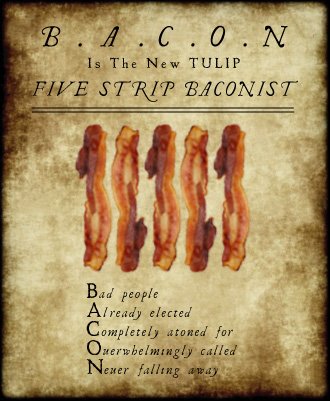
Are you among those people who find the 5 Points of Calvinism difficult to swallow? Perhaps you might find some bacon a little more tasteful than a TULIP. No, it’s not Kosher, but it is orthodox and Biblical:
- Bad people
- Already elected
- Completely atoned for
- Overwhelmingly called
- Never falling away
Broken-Down House: Living Productively in a World Gone Bad
I began reading Paul Tripp’s Broken Down House earlier this week. I had read it before, or rather I should say I skimmed it before, but did not take the time to allow Tripp’s poignant insights to resonate in my soul. I raced through it last time, getting the general gist, but not digesting much in the way of spiritual nourishment. That’s a mistake I am carefully avoiding this time through.
In Broken Down House Tripp uses the analogy of a home in serious disrepair as a reflection of our life in this world. In the video above he introduces the themes he writes about.
How to Build Community

Take a Repentance Tri-p

On a few occasions I have posted some thoughts and things about the concept of Tri-Perspectivalism. Tri-Perspectivalism (or, as some call it, Tri-P) is a fancy word for the simple concept of looking at our spiritual lives, and the ministry of our churches, from three distinct perspectives. Introduced by John Frame and Vern Poythress’ monumental work on the nature of knowledge, known as perspectivalism, the concept of Tri-P simply reminds us that Jesus perfectly embodies God’s authority, compassion, and wisdom, and expresses these through his offices of prophet, priest, and king, respectively. Guys like Dick Kauffman, David Fairchild, and Drew Goodmanson, among others, have provided significant insight about how Tri-P can be – and should be – applied to build well-balanced and gospel-centered ministry teams and congregations
I like the way a guy named Will Little summarizes the perspectives reflected by each office:
- Prophets enjoy studying the Word of God, protecting sound doctrine, and preaching/teaching others about God with influential passion and enormous vision.
- Priests appreciate and understand the needs of people, counsel them toward the Gospel, and get intimately involved with caring for the church and those around it.
- Kings love to plan, organize, and implement systems in order to get things done on time (and within budget).
Will recently composed an article for The Resurgence, titled Triperspectival Repentance, where he warns about some dangers of misapplying this concept, particularly agianst the notion of using Tri-P as a personality or temperment label, like a DISC or Myers-Briggs; and where he explores how we can deepen (if that is the right word) our experience and expressions of repentance when we see ourselves – or rather when we see Jesus more fully – though the lenses of Tri-P.
Little points out how misuse of Tri-P can easily feed the commonly held counterfeit gospel of Moralistic Therapeutic Deism that is plaguing the contemporary church:
- Morality: The Prophet’s Idol.
In their flesh, prophets preach graceless rule-following, or stale doctrine, for the purpose of good behavior and/or right belief. They will themselves be prone to derive identity and joy from success at (and control over) their personal legalisms rather than in those of God, our ultimate authority.
- Therapy: The Priest’s Idol.
Apart from the Spirit, priests will preach the value of emotional stability and felt needs being met over truth being proclaimed. They will miss Christ’s gospel and fall into liberalism as they derive identity and joy from counseling, serving, and caring for people, rather than the person and work of God, the Wonderful Counselor.
- Deism: The King’s Idol.
Kings are prone cast vision for numbers, systems, and goals. When detached from the gospel these things are often for the purpose of success rather than or more than for resting in the King of kings. King-types will succumb to deriving identity and joy from getting things done, as if God were a distant deity who isn’t involved in getting things done on our behalf. (See Psalm 127.1)
Martin Luther, in the first premise of his 95 Theses, observed:
“When our Lord and Master Jesus Christ said, ‘Repent’ (Mt. 4:17), he willed the entire life of believers to be one of repentance.”
With this in mind, Little points out that ultimately, repentance is God’s work of changing us to focus on God, rather than on our measly attempts at performing, whether theologizing, rule-following, serving people, or getting things done. As we focus on God, we can deepen our lives of repentance by perceiving him more completely than we do now.
- Prophets easily perceive God as the Word of God, fulfilled and embodied in Jesus as the perfect voice, vision, and revelation of God. Prophets can repent by meditating on God the Father and God the Holy Spirit, resting in the most powerful prophet, and by seeing Jesus as our perfect King and priest.
- Priests easily perceive God as the Wonderful Counselor, working intimately as the Holy Spirit as the perfect servant of God. Priests can repent by meditating on God the Father and God the Son, resting in the most compassionate priest, and by seeing Jesus as our perfect prophet and King.
- Kings easily perceive God as the King of kings, ruling and reigning with the authority of a perfect Father who plans, organizes, implements, and manages the universe. Kings can repent by meditating on God the Son and God the Holy Spirit, resting in the most organized King, and by seeing Jesus as our perfect prophet and priest.
Little concludes with wonderful application:
Too often, we reduce TriP into three buckets, give ourselves a 20-50-30 percentage breakdown (or whatever) and then work to improve our scores to try and be more like Jesus. But remember, “It is God who works in you, both to will and to work for his good pleasure.” (Phil. 2:13) If we focus on ourselves, we miss the whole point. We can instead see our gaps in the three buckets as opportunities to repent and perceive Jesus’ whole gospel, loving in deed and in truth (1 John 3:18), resting in the God who saves us and shapes us to image him as he sees fit.
Our Universal Need

“Just so you know, the need for repentance, redemption, and forgiveness is universal. I don’t care if you are a liberal or a conservative, a religious fanatic or a militant atheist, a ‘spiritual’/’religious’ person or someone who runs from all that. It doesn’t matter to me if you listen to Billy Graham or follow Camus – you are in need. No one in the human race is exempt. Its in our DNA…
When we finally acknowledge our need for forgiveness and come to God in repentance, we find true power; for we now have nothing to hide or protect, we don’t care what people say or think about us, we are willing to speak truth gently, and we are enabled to speak with tremendous, supernatural power.”
~ Steve Brown, from Three Free Sins

NOTE: Watch a preview video and listen to Tullian Tchividjian interview Steve Brown about Thee Free Sins: here
Qualla Boundary Bound
Headed to the Qualla Boundary to work with teens of the the Eastern Band of the Cherokee Nation at the Cherokee Reservation in North Carolina for the next week. I will be speaking Sunday night to the mission teams that are gathering, and then at the Cherokee Youth Center on Monday and Tuesday. My son, Matthew, will be speaking to the teens at the CYC on Thursday. Please pray for hearts to be opened, and for the gospel to be vividly demonstrated and clearly explained.
 GRACE & PEACE