Can Anyone Really Know What the Bible Actually Says?

In many ways it seems to be seen as the conversation stopper, the ultimate trump card.  Whenever a skeptic wants to take control of a spiritual conversation, the question gets tossed up like an impenetrable forcefield: With all the different translations and interpretations out there, how can anyone really know what the Bible says.

Of course sometimes it is not a conversation stopper, but a conversation starter. A person genuinely seeking, but perhaps confused or overwhelmed by all the Bible has to say may ask this very question.  Such a person may hope that there is an answer.  The good news is that there is an answer, and that the answer is “Yes”.

In this short 3-minute-plus video, Michael Horton tackles this question and gives a thoughtful response.

How to Preach the Gospel to Yourself

Preaching Gospel to Self

Paul, in Colossians 2.6, instructs us: “So then, just as you received Christ Jesus as Lord, continue to live your lives in him…”  Simple words, but powerfully practical when unpacked.

How did we “receive” Jesus?  By faith and repentance – or by repentance and faith.  We are not quite sure which comes first, but perhaps that does not matter.  It may be that the order is different with different people. What matters is that genuine conversion involves both of these elements: Repentance of our sin and of all our desire and attempts to save ourselves through our good behavior; Faith in the gospel – the good news – of what Jesus has done on our behalf, and what is offered to us in him.

If these are the two elements by which we received Jesus then, according to the Apostle’s instruction, these are the two elements that should be characteristic of our day-to-day life in Jesus.  The old Puritan Thomas Watson once wisely noted: “Faith and repentance are the two wings by which we fly toward heaven.”  In other words, faith and repentance are not only the instruments by which the journey of salvation is initiated, these are the practices by which we travel.  These are the ingredients of spiritual growth leading to maturity.

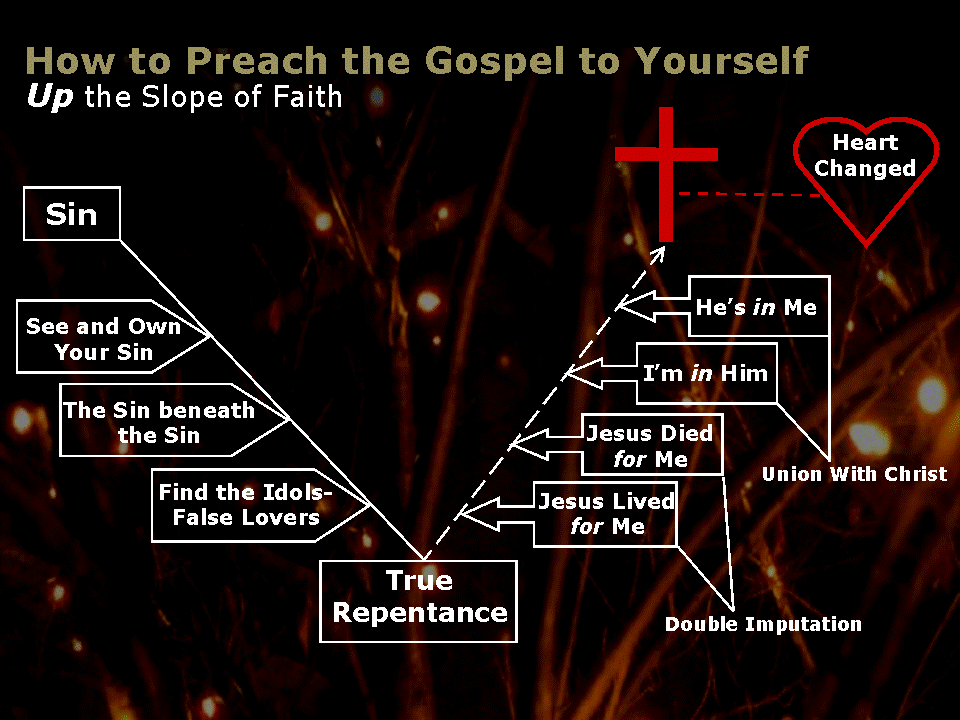
The chart above reflects both faith and repentance, and provides a tool to help us be able to “preach the gospel to ourselves”.

It reminds us that when recognize sin in our lives, our response should not be to simply resolve to “stop it”. We need to discern its source.  In other words, the sin we see, the sin which shows itself in our behavior (and in our attitudes), has deeper roots and causes.  So, like an explorer commissioned to trace the a great river to discover its tributaries and its origin, we are called upon to discover what “root sins” are tributaries of our behavior, and ultimately what idols are the original source.  Once discovered – or even while in the process of discovery – “putting sin to death” requires that we confess it and repent of it.  All of it – the sinful behaviors, the attitudes that lead to it, and the idols that source it.  Growth in grace is greater than mere moral reform.  Growth in grace is a work of the Spirit upon the heart which eventually and inevitably leads to a change in behavior.

Yet growth in grace does not come by confession and repentance alone.  Such may lead to behavior change, if we feel guilty enough and desire to change. But that is not growth in grace.  Growth in grace requires that we believe what grace gives; that we ponder what is true, and good, and beautiful: chiefly among such things is the gospel, the good news of what God promises – and does – when we trust  in Jesus.  (Philippians 4.8)   Reminded of the truths of the gospel, our hearts change; they turn toward God, causing us to hunger to grow more like him, and enabling us to rely more on his promise that what he began he will complete.  (Philippians 1.6)

This is the spiritual discipline of preaching the gospel to ourselves.

Leading in the Construction of Christ’s Church

Blue Construction

As one who has benefited from reading Jim Collins, John Kotter, Stephen Covey, and several other leadership gurus from the business world, I found this quote from Tony Morgan‘s Developing a Theology of Leadership  to be a very helpful reminder and convicting corrective:

It is true that we church leaders can learn from business leaders, but the corporate world should not set the foundation from which we lead. We can also learn from fellow church leaders, but they are also human and don’t provide a perfect model for Biblical leadership. When we look to other leaders, we are essentially holding on to our traditions rather than embracing the truth about leadership found in God’s Word. The Bible needs to become our filter for truth in every area of our life and ministry just because we see others doing it doesn’t mean that’s how God designed it.

Like Morgan, I still believe there is much to be learned from those who are effective in business, government, coaching, and other spheres. But as a pastor of a church – an under-Shepherd of part of the Church that Jesus is building – it is essential that I not fall for the notion that I will or can gain the most wisdom from these sources. I must never neglect or assume what the bible has to say about Leadership. Instead I must constantly submit all ideas of leadership, from whatever sources, to the scrutiny of the Scripture.

Matthew 16.18 reminds me that I am but a foreman, and that it is Jesus who is the architect, developer, and contractor. My job is to follow his design, and his lead.

Fatherhood of God

Neck Tie Quilt

After spending the better part of the past week preparing to preach about the Fatherhood of God, and the amazing doctrine of adoption, from Galatians 3.23-4.7, I am still pondering the richness and beauty of how the Heidelberg Catechism expresses it:

Q 26. What do you believe when you say: I believe in God the Father almighty, Creator of heaven and earth?

A. That the eternal Father of our Lord Jesus Christ, who out of nothing created heaven and earth and all that is in them, and who still upholds and governs them by his eternal counsel and providence, is, for the sake of Christ his Son, my God and my Father. In him I trust so completely as to have no doubt that he will provide me with all things necessary for body and soul, and will also turn to my good whatever adversity he sends me in this life of sorrow. He is able to do so as almighty God, and willing also as a faithful Father.

And this from the shortest chapter of the Westminster Confession, WCF 12:

All those who are justified God graciously guarantees to make partakers of the grace of adoption in and for his only Son, Jesus Christ. By this act they are taken into the number of God’s children and enjoy the liberties and privileges of that relationship; they are given his name; they receive the Spirit of adoption; they have access to the throne of grace with boldness; and they are enabled to cry, “Abba, Father.” Like a father, God has compassion on, protects, provides for, and chastens them; yet, they will never be cast off, but are sealed to the day of redemption, and will inherit the promises as heirs of everlasting salvation.

These are more than definitions.  These are summaries of the the gospel that are worthy of contemplation.  For I suspect most of our spiritual problems, and even our emotional troubles, are in one way or another due to our unbelief or lack of understanding of these great truths: first, God is the Father of all who believe, and who are therefore “in Christ:; second, we who believe, and who are therefore “in Christ”, are the beloved Children of God, who is the Creator and sustainer of the universe.

Culturally Literate Evangelism

Abstract Modern Landscape

Jonathan Dodson offers an astute assessment of the cultural landscape and some practical suggestions about how this effects the way we as Christians ought to engage in evangelistic efforts.  What Dodson offers refelcts the best of contextual ministry: The message should not change, but understanding those to whom we are speaking, knowing their needs and desires, shapes the way we present the message of the gospel.  ~ WDG

***

Cultural shifts have resulted in the collapse of Christendom, an official or unofficial relationship people have with their country and its civil religion. In America, moral views typically associated with Christianity have been replaced by more progressive views associated with libertarianism on marriage, sexuality, and gender.

In addition to loosening the American moral fabric, the collapse of Christendom has left behind a rubble of theological understanding. As the dust settles, we can no longer assume that people know what words like Christ, sin, faith, and God mean. For many, these words may no longer carry their original biblical meaning. We need to become culturally literate in order to be evangelistically fluent. If we don’t, the gospel gets lost in translation.

In secular culture people may actually hear us saying teacher for Christ, bad deeds for sin, wishful thinking for faith, or moldable deity for God. Today, it is a mistake to assume theological literacy. If we are to move forward, the Church must develop its ability to listen to new questions people are asking and learn how to translate the gospel into words and concepts that speak to the heart.

The Need for Cultural Literacy

Consider the need for cultural literacy in this story. A church planter in my city planted little wire signs in grassy medians around the city that read “RepentAustin.org.” I’ll admit it’s a pretty gutsy and confrontational tactic, but Jesus did call people to “repent and believe.” Yet, as I thought about this evangelistic approach, a major objection came to mind. These signs did not take into account contemporary understandings associated with the word “repent.” They conjure up images of judgmental people, filled with hatred toward “sinners,” who self-righteously speak words of condemnation. Instead of intriguing people, it probably elicited disinterest and, perhaps, unduly promoted a distorted view of the Gospel.

What makes this way of presenting the Gospel distorted? First, it does not call attention to Jesus — it focuses on a person’s need to change before they even get to hear about Jesus and what He has done. Second, there are strong cultural memories associated with the word, especially in the South, that are connected with a return to good, moral living — again, a response that has nothing to do with Jesus and what he has done. Many youths, when they hear the word “repent,” associate it with things like: stop listening to secular music, stop sleeping with your girlfriend, and start going to Church. This kind of repentance does not involve turning away from trusting in yourself to trust the Savior. It is simply a switch in lifestyles, secular to Christian. You can alter your behavior without altering your savior.

People adopt the trappings of faith—the religious habits, attempts at moral living, even a new Christianized culture that entails wearing a purity ring and listening to Christian music. But this cultural repentance is not a true turning to Christ; it is a turning to Christianity, to a religious subculture.

Slowing Down to Understand

To be effective in our new cultural landscape, we will have to slow down long enough to understand what people hear and how they speak in order to communicate the gospel in intelligible ways. This involves listening to what people think in order to communicate meaningfully what God thinks. This doesn’t require a PhD in Bible or theology. It requires love: sacrificing our time, tweaking our crammed schedules, putting away our canned responses, and actually conversing with people.

People don’t just need to hear a thirty-second gospel presentation. They need to understand why the Gospel is worth believing. To do this, we must learn their language and know their stories. We need to become “culturally literate in order to be gospel fluent, communicating the gospel in words and idioms that make sense to the people we talk to.

***

Jonathan Dodson (MDiv; ThM) serves as a pastor of City Life Church in Austin, Texas. He is the author of Gospel-Centered Discipleship, The Unbelievable Gospel, andRaised? Twitter: @Jonathan_Dodson

Gospel Greater Than God’s Law

Niagara at Night

Preaching through Paul’s Letter to the Galatians, I have received quite a bit of feedback – more than I receive during most series I have done.  Much to the relief of my thin skin, I have received no criticism (to date).  Most of the comments have been appreciative, either for the reminder of things that we need to remember, or for clarity on matters previously not understood.  (Either way, this is music to any ministers ears!)  The rest are questions – good questions; well-intentioned questions – concerning the role of our obedience. One godly man, a man I respect and enjoy, offered concerns about the possibility of people “hearing” cheap grace, knowing neither I nor our church believes grace is ever cheap.

These interactions have reminded me of what Martyn Lloyd-Jones wrote regarding the possible charge of anti-nomianism:

If your presentation of the Gospel does not expose it to the charge of Anti-nomianism you are probably not putting it correctly.

(NOTE: Anti-nomianism means “against law” or “anti-law.  It is a $20 word for someone who sees no use or present value for God’s law or commands in the Christian Life.)

This semi-famous saying is excerpted from Lloyd-Jones commentary on Romans.  Lloyd-Jones’ insights are so well expressed that they are worth revisiting even now and again.  Below are his thoughts from Romans 3 (which include the above statement):

A very good way of testing any view that you may hold is this one: Is this view humbling to me, glorifying to God? If it is, it is probably right. You won’t go far wrong if whatever view you are holding is glorifying to God, humbling to man. But if your view seems to glorify you and to query God, well (there’s no need to argue or to go into details) it’s wrong. It’s a very good universal rule– that!

My last word of all is, again, a word primarily to preachers – indeed it’s a word to everybody in the sense that if ever you are putting the Gospel to another person, you’ve got a very good test whether you are preaching the Gospel in the right way. What’s that? Well, let me put it like this to you: If your presentation of the Gospel does not expose it to the charge of Antinomianism you are probably not putting it correctly.

What do I mean by that? Just this: The Gospel, you see, comes as this free gift of God – irrespective of what man does.

Now, the moment you say a thing like that, you are liable to provoke somebody to say: “Well, if that is so it doesn’t matter what I do.”

The Apostle takes up that argument more than once in this great epistle. “What then,” he says at the beginning of chapter 6, “shall we do evil – commit sin – that grace might abound?” He’s just been saying: “where sin abounded grace does much more abound.” “Very well,” says someone. “This is a marvelous doctrine, this ‘Go and get drunk, do what you like the grace of God will put you right.’” Anti-nomianism.

Now, this doctrine of the Scriptures – this justification by faith only, this free grace of God in salvation – is always exposed to that charge of Anti-nomianism. Paul was charged with it. He said, “You know, some people say that’s what I’m preaching.” Paul’s preaching was charged with Anti-nomianism…So I say, it is a very good test of preaching.

You see – what is not evangelical preaching is this: It’s the kind of preaching that says to people, “Now, if you live a good life; if you don’t commit certain sins; and if you do good to others; and if you become a church member and attend regularly and are busy and active you will be a fine Christian and you’ll go to Heaven. That’s the opposite of Evangelical preaching – and it isn’t exposed to the charge of Anti-nomianism because…it is telling men to save themselves by their good works…And it’s not the Gospel – because the Gospel always exposes itself to this misunderstanding from the standpoint of Anti-nomianism.

So, let all of us test our preaching, our conversation, our talk to others about the Gospel by that particular test…If you don’t make people say things like that sometimes, if you’re not misunderstood and slanderously reported from the standpoint of Anti-nomianism, it’s because you don’t believe the Gospel truly, and you don’t preach it truly.

Fellowship of Jesus’ Followers

Community Collage

Stanley Grenz wrote, in Theology for the Community of God:

“The fellowship of Jesus’ followers is not merely a loose coalition of individuals who acknowledge Jesus. Rather, it is a community of disciples who seek to walk together in accordance with the principles of the kingdom. As Christ’s church, we desire to live out in the present the final reality that will come at the end of history, namely, the reconciled community. This forms the ultimate reason why the goal of evangelism is disciple making. The Spirit directs his great creative work toward establishing the eschatological community, a people who are bonded together by their mutual obedience to the God revealed in Jesus. It is their commitment to living as Jesus’ disciples which facilitates the mutuality that characterizes the community they form”

5 Things Church Members Wish Pastors Knew

Germoe Cathedral Impressionism (Slimm)

Anyone who has ever served on a ministry staff for any measurable amount of time knows the twin realities of the incredible joys and the exhausting difficulties.  Perhaps this tension is part of the reason why there is such large drop out rate among pastors and other ministry leaders in the American Evangleical Church.  Ministry is a tremendous privilege, to be allowed to be with people at both their best times and their worst, but it carries with it inevitable frustrations and hurt feelings, which frequently seems to lead to burnout, exhaustion, and isolation.

Part of the problem may be the disconnect between what those in pastoral ministry do, and what those in the congregation assume – and want – their ministers to do.   Just like some of the memes of various professions that one may see on Facebook or some other social medium suggests, there is often a difference.  Misconceptions easily become a source of tension.

Recently I re-read an article by Jason Boyett that I find helpful, reminding me to look at things from the other side: 5 Things Church Members Wish Pastors Knew.  it reminded me of one of Stephen Covey assertions from 7 Habits of Highly Effective People:”seek first to understand, then to be understood”. While I may desperately want to be “understood”, I have little to no control about what people may understand about me.  But I do have the ability to try to see things from the other side; to understand why people may not appreciate the same things I do, or agree with all that I may believe and say.

So, for my fellow ministry leaders, here are Boyett’s five assertions:

  1. Who you are reflects upon your membership. Churches reflect the character of its most visible pastors and ministers. “It’s not always fair,” one church member told me, “but people associate churches with the pastor.
  1. Churchgoers have lives (and ministries) outside of church. “I don’t eat and breathe this church,” a parishioner said.
  1. They value excellence but not showiness. Everyone makes mistakes. Every speaker, worship leader, or musician can have a bad day on-stage. Church members realize this, but at the same time appreciate good preparation.
  1. They want to be led…with honesty. Stories abound of churches that embarked on an exciting new vision only to backtrack a few weeks into it for a variety of reasons — too few volunteers, lack of funds, complaints from prominent church members, or some other kink.
  1. Sometimes, it looks like you have it easy. Anne Jackson, the author of Mad Church Disease and a former church staffer, once blogged about the perception — which she felt was well earned — that church staffers can be lazy. The post’s comment section should be required reading for pastors and ministers across the board.

To read more


Absence of Grace in the Culture Wars

Abstract Rainbow Birthday Cake

There has to be some way to better go about this.  The Washington Post reported last week of a man in Colorado, Bill Jack, who in attempt to demonstrate the hypocrisy of recent court rulings related to the Traditional Marriage vs. Gay Marriage debates, requested two cakes that together expressed clear anti-gay sentiments.  Jack seems to have chosen his target bakery knowing the owner supports LGBT positions.  Whether Marjorie Silva, the owner of Denver’s Azucar Bakery, is herself lesbian, none of the articles I read seemed to say.  But it really does not matter.

I too have been disappointed by some of the recent court rulings related to this issue – whether it is the bakers forced to close down their bakery for refusing to bake a cake for a gay wedding; the photographers who were legally penalized for declining an invitation to photograph a gay wedding; or the New York couple who have rented their barn to couples wanting rustic weddings, but  who have been fined so heavily that they may now have to sell their farm because they declined to acceopt a gay couples request to rent it for their wedding.  While the issues may be somewhat complex, and I have not kept up with the details of these incidents, the principles at stake, to my mind, are simple.  There is enough free commerce in this country that these folks – Azucar included – should not be required to accept business that violates their moral standards.  In a free market system, if these folks demonstrate egregious business practices, it is likely they will suffer the consequences at the hands of the public – i.e.  they will go bankrupt from lack of business.

Of course there are other issues at stake. High among them is whether these instances fall under the authority civil rights discrimination protection. But it is not the question of actual business practices that is no my mind at the moment. As disappointed as I am about some court rulings, I think I may be even more disappointed in the tactic employed by Bill Jack. (BTW, is that a real name? It sounds like the name of a morning D.J.?)

Sympathetic as I am to the frustration that led Mr. Jack to act, I find his tactic and, even worse, his stated motive to be dubious and misguided.  Acording to the Washington Post article:

“[Mr. Jack] believes Azucar Bakery ‘discriminated’ against him ‘based on my creed,’ which is Christian.”

Here is where I have my biggest problem.  While some may find reason to applaud Mr. Jack’s tactic in this culture war issue, I am deeply chagrined that he makes the suggestion that his action was compelled because he is a Christian.  Even if it can be argued that Mr. Jack did not say he acted because he was a Christian, he at the very least says he was discriminated against because Azcur Bakery refused to make his cake because of the “Christian” message. Either way, it seems quite evident that Mr. Jack is equating Christianity with his actions.  And for me, that is the rub – or that’s what rubs me the wrong way.

I am deeply disturbed when those who call themselves Christians conflate the culture wars with the only thing that makes any of us Christians – the gospel.  And however you slice this cake, neither Mr Jack’s action nor his message are distinctly “Christian”. In other words, while they may be in line with traditional biblical values, they have absolutely nothing to do with the gospel.

There does seem to be some disagreement about what Mr. Jack wanted on his cakes.

The Washington Times, quoting the owner of Azcur Bakery, says:

 Anti-gay phrases including “God hates gays” and an image of two men holding hands, covered in a big, red “X.”

To World Magaize Mr. Jack says:

[H]e requested two cakes in the shape of an open Bible. He asked that the first cake show on one page, “God hates sin – Psalm 45.7,” and on the facing page, “Homosexuality is a detestable sin – Leviticus 18.22.” He requested that the second cake have on one page, “God loves sinners,” and on the facing page, “While we were yet sinners Christ died for us – Romans 5.8.”

I tend to believe Mr. Jack in this. He is clear and intentional with his message. But I still maintain that, despite his use of Bible verses, there is nothing distinctly “Christian” in his message.  Further, his motive is certainly not driven by the gospel, but rather by the culture war.

I am not suggesting that Mr. Jack is not a Christian. Nor am I suggesting that Mr. Jack’s act is inherently wrong.  I am simply saying that while he may be free to act this way, and his values may be shaped by his faith, the action itself should not be viewed as Christian.

Jesus’ instruction to his followers is: “Be as shrewd as a serpent, and as innocent as doves.”  (Matthew 10.16) Mr Jack seems to me to have the serpents shrewdness down, but there seems to me to be no moral innocence here.  I stand on the same side as Mr. Jack in this cultural issue, but I do not stand with him.  I believe his actions – and actions like these – have actually served to distort the gospel, which will make it all the more difficult for critics of Christianity to hear the gospel and understand what followers of Jesus actually stand for.

I do not consider Mr. Jack to have been wronged, at least not for his faith.  As it stands, nothing in Mr. Jack’s actions, nor in the actions of similar cultural activists, communicates anything about the substitutionary death of Christ for sinners – i.e. the gospel.  So if there is nothing inherently Christian in his message, motives, or behavior to be discriminated against, it stands to reason that he was not discriminated against – at least not for the reasons he claims.

Bill Jack offers just another expression of a Christ-less culture warrior, under the guise of Christianity – just another one driven by values, but devoid of grace.

Be Not Afraid

by John Michael Talbot

You shall cross the barren desert, but you shall not die of thirst./ You shall wander far in safety though you do not know the way./ You shall speak your words in foreign lands and all will understand./ You shall see the face of God and live.

Chorus:

Be not afraid. I go before you always.
Come follow me, and I will give you rest.

Blessed are your poor, for the kingdom shall be theirs./ Blessed are you that weep and mourn, for one day you shall laugh./ And if wicked men insult and hate you all because of me,/ blessed, blessed are you!

Cries of the Poor

Comedian Steven Colbert made this statements:

“If this is going to be a Christian nation that doesn’t help the poor, either we have to pretend that Jesus was just as selfish as we are, or we’ve got to acknowledge that He commanded us to love the poor and serve the needy without condition and then admit that we just don’t want to do it.”

Now I am not one who believes that the United States was ever a “Christian Nation” in any true sense.  While it is evident that through our history our forefathers were guided by Judeo-Christian morays, and that the vast majority of citizens have traditonally recognized some expression of Christianity as the prevailing or most permeating faith in the land, the nation itself has held a different set of standards from than the gospel of Christ…

As to what solutions Colbert has to offer, I do not know.  But I know he has a valid point.

In a paper titled, Gospel-driven Principles, Dick Kaufmann, of Harbor Church in San Diego, makes these suggestions about our engagement with the poor:

1. KNOW THE POOR

The poor are mentioned over 200 times in the Old Testament. But who are the poor?

  • The Poor Are Needy. They have little or nothing of what the world values and as a result the world discards them. Now the Bible does say that some people squander the world’s goods and end up poor as a result of irresponsibility. But what is striking is this—80 to 90% of the passages on the poor do not say they had wealth but were irresponsible. On the contrary, there is reference to the fact that irresponsibility is a result of poverty not the cause of poverty. For example, Proverbs 10:15: “The wealth of the rich is their fortified city, but poverty is the ruin of the poor.” Frequently crime, addictions, irresponsibility, and unrest are a response to poverty. The Bible says by and large the vast majority of people who are in misery are born and come up having nothing of value so they are thrown away.

What is to be our response to the poor who are needy? Mercy. Overwhelmingly, the passages on the poor are not a rebuke to the poor but a call to God’s people to show them mercy. “Do not be hardhearted or tightfisted toward your poor brother…Give generously to him and do so without a grudging heart” (Deuteronomy 15:7-11).

  • The Poor Are Powerless. As a result they are oppressed. They have little that the world values but the little they have the world takes away. “A poor man’s field may produce abundant food, but injustice sweeps it away” (Proverbs 13:23). “A poor man is shunned by all his relatives—how much more do his friends avoid him! Though he pursues them with pleading, they are nowhere to be found” (Proverbs 19:7). You see it is not just a matter of irresponsibility. Things are broken. The poor are powerless; as a result, the little that they have is taken away from them.

What is to be our response to the poor who are oppressed? Justice. God calls us to defend the cause of the oppressed (Psalm 82). “Seek justice, encourage the oppressed, defend the cause of the fatherless, and plead the case of the widow” (Isaiah 1:17). But the problem goes much deeper than any social program can deal with. And so the Bible not only exhorts us to do justice but also to look to the day when God will come and make all things right. “The needy will not always be forgotten (Psalm 9:18)…’Because of the oppression of the weak and groaning of the needy, I will arise,’ says the Lord” (Psalm 12:5). And so Jesus begins his ministry reading from Isaiah 61 – “The Spirit of the Lord is on me, because he has anointed me to preach good news to the poor.” Central to what it means to be a follower of Jesus is to bring relief to the poor through mercy and justice. The Gospel helps us to know the poor and the Gospel helps us to…

2. BECOME THE POOR

In Matthew, Jesus does say, “Blessed are the poor in spirit” (Matthew 5:3). The Gospel comes to you only if you get rid of your middle-class spirit and get the spirit of the poor. That means three things:

  1. Acknowledge That You Are Needy. The middle-class spirit says: “If I live a good life then I will have something of value to present to God. If I give to the poor, show mercy and do justice I can present something to God that he will value. I can do it.” But the Gospel says: “No one is good, no not one.” Even our good deeds are filthy rags. They stink of self-righteousness. Because they have been done to feel superior to others and to get leverage with God so that He owes us a good life. They have absolutely no value to God.
  1. Acknowledge That You Are Powerless. The middle class spirit says: “Okay, if I have failed I will just pick myself up and try harder. I will turn over a new leaf. I may be down but I am not out. I’ll double my effort. Never say never, think positive, visualize success—I can do it. I will do it!” But the Gospel says: “Not only are you spiritually bankrupt with nothing of value to present to God but you are totally incapable of reversing the situation.” It is like a drowning man trying to pull himself out by his own hair. No, it is worse. It is like a dead man trying to dig himself out of the grave. The Bible says: You are spiritually dead and totally powerless to do anything that would merit God’s approval.
  1. Acknowledge That Your Only Hope Is A Poor Man. Trust in the King who became a poor man. He was born in a feed bin, in a cattle shed. At his dedication, his parents gave the smallest offering possible. He was raised in a poor family, in a poor community. All his life he was poor. “Foxes have holes and birds have nests but the Son of Man has no place to lay his head.” He entered Jerusalem on a borrowed donkey, had his last meal in a borrowed room, and was buried in a borrowed grave. He died naked. He had little the world valued and the little he had was taken away. He was discarded, thrown away. And only because of Him do you we have any hope. Your only hope is a crucified poor man. If this offends you, you are middle class in spirit and you cannot be saved. You must become the poor. And finally, the Gospel calls us and enables us to…

3. LOVE THE POOR

To the extent that the Gospel works in your heart you will love the poor in three ways:

  1. You Will Identify With The Poor. You will see that they are just like you. You will see their dirty, tattered clothes and think: “All my righteousness is a filthy rag, but in Christ we both are clothed in his white robes of righteousness.” You don’t pity them. You have empathy for them, but you don’t look down on them. You respect them. Instead of serving them in a paternalistic way you see them as partners in ministry—people from whom you have much to learn.
  1. You Will Be Generous To The Poor. Does the Bible call us to give everything away? No. Does it call us to stay rich? No. The Bible calls us to become incredibly contented and daringly generous with what we have because our riches are in heaven.
  1. You Will Stand With And For The Poor. That’s what it means to do justice for the oppressed. The Gospel frees us from our obsession with our reputation and our comfort and enables us to so identify with the poor that we are willing to stand with and for them against injustice and oppression.

The Gospel of Jesus is for the poor and only the poor—the spiritually poor and especially the materially poor. For the Gospel to come to you, you must become poor. When that happens the Gospel enables you to know and love the poor.

Repenting of “Biblical” Manhood

Abstract Balance (Sutton)

The following was written by Kyle Worley, from Village Church in Dallas, and was posted on CBMW‘s web.  I thought about editing, but realized there is nothing I could add, nor is there anything for me to delete.  So I post it here in its whole, as one who shares this complimentarian  perspective (here, here) and sentiment.  ~ WDG

***

As we have been reflecting on some of the corruptions of biblical manhood, I think that it is high time that we take an opportunity to apologize for the impact and influence any of these corruptions have had on the home, the church, or the culture. Without a doubt it is one of the most perverse aspects of sin that it can take the truth of scripture and bend it to the will and the ways of man. Like God in the garden, who enquires “who told you that you were naked?” What corruptions have you swallowed? What lies do you believe? Who told you that ‘biblical’ manhood looked like that?

While we firmly believe that God has ordained complementarianism as the governing sexual and marital ethic of the Christian life, we acknowledge that a corrupt complementarianism and those false ways of living that some may have treacherously called ‘biblical’ manhood have led to the perversion of the wonderful truth that God has laid out for human flourishing in the home, in the church, and in the culture.

So, in the vein of those prophets who pled for the sins of their kinsman, it is time that we corporately repent and lament the perverseness of a manhood that has been shaped by sin and not by the authority of Scripture.

Lord,

We confess that we are broken and are in need of your grace. May you draw our gaze to the God-man Jesus Christ and the full scope of scripture as the authoritative revelation for what biblical manhood should resemble.

We repent for the sins of our passive brothers, unwilling to lead when it counts.

We repent for the sins of our chauvinist brothers, covering up abuse in the name of authority and male leadership.

We repent for the sins of our brothers who refuse to grow up, Lord would you call them to greater maturity.

We repent for any machismo that has seeped into our churches , may we be disgusted with misogyny in all its forms.

We repent for men who are trying to escape from the responsibilities you have entrusted to them, may they find joy in their stewardship.

We repent for men who are attempting to “lone wolf” their lives, Lord may they find your church as beautiful as you do.

We repent for men unwilling to sacrifice their control and comfort to lead in all spheres of life , may they look to He who laid down His life for His bride.

We repent for men who are so jaded with cynicism that they lose love for the King and hope for his coming kingdom.

We pray that you would rescue women who are trapped in abuse and that you would crush the purposes of abusers who treacherously call themselves “complementarians” or “biblical men.” Bring them to repentance and comfort those who have been bruised and broken beneath their hands.

We pray for those men who are trapped in sexual immorality. Lord, would you break the chains of pornography in the life of the church. Those wicked chains that place men in shackles next to the sex trafficking victims, pornographers, and orphaned.

We pray that you would continue to renew a movement towards good, beautiful, and true complementarian practice. May the witness of those men and women who have been created in your image, given distinct roles in the world, and who treasure the gospel tell the true story of complementarianism. May the lies that creep in under the banner of complementarianism in churches, homes, and communities across the world be crushed by this witness.

Comfort the woman abused, the child orphaned, the widowed mother, the widowed father, the church filled with faithful women.

Comfort the young woman not righteously pursued, the young boy with no father to learn from, the wife who serves the belligerent and lazy husband.

Confront those trapped in sexual immorality, confront churches filled with passive men, confront the young men unwilling to grow up.

Crush abortion, crush the movement to undermine the beauty of Christian covenant marriage, crush the porn industry, crush abuse at home and in the church.

Come, Lord! Come, Lord! Come, Lord, would you come?

 ***

Kyle Worley is Connections Minister at the Village Church in Dallas, TX. He is the author of Pitfalls: Along the Path to Young and Reformed and blogs regularly at The Strife. You can find Kyle on Twitter @kyleworley.