The Problem of Pretentious Piety

When Samuel Blair assumed the pulpit of Faggs Manor Church in 1740, he found a congregation in a spiritual condition not uncommon in our day. Blair wrote that when he came to the church he found “many good religious people who performed their religious obligation rather well”. Yet they were, in his estimation, somewhat formal and unenthusiastic:

If they performed these duties pretty punctually in their seasons and, as they thought, with good meaning, out of conscience, and not just to obtain a name for religion among men, then they were ready to conclude that they were truly and sincerely religious. A very lamentable ignorance of the main essentials of true practical religion, and the doctrines nearly relating thereunto very generally prevailed. The nature and necessity of the new birth was but litle known or thought of, the necessity of a conviction of sin and misery, by the Holy Spirit’s opening and applying the law to the conscience, in order to a saving closure with Christ, was hardly known at all to most. It was thought, that if there was any need of a heart-distressing sight of the soul’s danger, and fear of divine wrath, it was only needed for the grosser sort of sinners; and for any others to be deeply exercised this way (as might in some rare instances observable), this was generally looked upon to be a great evil and temptation that had befallen those persons. The common names for such soul-concern were, melancholy, trouble of mind, or despair. These terms were common, so far as I have been acquainted, indifferently used as synonymous; and trouble of mind was looked upon as a great evil, which all persons that made any sober profession and practice of religion ought carefully avoid. …There was scarcely any suspicion at all, in general, of any danger of depending upon self-righteousness, and not upon the righteousness of Christ alone for salvation. Papists [Roman Catholics] and Quakers would be readily acknowledeged guilty of this crime, but hardly any professed Presbyterian. The necessity of being first in Christ by a vital union, and in a justified state, before our religious services can be well pleasing and acceptable to God, was very little understood or thought of; but the common notion seemed to be, that if people were aiming to be in the way of duty as well as they could, at they imagined, there was no reason to be much afraid.

[Source: The Forming of an American Tradition: A Re-Examination of Colonial Presbyterianism, by Leonard J. Trinterud; Westminster Press, 1959; pp. 77-78]

Unfortunately, it seems that this same presumption still exists in too many congregations, and among too many professing Christians. Brennan Manning, in his thoughtful book, Ruthless Trust, identifies the problem with the superficial spirituality of pretentious piety:

In a world where the only plea is “Not Guilty”, what possibility is there of an honest encounter with Jesus, who “died for our sins”? We can only pretend that we are sinners, and thus only pretend that we are forgiven.


Gospel-Driven Sanctification

by Jerry Bridges

Early in my Christian life I heard someone say, “The Bible was not given to increase your knowledge but to guide your conduct.” Later I came to realize that this statement was simplistic at best and erroneous at worst. The Bible is far more than a rulebook to follow. It is primarily the message of God’s saving grace through Jesus Christ, with everything in Scripture before the cross pointing to God’s redemptive work and everything after the cross–including our sanctification–flowing from that work.

There is an element of truth in this statement, however, and the Holy Spirit used it to help me to see that the Bible is not to be read just to gain knowledge. It is, indeed, to be obeyed and practically applied in our daily lives. As James says, “But be doers of the word, and not hearers only, deceiving yourselves” (James 1:22).

With my new insight, I prayed that God would use the Bible to guide my conduct. Then I began diligently to seek to obey it. I had never heard the phrase “the pursuit of holiness,” but that became my primary goal in life. Unfortunately, I made two mistakes. First, I assumed the Bible was something of a rulebook and that all I needed to do was to learn what it says and go do it. I knew nothing of the necessity of depending on the Holy Spirit for his guidance and enablement.

Still worse, I assumed that God’s acceptance of me and his blessing in my life depended on how well I did. I knew I was saved by grace through faith in Christ apart from any works. I had assurance of my salvation and expected to go to heaven when I died. But in my daily life, I thought God’s blessing depended on the practice of certain spiritual disciplines, such as having a daily quiet time and not knowingly committing any sin. I did not think this out but just unconsciously assumed it, given the Christian culture in which I lived. Yet it determined my attitude toward the Christian life.

Continue reading

How to “Hallow” God’s Name

The first petition of the model prayer Jesus taught his disciples to pray was “hallowed be your Name”. We are instructed to pray that God would act in such a way that his name would be recognized, revered, valued, and celebrated by Peoples throughout the whole world.

As the Westminster Shorter Catechism in Modern English expresses it:

In the first request (“hallowed be your name”) we pray that God will enable us and others to glorify Him in everything He uses to make Himself known and that He will work out everything to His own glory.

The Heidelberg Catechism, from the Dutch tradition, is a bit more elaborative:

“Hallowed be your name” means: Help us to truly know you, to honor, glorify, and praise you for all your works and for all that shines forth from them: your almighty power, wisdom, kindness, justice, mercy, and truth. And it means, Help us to direct all our living – what we think, say, and do – so that your name will never be blasphemed because of us but always honored and praised.

Only recently, as I was preparing for a series of messages from the Lord’s Prayer, did I notice that in Psalm 8 King David provides a wonderful example of what it looks like to have the hallowing of God’s name as a heartfelt passion and priority. Notably we see through Psalm 8 several aspects of David that are essential characteristics of anyone who hallows God’s name:

  1. An awareness of how unfathomably awesome Our Father in Heaven truly is;
  2. An appreciation for the transcendent beauty of all of God’s Creation;
  3. A personal humility rooted in an awareness of his own nature, especially in comparison with the incomparable holiness of God;
  4. An awareness that his hope and significance come only from God;
  5. A thankfulness for God’s gracious promises and provision;
  6. A consequential desire that God’s name be glorified throughout the earth.

O Lord, Our Lord, How majestic is you name in all the earth!

The Ways & Means of Following Jesus

Eugene Peterson, in his book, The Jesus Way, wrote:

Following Jesus necessarily means getting his ways and means into our everyday lives. It is not enough simply to recognize and approve his ways and get started in the right direction. Jesus’ ways are meant to be embraced and assimilated into our habits. This takes place only as we pray our following of him. It cannot be imposed from without, cannot be copied. It must be shaped from within. This shaping takes place in prayer. The practice of prayer is the primary way that Jesus’ way comes to permeate our entire lives so that we walk spontaneously and speak rhythmically in the fluidity and fluency of holiness.

Hallowed Be MY Name

The first petition Jesus taught his disciples to pray is “Hallowed be YOUR Name”. (Matthew 6.9) In other words, the priority of our lives – of the lives of all who are followers of Jesus – is to love God, enjoy God, and to seek his glory above all else.

J.I. Packer, in his book Growing in Christ, however, mindful of our tendency toward Self, suggests:

“Were we left to ourselves, any praying we did would both start and end with ourselves, for our natural self-centeredness knows no bounds.”

What would a self-serving prayer sound like? Perhaps something like this prayer I recently stumbled upon:

My Father in Heaven,

Hallowed be MY Name: My Kingdom come: Give me more; fame & fortune; prestige & power; Let ME be the Ruler of MY life, each and every hour.

Hallowed be MY Name:  My Will be done. The perfect family; the next promotion… You say you know my desires… Well then, set them in motion…

Hallowed be MY Name: Give me this day my perceived need; Give me what I want – and don’t call it Greed…

Hallowed be MY Name: Forgive my sins, at least the ones I will admit; all of the others you’ll just have to permit.

Hallowed by MY Name: Lead me not into temptation – I mean the severest of kind; those temptation I find insignificant, those should be fine…

Hallowed be MY Name: Deliver me from evil, death, and despair; For me to experience them would never seem fair.

Hallowed be MY Name: For My Kingdom; For My Power; and For My Glory.

Directions for Reading Christian Books

Trinity College Library (Ireland)

[Adapted from Richard Baxter’s Christian Directory of 1673]

Because God has made available the excellent, holy writings of his servants; and many may have a good book, on any day or at any hour of the week, even those who have no access to a good preacher – I advise all God’s servants to be thankful for so great a gift as books, and to make use of them, and to read much. For reading can be more conducive to knowledge than hearing is, because you may choose what subjects, and the best treatises, you please; and you may read as often as you please; and you may peruse again and again whatever you forget; and you may take your time as you go, to fix it in your mind. And as is the case with very many, reading does more than hearing to move the heart – because lively books may be more easily accessed than lively preachers.

Especially these sorts of men and women should be much in reading:

  1. Mothers and Fathers, or heads of households, who have more souls to care for than just their own.
  2. People who live where there is no preaching; or, where there is only bad preaching. (Bad preaching is even worse than none!)
  3. Infirmed people, servants, and children, who are forced on many Lord’s Days to stay at home, while others have the opportunity to hear the Word preached.
  4. And non-working persons, since they have more leisure than others have.

To all these, but especially to parents, I shall here give a few directions.

Direction 1 – I presuppose that you keep the devil’s books out of your hands and house. I mean graphic romance novels or “love-books”, and the false, bewitching and seducing books of all false teachers; and the railing books by various factions written against each other, on purpose, to teach men to hate one another. For where these are allowed to corrupt the mind, other useful writings are forestalled in their benefits. It is an awful wonder to see how powerfully these kinds of writings poison the minds of children, and of many other empty heads.

Also refrain from books that are written by contemporary “sons of Korah“; those written to breed distastes and discontents in the minds of the people against their governors – both magistrates and ministers. For there is always something, even in the best leaders, for the tongues of seditious men to fasten on, and then to aggravate in the people’s ears and minds; and there is something even in godly people, which tempts them all too easily to become ill-tempered,  then to take aim and take fire, before they are aware of what they are doing. Rarely do most people, even godly people, foresee the evil to which such treachery leads.

Direction 2 – When you read to your family, or to others, let it be seasonably and timely – at a time when silence and participation are most likely to bear fruit; not when children are crying or talking, or servants bustling to disturb you. Distraction is worst in the greatest businesses.

Direction 3 – Choose such books as are most suitable to your condition, or to the spiritual condition of those you read to. It is worse than unprofitable to read books designed for comforting troubled minds to those that are block-headedly self-secure, and who have hardened, obstinate, un-humbled hearts. It is just as bad as a physician giving medicines or remedies that are contrary to a patient’s need, and that would actually nourish the disease! So it is to read books that are too high-a-style, or subject too deep, to dull or ignorant hearers. We use to say: “That which is one man’s meat, is another man’s poison.” It is not enough that the substance is good – but it must be agreeable to the situation for which it is used.

Direction 4 – In a common family, begin with those books which both, and at once, inform the understanding about the fundamentals of the faith and awaken the affections of the heart, such as treatises about regeneration, conversion, or repentance.

Remember that they are not the most learned, who read most – but those who read that which is most necessary and profitable.

“Remember that they are not the most learned, who read most – but those who read that which is most necessary and profitable.”

Direction 5 – Next, read over those books which are most suited to the state of young Christians for their growth in grace, and for their exercise of faith, and love, and obedience, and for the mortifying of selfishness, pride, sensuality, worldliness, and other of the most dangerous sins.

Direction 6 – At the same time labor to methodize your knowledge; and to that end read first and learn some short catechism, and then some larger catechism. And let the catechism be kept in memory while you live, and the rest be thoroughly understood.

Direction 7 – Next read (to yourselves or or to your families) some larger expositions of the Apostles’ Creed, Lord’s Prayer, and Ten Commandments; such as Thomas Watson on the Commandments; that your understanding may be more full, particular, and distinct, and your families may not be limited to a mere general knowledge, which, in truth, is not as valuable as genuine understanding.

Direction 8 – Read often and much those books that direct you in a course of daily communion with God, and a holy ordering of your daily life.

Dangers of Spiritual Resolutions

I’ve been there. Likely, so have you.  The year begins with good intentions, and maybe even a strong start, only to fizzle days later.  The Statistic Brain Research Institute reports that 75% of New Years Resolutions are broken within the first week of the New Year.  No doubt most of the others go down soon thereafter.

Among the more frequent vows is a renewed commitment to read the Bible:

  • Read the whole Bible in one year
  • Read the Bible daily, or just more often

This seems a noble resolve. And as a church pastor, it is certainly one I applaud.  In fact, I often share some Bible Reading plans for anyone who endeavors to take up this challenge.  (Like this one: Bible Reading Plan for Slackers & Shirkers)

But in the brief (3 minute) video above, Steve Childers, of Global Church Advancement, offers a caution about making such resolutions – even resolutions such as to pray more or to read the Bible.

It may seem odd that I am posting such caution about making spiritual resolutions, especially since I commended the Resolutions of Jonathan Edwards in a post just yesterday.  But without denying the potential benefit of reflecting upon Edwards’ Resolutions, nor even the positive effects of increased Bible reading and prayer during the coming year, I think Childers makes a good point.

Consider this:

The state of our heart is of utmost importance as we practice spiritual disciplines. It’s possible to read our Bibles, pray, attend Lord’s Day worship, and even take the Lord’s Supper for all types of reasons. But unless we do it for God’s glory, and our joy in him, it does us no ultimate good.

Or as Charles Spurgeon reasoned:

“It is not enough to do the correct thing; it must be done in a right spirit, and with a 
pure motive. A good action is not wholly good unless it be done for the glory of God, 
and because of the greatness and goodness of his holy name.”

In no way would I ever dissuade anyone from increasing their spiritual vitality through partaking in such means of grace as prayer and Bible study. Nor does Childers.  But Childers does wisely warn against resolutions that may result in merely going through religious motions – even if those motions come more frequently.  Instead Childers points us to the source of all grace, and encourages us to avail ourselves of all that is offered.

Take a moment to watch the video, and to consider what Childers says.  For those who prefer to read, a transcript of the message can be read on Childers’ blog: Pathway Learning

Warped Christianity

Warped Reality

Sociologist Christian Smith introduced the phrase Moralistic Therapeutic Deism in his book Soul Searching:The Religious and Spiritual Lives of American Teenagers.  Smith, and his colleagues, assert that, from their research, this would be a fitting description of the spirituality of the typical American teenager – a spirituality they gained from watching and listening to their Baby Boomer parents.

Al Mohler, in a post titled Moralistic Therapeutic Deism – the New American Religion, describes Moralistic Therapeutic Deism as consisting of beliefs like these:

  1. “A god exists who created and ordered the world and watches over human life on earth.”
  2. “God wants people to be good, nice, and fair to each other, as taught in the Bible and by most world religions.”
  3. “The central goal of life is to be happy and to feel good about oneself.”
  4. “God does not need to be particularly involved in one’s life except when God is needed to resolve a problem.”
  5. “Good people go to heaven when they die.”That, in sum, is the creed to which much adolescent faith can be reduced.

What is perverse about these statements is that none of them is entirely wrong.  But it is the subtle errors that erode genuine faith, especially when the propositions fit together to form a worldview.  Together they create a warped perspective that, while borrowing the language of Christianity, is not actually Christianity.

How to Preach the Gospel to Yourself

Preaching Gospel to Self

Paul, in Colossians 2.6, instructs us: “So then, just as you received Christ Jesus as Lord, continue to live your lives in him…”  Simple words, but powerfully practical when unpacked.

How did we “receive” Jesus?  By faith and repentance – or by repentance and faith.  We are not quite sure which comes first, but perhaps that does not matter.  It may be that the order is different with different people. What matters is that genuine conversion involves both of these elements: Repentance of our sin and of all our desire and attempts to save ourselves through our good behavior; Faith in the gospel – the good news – of what Jesus has done on our behalf, and what is offered to us in him.

If these are the two elements by which we received Jesus then, according to the Apostle’s instruction, these are the two elements that should be characteristic of our day-to-day life in Jesus.  The old Puritan Thomas Watson once wisely noted: “Faith and repentance are the two wings by which we fly toward heaven.”  In other words, faith and repentance are not only the instruments by which the journey of salvation is initiated, these are the practices by which we travel.  These are the ingredients of spiritual growth leading to maturity.

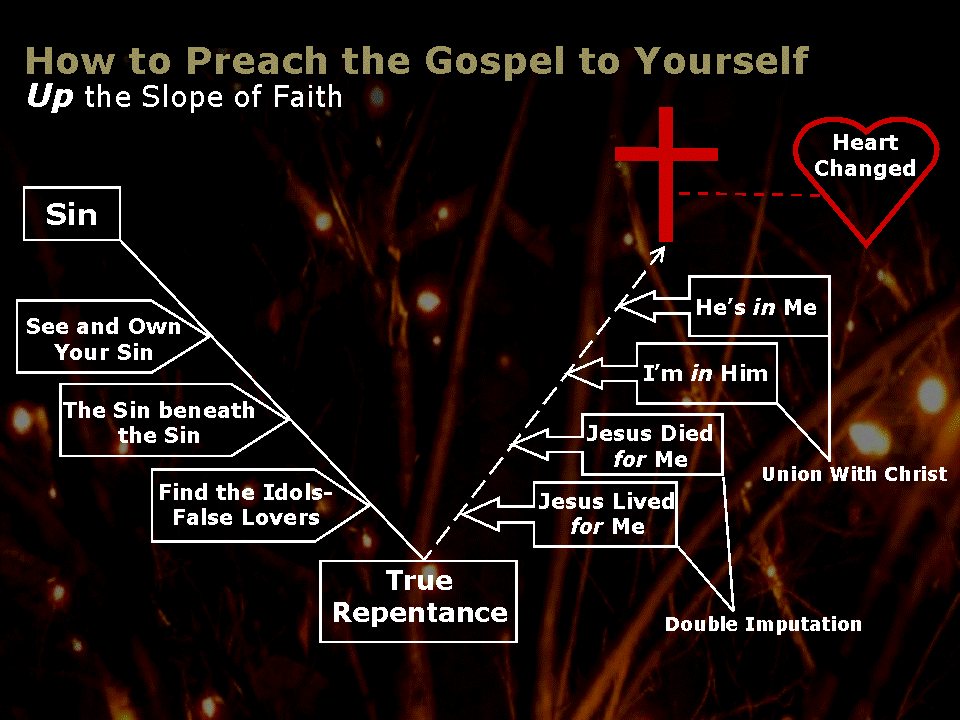
The chart above reflects both faith and repentance, and provides a tool to help us be able to “preach the gospel to ourselves”.

It reminds us that when recognize sin in our lives, our response should not be to simply resolve to “stop it”. We need to discern its source.  In other words, the sin we see, the sin which shows itself in our behavior (and in our attitudes), has deeper roots and causes.  So, like an explorer commissioned to trace the a great river to discover its tributaries and its origin, we are called upon to discover what “root sins” are tributaries of our behavior, and ultimately what idols are the original source.  Once discovered – or even while in the process of discovery – “putting sin to death” requires that we confess it and repent of it.  All of it – the sinful behaviors, the attitudes that lead to it, and the idols that source it.  Growth in grace is greater than mere moral reform.  Growth in grace is a work of the Spirit upon the heart which eventually and inevitably leads to a change in behavior.

Yet growth in grace does not come by confession and repentance alone.  Such may lead to behavior change, if we feel guilty enough and desire to change. But that is not growth in grace.  Growth in grace requires that we believe what grace gives; that we ponder what is true, and good, and beautiful: chiefly among such things is the gospel, the good news of what God promises – and does – when we trust  in Jesus.  (Philippians 4.8)   Reminded of the truths of the gospel, our hearts change; they turn toward God, causing us to hunger to grow more like him, and enabling us to rely more on his promise that what he began he will complete.  (Philippians 1.6)

This is the spiritual discipline of preaching the gospel to ourselves.

Spiritual Chrysalis

Chrysalis

In preparation for  this past Sunday message from Galatians, I again marveled at the insight and passion of Martin Luther concerning our Union with Christ:

“So far as justification is concerned, Christ and I must be so closely attached that He lives in me and I in Him. What a marvelous way of speaking!

Because He lives in me, whatever grace, righteousness, life, peace, and salvation there is in me is all Christ’s; nevertheless, it is mine as well, by the cementing and attachment that are through faith, by which we become as one body in the Spirit.

Since Christ lives in me, grace, righteousness, life, and eternal salvation must be present with Him; and the Law, sin, and death must be absent. Indeed, the Law must be crucified, devoured, and abolished by the Law—and sin by sin, death by death, the devil by the devil.

In this way Paul seeks to withdraw us completely from ourselves, from the Law, and from works, and to transplant us into Christ and faith in Christ, so that in the area of justification we look only at grace, and separate it far from the Law and from works, which belong far away…

But faith must be taught correctly, namely, that by it you are so cemented to Christ that He and you are as one person, which cannot be separated but remains attached to Him forever and declares: ‘I am as Christ.’

And Christ, in turn, says: ‘I am as that sinner who is attached to Me, and I to him. For by faith we are joined together into one flesh and one bone.’

Thus Ephesians 5.30 says: ‘We are members of the body of Christ, of His flesh and of His bones,’ in such a way that this faith couples Christ and me more intimately than a husband is coupled to his wife.”

~ from Luther’s Works, Vol. 26: Lectures on Galatians, 1535, Chapters 1-4

Valley of Vision

Foggy Fall @ Cades Cove

Having spent the bulk of my years in ministry residing and serving in mountainous regions, this Puritan prayer, from which the Valley of Vision collection takes its title, has always carried deep meaning for me. For not only was it descriptive of my geographic and topographic surroundings, but even now that I am living a long way from any of the mountains I love, this prayer vividly depicts the state of my soul and reminds me of my hope.

***

Lord, High and Holy, meek and lowly,
Thou hast brought me to the valley of vision,
where I live in the depths but see thee in the heights;
hemmed in by mountains of sin, I behold thy glory.

Let me learn by paradox
that the way down is the way up,
that to be low is to be high,
that the broken heart is the healed heart,
that the contrite spirit is the rejoicing spirit,
that the repenting soul is the victorious soul,
that to have nothing is to possess all,
that to bear the cross is to wear the crown,
that to give is to receive,
that the valley is the place of vision.

Lord, in the daytime stars can be seen from deepest wells,
and the deeper the wells the brighter your stars shine;

Let me find your light in my darkness,
your life in my death,
your joy in my sorrow,
your grace in my sin,
your riches in my poverty
your glory in my valley.

Valley of Vision

Gospel vs. Legalism

Gospel vs. Legalsim

What is the difference between legalism and the gospel?

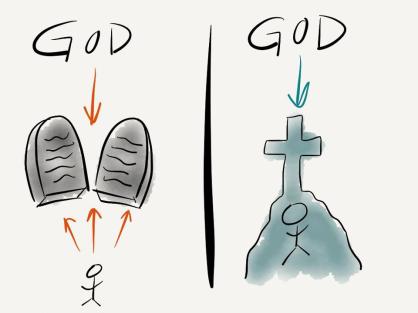
  • Legalism (or Moralism) says God looks at how well we keep the law.
  • The Gospel says we are hidden in Christ. So God sees how well Jesus kept the Law (perfectly), all his works, and his death on our behalf.  Consequently, because we are hidden in Christ, God sees the work of Jesus when he sees us. The gospel says that, because of God’s grace, all that Jesus is and did is credited (imputed) to us, through faith.  (Colossians 3.3, Ephesians 2.8, Romans 5.2, Galatians 2.20)

So what is the difference between the gospel and legalism? It is the difference between Christianity and every religion in the world.

Gospel Wakefulness

One of the more helpful works I have read concerning gospel-centered Christianity is Jared Wilson‘s Gospel Wakefulness.  Perhaps most insightful to me was Jared’s point that gospel-centeredness can be explained but cannot be taught.  In other words, it requires a grace of the holy spirit.  I do not think this realization moves gospel-centeredness into a neo-gnostic or higher life kind of category.  It simply is the realization that it is God who must work in us in our sanctification.  Thus the phrase Jared Wilson uses is Gospel Wakefulness.

In this video, Jared Wilson explain what Gospel-Wakefulness is.   This is not a short video, by any measure.  But it is worth taking the time – whether in one sitting, or in a series of starts-and-stops.

Counterfeit Gospels

Having begun a new series of messages at our church, Freedom: A Study of Galatians, I am struck anew by the passion with which the Apostle Paul uncompromisingly declares: “There is NO OTHER Gospel!”  What Paul does throughout his letter to the Galatians, and vividly in the opening verses, is to impress that claim upon his readers as he points out and combats the counterfeit gospels – philosophies which purport themselves to be good news, but which are in reality fraudulent teachings dressed in Christianese garb.  Paul’s response to these philosophies is to declare: “Even if we (Apostles, including he himself), or an angel from heaven comes and teaches you something other than the gospel you originally received, let them be eternally cursed!.” The essence of what he says is: “Anyone who tries to teach a fraudulent gospel can just go to hell!”  He is obviously serious about this to offer such a severe retort.

Counterfeit gospels are not just something from the Apostolic age.  They are all too prevalent today – and not only in heterodox churches.  They are present in the best of churches, and in the hearts of some of the most sincere followers of Christ. I suspect it is in our spiritual DNA, part of our broken nature. Are hearts are deceitful. (Jeremiah 17.9)  We are susceptible to gospel distortions – which Paul reminds us “are no gospel at all”.

Some time ago I picked up and read a book by Trevin Wax, Counterfiet Gospels.  I found it to be among the most helpful books I have read.Counterfeit Gospels

In one sense, nothing in the book was new for me.  Still, Trevin does an excellent job of explaining the gospel in it’s various aspects:

  • Gospel Story: Creation, Fall, Redemption, Restoration
  • Gospel Announcement: Life, Death, Resurrection, and Exaltation of Jesus
  • Gospel Community: The Church

Just as important, he takes some commonly held notions and connects them to the different dimensions of the gospel. Included among the categories he connects with and compares to the gospel:

  • Activist Gospel
  • Moralistic Gospel
  • Pietistic or Quietistic Gospel
  • Therapeutic Gospel
  • Judgmentlessness Gospel
  • Churchless Gospel

In exploring these ideas, he shows that while at root they are in may respects good, yet how when misunderstood or misapplied they are contributing to an erosion of  the Faith.

What I don’t think I had ever before adequately considered was the connection of the categories Trevin identifies with the gospel. And what I think I appreciated most is that he identifies and examines not only the negatives of these  ideas, but he also explains their positives points as well.  He astutely points out that it is the very real positive aspects that make these points popular and palatable, and yet which also make them easily confused and dangerous.

In the short video above Trevin Wax provides a quick overview of his book, and briefly explains the categories he identifies.  So even if you find my description of his book a little fuzzy or confusing, take a moment to watch the video so Trevin can clarify what I am trying to convey.

Seasons of Revival

Holy Spirit

No matter how many times I have seen them, my bemusement has never seemed to wane.  I appreciate the zeal, yet marvel at the naivete’.  Signs and banners adorning church doors and properties: “Revival Tonight!” “Revival This Week!”

Don’t get me wrong, I long to experience revival – a genuine work of God, an outpouring of the Holy Spirit in ways that bring widespread renewal.  But whenever I see such signs I am reminded of something I heard long ago: “Just because you put up a sign does not mean there is a revival; and if there is a true revival, you won’t need to put up a sign.”

Again, while I appreciate the zeal, I suspect many people are confused about what a revival is and is not.  A genuine revival is beyond human control. It is a work of God.  A Reformation, on the other hand, is something that we – the Church – should continually labor toward.  A Reformation is the conforming of our practices to the ways of God expressed in the Word.  There is always need for us to be at work to this end, since we are prone to drift toward fads and to our own devices.  But where we work toward Reformation, we can only – and must! – pray for Revival.

As we embark on a new year, a time when many of us pause and press the mental reset button, I am praying that perhaps in this coming year I might see and experience a genuine revival.  But I wonder if what I pray for is the same as what those who place signs on their doors are hoping to see.  As I consider the possible differences of opinion I may have from others on this subject, I appreciate the insights of Tim Keller describing one of the points of confusion – the difference between Seasons of Revival and mere Revivalism:

How do seasons of revival come? One set of answers comes from Charles Finney, who turned revivals into a “science.” Finney insisted that any group could have a revival any time or place, as long as they applied the right methods in the right way. Finney’s distortions, I think, led to much of the weakness in modern evangelicalism today, as has been well argued by Michael Horton over the years. Especially under Finney’s influence, revivalism undermined the more traditional way of doing Christian formation. That traditional way of Christian growth was gradual – whole family catechetical instruction – and church-centric. Revivalism under Finney, however, shifted the emphasis to seasons of crisis. Preaching became less oriented to long-term teaching and more directed to stirring up the affections of the heart toward decision. Not surprisingly, these emphases demoted the importance of the church in general and of careful, sound doctrine and put all the weight on an individual’s personal, subjective experience. And this is one of the reasons (though not the only reason) that we have the highly individualistic, consumerist evangelicalism of today.

Read the rest of Keller’s article: Revival: Ways & Means