Choosing the Better Thing

I really appreciate this thought by Skye Jethani, reflecting on Jesus’ Parable of the Two Sons, passed along to me recently by a good friend:

“What brought the father joy was not the older son’s service but simply his presence – having his son with him…….what mattered most to the father was neither the younger son’s disobedience nor the older son’s obedience, but having his sons with him.”

What Jethani expresses is something I am in constantant need of remembering. When I was younger (and knew a lot more than I do today) I needed to to learn that it is not my accomplishments or anything I could deliver to God or for God that the Father values most, but my delight in him.  Now that I am older, and take great joy in this reality, I need to constantly remember that this is what Jesus described in aother place, to Martha, as “choosing the BETTER thing.” (Luke 10.42)

Our Part in Practicing the Presence of God

Here is a thought worthy to ponder, and a discipline worthy to practice, excerpted from Dallas Willard‘s The Great Omission:

Our part in practicing the presence of God is to direct and redirect our minds constantly to him.  In the early times of our practicing, we may well be challenged by our burdensome habits of dwelling on things less than God. But these are habits – not the Law of Gravity – and can be broken…

Soon our minds will return to God as the needle of a compass constantly returns to the North. 

Revised Resolutions of Jonathan Edwards

As a young man – a teenager, really – Jonathan Edwards set down on paper a series of thoughts and practices to help cultivate growth in grace.  (See 2 Peter 3.18)  Edwards then re-read this list at least once a week to keep his mind focused and renewed.  The result: A man of humble godliness, who was to become a significant spark used to ignite one of the greatest revivals known to history.  Even many unbelieving scholars admit Edwards may have been the greatest mind to have been born on the North American continent.

The Resolutions of Jonathan Edwards are still a practical and beneficial tool for spiritual cultivation.  But one problem for many is that the early 18th Century language makes it sometimes difficult to grasp what Edwards wrote.   I have taken it upon myself to attempt to translate Edwards’ meaning in hopes that these resolutions might be used by some who might otherwise feel discouraged by the archaic words.  And while I admit that there are a few of these resolutions that I cannot embrace, I will leave it to each individual to pick out anything that might seem worthy for adoption among his/her own personal resolutions.

***

Aware that I am unable to do anything without God’s help, I do pray that, by his grace, he will enable me to keep these Resolutions, so far as they are in line with his will, and that they will honor Christ.

NOTE: Remember to read over these Resolutions once a week.

1. Resolved:  I will DO whatever I think will be most to God’s glory; and my own good, profit and pleasure, for as long as I live. I will do all these things without any consideration of the time they take.  Resolved: to do whatever I understand to be my duty and will provide the most good and benefit to mankind in general. Resolved to do this, whatever difficulties I encounter, and no matter how many I experience or how severe they may be.

2. Resolved: I will continually endeavor to find new ways to practice and promote the things from Resolution 1.

3. Resolved: If ever – really, whenever – I fail & fall and/or grow weary & dull; whenever I begin to neglect the keeping of any part of these Resolutions; I will repent of  everything I can remember that I have violated or neglected, …as soon as I come to my senses again.

4. Resolved: Never to do anything, whether physically or spiritually, except what glorifies God.  In fact, I resolve not only to this commitment, but I resolve not to to even grieve and gripe about these things, …if I can avoid it.

5. Resolved: Never lose one moment of time; but seize the time to use it in the most profitable way I possibly can.

6. Resolved: To live with all my might, …while I do live.

7. Resolved: Never to do anything which I would be afraid to do if it were the last hour of my life.

8. Resolved: To act, in all respects, both in speaking and doing, as if nobody had ever been as sinful as I am; and when I encounter sin in others, I will feel (at least in my own mind& heart) as if I had committed the same sins, or had the same weaknesses or failings as others.  I will use the knowledge of their failings to promote nothing but humility – even shame – in myself. I will use awareness of their sinfulness and weakness only as an occasion to confess my own sins and misery to God.

9. Resolved: To think much, on all occasions, about my own dying, and of the common things which are involved with and surround death.

10. Resolved: When I feel pain, to think of the pains of martyrdom – both of Jesus and of Believers around the world;  and remind myself of the reality of hell.

11. Resolved:  When I think of any theological question to be resolved, I will immediately do whatever I can to solve it, … if circumstances don’t hinder.

12. Resolved: If I find myself taking delight in any gratification of pride or vanity, or on any other such empty virtue, I will immediately discard this gratification.

13. Resolved: To be endeavoring to discover worthy objects of charity and liberality.

14. Resolved: Never to do anything out of revenge.

15. Resolved: Never to suffer the least emotions of anger about irrational beings.

16. Resolved: Never to speak evil of anyone, except if it is necessary for some real good.

17. Resolved: I will live in such a way as I will wish I had done when I come to die.

18. Resolved: To live, at all times, in those ways I think are best in me during my most spiritual moments and seasons – those times when I have clearest understanding of the gospel and awareness of the World that is to come.

Continue reading

Deeper Into the Gospel

Reflecting on Colossians 1.6, Tullian Tchividjian, in his book Jesus + Nothing = Everything, offers this poignant perspective about the present practicality of the gospel:

The gospel represents both the nature of Christian growth and the basis for it.  Whatever progress we make in our Christian lives – whatever going onward, whatever pressing forward – the direction will always be deeper into the gospel, not apart from it, not aside from it. Growth in the Christian life is the process of receiving Christ’s “It is finished” into new and deeper parts of our being every day, and it happens as the Holy Spirit daily carries God’s good word of justification into our regions of unbelief – what one writer calls our “un-evangelized territories”.

How I wish – and pray – more people would realize this.  Too many pulpits – conservative and heterodox alike – proclaim alternatives to the gospel – counterfeit gospels, really.  They do this because it sells.  The masses are in need of a remedy only an increasing application of the gospel is able to supply, but they clamor for placebos – spiritual sugar pills.

May I always be mindful of Paul’s words:

  • I resolve to know nothing among you except Jesus Christ and him crucified. (1 Corinthians 2.2)
  • But even if we or an angel from heaven should preach a gospel other than the one we preached to you, let him be eternally condemned! (Galatians 1.8)

Disinfecting Ourselves of Spiritual Malware

In his masterful work, Institutes of the Christian Religion, John Calvin observed:

“Man’s nature, so to speak, is a perpetual factory of idols.”

That may seem to be a peculiar notion. Some will, no doubt, simply chalk it up to “O, that Calvin guy had a lot of strange ideas”.  Some, being a bit more charitable, may concede that this might be true of man in his fallen nature, but certainly no longer the case once we have been made new creations through faith in Jesus Christ.  Some may go even a little further, admitting that sometimes Christians do struggle with issues akin to idolatry, such as lust and pornography, love of money or materialism,  or co-dependency and fear of man.

But Tim Keller, in his book Counterfeit Gods, goes even further and deeper:

We think that idols are bad things, but that is almost never the case.  The greater the good, the more likely we are to expect that it can satisfy our deepest needs and hopes. Anything can serve as a counterfeit God, especially the very best things in life.

What is an idol? It is anything more important to you than God, anything that absorbs your heart and imagination more than God, anything you seek to give you what only God can give.

A counterfeit God is anything so central and essential to your life that, should you lose it, your life would feel hardly worth living. An idol has such a controlling position in your heart that you can spend most of your passion and energy, your emotional and financial resources, on it without a second thought…

If anything becomes more fundamental than God to your happiness, meaning in life, and identity, then it is an idol.

While Keller clearly states that idols are often the good things in our lives, I have found that many people, godly people, may accept this as truth yet still fail to recognize the idols that drive and shape them. They get caught up by phrases such as “more important that God”.  To their minds, nothing is more important to them than God. And while in many cases I have no question that this is true of them when it comes to their professional faith (the faith they profess, and actually intellectually believe), they are unaware of the idols that influence them and their functional faith (the faith that effects the moment by moment emotions).

It is somewhat like a malware virus I have had on my computer on a few occasions.  Once the virus infects the computer it automatically blocks any attempts to identify the problem.  In fact, every attempt to clean it out only serves to further strengthen and entrench the virus.  Likewise, in some people I have encountered such a powerful block that any attempts to identify the spiritual malware – the idols –  is met with a greater resolve that they are not infected.  This  especially seems to be the case when the malware is something good, something very good, something even godly, such as a powerful desire for church growth, evangelism, doctrinal purity, etc.  Malware in such guise seems to almost always shut down any suggestion that these are problems.

Continue reading

The Advent of Humility

The following article, by Tim Keller, first appeared in the December 2008 edition of Christianity Today Magazine.  In this article Keller explains why the Advent of Jesus gives us reason to stop concentrating on ourselves.

***

Innumerable Christmas devotionals point out the humble circumstances of Jesus’ birth—among shepherds, in a crude stable, with a feed trough for a bassinet. When Jesus himself tried to summarize why people should take up the yoke of following him, he said it was because he was meek and humble (Matt. 11.29). Seldom, however, do we explore the full implications of how Jesus’ radical humility shapes the way we live our lives every day.

Humility is crucial for Christians. We can only receive Christ through meekness and humility (Matt. 5.3, 5; Matt 18.3-4). Jesus humbled himself and was exalted by God (Phil. 2:8-9); therefore joy and power through humility is the very dynamic of the Christian life (Luke 14.11; 18.14; 1 Peter 5.5).

The teaching seems simple and obvious. The problem is that it takes great humility to understand humility, and even more to resist the pride that comes so naturally with even a discussion of the subject.

We are on slippery ground because humility cannot be attained directly. Once we become aware of the poison of pride, we begin to notice it all around us. We hear it in the sarcastic, snarky voices in newspaper columns and weblogs. We see it in civic, cultural, and business leaders who never admit weakness or failure. We see it in our neighbors and some friends with their jealousy, self-pity, and boasting.

And so we vow not to talk or act like that. If we then notice “a humble turn of mind” in ourselves, we immediately become smug—but that is pride in our humility. If we catch ourselves doing that we will be particularly impressed with how nuanced and subtle we have become. Humility is so shy. If you begin talking about it, it leaves. To even ask the question, “Am I humble?” is to not be so. Examining your own heart, even for pride, often leads to being proud about your diligence and circumspection.

Christian humility is not thinking less of yourself; it is thinking of yourself less, as C. S. Lewis so memorably said. It is to be no longer always noticing yourself and how you are doing and how you are being treated. It is “blessed self-forgetfulness.”

Humility is a byproduct of belief in the gospel of Christ. In the gospel, we have a confidence not based in our performance but in the love of God in Christ (Romans 3.22-24). This frees us from having to always be looking at ourselves. Our sin was so great, nothing less than the death of Jesus could save us. He had to die for us. But his love for us was so great, Jesus was glad to die for us. Continue reading

Portrait of a Recovering Pharisee

by Nancy Scott     

When Sally first heard the gospel at age eleven, she understood immediately that God’s grace is what saves us. She already knew her heart was full of evil and that she had nothing to bring to God. It made perfect sense that God would have to do the saving, if any saving was to be done. The solution of Jesus’ death on the cross was perfect, and she understood that He had died in her place.

The Bible church where Sally began her pilgrimage strongly taught the concept of grace. She learned that grace meant “undeserved favor.” Grace was getting something you didn’t deserve, whereas mercy was NOT getting what you did deserve. The gospel addressed both of these areas of life in the provision of Jesus’ death on the cross. So she fully understood that she came to Christ because God was reaching deep into her soul to regenerate her and to bring her to an awareness of her need and of His provision for her salvation. She entered the path to the kingdom on her knees, got up, and took off running.

By the time Sally was seventeen, life was not as clear-cut as it had been at the tender age of eleven. She had understood what it meant to be saved by grace; now she began wondering what it meant to live there. She began to struggle with the difficult choices of life and a tension in her desires to do the right thing. When she went to her Bible teachers for advice, they told her that God had given her all the resources she needed to live a victorious Christian life, and she only needed to avail herself of the Spirit of God who now lived inside her. If she tapped into His power, He would grant her the ability–and the desire she lacked–to do the right thing. The Bible teachers asked Sally if she did her daily devotions, and they recommended some helpful Bible studies. These things, they said, would help unleash the Spirit’s power to work in her life.

Sally took off running again. She dove into her daily devotions with renewed vigor, and even though she wasn’t a morning person, she began to get up an hour earlier. Sally was so grateful that God had given her this extra measure of grace to be so dedicated to him at such a young age. Things seemed to improve for a while.

Then something slowly changed. The excitement began to wear off, and Sally suspected that her non-Christian friends were having more fun than she. She indulged with them every now and then, only to feel tremendously guilty and to make a renewed commitment to God with each failure. The longer this pattern went on, the more confused Sally became. Why wasn’t God unleashing His Spirit inside her for victory anymore, even when she carried out all her spiritual practices and dedication? Why was the evil around her becoming more attractive instead of less attractive? Was it normal for her to find herself rededicating her life to God so routinely? Was this what it meant to live by grace?

Continue reading

The Old Man and the Flesh

by Robin Boisvert

What actually changes when one becomes a Christian?  Confusion about this is common, especially when we realize that we continue to struggle with sin and temptation even after conversion.  Paul tells us in Galatians that we have a war that goes on within us after conversion: “For the desires of the flesh are against the Spirit, and the desires of the Spirit are against the flesh, for these are opposed to each other, to keep you from doing the things you want to do. ” (Galatians 5.17)   In this short essay Robin Boisvert helps bring some clarity.  ~ WDG

***

Some of the terms which the apostle Paul uses in discussing the believer’s relationship to sin can cause confusion. I’m speaking of terms such as “old man,” “new man,” “body of sin,” “flesh,” and others. These can be difficult to understand. Add to this the variations which modern translators have given these words and the subject can appear daunting.

We know a profound change has occurred in the life of the believer through conversion, but just how has the believer changed?

For we know that our old self was crucified with him so that the body of sin might be done away with, that we should no longer be slaves to sin — because anyone who has died has been freed from sin. (Romans 6.6-7, emphasis added)

Let’s begin by trying to define our terms. “Old man” (as it is translated in the King James Version and American Standard Version) is equivalent to “old self”  (NIV, NASV).  This term refers to the unregenerate life we lived before we were converted. As John R.W. Stott has written, the old self “denotes not our old unregenerate nature [flesh], but our old unregenerate life. Not my lower self, but my former self. So what was crucified with Christ was not a part of me called my ‘old nature’, but the whole of me as I was before I was converted.”1  John Murray’s definition concurs:

“‘Old man’ is a designation of the person in his unity as dominated by the flesh and sin.”2

It’s important for us to see that the believer is not at the same time an “old self” and a “new self,” alternately dominated and directed by one or the other. We are indebted again to Murray’s insight:

The old man is the unregenerate man; the new man is the regenerate man created in Christ Jesus unto good works. It is no more feasible to call the believer a new man and an old man, than it is to call him a regenerate man and an unregenerate.  And neither is it warranted to speak of the believer as having in him the old man and the new man. 3

Thus, terms like “old man,” “old self,” “unregenerate life,” and “former self” are synonymous, all referring to the entity that was crucified with Christ.

Notice two significant grammatical features of the passage from Romans 6 cited above. First, the verb is used in the past tense: “our old self  crucified…” The crucifixion of the old self is a finished fact. Second, the verb is also passive in voice, meaning that the subject (our old self) is being acted upon. In other words, the crucifixion of the old self is not something we must do, but something that is done to us.

Another important concept in the biblical doctrine of sanctification has traditionally been designated by the word “flesh” (King James Version). The New International Version uses “sinful nature.” According to Stott, “flesh” refers to a “lower” nature, that part of our being inclined toward rebellion against God. This is that part of you that wants to pass on a juicy bit of gossip; that urges you to take a second look at the  immodest images on the television screen. “Whatever we may call this tendency [“indwelling sin,” 4 “remnants of corruption,”5 “vestiges of sin,”6 or “my sinful nature”7]  we must remember that even after we have been regenerated we still have such sinful impulses, and must still fight against them as long as we live.” 8

In Romans 6.6 Paul calls our sinful nature (i.e. flesh) the “body of sin.” He says our old self was crucified with Christ so that this “body of sin might be done away with…” To be “done away with” here means to be put out of action, rendered powerless. It does not mean to be annihilated, gone without a trace. But our sinful nature’s mastery over us has been broken.

Some, not understanding the distinction between the “old self” and the “sinful nature” have gotten Romans 6.6 confused with Galatians 5.24, which also speaks of crucifixion and the believer. Consider two translations of this verse:

  •  Those who belong to Christ Jesus have crucified the sinful nature with its passions and desires. (Galatians 5.24 NIV)
  •  And they that are Christ’s have crucified the flesh with the affections and lusts. (Galatians 5.24 KJV)

Though helpless to take anything but a passive stance in regard to the old self (Romans 6.6), we do have an active part to play, as the Galatians learned, in the subjugation of the flesh. Stott sums this up with characteristic clarity:

 First, we have been crucified with Christ; but then we not only have decisively crucified (i.e. repudiated) the flesh with its passions and desires, but we take up our cross daily  and follow Christ to crucifixion (Luke 9.23). The first is a legal death, a death to the penalty of sin; the second is a moral death, a death to the power of sin. The first belongs to the past, and is unique and unrepeatable: I died (in Christ) to sin once. The second belongs to the present, and is continuous and repeatable: I die (like Christ) to self daily. It is with the first of these two that Romans 6 is concerned. 9

And Galatians 5 is concerned with the second.

So the old self has been dealt with. In its place we have been given a new self: “Therefore, if anyone is in Christ, he is a new creation; the old has gone, the new has come!” (2 Corinthians 5.17). And while our sinful nature (the flesh, indwelling sin, etc.) is still very much with us, its dominion over us has ended.

Continue reading

Appropriating the Justifying Work of Christ

Only a fraction of the present body of professing Christians are solidly appropriating the justifying work of Christ in their lives.

Many have so light an apprehension of God’s holiness and of the extent and guilt of their sin, that consciously they see little need for justification. Below the surface, however, they are deeply guilt-ridden and insecure. Many others have a theoretical commitment to this doctrine, but in their day-to-day existence they rely on their sanctification for justification….drawing their assurance of acceptance with God from their sincerity…their recent religious performance or the relative infrequency of their conscious, willful disobedience.

Few start each day with a thoroughgoing stand upon Luther’s platform: you are accepted, looking outward in faith and claiming the wholly alien righteousness of Christ as the only ground for acceptance, relaxing in that quality of trust which will produce increasing sanctification as faith is active in love and gratitude.

~ Richard Lovelace, Dynamics of Spiritual Life

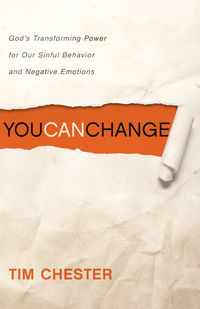
You Can Change

I started reading You Can Change by Tim Chester of The Crowded House.  It is different from most books about transformation and personal growth because Chester roots everything in the dual truths of the Christian’s new identities and the power of the gospel. 

This video is Tim’s introduction and explanation of the book.

Here is what a couple others are saying about You Can Change:

A book about Christian growth that is neither quietistic nor moralistic is rare. A book that is truly practical is even rarer. Tim Chester’s new volume falls into both categories and therefore fills a gap.  ~ Tim Keller

There are few books that are shockingly honest, carefully theological, and gloriously hopeful all at the same time. Tim Chester’s book, You Can Change, is all of these and more. He skilfully uses the deepest insights of the theology of the Word as a lens to help you understand yourself and the way of change, and, in so doing, helps you to experience practically what you thought you already knew. The carefully crafted personal ‘reflection’ and ‘change project’ sections are worth the price of the book by themselves. It is wonderful to be reminded that you and I are not stuck, and it’s comforting to be guided by someone who knows well the road from where we are to where we need to be. ~ Paul Tripp

Be Gentle With Me

I think it was Mark Galli who wrote:

The prophets of the Old Testament were concerned about one thing… and it was not people’s feelings.

I am encouraged by that insight.  Despite their directness and sometimes crassness, there can be no doubt they were called by God, and used by God for the advancement of God’s purpose.

Not only am I encouraged by this, I am comforted.  For among my many weaknesses, one of  the most apparent is an often seemingly too strong personality.  It is not intentional.  But more than a few people later told me that for some reason they at first wondered if I was approachable; that they initially felt intimidated.  (Obviously they got over it, else they would never have told me something like that!)  This is not the perception of everyone, probably not even most.  But over the years I have heard this refrain enough to take note.  It is not an image I want to project.

I pray that the fruit of gentleness would continually grow in me – and that it would somehow be more evident. While many who know me have encouraged me by commenting on my kindness, I want that kindness to be accompanied by gentleness.  I envy those folks who ooze gentleness and approachability.

I have wondered, though, about some who seem to be gifted with gentleness.  Some  whom I have encountered are indeed gentle in their demeanor – far more than I.  Yet beneath their surface something is missing. Deep down they may be self-absorbed and uncaring – at least not caring enough to put themselves out much.

What I have also wondered is about the difference between being gentle and being timid.  Some appear to be gentle when in fact they are merely timid.

Here is what I suspect may be the difference:

  • Gentleness is motivated by love for another.  It is sacrificial.
  • Timidity is generated by a love for self.   It is a fear of being rejected.  It is self-preservation.

I am not sure I can always tell the difference, but I think the difference is important. The appearance of gentleness, when it is really a mask for timidity, is not a spiritual fruit.  Given that understanding, I think I prefer being kind yet sometimes misunderstood, to being insecure yet credited as something else.  After all, the Lord searches the heart.

Still, I know that this distinction is no substitute for growing in the fruit of gentleness.  I am a work in progress.  I cling to the promise that “He who began a good work in you will see it through the end.”  (Philippians 1.6) This gives me hope that one day more people will perceive me to be gentle. In the mean time, perhaps I can take some solace from C.S. Lewis’ metaphorical portrayal of our gentle King in the form of Aslan:

Lucy: A lion?! I think I should be afraid to meet a lion. Is he safe?

Mr Tumnus:  Safe! Heavens no!  But he is good.

Mirror, Mirror on the Wall

In the Preface to Joe Thorn‘s book, Note to Self, Sam Storms penned a paragraph that strikes at the heart of the difference between those with a vital Chrisian faith, and those who show little if any hint of actually being a follower of Jesus Christ.  Here is what Storms says about the functional place of Scripture in the life of a Believer:

Merely affirming the Bible is inspired accomplishes very little.  Asserting it’s authority isn’t much better.  The inspiration and authority of the Scriptures are of value to us only so far as we change our beliefs to conform to its principles and alter our behavior to coincide with its imperatives.  The Bible is meant to govern our lives, to fashion our choices, to challenge our cherished traditions, and ultimately make us more like Jesus.

The question for each of us, then, is whether the Bible actually functions in this way.

  • Do we submit to its dictates?
  • Do we put our confidence in its promises?
  • Do we stop living in a certain way in response to its counsel?
  • Do we embrace particular truths on its authority?
  • Do we set aside traditional practices that conflict with its instruction?

In other words, for the Bible to be of value to us it must actually function to shape how we think, feel, and act, as well as what we believe, value, and teach.

I think Storms nails it here; hits it square on its head.

A number of dialogues I have recently had broached the subject of the differences of maturity levels between professing Christians. What Storms addresses is one of the most vital dynamics that explain the differences.  In fact, since we who believe have all been given the same Spirit, perhaps the differences in the way we approach and apprehend the Scripture may be THE most important explanation for such differences.

Some see the Scriptures as they are to be seen, as a revelation of what is good and a mirror to show us what needs addressing in our lives, which in turn drives us to the Cross, where the power of transformation rests.  Here they find the promises of God to be true: He is making us beautiful, to become a Bride for the King.

Others also see the Scriptures as a mirror. But, for these folks, this mirror is more like the one used by that witch in the story Snow White, who declared: “Mirror, mirror on the wall, who is the fairest one of all?”  All she wanted was to hear how good she was; how much better she was than others. Sadly some people look to the mirror of Scripture only willing to see whatever appears to validate them.  Failing to see, by the mirror, the ugly-fying effects of sin in their hearts and lives, they see no real need to return to the Cross.  Thus they seem to never be changed.  They never become truly beautiful.