Drilling Down

I have greatly benefited from being introduced to Tri-Perspectivalism.   While it is an odd sounding word, as a concept Tri-Perpectivalism is reasonably easy to grasp.  It is a multi-facted perspective, or looking at things from three distinct perspectives, rooted in the personality and offices of Christ: Prophet, Priest, and King.

John Frame was probably the first to touch upon this leadership-personality grid. Dick Kaufmann contributed significant practical insights and applications.  And David Fairchild has taken the whole thing a step further.

Speaking at a conference in Fall 2010, Fairchild explained that there are different types of prophets, priest, and kings. While each individual has a primary wiring (i.e. Prophet, or Priest, or King) each also has a secondary, or modifying, perspective.  Fairchild suggested:

In fact, the secondary perspective is sort of like their delivery method. In other words, you might be a priest and enjoy counseling, but your secondary is king. So you enjoy working with people that need pastoral care by applying wisdom to their particular situation like finances or work related counsel. This is effortless and easy for a kingly priest, but not so for a priestly priest.

Let’s explore some breakdowns:

Continue reading

Mistakes

Steve Childers is Founder and President of Global Church Advancement. He is also professor of Practical Theology at Reformed Theological Seminary-Orlando.  In a former life Steve was an effective pastor and church planter.  A  number of years ago I had the privilege of taking a doctoral class in church planting under Steve’s tutelage.  I have appreciated him ever since.

Now Steve has done us the favor of, not only sharing his great insights about ministry and church planting but, chronicling his biggest ministry mistakes.  These mistakes are obviously beneficial for fellow pastors to aviod.  But I think that these short, insightful confessions can also profit others in church leadership, be it those holding official office or those with unofficial influence. In fact, some of Steve’s insights translate to the values we hold that shape our lives and congregations.

In no particular order:

  1. Failure to Understand the Importance of How I Define Ministry Success
  2. Managing My Time and NOT Managing My Life
  3. Not Understanding the Difference Between My Goals and My Desires
  4. Not Understanding the Difference Between Pursuing the Grace of God and the God of Grace
  5. Failure to Understand the Way Up is the Way Down
  6. Failure to Understand the Priority of People Over Programs
  7. Not Understanding Product Living vs. Process Living
  8. Failure to Initiate Supportive Relationships

5 Reasons Church Leaders Quit

Why do so many church leaders quit or go into early permanent retirement?  This is epidemic these days.  According to Pastor in Residence, a ministry aimed at restoring ministry casualties back to active duty, at any given time as many as 33% of American pastors consider throwing in the towel.  And this is not a problem isolated among the “professionals”.  Some of the same stressors also plague non-staff church leaders.

Perry Noble offers some wise insight aimed at my ministerial colleagues – and me.  These are things we need to be reminded regularly.  I know I do.

#1 – Burnout

I once heard someone say, “I would rather burn out than rust out.”  Uh…BOTH are bad because NEITHER of them finish well.  Too many people in the ministry work themselves into a frenzy, never take time to disconnect and refresh, and do absolutely nothing for fun–this always ends badly!

When it comes to leadership circles in America, we’ve equated being busy with being godly; however, the haunting reality that confronts that idea is what God Himself said in Psalm 46:10, “BE STILL and know that I am God,” not “be busy!”

If we are not taking regular breaks, doing things “just for fun,” and disconnecting, then burnout isn’t a matter of “if,” but “when!”

#2 – Unrealistic Expectations

Too many people believe that “ministry = easy” despite the fact that it seemed to go really badly for everyone in the Scriptures that sold their lives out to Him!  Jesus went to the “place of the skull” to be crucified…why would we ever believe He would lead us to “the place of the mattress?”

When we impose our plans and ideas on God and refuse to surrender to His, it usually leads to people “giving up” because “God just didn’t come through.”

#3 – Criticism

Criticism hurts, it always will, and if it ever doesn’t, then, according to my counselor, something is dead inside of you.  And it is always personal (especially when someone begins with, “Don’t take this personally, but…).

You can’t let the critics dictate what you think/feel!  If you have a ministry that constantly responds to critics, then you will not have one that responds to Jesus.  You MUST respond to the people who God has placed in your life to surround you and protect you–that’s not criticism but rather correction.  However, you cannot allow those who know you the least to control you the most–period!

#4 – Discouragement

Every church leader I’ve ever chatted with has done some serious battles with discouragement.  After your message on Sunday, the enemy comes in and begins to accuse you, telling you that you did a pathetic job and that no one is going to come back next week.  I’ve had to battle discouragement during the message before, hearing voices inside of my head saying things like, “You stink, these people hate you…you need to quit the ministry…” and so on.

This is why it is essential for leaders to get in a place like David did in I Samuel 30:1-6.  David faced an incredibly discouraging situation and yet somehow managed to find His strength in the Lord.  I do this by reading through encouraging letters and e-mails that I’ve received in the past, placing myself in encouraging environments, and focusing on what God’s Word says about me.

#5 – Losing Focus on God’s Power

When we actually believe it is up to us to make people come back to church every week rather than believing we are conduits that God wants to work through to do that very thing…it’s over!  Because we fall into the trap of trying to outdo ourselves every week, every series and every year and prayer/seeking the Lord become some things we love to talk about but fail to do.  He saves…He draws people…and He uses us to do it.  It’s not up to us but rather we need to allow Him to work through us to accomplish all that He wants to do!

Face it; on our own, we don’t have enough power to blow our noses.  We need Him. He is the game changer!

~ Perry Noble is pastor of New Spring Church in Anderson, South Carolina

Putting Off My Procrastination

Here are some words I would be wise to regularly remind myself:

No unwelcome tasks become any the less unwelcome by putting them off till tomorrow. It is only when they are behind us and done, that we begin to find that there is a sweetness to be tasted afterward, and that the remembrance of unwelcome duties unhesitatingly done is welcome and pleasant. Accomplished, they are full of blessing, and there is a smile on their faces as they leave us. Undone, they stand threatening and disturbing our tranquility, and hindering our communion with God. If there be lying before you any bit of work from which you shrink, go straight up to it, and do it at once. The only way to get rid of it is to do it.

Alexander MacLaren (1826–1910)

Questions of Prophets, Priests, and Kings

Some time ago I introduced the concept of Tri-perspectivalism, the recognition that every Church ought to reflect the three offices of Christ: Prophet, Priest, and King.  Each person, or Christian leader, has a natural inclination toward one of these perspectives, but all three are equally necessary to reflect Christ in our Body.

There are many questions that can be, and have been, asked. Perhaps among the most practical is: How do I know which I am?  To answer that question there is no substitute for experience – exprience in service and experience of genuine relationships.  But questions may still remain if we are not certain what we are looking for. 

In an address from the 2009 Acts 29 Bootcamp, Darrin Patrick offers the following questions. Patrick suggests that persons inclined to each perspective tend to ask reflective questions:

Prophet

  • WHAT does the Bible say?
  • WHERE are we going because of what the Bible says?

King

  • HOW are we going to do that?
  • WHY are they/we doing that?

Priest

  • WHO?  (Priests are all about people and shepherding.)

Do you find yourself frequently asking any of these questions? Perhpas it is an indication of how God has wired you.

Mistaken Identity

Like many churches throughout the land, our church is entering into a season of officer nominations. As a presbyterian congregation, specifically, we are inviting the members of our congregation to submit the names of fellow church members who they believe fit the Biblical requirements, found in Titus & 1 Timothy 3, for the offices of Elder and Deacon. 

Also, like many in other congregations, some of the members of our church are not quite sure what exactly these offices mean, nor what those who serve them are responsible to do. 

In a post on Coram Deo, Bob Thune offers a brief but helpful explanation, dispelling one of the more common misconceptions about Elders…

Click: Elder vs. Board Member

Prophets, Priests, and Kings

An important concept to explore and implement in the ministry of the local church is the reflection of the Offices of Christ: Prophet, Priest, and King.  This is known as Tri-Perspectivalism or Multi-Perspectivalism.  I have written and spoken a little about this, but I am still far more a student than an expert when it comes to the implications.

Richard Lovelace, author of Dynamics of Spiritual Life – a MUST READ for those charges with ministry leadership – offers this insight:

“Our union with the Messiah and his desire to continue his earthly ministry by living his life through us are so strong that we may be said to share his three offices of leadership.  We are priests as we pray for those near us and draw them into the sphere of God’s mercy and blessing.  We are prophets as we hold a biblical straightedge against whatever is crooked around us.  And we are kings as we use whatever powers we have to straighten what is crooked, reshaping whatever falls within the scope of our responsibility until it reflects the order of heaven.”  

Leading Lasting Changes

At Walnut Hill Church we are blessed with a strong tradition and a membership with a high level of satisfaction.  Like most ministries and organizations we have our share of folks who express varying degrees of dissatisfaction – some because we are experiencing growth & change, and others because we have not changed & grown quickly enough.

Change is inevitable but it is also uncomfortable.

For one thing, not all change is good. Degeneration is a change of condition, but it is not something I want to experience in my health or my church.

But even good changes can make some people uncomfortable.  Change marks the passing of something familiar.  It is a constant reminder that nothing remains the same, and we cannot always go back. So when change occurs, even good change, it disturbs our nostalgia.

The key words for the leader concerning change are: effective, positive, and lasting.

Harvard professor John Kotter outlines 8 stages of effective change:

1. Establish a Sense of Urgency

  • Examine market and competitive realities
  • Identify and discuss crises, potential crises or major opportunities

2. Developing the Guiding Coalition

  • Assemble a group with enough power to lead the change effort
  • Encourage the group to work as a team

3. Developing a Vision & Strategy

  • Create a vision to help direct the change effort
  • Develop strategies for achieving that vision

4. Communicating the Change Vision

  • Use every vehicle possible to communicate the new vision and strategies
  • Teach new behaviors by the example of the Guiding Coalition

 5. Empowering Broad-based Action

  • Remove obstacles to change
  • Change systems or structures that seriously undermine the vision
  • Encourage the risk-taking and nontraditional ideas, activities, and actions

6. Generating Short-term Wins

  • Plan for visible performance improvements
  • Create those improvements
  • Recognize and reward employees involved in the improvements

7. Don’t Let Up: Consolidating Gains & Produce More Change

  • Use increased credibility to change systems, structures and policies that don’t fit the vision
  • Hire, promote, and develop employees who can implement the vision
  • Reinvigorate the process with new projects, themes, and change agents

8. Make Change Stick: Anchoring New Approaches in the Culture

  • Articulate the connections between the new behaviors and organizational success
  • Develop the means to ensure leadership development and succession

These steps come from the business world, but church & ministry leaders would be wise to consider and apply these principles to our own situations.

Lutheran leader Steve Goodwin, in a 2005 interview, said:

 “I see so many pastors making the mistakes John Kotter wrote about 20 years ago.”

In an article for Leadership Journal, titled Before You Introduce Change, Bruce Boria observes that most pastors make the mistake of beginning at stage 4.

Boria explains:

I’ve found [Kotter’s] process has substantial implications for guiding change in my church.

In Kotter’s opinion the first three steps are necessary to defrost a hardened status quo. Steps four to seven introduce a number of new practices. And the last step grounds the changes into the organization’s culture.

As pastor of Walnut Hill Church I have intentionally embraced a slow approach to change.  This church was not ailing when I came in, so I wanted to affirm the positives that already existed and pre-dated my arrival.

At the same time, because nothing remains the same, and because there are issues that require strategic attention, change is a necessity. With Kotter’s principles in mind, the questions I am asking are these:

  • How do we cultivate a sense of need and urgency in a congregation widely satisfied with the way things have, for the most part, always been?
  • How do we create a hunger for a better future?

Until we get a handle on these questions no pithy mission or vision statements will produce positive lasting changes.  Instead, I suspect, we will find ourselves reminded of the poetic words of the Bard of Ayrshire: “The best laid plans of mice and men often go astray.”

Right People, Right Direction

There are two common maxims offered to pastors when entering a new ministry.  Both are wise and true. But they are mutually exlusive:

  • “Don’t change anything in the first year.”
  • “If you don’t change anything in the first year, you will never be able to change anything later.”

One way to resolve the tension is to realize that not all churches are the same. And not all churches are in the same condition when a pastor, or others, assumes leadership. Therefore wisdom dictates applying the proper suggestion to the present state of the church. 

For instance,

The first established church I pastored was a total mess.  The church had existed for nearly 50 years, and had fired every pastor. The longest tenure, prior to my arrival, had been 5 years.  Presbytery was sick and tired of the church’s shenanigans, and threatened to remove them from the denomination if they persisted.  The church averaged about 25 people on Sunday morning, and had only two children under age 18.  Obviously change was needed. Equally obvious was that change needed to happen immediately.

The second church I pastored had enjoyed solid numerical growth in the years prior to my arrival. Much of this growth was not healthy, however, but that was not particularly apparent to most people.  There were a lot of good things going on, but still areas that needed attention and revision.  Wisdom would have been to learn the landscape and go slower with initial changes.

The present church I pastor, Walnut Hill Church, was in many ways healthy when I came on board.  My predecessor had enjoyed 16 years of relatively effective ministry, and the Interim Pastor between us was (and is) a gem. The church leadership had come to a conclusion that this church, while in many ways good, was not functioning on all cylinders, and therefore needed to take the opportunity afforded by a transition to reevaluate the ministry.  Change is needed, and even desired, but what is the best approach: quick or slow?

Change is always needed. My college football coach, Johnny Majors, frequently reminded us that we never stay the same. Each day we either get better or we decline.  And, at least in this way, what is true of football teams, and athletes, is also true of churches and organizations. 

But one of the problems resulting from change, perhaps especially in a church, is disenfranchisement.  People have invested themselves in a church long before changes are even on the radar. In fact, people are often part of a particular church, even with it’s warts and weaknesses, because they like that church the way it is. When change starts taking place, whether systematic or unintentional, fear often accompanies it.  And fear keeps whispering in the ear: Am I sure I will still like this place if it changes?   

This is an important dynamic working against change, and against leaders who bring change.  And the problem is enhanced when the leader is focused more on bringing the change, and the anticipated positive results, than they are on the people in the church.  Not only is this recipe un-pastoral, it is ultimately ineffective.

I am not suggesting that the leader is responsible to appease all the people.  That is not possible – and it is not our job.  I am suggesting that sometime, as pastors, we have been so exhorted by the experts and the know-it-all books to make necessary changes for the sake of the ultimate “potential” good, that we may lose perspective.  We are anxious for success but forget what our success really looks like.

While it is true that to lead any necessary change, to chart any specific vision, risks losing some people, I wonder what place among our priorities  Jesus’ instruction to “count the cost” holds. I wonder if we tally everything up correctly, or if sometimes we cook our books like ENRON did – counting only the gains, ignoring the losses. 

The fact is sometimes some people need to go. This is especially true in an unhealthy church. (How else did it become unhealthy unless the stakeholders allowed it to become unhealthy and unfaithful?)   This is a sometimes painful reality. (At other times it is really not so painful. It may even feel blissful. But, as pastors, we’re not supposed to say that.) The questions are: How many losses are necessary? How many are appropriate? How many could have been averted, yet still allow the church to be faithful to the new (or renewed) vision and purpose? 

Tomorrow I plan to post the insights of leadership expert, John Kotter, about the stages of effective change. That post will apply Kotter’s insights to the mission of bringing appropriate, and necessary, change to the local church; and the ways pastors and churches  commonly act unwisely. Chief among them is moving too quickly to implement a new vision. But that will be for tomorrow.  At present, however, I want to ask the question: How many people might we keep if we were wiser about the change process?  What if we  moved a little slower, in cases that allow for it?  Of course, we will never know the real answer. But one thing I am convinced of: More harm than good is done in many churches because of unwise implementation of change.

In a post last week I introduced the following quote by Jim Collins, from his best-selling book Good to Great

The executives who ignited the transformations from good to great did not first figure out where to drive the bus and then get people to take it there. No, they first got the right people on the bus (and the wrong people off the bus) and then figured out where to drive it. They said, in essence, “Look, I don’t really know where we should take this bus. But I know this much: If we get the right people on the bus, the right people in the right seats, and the wrong people off the bus, then we’ll figure out how to take it someplace great.

I am convinced what Collins observed should be an important element for consideration in the early stages of all church vision and mission planning.  Clearly his approach does not eliminate the loss of some – maybe even many – people. But his approach does guard against the loss of good people who avoidably become disenfranchised due to  premature implementation of new direction. 

One last observation. Collins is not stating that the leader does not have any idea about where he/she might like to take the “bus”.  He is saying that the effective leader places a priority on the right people, and does not see himself as the sole navigator.  I suspect that the effective leader may well have a good idea of where the bus should go, but in genuine humility he is willing to consider the God-given insights of others.  What Collins is suggesting, as applied to the church, is that we lead to where God would have us go, and be less concerned about whether the destination is primarily according to the leader’s preconceived atlas.

Putting a Bus Stop at Our Church

A generation ago it was not uncommon for a churches to have bus ministries. Volunteers would drive a bus to pick people up from around the community and shuttle them to and from the church.  Jim Collins, in his best-selling book Good to Great, seems to suggest churches still need to get people on and off the “bus”.  But Collins, if we apply what he writes to ministry, has a more allegorical idea about the Church Bus:

The executives who ignited the transformations from good to great did not first figure out where to drive the bus and then get people to take it there. No, they first got the right people on the bus (and the wrong people off the bus) and then figured out where to drive it. They said, in essence, “Look, I don’t really know where we should take this bus. But I know this much: If we get the right people on the bus, the right people in the right seats, and the wrong people off the bus, then we’ll figure out how to take it someplace great.

Collins’ insight offers great wisdom to those leading churches and minstries.  Thom Rainer picks up and develops this idea, in his book Breakout Churches, calling it the Who/What Simultrack. I am certainly giving it serious consideration as the church I have the privilege to pastor, Walnut Hill Presbyterian Church, gives thought to our mission and vision. 

First, I think Collins’ observation is consistent with Solomon’s counsel of Proverbs 15.22:

Plans fail for lack of counsel, but with many advisers they succeed.

Anyone can offer a two-bit opinion. But to gain wise counsel we need the insights of the right people.

Second, it reminds me that people are at the very heart of God, not necessarily success.  To be  successful a church must focus on people. People are our mission, not programs.

Third, it inclines me toward humility. If Collins is right (and I believe he is) then I cannot do this alone.  I need the people God will bring into the picture, or will put on the bus, in order for us to be what God intends us to be and do what he has purposed for us to do. We have already seen examples of that, as God has brought certain people, and their gifts, to add to those who were already aboard. 

Fourth, it promotes patience. There are people who we need to get on our bus, but they won’t get on until we get to their stop.  It is foolishness, and counter-productive, to assume that the people  already with us will do all we need done; that they will do what God has not desgined them to do.  We must patiently depend upon God to introduce us to the people he wants to use.  As Rainer points out: Better to leave a postion unfulled for a long time than to rush to fill it with the wrong person.

Under the Spell of the Wizard of Westwood


He was known as a wizard – the Wizard of Westwood.  I am not sure how that moniker came to be attached to him, except that this pithy alliteration well described his mastery of the the basketball court as coach of the UCLA Bruins.  But that nickname seems to have rung true for another reason. By all accounts the influence of Coach John Wooden‘s ‘spell’  left his former players, and others around him, better for having had him around.

An era has passed. In a way it is odd to say this, since the John Wooden era of coaching ended more than 35 years ago.  But the era ended completely with the passing of Coach Wooden, who went to be with his Lord, and his long-departed wife, Friday evening. 

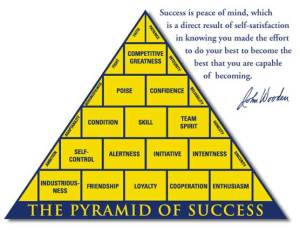
Still, even in his parting, Wooden influence will continue to live in those he coached, and through those whose lives have been enhanced through the life & leadership lessons Wooden took a lifetime to craft, and which he devoted to sharing in his retirement years: Wooden’s  Pyramid of Success.  

Despite his nickname, there is nothing ‘magical’ about the Wooden Way.  His success formula is rooted in integrity, discipline, loyalty, and hard work. And unlike many of the self-help principes on the market, Wooden’s philosophy was woven in his Faith. 

In summary: Wooden was more than just a coach.  He was a godly man who was on a mission to bless those around him.

As a father of a son, entering college, who aspires to be a coach, I can think of no example I would rather have influence him, in that endeavor, than that which John Wooden embodied. 

John Wooden’s legend will be long remembered.  John Wooden’s character & principles will continue to speak for generattion to come.

Ambition

I’ve been listening to the audio of sessions from Acts 29 Network’s 2009 Bootcamp: Ambition. While not everyone will find these talks of interest, I think they are challenging and stimulating for those of us in ministry and church leadership.

Ministry for the Long Haul & Ambition (Matt Chandler)

Decoding Your City & Ambition (Kevin Cawley)

Discipleship & Ambition (Bob Thune)

Preaching as Expository Exorcism (Russell Moore)

Leadership & Ambition (Darrin Patrick)

The Church & Ambition (Steve Timmis)

Church Planting & Ambition (Ed Stetzer)

The Gospel & Ambition (Dave Harvey)

My thanks to the folks at Sojourn Community Church, who have made all the above sessions available to be listened to online and/or downloaded. Click: Ambition Conference.

Acts 29 is a missional church planting network of Reformed Evangelicals.  Each year they hold Boot Camps to train and re-energize like minded church planters and church leaders.  Many of these, and other, talks are available on the Resource section of thier web page.

Core Values of Walnut Hill Church

Walnut Hill Logo

I recently finished a series unveiling the Core Values of Walnut Hill Presbyterian Church.   The Elders of our church worked on these for several months, as we tried to discern the characteristics that define and drive our church.

Leadership expert Aubrey Malphurs calls Core Values “the qualities that make up and establish an organizations character, and that character determines how the organization conducts its ministry or business…” 

In short you might say that the Core Values reflect the DNA of a church or organization.  While other things my change, such as worship style, ministries, etc, the Core Values should remain pretty much intact.  In the fae of a changing surrounding culture, or the addition of new members, the Core Values themselves do not change. Only the ways that the values are expressed should change.

So what are those Core Values that make Walnut Hill unique?

God’s Global Glory 

Authentic Spirituality

Gospel Transformation

Kingdom Advancement

Relational Vitality

Contagious Joy

Overcoming Evil Leadership

leader

Reggie McNeal, in his book Practicing Greatness, makes this audacious statement:

“Bad leaders are a form of evil.”

When I first read that statement I thought “Woe! That’s a bit strong.”  But as I read further I came to understand his thinking… and agreed. 

Consider his whole point:

Bad leaders are a form of evil. They curse people by diminishing their life. They rob people  of hope. They reduce people’s dreams and expectations for their lives. They discourage and disparage people.  They leave people worse off than when they found them. Bad leadership is not always the result of bad character or intentional malevolence. It can result from simple incompetence.

While McNeal’s assertion is strong, I think it has strong merits.  Consider the results he associates with bad leadership: lost hope, diminished dreams that lead to settling, demoralization and discouragement.  All of these things are bad, even evil really.  And while poor leadership is not the only cause of such attitudes, bad leadership is a frequent incubator of them. 

As a pastor, which is the primary target McNeal is aiming at, this perspective hits home. It also hits deep.  My very job, my calling, is to remind people of the hope they have in Christ and to help them to function in line with that hope according to their God-given purpose.  When, by God’s grace, I am effective, I get to see God change peoples lives for the better.  When that happens it is exciting and exhilerating.  But when I fail… well it can get pretty ugly.  And I do fail. Sometimes because of matters beyond my influence. But at other times I fail because I am not up to the challenge – which is a gentle way of admitting my incompetence.

I have become keenly aware of the influence of bad leadership, not only by my own failures, but as I have watched my son’s athletic career.  I have seen good coaches make a positive impact that extends far beyond the playing fields.  And I have seen my son demoralized, I have seen his dreams and aspiarations diminished, and I have seen the sense of purposelessness that accompanies hopelessness, not because of an innate lack of talent but as a result of bad coaching – or bad leadership from a coach.  McNeal’s perception is all the more pertinent as I  watched this take place, because the coach who was primarily responsible for this is not a bad guy. Quite the contrary. He is likeable. He seems to have his priorities in exemplary order.  He was never unpleasant. He was simply not competent in the job he held. And that incompetence negatively influenced scores of young men, including my son.  So, as McNeal says, while the man is good, the effects of his bad leadership are evil.  

It is sobering to realize I can have that same negative effect on people when I fail them as a pastor, or as a father, or in any other leadership role I may assume.

A few applications come to mind as I think through this.

1. This truth applies to every person in a position of leadership, professional or volunteer, formal or informal, organizational or recreational.  The purpose of leadership is always to guide and ultimately enhance.

I say “ultimately” because sometimes leadership requires breaking down or taking steps backward before moving forward.  It depends upon the inherited situation. At such times what may temporarily appear to be failure, is in reality a necessity. Not everyone will always see this, but then again, that’s why not everyone was called to be the leader.

This is humbling, and a bit frightening.  But the words of the Lord to Joshua come to mind: “Be strong and corageous…” (Joshua 1.6) And paraphrasing the rest of that passage: “Be strong and very courageous, being careful to do everything God has called you to do, and to do it in the manner he wants you to do it.”

This command applies to all of us who assume leadership roles. In the church, as Elders, youth leaders, etc; In the community as coaches, civic leaders, elected officials, etc; or in the business world as supervisors, foremen, or executives.  All of these roles can be catalysts for the advancement of God’s Kingdom, done for his glory, and can benefit  those God has called us to lead. (1 Corinthians 10.31)

2. We must live in line with the Gospel, or with the Gospel always in mind. 

Now, of course, this is always a truth. But I think it is pertinent to say again here for a simple reason. We will all fail at some point in our leadership. Only God is omni-competent.  Some of our failures will be situational, and are not reflective of our leadership abilities. But at other times the Peter Principle comes into play – we are in over our heads, not up to the challenge, not competent for the job.  At those times we embody the “good guy, bad leader = evil” eqation.

Knowing this ahead of times makes leadership rather daunting. Many would rather foresake the risk of leadership altogether – if they could. But this need not be our attitude if we understand the gospel.  God does not, and will not, reject us on the basis of our failure and incompetence, even when that spells evil.  Quite the contrary, God called us who are evil, failures, and incapable in the first place.  He redeemed such people through the blood of Christ. And He is in the process of shaping us and growing us.  So we can own up to our “evil” in leadership, and be grateful for God’s provision in Christ. 

In fact, we should even be grateful for the reminder of our inability.  Because the one whom God is angered with and rejects is not the one who humbly recognizes failure and incompetence, and consequently turns to Jesus. Instead the Lord rejects the one who is confident in his/her own leadership abilities and, at best, simply pays lip service to God.

3. I need to pursue greatness in leadership. It is not so that I become the object of admiration. And it is not only so I can avoid being a contributor to evil.  It is so that I can bless others through serving them as a leader. Or put a better way, so that God can bless people through me and my simple competent leadership.

A Team Approach to Effective Church Ministry

As a Presbyterian minister I am keenly familiar with committees.  While committees are a familiar staple in churches of almost any flavor, we Presbyterians especially like to have everything done ‘decently and in order’.  This makes the committee structure seem almost inherently appealing to our ecclesiastical DNA.  But to be honest, from time to time I find myself asking “Why do we need committees?”  Are there not any other options?

PORTRAIT of a COMMITTEE

Let me sketch a synical picture:

The old cliche’ seems all too true: “A committee is a group of people who take hours just to keep minutes.”

Let’s be honest. In most churches, some seem to equate frequent meetings with effective ministry.  Yet, in those same churches, others avoid serving on committees just so they don’t have to go to meetings. True?

The typical committee will gather on occasion to discuss some particular matter.  (Frequency of meetings vary, and is seems to be decided by how much the chairperson likes to attend meetings. Food to be consumed during the meeting is optional.)   Usually the meeting officially opens with some perfunctory prayer (not real worship or intercession), and is followed by a lot of chatter.

Committee members are not often experts about the subject they are discussing, nor necessarily even students of the related issues.  Nevertheless, there rarely  seems to be any lack of opinions.

There has to be a better way.

What if, in a particular church, each ministry simply had a director?  A director would be someone with a growing knowledge (expertise?) and who senses a passion for, and even a calling to, a particular ministry or work.  What if such a person were the one to set the direction & pace?  Would we still need to have committees?

OBJECTIONS

I know there are objections to such a notion. Among them might be:

1. People would not have a voice. They would feel no ownership, and therefore might not participate or support a ministry.

2. There is a need for a shared work load.

I’ve heard both, so let me take a moment to address these concerns.

1. People would not have a voice, and might not participate or support the ministry.

I suspect that this is probably true in some cases.  If the leadership of the church (in Presbyterian cirlces meaning the Session, or Elders) appointed a person or persons, but did not open it up to anyone who wanted to volunteer, there may be some objections. But where this is true I think it reflects a more fundamental problem than the presence or absence of a committee structure.

What does such an attitude say about the people and their respect for the leadership of the church?  In such situations, it seems to me, there is at least one of three issues undermining the overall health of the church: 1) the leadership may have a history of being inept; 2) more common, the people in the church have a seriously deficient view of the role of leadership; 3) and worst of all, people are sinfully rejecting the God-ordained leadership of the church.

The presence of any one of these conditions undermines the possibility of an effective ministry.  And these conditions reflect a far more serious problem than the lack of a committee, or even the lack of a ministry.  If leadership is rejected because of incompetence or a history of unqualified leaders, then the church must ask itslef why such leaders were ever elected, or allowed to be appointed, in the first place. If people are rejecting and rebelling against a qualified leadership that God has put in place in that church, then ultimately the people are acting against God himself.  In either case the church has sin that needs to be addressed. No structure will compensate.

Now, let’s assume that the problem is the unwillingness of the people – or the unwillingness of a visible small group of people – to follow the direction of godly leadership.  Do we really want to establish (or perpetuate) a committee system just to appease people in their sin? (NOTE: I am not saying that having a committee structure is sinful, just asking if appeasement is sufficient reason to operate that way.)

2. There is need for a shared workload.

This is a very valid point. Most ministry is too cumbersome to be accomplished alone.  This is especially true when the leader is employed in another vocation.  He/she has responsibilities to honor God through work in that field, and responsibilites to those who work with him/her at that business.  On top of that there are family priorities, not to mention service to the community.

Time is a precious commodity – and a limited one.  I suspect that is why so many Americans are willing to simply write a check. More money we can often find, but time is a little scarce.

Because of time limitations it would be difficult for most people to lead every aspect of a multi-facted ministry.  It would be even more difficult to develop the level of expertise in each area that would facilitate effecitveness.  The work load needs to be shared.

TEAM APPROACH vs. COMMITTEES

To me the TEAM approach seems to be a much better idea than traditional committees.  Committees may be very helpful when reviewing the work of someone or something. Different perspectives can enhance understanding and perceptions.  But this is not the same thing as getting something accomplished.

Teams are composed of a group of individuals with a shared commitment and shared goals.  Each member of any team has a specific position to play, a particular responsibility. The whole team depends upon each person to perform his/her job to be effective.  This requires that each person becomes an ‘expert’ or advanced ‘student’ of their respective position.

Each team may have one person who is the organizational leader, like a coach or captain. (This would be the Director I mentioned earlier.) But it takes every person on the team to know what they need to do and how to do it to succeed.  When each person does their job the team “wins”.

Now, what if we applied more TEAM concept than traditional committees to the ministries of our churches? A few things come to mind:

1. Effectiveness

Team members would be clear about what they were attempting to do, and how their efforts were contributing to the success of the whole; and ultimately to the advancement of God’s Kingdom.  No one would be on the team without a specific responsibility.  This is not always the case in the traditional committee structure.  Many times a committee is composed of a represntative sample from the congregation merely so every part of the church has a voice.  People do not always have specific ongoing spheres of responsibility. They have no particular area where they provide informed insight, only opinions.  Meetings can get bogged down trying to come to some consensus of opinion, rather than experienceing the synergy that occurs when each member performs a vital part.

2. Retention

The lack of clear responsibility and ineffectiveness are perhaps the two primary reasons people decline to serve on committees. No one wants to put in time and effort if they are unsure of what they are trying to accomplish, or if they see no accomplishment for their labors.  But if members have clear job descriptions and see thier work contributing to something bigger than themsleves, I suspect fewer people would resign from the various ministries of the church.

3. Unity

There is less room for division or conflict when each member knows his/her role and the role of the others.  And if conflict does arise it will be much easier for all to recognize the source.  Either, 1) someone is not doing his/her job, thus causing stress to other team members; or 2) someone is overstepping thier bounds, disrespecting or even hindering another team member is his/her responsibility.  (Should such a thing happen Matthew 18 & Galatians 6.1-2 can be applied to bring about reconciliation.)

4. Community

These teams provide an opportunity to develop relationships.  A shared task binds people together.  This would have to be intentional.  Team members are not only interdependent, but can offer themselves into voluntary accountability, much as is generally expected in small groups.  (Roberta Hestenes has written a short booklet about this called, Turning Committees Into Communities.)

Conclusion

Maybe it is merely a matter of semantics.  Maybe we simply need to raise the standard bar for our committees, rather than reinvent our structures.  But It seems to me that moving more toward this approach would produce more effectiveness in the work of the Kingdom. Maybe even more than that, as I look at some of the possible outcomes of such an approach, it might be an opportunity to better reflect the Kingdom within our churches.