A Topical Outline of the Westminster Confession

Ligon Duncan, one of my former professors at Reformed Theological Seminary, now president of RTS, has developed A Topical Outline of the Westminster Confession of Faith. I have found this to be a helpful tool for surveying the doctrines of the Christian Faith.

1. Holy Scripture
1.1 The necessity of Scripture
1.2 The contents of Scripture (positively stated): canon
1.3 The contents of Scripture (negatively stated): “apocrypha”
1.4 The authority of Scripture
1.5 The authenticity of Scripture
1.6 The sufficiency of Scripture
1.7 The clarity of Scripture
1.8 The immediate inspiration, preservation and translation of Scripture
1.9 The interpretation of Scripture
1.10 The supreme authority of Scripture in all theological controversy

2. God and the Trinity
2.1 God himself
The one, living, true, infinite, perfect God
The spirituality, invisibility, incorporeality, and impassibility of God [and simplicity*]
The immutability, immensity, eternality, incomprehensibility, and omnipotence of God
The unchangeable and righteous purpose of God
The love, grace, mercy, patience, goodness, faithfulness, and forgiveness of God
The generous reward of God
The just and terrible judgment of God
2.2 God in and of himself
The inherent blessedness of God
The all-sufficiency and glory of God
The self-existence (aseity) of God
The sovereignty of God
The omniscience of God
The holiness of God
The worthiness of God
2.3 God the Trinity
The Trinity defined: God is one essence in three persons, consubstantial, co-omnipotent, co-eternal
The personal property of the Father: neither begotten nor proceeding
The personal property of the Son: eternally begotten
The personal property of the Spirit: eternally proceeding from the Father and the Son (filioque)

3. God’s Eternal Decree (comprehensive, eternal, unchangeable, holy, wise, sovereign purpose and plan)
3.1 The scope of the decree defined in relation to sin, choice, and contingency
3.2 The relation of the decree to God’s absolute, exhaustive foreknowledge
3.3 The inclusiveness of the decree (both predestination to life & foreordination to death)
3.4 The absolute unchangeability of the decree as to predestination and foreordination
3.5 The noncontigency of predestination to life, not conditioned or caused by the creature
3.6 The comprehensiveness of the decree, entailing the ends, means and subjects of redemption
3.7 The proximate cause and end of the decree of preterition
3.8 The special pastoral care and prudence required in the handling of this doctrine
Continue reading

Symbol of a New Day Dawning

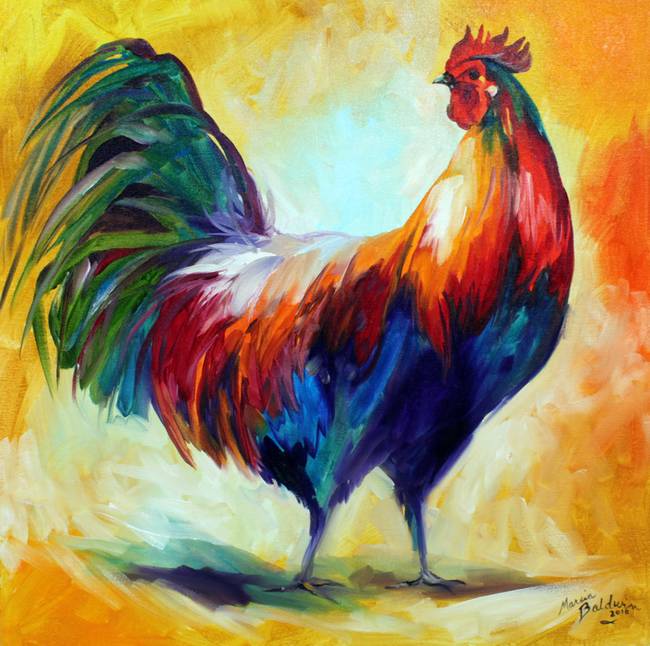
Rooster Colors

From time to time I am asked why I have a rooster for a profile picture, both on my blog and on Facebook.  What’s more, the rooster is also the screensaver on my phone.  I use these images for more reason than just the bucolic tranquility they depict.  The rooster has a long history as an interesting symbol.

While Celtic and Norse cultures saw the rooster as a creature of the underworld – a messenger screeching warnings of danger, and calling for the souls of those killed in battles; most have viewed the rooster in a more positive light.

In art, the rooster has long symbolized the fanning out of brilliance – i.e. showing the world the shimmering facets of ones personality.  As one  scholar has noted, the rooster is used in art to display courage, strength, pride,  honesty, vigilance, watchfulness, as well as flamboyance.  Most of these are excellent qualities. And flamboyance is not entirely bad, though too much of it may be somewhat obnoxious.

In Christianity the rooster is associated with Peter’s denial of Christ on the night of betrayal, leading up to the crucifixion.  So the rooster is associated with Christ’s death – which while tragic, was also God’s intention, the reason for which Jesus was born.  And while not lessening the tragedy, it is important to remember that Jesus himself says of the crucifixion: “I lay down my life, no one takes it from me.”  (John 10.11-18) Jesus laid down his life that those who believe would have life. Yet the effect of his substitutionary death only reached its full effect upon his resurrection – which Jesus hinted at in John 10.17.  In that sense the rooster, which symbolizes betrayal and death, cannot be separated from the purpose of Jesus’ death, and thus cannot be separated from the resurrection.  Therefore, the rooster is an appropriate symbol of the gospel itself.

What the rooster most symbolizes, at least to me, is the dawning of a new day. This is the reason I use it so freely.   The rooster crows at the first hints of new light.  This was a primary reason the rooster was used as a symbol of the Reformation – it was a reminder that the Reformation itself signaled a new day.  Of course the resurrection of Jesus is the ultimate sign of a new day.  And God himself tells us, through his prophet Jeremiah, that “his mercies are new every morning”.  (Lamentations 3.22-23)

So to me, the rooster is a constant reminder of the gospel, and that today is a new day – every day is a new day.  This being New Years Day, the rooster seems to me to be an especially appropriate symbol.

Inebriated by the Gospel

Smoky Mountain Moonshine

Great grace laced imagery from Robert Capon:

The Reformation was a time when men went blind, staggering drunk because they had discovered, in the dusty basement of late medievilism, a whole cellarful of fifteen-hundred-year-old, two-hundred-proof grace – of bottle after bottle of pure distillate of Scripture, one sip of which would convince anyone that God saves us single-handedly. The word of the gospel – after all those centuries of trying to lift yourself into heaven by worrying about the perfection of your bootstraps – suddenly turned out to be a flat announcement that the saved were home before they started… Grace has to be drunk straight: no water, no ice, and certainly no ginger ale; neither goodness, nor badness, nor the flowers that bloom in the spring of super-spirituality could be allowed to enter into the case.

You Might Be Reformed If…

Reformation Wall @ Geneva

As one who dwells firmly within the Reformed wing of Evangelical Christianity, I found the following to be astute, accurate, and a little bit amusing:

You might be Reformed …

  • If you think prayer is more than just trying to manipulate God into giving you what you want …
  • If you think that there are things more important to God than your comfort …
  • If you think the Bible has more to say about the Church than just what is found in the second chapter of Acts …
  • If you suspect that how you “think” about God might be at least as important as how you “feel” about God …
  • If you believe that the fact that a doctrine is described in the Bible supersedes your personal feelings about that doctrine…
  • If you feel that nagging suspicion that something isn’t right when the pastor can preach an entire sermon series without ever opening a Bible…
  • If you think that all of those letters that Paul, Peter, James and John wrote to the churches have something to do with how the Church should look today…
  • If you think that there has to be more to the Christian life than just being nice…
  • If you have always suspected that the pick­-and­-choose belief buffet can’t really reflect Christianity as it is expressed in Scripture…
  • If the theology of, “God has a plan, and it’s all about you!” makes you suspicious…
  • If you like the hymns unrelated to “tradition,” but because they are meaningful and true; in contrast with the mindless drivel of many “modern worship” songs…
  • If you accept God’s election because you find the doctrine clearly stated in Romans, even if you don’t necessarily  “like it” …
  • If you get a little creeped-out when someone stands up in church and declares: “I’ve had a revelation from God” …
  • If a “worship service” comprised of 45 minutes of near ­meaningless, highly repetitive songs leaves you hungering and thirsting for something real and meaningful…
  • If you’ve secretly abandoned Dispensationalism for not making sense, and gone searching for an eschatology that actually reflects what is taught in Scripture.

***

Thanks to Timothy J. Hammon.  This post originally appeared on his blog: The Things That Matter

Uneasy ‘Calvinist’

Branded

I feel no little uneasiness when labeled a Calvinist.  It is not that the description is unfitting.  Nor is it because I have any disaffection for Calvin. Quite the contrary.  My reservation is that there is much baggage that accompanies that label – baggage assigned by those who reject the tenants of the Faith associated with this particular theological system; and baggage freely toted by some who proudly – and sometimes obnoxiously – wear the label.  So, while happy to be identified as belonging in the Calvinist camp, I tend to agree with theologian Douglas Wilson who says that whoever coined the phrase “Calvinist” is a “marketing chucklehead”.  Wilson says he prefers to simply be called “Christian”.  Me too.

I am gladdened, though, that I do not need to carry my ill-ease alone; nor do I need to craft a defense or explanation of my (clearly Calvinistic) convictions.  It has already been marvelously expressed, by no less a stalwart of the Faith than Charles Haddon Spurgeon.  In his autobiography, The Early Years, Spurgeon wrote:

I have my own private opinion that there is no such thing as preaching Christ and Him crucified, unless we preach what is nowadays called Calvinism. It is a nickname to call it Calvinism; Calvinism is the gospel, and nothing else. I do not believe we can preach the gospel . . . unless we preach the sovereignty of God in His dispensation of grace; nor unless we exalt the electing, unchangeable, eternal, immutable, conquering love of Jehovah; nor do I think we can preach the gospel unless we base it upon the special and particular redemption of His elect and chosen people which Christ wrought out upon the Cross; nor can I comprehend a gospel which lets saints fall away after they are called.’

Well said.

Here I Stand

Today being Reformation Sunday, the day on the ecclesiastical calender commemorating the anniversary of Martin Luther posting his 95 Theses on the doors of the church at Wittenburg, which inadvertantly set into motion a radical transformation of both the church and Western Culture, I thought it might be appropriate to review the roots of what we celebrate.

The standard for Luther biography is set by historian Roland Bainton in his seminal work, Here I Stand.  Taking his cue from Bainton’s work, acclaimed narrator Max McLean introduces the events leading up to the Diet of Worms:

  • Martin Luther’s prayer the night before he delivered his speech
  • Luther’s stirring defense
  • the Catholic church’s rebuttal
  • Luther’s final heartfelt response

The entire audio is available below:

Total run time is 24 minutes.

McLeans cd and mp3 can be purchased by clicking: Here I Stand