Counterfeit Gods

In his reletively recent book, Counterfeit Gods, Tim Keller explains what a counterfeit god is and describes how to make one – as we are so prone to do:

A counterfeit god is anything so central and essential to your life that, should you lose it, your life would feel hardly worth living.  And idol has such a controlling position in your heart that you can spend most of your passion and energy, your emotional and financial resources, on it without a second thought.  It can be family and children, or career and making money, or achievement and critical acclaim, or saving “face” and social standing.  It can be a romantic relationship, peer approval, competence and skill, secure and comfortable circumstances, your beauty or your brains, a great political or social cause, your morality and virtue, or even sucess in the  Christian ministry.

Keller also asserts:

When your meaning in life is to fix someone else’s life, we may call it “codependency” but it is really idolatry.  An idol is whatever you look at and say, in your heart of hearts, “If I have that, then I’ll feel significant and secure.”  Introduction, p. xviii)

I greatly apprecialte Keller delving into this subject. While few people are likely to identify themselves as Idolotors, it is an affliction that plagues us all.  

John Calvin was correct when he declared: “Our hearts are little idol factories”.  Understanding how we each make our individual idols, and identifying how they influence our actions and thoughts, is a major step toward diplacing them.

Passing the Baton

This past spring my wife and I would spend a few afternoons each week attending the track meets of our junior high daughter and our high school Senior son.  While each child has different specialties, both particpated on relay teams.  Few things offered as much pleasure as sitting out in the Spring-time sun, and watching our kids receive, run, and pass their batons.

Bob Kauflin uses that analogy, the passing of a baton in a relay race, to express the importance of ministry to the next generation.  For those of us who now see more sand in the botton half of our hour glass than is reamining in the top, Kauflin offers some important thoughts. 

Click: Receiving the Baton.

I Want Change

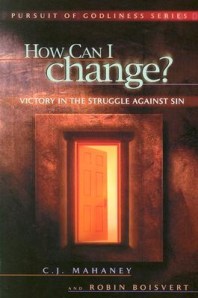
Change is inevitable, but it is not always pleasant.  But perhaps even less pleasant than unexpected change is the lack of change when it is desired and needed – particularly change in ourselves and in our spiritual development.  The questions are common: How Can I Change? When Will I Change? 

C.J. Mahaney & Robin Boisvert have written a helpful little book that addresses these very questions.  Here is an excperpt from the Foreword:

“In a day when quick solutions to longstanding problems are too easily offered, we wish to recommend the old paths, having found them tried and true. There is no short course to Christian maturity. There is no cross-less way to follow Christ, no instant secret to the Christian life. But like distance running, if the way of the cross is not easy, neither is it complicated. God presents us with a pathway that is narrow yet straight. He makes his ways plain to those who are sincerely interested in following him, and he will show himself strong on behalf of all whose hearts are fully his.

Although our vigorous effort is required, all growth is by his grace. With that wonderful truth as our starting block, let us press on toward the mark, each confident that ‘he who began a good work in you will carry it on to completion until the day of Christ Jesus.’ (Philippians 1:6).”

Thanks to Sovereign Grace Ministrires, this little book is available in .pdf for FREE.  Click on the Chapter Titles to read or download:

Introduction

  1. Caught in the Gap Trap
  2. Where It All Begins
  3. United With Christ
  4. The Battle Against Sin
  5. Tools of the Trade – Part 1
  6. Tools of the Trade – Part 2
  7. Living for That Final Day

Appendices

  • Appendix A – Different Roads to Holiness
  • Appendix B – The Old Man and the Flesh 

Some Aspects of Sin

Something I have long found intriguing: In the opening chapter of his book, HolinessJ.C. Ryle dedicates his entire attention to the subject of Sin. At first I wondered why that was. Eventually I realized that we cannot grow in holiness unless we understand our very real condition and the effects it has on us.  

Just what is sin, though?

The Westminster Shorter Catechism defines it this way:

Sin is any lack of conformity to, or transgression of, the Law of God

According to Richard Trench’s Synonyms of the New Testament, Sin is decribed in the Bible as having at least eight different aspects:

  1. Missing the Mark or Aim; Falling Short
  2. Passing Over or Transgressing a Line
  3. Disobedience to a Voice
  4. Falling When One Should Have Stood Upright
  5. Ignorance of What One Should Have Known
  6. Diminishing of that which Should Have Been Rendered in Full
  7. Non-observance of a Law
  8. Discord in the Harmonies of God’s Universe.

That last one is also described by Cornelius Plantinga as “A Violation of Shalom”.  (See: Not the Way It’s Supposed to Be.)

Understanding our condition of sin is as important to our overcoming it and growing in holiness as it is for those with some form of cancer to understand their condition and its effects so they know how to treat it and beat it. My father-in-law, while fighting a rare lymphoma, used to say: “Be as nasty to your cancer as your cancer is to you.”  Not only is that good advice for cancer patients, but it is good advice applied to those of us who are infected by sin. This is known as “mortifying” our sin or “dying” to sin.

Growth in Grace


by Archibald Alexander

The following essay by Archibald Alexander, first president of Princeton Theological Seminary, is a masterpiece integrating sound doctrine, practice, and personal experience. I have appreciated Archibald Alexander’s insights for more than a decade now, perhaps none more than this classic. Christians in this generation would find great refreshment if only we would, at least occasionally, drink from the fountain that springs from the writings of Alexander and others of his day.   – WDG

***

WHEN there is no growth, there is no life. We have taken it for granted that among the regenerate, at the moment of their conversion, there is a difference in the vigour of the principle of spiritual life, analogous to what we observe in the natural world; and no doubt the analogy holds as it relates to growth. As some children who were weak and sickly in the first days of their existence become healthy and strong, and greatly outgrow others who commenced life with far greater advantages, so it is with the ‘new man’. Some who enter on the spiritual life with a weak and wavering faith, by the blessing of God on a diligent use of means, far outstrip others who in the beginning were greatly before them.

It is often observed that there are professors who never appear to grow, but rather decline perpetually, until they become in spirit and conduct entirely conformed to the world, from whence they professed to come out. The result in regard to them is one of two things; they either retain their standing in the Church and become dead formalists, ‘having a name to live while they are dead’—‘a form of godliness, while they deny the power thereof’—or they renounce their profession and abandon their connection with the Church, and openly take their stand with the enemies of Christ, and not infrequently go beyond them all in daring impiety. Of all such we may confidently say, ‘They were not of us, or undoubtedly they would have continued with us.’ But of such I mean not now to speak further, as the case of back-sliders will be considered hereafter.

That growth in grace is gradual and progressive is very evident from Scripture; as in all those passages where believers are exhorted to mortify sin and crucify the flesh, and to increase and abound in all the exercises of piety and good works. One text on this subject will be sufficient: ‘Grow in grace and in the knowledge of our Lord and Saviour Jesus Christ.’ (2 Peter 3.18) And this passage furnishes us with information as to the origin and nature of this growth. It is knowledge, even the knowledge of our Lord and Saviour Jesus Christ. Just so far as any soul increases in spiritual knowledge, in the same degree it grows in grace. Persons may advance rapidly in other kinds of knowledge, and yet make no advances in piety, but the contrary. They may even have their minds filled with correct theoretical knowledge of divine truth, and yet its effect may not be to humble, but to ‘puff up’. Many an accurate and profound theologian has lived and died without a ray of saving light. The natural man, however gifted with talent or enriched with speculative knowledge, has no spiritual discernment. After all his acquisitions, he is destitute of the knowledge of Jesus Christ. But it should not be forgotten that divine illumination is not independent of the Word, but accompanies it. Those Christians, therefore, who are most diligent in attending upon the Word in public and private, will be most likely to make progress in piety.

Continue reading

7 Maxims of Repentance

Jesus said:

“This is what is written: The Christ will suffer and rise from the dead on the third day, and repentance and forgiveness of sins will be preached in his name to all nations, beginning at Jerusalem.”  (Luke 26.46-47)

Seemingly few recognize that repentance is part of the message of the Great Commission.  But that is clearly what Luke records Jesus as saying.  Not only is a call to repentance connected to the forgiveness of our sin, but I am convinced that repentance is one of the ways in which we express “obedience” to everything Jesus commanded us. As Martin Luther postulated in the first of his 95 Theses:

When our Lord and Master, Jesus Christ, said “Repent”, He willed that the whole life of believers be lived out in repentance.

Yet, just as seemingly few are aware that repentace is part of the Great Commisson, seemingly fewer realize repentance should be a way of life for the Christian. Building upon Luther’s observation, contemporary pastor/theologian Sinclair Ferguson declares:

“According to Scripture, the Christian Life is repentance from beginning to end! So long as the believer is at the same time righteous and yet a sinner, it can be no other way.”

In his masterful book on the subject, Repentance: The First Word of the Gospel, Richard Owen Roberts offers a series of lists, including 7 Maxims of Repentance:

  1. True Repentance is a Gift of God
  2. True Repentance is NOT a Single Act but an Ongoing and Continual Attitude
  3. True Repentance is NOT Merely Turning From What You Have Done but From What You ARE
  4. True Repentance is Not What you Do for yourself but What You do for God
  5. True Repentance is Not Merely of the Fruits of Sin but of the Very Roots
  6. True Repentance is Not Secret but Open
  7. True Repentance is Both Negative and Positive

While I would wholeheartedly commend the reading of Roberts’ book, merely pondering this list will itself offer some rewarding insights as to the nature and benefits of repentance.  While some maxims are more immediately understood than others, all are discernable.

Benefitting in the Benefactor

Sinclair Ferguson offers this wise insight about the gospel-centered life:

“…we must never separate the benefits (regeneration, justification, sanctification) from the Benefactor (Jesus Christ). The Christians who are most focused on their own spirituality may give the impression of being the most spiritual … but from the New Testament’s point of view, those who have almost forgotten about their own spirtuality because their focus is so exclusively on their union with Jesus Christ and what He has accomplished are those who are growing and exhibiting fruitfulness. Historically speaking, whenever the piety of a particular group is focused on OUR spirituality that piety will eventually exhaust itself on its own resources. Only where our piety forgets about ourself and focuses on Jesus Christ will our piety nourished by the ongoing resources the Spirit brings to us from the source of all true piety, our Lord Jesus Christ.”

Spiritual Pride

Here is a great insight from Jonathan Edwards as relevant today as it was in his Colonial American culture:

The first and worst cause of error that prevails in our day is spiritual pride. This is the main door by which the devil comes into the hearts of those who are zealous for the advancement of Christ. It is the chief inlet of smoke from the bottomless pit to darken the mind and mislead the judgment, and the main handle by which Satan takes hold of Christians to hinder a work of God. Until this disease is cured, medicines are applied in vain to heal all other diseases.

Pride is much more difficult to discern than any other corruption because, by nature, pride is a person having too high a thought of himself. Is it any surprise, then, that a person who has too high a thought of himself is unaware of it? He thinks the opinion he has of himself has just grounds and therefore is not too high. As a result, there is no other matter in which the heart is more deceitful and unsearchable. The very nature of it is to work self-confidence and drive away any suspicion of evil respecting itself.

Pride takes many forms and shapes and encompasses the heart like the layers of an onion- when you pull off one layer, there is another underneath. Therefore, we need to have the greatest watch imaginable over our hearts with respect to this matter and to cry most earnestly to the great searcher of hearts for His help. He who trusts his own heart is a fool.

Since spiritual pride in its own nature is secretive, it cannot be well discerned by immediate intuition of the thing itself. It is best identified by its fruits and effects, some of which I will mention together with the contrary fruits of Christian humility.

The spiritually proud person is full of light already and feels that he does not need instruction, so he is ready to despise the offer of it. On the other hand, the humble person is like a little child who easily receives instruction. He is cautious in his estimate of himself, sensitive as to how liable he is to go astray. If it is suggested to him that he does go astray, he is most ready to inquire into the matter.

Proud people tend to speak of other’s sins, the miserable delusion of hypocrites, the deadness of some saints with bitterness, or the opposition to holiness of many believers. Pure Christian humility, however, is silent about the sins of others, or speaks of them with grief and pity. The spiritually proud person finds fault with other saints for their lack of progress in grace, while the humble Christian sees so much evil in his own heart, and is so concerned about it, that he is not apt to be very busy with other hearts. He complains most of himself and his own spiritual coldness and readily hopes that most everybody has more love and thankfulness to God than he.

Spiritually proud people often speak of almost everything they see in others in the harshest, most severe language. Commonly, their criticism is directed against not only wicked men but also toward true children of God and those who are their superiors. The humble, however, even when they have extraordinary discoveries of God’s glory, are overwhelmed with their own vileness and sinfulness. Their exhortations to fellow Christians are given in a loving and humble manner, and they treat others with as much humility and gentleness as Christ, who is infinitely above them, treats them.

Spiritual pride often disposes people to act different in external appearance, to assume a different way of speaking, countenance, or behavior. However, the humble Christian, though he will be firm in his duty; going the way of heaven alone even if all the world forsake him; yet he does not delight in being different for difference’s sake. He does not try to set himself up to be viewed and observed as one distinguished, but on the contrary, is disposed to become all things to all men, to yield to others, to conform to them, and to please them in all but sin.

Proud people take great notice of opposition and injuries, and are prone to speak often about them with an air of bitterness or contempt. Christian humility, on the other hand, disposes a person to be more like his blessed Lord, who when reviled did not open His mouth but committed Himself in silence to Him who judges righteously. For the humble Christian, the more clamorous and furious the world is against him, the more silent and still he will be.

Another pattern of spiritually proud people is to behave in ways that make them the focus of others. It is natural for a person under the influence of pride to take all the respect that is paid to him. If others show a disposition to submit to him and yield in deference to him, he is open to it and freely receives it. In fact, they come to expect such treatment and to form an ill opinion of those who do not give them what they feel they deserve.


***

Adapted from Jonathan Edwards’ Some Thoughts Concerning the Present Revival of Religion in New England. This article previously appeared in Banner of Truth.

God’s Workmanship

One of the glories of Christianity is the assurance that we are God’s workmanship, created in Christ Jesus to do good works, which God prepared in advance for us to do” (Ephesians 2.10). 

This statement by Paul that we are “created” does not simply refer to our physical formation, as God has, of course, created all human beings (see Genesis1.26-27). Rather, Paul is talking about being “created in Christ.” It means that every person who believes in Christ does so because she or he is the object of a process of God’s “spiritual creation.”
 
The word workmanship is very important; it is the Greek word poema from which we get our word “poem.” It means that every believer is essentially a work of art – God’s art!
 
Consider how artists work, whether they are writers, musicians, painters, sculptors, etc. They labor long and hard and with the utmost care and detailed attention. Sometimes they do very little, only a stroke here or there. Other times they make massive changes. But always they seek to bring the raw material into line with an artistic vision. Thus Paul is telling us that God labors over all believers throughout our entire lives, intervening and guiding and shaping us to bring us into line with a vision he has for us. This is mentioned also in Ephesians 2.10 -“created to… good works,  which God prepared in advance for us to do.” Thus, God has a particular set of “good works” for us to do, for which he prepares us our whole lives.
 
Looking at Our Lives
  
It is therefore of utmost importance to look back on our lives and see everything that has happened through this grid, namely that:
  • God has been at work through the various influences of our lives – “created in Christ.” All of our experiences and troubles and our family and friends must be seen as the instruments of an artist used to mold and shape us. He has been at work all of our lives!
  • God has been at work to make us something beautiful – “workmanship.” God is out to make our beings something great—to give us characters of love, joy, peace, patience, kindness, integrity, humility and self-control.
  • God has been at work to make us something useful – “good works… prepared beforehand.” God is also out to make our doings something great – to make us helpful and able to serve others in special ways.
Paul uses this “doctrine of workmanship” like a pair of spectacles through which to view his entire life.
 
First, in Galatians 1.13-23, he shows us that he now sees God at work throughout his whole life (“God, who set me apart from birth and called me,” v.15).
 
Secondly, he now sees that God used the gospel to make him something beautiful. He had been a fanatically intense person who felt superior in his self-righteousness and only criticized others (“intensely I persecuted… extremely zealous for the traditions,” v.14). But God humbled him and showed him he was nothing apart from undeserved grace (“called me by his grace and was pleased to reveal his Son in me”) so that now he loves to lead people to praise and thanks (“they praised God because of me,” v.24). 
 
Thirdly, he realizes that though his obsessive study of the Bible and theology (“the traditions”) was originally motivated by self-righteousness and the need to feel superior, he was now, as a Christian, uniquely equipped to be a preacher, teacher and evangelist (“so that I might preach him among the Gentiles”). His scholarship and knowledge of the Bible enabled him to bridge the gap between Christianity and various pagan philosophies and religions.

-Taken from Tim Keller’s A Gospel Changed Life

Scandalous Freedom


In his book A Scandalous Freedom, Steve Brown provocatively writes:

They lied to you about being a Christian. When you first “joined the club,” they promised you’d be set free. But let’s get honest, you’re not free. In fact, you’re religious, afraid, guilty, and bound. What’s worse, now that you’ve been in the club awhile, you’re stuck pretending you’re better than you are. And worse than that, you prefer the security and rules of your self-imposed boundaries. It’s time for a change. You need Scandalous Freedom.

There is no question in my mind that Steve Brown is correct.

So many Christians are imprisioned by their own consciences.  What I think is startling about this is that most don’t even seem to be aware of their spiritual and emotional bondage.  In fact, since most people they know are in the same condition, they assume this is the norm, and that THIS is the freedom for which Christ came to set us free!  And even more perplexing is that, when faced with the radical nature of the gospel, many seem to prefer this state of existence to the freedom offered and secured by the gospel!

I see it all the time. I do it all the time.

But Steve Brown winsomely, humorously, and profoundly, calls it like it is.  And he offers us a path to freedom. It is not a path Steve has blazed. He is one, of many, who has simply labored to uncover the path for us that Jesus laid out. Sadly much of what Jesus paved seems to have been covered over by the garbage of religious tradition and fundamentalism.

Listen Steve Brown’s related podcast series: Scandalous Freedom.

Gospel Discipling: Gospel & Renewal

Not only is Gospel discipling the very heart of discipleship within churches, it is also the critical issue in the matter of renewal or revival in the church at large.

Dr. Richard Lovelace, in his modern classic work Dynamics of Spiritual Life, asks why the Church must think in terms of what he calls “cyclical renewal” when the abiding presence of the Holy Spirit should allow “continuous renewal”.  As he explains his “primary elements of continuous renewal,” they are summarized in what he calls a “depth presentation of the gospel”.

Lovelace writes:

Only a fraction of the present body of professing Christians are solidly appropriating the justifying work of Christ in their lives. … Few know enough to start each day with a thoroughgoing stand upon Luther’s platform: you are accepted, looking outward in faith and claiming the wholly alien righteousness of Christ as the only ground for acceptance, relaxing in that quality of trust which will produce increasing sanctification as faith is active in love and gratitude.

In order for a pure and lasting work of spiritual renewal to take place within the church, multitudes within it must be led to build their lives on this foundation.

This is another way to speak of gospel discipling, and we are seeing evidence of such quiet but deep renewal in ministries in the United States and in other nations.

***

This is Part 4 of a 5-part series titled Gospel Discipling. This series is taken from an essay by Stephen Smallman, author of Spiritual Birthline and past Executive Director of World Harvest Mission. Some of the content has been edited. 

Thanks also to New City Fellowship of St. Louis, who posted Smallman’s essay on their web page.

To read Parts 1-3 click: Introduction; Romans as Model; Gospel & Adoption

10 Dumbest Things Christians Do

There is a book out there with the title: The 10 Dumbest Things Christians Do. I feel compelled to pick up a book with a title like that. I want to see how many of these 10 dumb things I am guilty of doing.

I don’t know if the list the author, Mark Atteberry, compiled is right or not.  Are these the DUMBEST things Christians do? Some of us do so many dumb things, it is tough to tell which are the dumbest.  But I must concur. He is right. These are some stupid things many Evangelical Christians do:

  1. Slinging Mud on the Bride of Christ
  2. Winning People to Church Rather Than to Jesus
  3. Living Below the Level of Our Beliefs
  4. Speaking Above the Level of Our Knowledge
  5. Hopping From Church to Church
  6. Fighting Among Oursleves
  7. Missing Golden Opportunities
  8. Settling for Mediocrity
  9. Allowing Wolves to Live Among the Sheep
  10. Accepting the Unacceptable

Ah!! You Just Said a BAD Word!

Tony Campolo is famous – or infamous – for a statement made at a Christian college chapel service:

“The United Nations reports that over ten thousand people starve to death each day, and most of you don’t give a SH%T.  However, what is even more tragic is that most of you are more concerned about the fact that I just said “sh%t” than you are about the fact that ten thousand people are going to starve today.”

Let me ask you:

  • What was your first thought when you read that quote?  Did you visualize thousands of starving people? Or were you stunned by the use of the “bad” word?
  • Imagine if you had been in the congregation at your church and he made that statement. What would have struck you then?
  • Can think of any better way to point out that sometimes we do not have the heart and priority of Christ? 
  • Can you think of a better way to reveal our tendency toward self-righteousness and legalism?

I’ve never had the nerve to say anything like this from the pulpit. Maybe if I was a traveling speaker who didn’t have to face the same crowd again a week later I might have considered it…

Taking Pieces of Heaven to Place of Hell On Earth

Jesus says: “I will build my church and the gates of Hell will not stand up…” –Matthew 16.18

First it is important to remind ourselves that in this challenge Jesus is calling his church to take an Offensive stike, not a Defensive response. The church is to take the initiative, go, and storm the gates. This verse does not suggest the church create a fortress and stand guard, as we too freequently have done.

Second, we must ask ourselves what this means practically. I’ve been through some pretty rough neighborhoods, but I have yet to see a literal enterence to the actual Hell.  So how can we act out on this passage?

Palmer Chinchen offers us some insights.  In the line of thinking presented in Richard Stearns’ The Hole in Our Gospel, Chinchen challenges Christ’s church to come together to make a difference, and storm the gates and stem the growth of Hells on Earth. 

Chinchen, pastor of The Grove in Chandler, Arizona, is brother of one of my old seminary classmates.  I don’t know Palmer, but have high regard for Paul. Now I also have high regard for Palmer’s passion.

Me Worship

The foolishness caricatured in this video probably needs no comment. It touches on what is perhaps the most common plague of American Evangelicalism: the notion that life (and Church)  is all about me – what I like, what I want, etc. 

God seems to have other ideas. In Isaiah 48.11 God says:

For my own sake, for my own sake, I do this.
       How can I let myself be defamed?
       I will not yield my glory to another
.

This problem may nowhere be more evident than in the worship wars that erupt in many congregations. What might worship be like if our primary concern was God’s glory? If we primarily asked ourselves what God enjoys?