Bible Reading Plan for Slackers

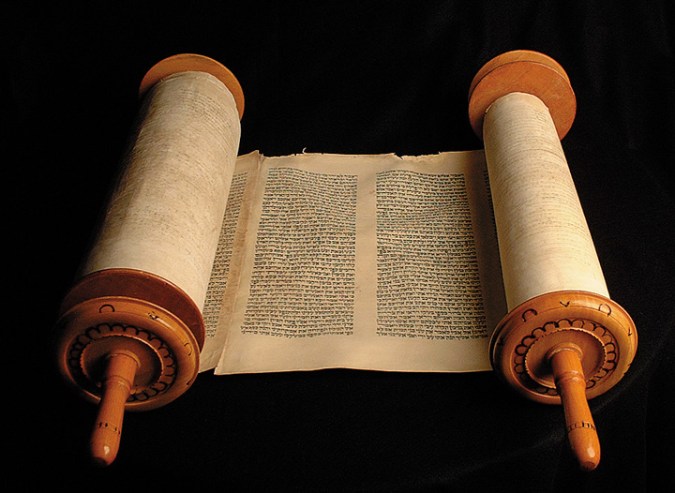
Hebrew Scroll

I am long overdue to draft a post. But new year equals new beginnings, right?  While I will again eschew making any New Years Resolutions, except to resolve not to make any resolutions – (hey, it worked last year!)  … I do plan to get back into the swing of writing and posting.

Let me begin 2013 by suggesting a different kind of Bible reading plan, one that writer Margie Haack, of Ransom Fellowship, calls “The Bible Reading Plan for Slackers & Shirkers“.  She explains:

The big difference between this plan and any other I had tried was that it was not tied to any particular date. On any day of the week, say it was Friday, I read the assigned portion and happily checked it off. Fridays were good days and it is true I finished all of them before I finished the Saturdays, but then I simply read wherever I was behind.

I was not tempted to cheat, because there were no unsightly gaps. I knew it was going to take me longer than a year. And, after all, what is so inspired about doing it in a year? Nothing. I also liked not having to look up five different references in one day. You could just settle in and read an entire assignment which came from one book.

In short, here is a synopsis of some of the advantages of this plan:

  1. It removes the pressure to ‘keep up’ with getting through the entire Bible in a year.
  2. It provides variety throughout the week by alternating genres.
  3. It provides continuity by reading the same genre on the same day of each week.

Here’s how it works:

  • Sundays: Poetry
  • Mondays: Penteteuch (Genesis through Deuteronomy)
  • Tuesdays: Old Testament History
  • Wednesdays: Old Testament History
  • Thursdays: Old Testament Prophets
  • Fridays: New Testament History (Gospels & Acts)
  • Saturdays: New Testament Epistles (letters)

The benefit of a plan like this is that it provides guidance but it does not put promote guilt if we miss a day.  Just pick up with the next reading for whatever day it happens to be.

To download .pdf click: Bible Reading Plan for Slackers & Shirkers

The True & Better

In this brief video, Tim Keller shows us how Jesus can be seen throughout the familiar narratives of the Old Testament.  This is not an exercise like Where’s Waldo? , where you scour a picture to see if you can find the hidden face.  Nor is this mere metaphor.  This is God’s intended revelation of his grace that was to come.  Each instance is a typology in which, through real life historical figures and events, there is a foreshadowing of the life, work, and/or character of the promised Messiah.  This is why Jesus said to his disciples along the Emmaus Road: “All the Scriptures speak of me.”  (See Luke 24.25-27)

Finding Your Place in God’s Story

Knowing scripture is vital. But it is not the essence of Christianity.  That may sound surprising, but it really should not be.  Knowing the Bible is foundational, even essential, to vibrant faith and life. But it is also possible to have great knowledge yet have little understanding. The essence of the Faith is not information but formation.  It is understanding who God is, what he has done and is doing, and what he expects from you and me.  It is, borrowing a good popular phrase, finding your place in God’s story and living it out in light of the gospel.

I started reading D.A. Carson’s The God Who Is There.   This is a tremendous resource.  Carson does a wonderful job in walking the reader through the narrative of the Bible, or what he calls “the Big Story of Scripture”.  He touches on the major themes, comprehensively yet easily readable. And in doing this, Carson helps us understand the grand narrative of scripture, thus assisting and enabling us to more easily find our place in it.

As it so happened, in February 2009 Carson presented a 14-part seminar  at Bethlehem Baptist Church in Minneapolis. The book was developed from those messages.  And thanks to The Gospel Coalition, the MP3s and videos of the conference that closely correspond with the book are available for all 14 chapters:

  1. The God Who Made Everything | MP3 | Video
  2. The God Who Does Not Wipe Out Rebels | MP3 | Video
  3. The God Who Writes His Own Agreements | MP3 | Video
  4. The God Who Legislates | MP3 | Video
  5. The God Who Reigns | MP3 | Video
  6. The God Who Is Unfathomably Wise | MP3 | Video
  7. The God Who Becomes a Human Being | MP3 | Video
  8. The God Who Grants New Birth | MP3 | Video
  9. The God Who Loves | MP3 | Video
  10. The God Who Dies—and Lives Again | MP3 | Video
  11. The God Who Declares the Guilty Just | MP3 | Video
  12. The God Who Gathers and Transforms His People | MP3 | Video
  13. The God Who Is Very Angry | MP3 | Video
  14. The God Who Triumphs | MP3 | Video

Our Great Shepherd

“The Lord’s my shepherd – I shall not be in want.”

(Psalm 23.1)

I am completely satisfied with his management of my life.  Why? Because He is the sheepman to whom no trouble is too great as He cares for His flock.  He is the rancher who is outstanding because of His fondness for sheep – Who loves them for their own sake as well as his personal pleasure in them.  He will, if necessary, be on the job twenty-four hours a day to see that they are properly provided for in every detail.  Above all, He is very jealous of His name and high reputation as ‘The Good Shepherd’.

~ Phillip Keller, from A Shepherd Looks at Psalm 23

A Word From a VBS Valedictorian

Trekking incognito along the Emmaus Road, shortly after his resurrection, unrecognized even by the few of his own disciples who walked with him, Jesus challenged the groans of perplexity and faithlessness:

He said to them, “How foolish you are, and how slow of heart to believe all that the prophets have spoken!  Did not the Christ have to suffer these things and then enter his glory?” And beginning with Moses and all the Prophets, he explained to them what was said in all the Scriptures concerning himself. (Luke 24.25-27)

All of the Scriptures speak about Jesus? Really? Yep.  And in the video above, this young guy recounts the overarching reflections of the Messiah revealed in every book of the Bible.

Impressive.

Bible Reading Plan for Slackers & Shirkers

Let me suggest a different kind of Bible reading plan, one that writer Margie Haack, of Ransom Fellowship, calls “The Bible Reading Plan for Slackers & Shirkers“.  She explains:

The big difference between this plan and any other I had tried was that it was not tied to any particular date. On any day of the week, say it was Friday, I read the assigned portion and happily checked it off. Fridays were good days and it is true I finished all of them before I finished the Saturdays, but then I simply read wherever I was behind.

I was not tempted to cheat, because there were no unsightly gaps. I knew it was going to take me longer than a year. And, after all, what is so inspired about doing it in a year? Nothing. I also liked not having to look up five different references in one day. You could just settle in and read an entire assignment which came from one book.

In short, here is a synopsis of some of the advantages of this plan:

  1. It removes the pressure to ‘keep up’ with getting through the entire Bible in a year.
  2. It provides variety throughout the week by alternating genres.
  3. It provides continuity by reading the same genre on the same day of each week.

Here’s how it works:

  • Sundays: Poetry
  • Mondays: Penteteuch (Genesis through Deuteronomy)
  • Tuesdays: Old Testament History
  • Wednesdays: Old Testament History
  • Thursdays: Old Testament Prophets
  • Fridays: New Testament History (Gospels & Acts)
  • Saturdays: New Testament Epistles (letters)

The benefit of a plan like this is that it provides guidance but it does not put promote guilt if we miss a day.  Just pick up with the next reading for whatever day it happens to be.

To download .pdf click: Bible Reading Plan for Slackers & Shirkers

How to – or NOT to – Read Your Bible

How should we read our Bibles? There are a number of good ways.  But Dane Ortland offers some suggestions about how not to approach it:

  • The Gold Mine Approach – reading the Bible as a vast, cavernous, dark mine, in which one occasionally stumbles upon a nugget of inspiration. Result: confused reading.
  • The Hero Approach – reading the Bible as a moral hall of fame that gives us one example after another of heroic spiritual giants to emulate. Result: despairing reading.
  • The Rules Approach – reading the Bible on the lookout for commands to obey to subtly reinforce a sense of personal superiority. Result: Pharisaical reading.
  • The Artifact Approach – reading the Bible as an ancient document about events in the Middle East a few thousand years ago that are irrelevant to my life today. Result: bored reading.
  • The Guidebook Approach – reading the Bible as a roadmap to tell me where to work, whom to marry, and what shampoo to use. Result: anxious reading.
  • The Doctrine Approach – reading the Bible as a theological repository to plunder for ammunition for my next theology debate at Starbucks. Result: cold reading.

This post is excerpted from Ortland’s post on The Resurgence blog: Transform Your Bible Reading.  The expanded article offers some valuable insights.

Chicken Soup for My Soul

Feeling a little bit in a funk recently, as if I am failing in some way but I am not sure what… I have been reflecting upon the beautiful words of Psalm 143:

[1] Hear my prayer, O LORD;
give ear to my pleas for mercy!
In your faithfulness answer me, in your righteousness!
[2] Enter not into judgment with your servant,
for no one living is righteous before you.

[3] For the enemy has pursued my soul;
he has crushed my life to the ground;
he has made me sit in darkness like those long dead.
[4] Therefore my spirit faints within me;
my heart within me is appalled.

[5] I remember the days of old;
I meditate on all that you have done;
I ponder the work of your hands.
[6] I stretch out my hands to you;
my soul thirsts for you like a parched land. Selah

[7] Answer me quickly, O LORD!
My spirit fails!
Hide not your face from me,
lest I be like those who go down to the pit.
[8] Let me hear in the morning of your steadfast love,
for in you I trust.
Make me know the way I should go,
for to you I lift up my soul.

[9] Deliver me from my enemies, O LORD!
I have fled to you for refuge!
[10] Teach me to do your will,
for you are my God!
Let your good Spirit lead me
on level ground!

[11] For your name’s sake, O LORD, preserve my life!
In your righteousness bring my soul out of trouble!
[12] And in your steadfast love you will cut off my enemies,
and you will destroy all the adversaries of my soul,
for I am your servant.

Psalm 143 – ESV

Misusing the Proverbs

Great post by John Armstrong on Proverbs.  Armstrong asserts:

Perhaps no part of Holy Scripture has been more frequently abused… than the book of Proverbs.

Armstrong goes on to explain what the proverbs are and are not, and their God-intended purpose.

Not long ago a friend and I were discussing this very same problem, after some pastors he knew had thrown around a proverb or two, wielding them as if they were laws.   But proverbs are not laws. They are expressions of wisdom.   Sometimes they are even contradictory wisdom.

Now I do not believe, as many assert, that the Bible “contradicts” itself.  The laws and promises are consistent in all ways.  One has to remove them from their intended context to make a case that they are contradictory.  But when it comes to the book of Proverbs it is reasonable to see that some sayings offer different outcomes for similar actions.  That is easy enough to explain.  Again, proverbs are not laws or promises, they are expressions of wisdom to help us navigate life.  I’ve heard R.C. Sproul says about Proverbs, essentially, in life “sometimes this will happen, and sometimes that will happen.”  Proverbs prepares us for “this” and “that”.

Check Out: Misusing the Proverbs

Bible in 6 Minutes

Is there a particular theme that runs through the whole Bible?  No doubt there are many stories and lessons, but is there a central message by which we can connect all else?

Dane Ortland asked several pastors and scholars if they could summarize the Bible in one sentence. Here are some notable responses:

John Frame:

God glorifies himself in the redemption of sinners.

Kent Hughes:

God is redeeming his creation by bringing it under the lordship of Jesus Christ.

Tom Schreiner:

God reigns over all things for his glory, but we will only enjoy his saving reign in the new heavens and the new earth if we repent and believe in the gospel of Jesus Christ, who is the crucified and risen Lord and who gave himself on the cross for our salvation.

Mark Dever:

God has made promises to bring His people to Himself and He is fulfilling them all through Christ.

Kevin DeYoung:

A holy God sends his righteous Son to die for unrighteous sinners so we can be holy and live happily with God forever.

And, finally, my favorite…

Ray Ortlund:

The Lover of our souls won’t let the romance die, but is rekindling it forever.

In the above video Bible scholar D.A. Carson provides a concise, comprehensive, and comprehensible, summary of the theme that permeates the entire Bible.

Of Paramount Importance

Take a moment to ponder these observations about the paramount importance of God’s Word:

Since there is a more excellent appearance of the Spirit of God in the holy scripture than in any other book,  it has more power and ability to convey the Spirit and make us spiritual, by imprinting itself upon our hearts.

Since there is more of God in it, it will acquaint us more with God, and bring us nearer to Him, and make the reader more reverent  and godly.

Let scripture be first and most in your hearts and hands, and other books used as subservient to it.

The endeavor of the devil… is to keep it from you, which is evidence that reading it is most necessary and desirable, and beneficial to you.

Adapted from the Works of Richard Baxter.

Prevailing: An Honest Look at Philippians 4.13

Sometimes I want to scream! One thing that makes me want to scream is people, Christian people, who under the guise of faith, take scripture out of it’s God-given context and apply it to their own pretentious favor.  ARGH!!

I wonder, is there any passage where this more frequently occurs than it does with Philippians 4.13:

“I can do all things through him who gives me strength.”

All too often, it seems, this is claimed as the “life verse” by athletes, coaches, and others facing various forms of adversity.  Those involved in athletics so commonly claim this verse that I sometimes, tongue-in-cheek, refer to this mindset as FCA Christianity. (OK.  I know that this is not fair to FCA.  While this mindset may commonly be heard around FCA Huddles and events, there are also many faithful, deep, godly folks involved with FCA.  In truth, I don’t know that this mindset is more prevalent with FCA-ers than it would be in my denomination, PCA, or even the church that I pastor.)

Philippians 4.13 is often invoked whenever the odds of success seem stacked against someone. The person reminds himself/herself: “I can do this… Like Rocky Balboa, I can defy the odds… I can do ALL things through Christ who gives me strength… I can win!!”

What is wrong with this perspective is not the desire to prevail, whatever the endeavor. There is nothing wrong with that. The problem is that to use this verse, and suppose the Bible here champions winning, takes this verse out of it’s context and redirects the aim of the gospel, the purpose of the Christian faith, to serve our agenda and goals.  It assumes that our personal success is the goal of the Kingdom.  It turns the gospel upside-down.

Continue reading

Bible Reading Plans for 2011

New Years Day has come and gone, and 2011 is trudging along.  You want to do some things different this year.  You’ve always wanted to read through the Bible, but you’ve never been quite sure how to do it.  Or, you have read through the Bible before but you are looking for a different approach.

If one of your Resolutions for 2011 is to make Bible reading a regular part of your daily disciplines, you are in luck (err, you are in Providence)!  It is not too late to get started. (It’s never too late.) There are several plans available from the publishers of the ESV.

Click: Bible Reading Plans

The Gospel of Mark by Max McLean

If you have not seen the Bible brought to life through one of Max McLean‘s performances you have missed out. I first saw him when he came to chapel while I was a student at Reformed Theological Seminary. McLean is an acclaimed thespian who lends his substantial talents to verbatim oral interpretation of Books of the Bible, among other roles.

I learned from Justin Taylor that McLean’s live portrayal of John Mark, author of the Gospel of Mark, from the show run last year in the Chicago Theatre District, is now available on DVD.  I also leaned that it is available free online.

Click the chapters and watch McLean bring the Gospel of Mark to life, word-for-word:

Try reading along to dramatize your Devotional time for several days.