Author: Dennis Griffith

  • 10 Differences Between Leaders & Cheerleaders

    Leadership Word Puzzle

    Philip Nation distinguishes the difference between genuine leaders and cheerleaders, or what he calls the difference between those in leadership positions who use buzzwords and those who actually lead.  Think for a moment about this vital distinction:

    I think that a key facet of leadership is knowing the difference between a strategy and a collection of buzzwords.

    So what are some of the differences Nation notes between leaders and cheerleaders ?

    1. Buzzwords begin as a rallying cry and end as words to broadly applied. / Leadership constantly looks for fresh ways to keep the movement alive.

    2. Buzzwords are a poor substitute for the real content. / Leadership offers a vocabulary of meaningful dialogue.

    3. Buzzwords give a false sense of momentum when stagnation is the reality. / Leadership identifies stagnation and tackles it.

    4. Buzzwords are an easy way to say nothing when those who follow you need to hear something. / Leadership shows the willingness to have the difficult conversations.

    5. Buzzwords kill the meaning of a movement. / Leadership continues to give life to a movement.

    6. Buzzwords are the escape hatch for the speaker who is unprepared. / Leadership finds a way to be the most prepared person in the movement.

    7. Buzzwords provide a facade of being knowledgeable. / Leadership actually learns.

    8. Buzzwords give false hope of a possible future. / Leadership tells a beautiful and detailed story of what can be.

    9. Buzzwords are big ideas boiled down to the lowest common denominator of thought. / Leadership offers everyone a way to access the big ideas and bring understanding to them.

    10. Buzzwords make important words eventually seem disposable. / Leadership redeems the important meaning of words and phrases.

    To read Nation’s full article: Buzzwords & Leaders

  • 6 Gospel Aspects

    Seeing Six Aspects

    As I teach and preach – and even talk to people – it is not uncommon for someone to ask for clarification of what I mean when I casually and frequently use the term “gospel”.  For some the word has very little meaning. Folks are confused, wondering if it is a style of music, a metaphor for “truth”, or something else.  This is understandable, since the word is used indiscriminately, even if not erroneously.  But others, who are heartfelt follows of Christ, also ask on occasion.  They understand it is the Good News related to Jesus, but what are the essential elements?

    Welsh scholar C.H. Dodd helpfully sumarized the gospel in six distinct aspects:

    1. The Age of Fulfillment has dawned, the “latter days” foretold by the prophets.  (Acts 3:18)
    2. This has taken place through the birth, life, ministry, death and resurrection of Jesus Christ.  (Acts 2.22-31)
    3. By virtue of the resurrection, Jesus has been exalted at the right hand of God as Messianic head of the new Israel.  (Acts 2.32-36)
    4. The Holy Spirit in the church is the sign of Christ’s present power and glory. (Acts 10.44)
    5. The Messianic Age will reach its consummation in the return of Christ.  (Acts 3.20-21)
    6. An appeal is made for repentance with the offer of forgiveness, the Holy Spirit, and salvation.  (Acts 2.37-41)
  • Wings

    This video, shared with me by my colleague Camper Mundy, reflects a sad commentary about the shallow consumerism of our society.

  • Fascinations that Lead Away from the Cross

    Maze of Fascinations

    by Michael Horton

    Martin Luther opposed the “theology of the cross” to all “theologies of glory.” The latter can be generally placed into three categories: three types of “ladders” we try to climb in order to see “God in the nude,” as Luther put it. These ladders were mysticism, speculation, and merit. I would like to suggest a few contemporary expressions of the theology of glory along these lines.

    Fascination with the Miraculous

    As in our Lord’s day, few today who seek miracles are interested in that to which signs point. “A wicked generation seeks for signs,” Jesus said, followed by Paul’s reminder that his fellow Jews were so busy looking for miraculous wonders that they stumbled over the Gospel of Christ crucified. Seeking direct experiences with God without the mediation of Scripture, preaching, and sacraments is a theology of glory. Longing for “power encounters,” we trip over the weakness of the cross. This is also true of our triumphalism, long a problem of evangelical revivalism. With its vision of conquering and reigning, the cross-bearing life of Christ which our Savior graciously allows us to share with him is traded in for a crown before the appointed time. Often, we behave like the disciples during our Lord’s ministry. Philip saw Jesus as a means to an end: “Now, just show us the Father and we’ll be satisfied,” he said. “Philip, have you been with me so long and you still don’t get it? He who has seen me has seen the Father!” Those looking for God in demonstrations of power miss the true appearance of God in the humiliation and weakness of the Suffering Servant.

    His disciples never did understand him when he said he must suffer and die, and whenever he brought it up, they tried to ignore it. Or, as in Peter’s case, they rebuked him: “Surely this will never happen to you!” As Satan had offered Jesus a crown without a cross, so even Jesus’ own brothers, impressed with his success as a miracle-worker, anxiously offered a tour of the major cities. Similarly, James and John wanted to call down fire on their enemies, and their mother came to Jesus to ask him to allow her sons to sit on his left and right hand in his kingdom. Everyone was planning for glory, but Jesus was planning for the cross. “You do not know what you are asking,” Jesus told their proud mother. “Can they drink the cup that I am about to drink?” “Of course we can!”, they eagerly replied. Triumphalism ignores the cross, and when the hour of trial (sin, failure, loss of popularity, shame, and abuse) comes, we, like the disciples, flee for cover instead of sharing in Christ’s suffering. The triumphalism of theologies of glory can be discerned in much of today’s popular Christian music. Here the realities of life are replaced with platitudes and sentimentalism, a far cry from the emotional and moving words of the psalmist. Contrast much of contemporary Christian music with the depth of the classic hymns of the Moravians, Lutheran and Reformed hymn writers, Charles Wesley, and the old African-American “spirituals.”

    Fascination with the Moralistic

    Sadly, evangelicals and liberals often read the Bible in a similar way these days. While the former may be more conservative in their interpretations, both tend to read (and preach) the Bible moralistically: that is, either as positive tips for better living or as scolding for not being what one should be. Thus, the key biblical characters become heroes to imitate rather than figures in a redemptive-historical plot centering around Jesus Christ. Jesus told the Pharisees that in spite of their ostensive devotion to the Scriptures, they did not really understand what they were reading, since he (Jesus) is the point of all of Scripture. Similarly, after his resurrection, he rebuked his disciples for not understanding how his death and resurrection were foretold. So “beginning with Moses and all the prophets, he expounded to them in all the Scriptures the things concerning himself” (Luke 24:27).

    If an obsession with “power encounters” stumbles over the weakness of the cross, the preoccupation with moralism finds the preaching of the cross “foolishness.” How can the wicked be declared righteous while they are still sinful? If I could know right now that nothing I did counted for my salvation, why would I even try to be holy? It’s unfair for God to elect people without basing his choice on anything in or foreseen in those who are chosen. Or, as we have seen already from Feuerbach’s pen: “The Christian theory of justification by faith is rooted in a cowardly renun-ciation of moral effort,” and belief in the hereafter nothing more than “an escape mechanism.” Our fallen sensibilities rebel against the utterly gracious character of God’s way of saving. When sin and grace are replaced with therapeutic, ethical, political, and pragmatic concerns, it is a sure sign that we too have stumbled over the Rock of offense.

    The Puritan Thomas Goodwin warns us of our ten-dency even as Christians to attempt to turn faith into a work. Seeing the condition of his ship of faith and obedience, one sets out to rebuild another ship, “so he undoes himself in what he endeavors, and goes to hell by striving to go to heaven.”

    Fascination with the Mysterious

    As liberal theologian Paul Tillich pointed out (and exhibited), mysticism and rationalism are of one piece. Like Plato, the mystic-rationalist does not care much for this world and wishes to escape the world of “appear-ances” by abstract contemplation of “the Divine.” Christianity is deeply committed to this world (creation, provi-dence, redemption through historical events, restoration of the whole creation at the end of the age, including the resurrection of our bodies), and announces that God cannot be known directly by our reason, but must reveal himself by condescending to our capacity. The mystic-philosopher who attempts to penetrate God’s hidden council, either by specu-lation or claims to secret knowledge of God’s will beyond what is revealed in Scripture, is a theologian of glory. The theologian of the cross is content to know God as he has graciously manifested himself in the Living and written/preached Word.


    The Alliance of Confessing Evangelicals exists to call the church, amidst our dying culture, to repent of its worldliness, to recover and confess the truth of God’s Word as did the Reformers, and to see that truth embodied in doctrine, worship, and life.

    This article appeared in the  July/August 1997, Modern Reformation/ACE

  • 11 Indicator Lights of Spiritual Condiditon

    Engine Warning Lights

    In my old Jeep it is not uncommon for one of the indicator lights to flash on. Sometimes more than one may illumine.  Whenever this occurs it is an indication that there may be a problem.  Because it is an old Jeep, some lights pop on more frequently than others – often enough that it would be easy enough to ignore.  But to disregard any of these signs, common or not, could prove costly in the long run.

    What is true of that old Jeep is, in a way, also true of my life.  For one thing, I have some miles on me, and no little wear and tear.  And sometimes my body will provide me with warning signs. But what of the parts of me that are not physically detectable?  They also can go out of kilter.  And neglect of these areas is even more perilous than neglect of the body. (1 Timothy 4.8)

    Fortunately there are some indicators of our Spiritual vital signs.  While not “scientific” the following inventory, adapted from a list developed by Jared Wilson, are excellent personal examination points to consider:

    1. The gospel doesn’t interest you – or it maybe it does, but just not as much as some other religious subjects.
    2. You take nearly everything personally.
    3. You frequently worry about what other people think.
    4. You treat inconveniences like minor tragedies (or maybe even major tragedies).
    5. You are impatient with people.
    6. In general, you have trouble seeing the fruit of the Spirit in your life.  (Galatians 5.22-23)
    7. The Word of God holds little interest.
    8. You have great difficulty forgiving.
    9. You are told frequently by your spouse, a close friend, or some other family members that you are too “clingy” or too controlling.
    10. You think someone besides yourself is the worst sinner you know.  (1 Timothy 1.15)
    11. The idea of gospel-centrality makes no sense to you.

    “OK”, you might say, “I have checked the list and see that a few of these lights come on at least every now and again. So now what?

    (more…)

  • 8 Questions to Diagnose Your Leadership

    King & Queen

    In his booklet, Leadership: How to Guide Others with Integrity, Stephen Viars asks these instructive, recalibrating questions:

    1. Do people understand more of God’s mercy because of the way I respond to their mistakes?
    2. Do people understand more of God’s holiness because of my high ethical standards?
    3. Do people understand more of God’s patience because of the time I give to grow and develop?
    4. Do people understand more of God’s truthfulness because of the way I communicate honestly?
    5. Do people understand more of God’s faithfulness because they see me keep my promises?
    6. Do people understand more of God’s kindness because of the tone of my voice?
    7. Do people understand more of God’s love because I go out of my way to help and serve them as I lead?
    8. Do people understand more of God’s grace because I avoid being harsh and unreasonably demanding?

    H.T. > Justin Taylor

  • Gospel-centered Church

    Centered

    At Grace Covenant we talk a lot about being gospel-centered as a church, and we encourage gospel-centered living among our people. From time to time we get asked by our newcomers, “What exactly does that mean? What does it look like?” Here is a brief explanation.

    The Gospel

    Before we jump into gospel-centeredness we need to be clear about the gospel itself. In the simplest of terms the gospel is the life, death and resurrection of Jesus that accomplishes redemption and restoration for all who believe and all of creation. In his life Jesus fulfilled the law and accomplished all righteousness on behalf of sinners who have broken God’s law at every point. In his death Jesus atones for our sins, satisfying the wrath of God and obtaining forgiveness for all who believe. In his resurrection Jesus’ victory over sin and death is the guarantee of our victory over the same in and through him. Jesus’ saving work not only redeems sinners, uniting them to God, but also assures the future restoration of all creation. This is the gospel, the “good news,” that God redeems a fallen world by his grace.

    Gospel-Centered: The Big Picture

    Therefore, to be gospel-centered means that that the gospel – and Jesus himself – is our greatest hope and boast, our deepest longing and joy, and our most passionate song and message. It means that the gospel is what defines us as Christians, unites us as brothers and sisters, changes us as sinner/saints and sends us as God’s people on mission. When we are gospel-centered the gospel is exalted above every other good thing in our lives and triumphs over every bad thing set against it.

    The Gospel-Centered Life

    More specifically, the gospel-centered life is a life where a Christian experiences a growing personal reliance on the gospel that protects him from depending on his own religious performance and being seduced and overwhelmed by idols. The gospel centered life produces:

    Confidence  (Heb. 3:14; 4:16) When the gospel is central in our lives, we have confidence before God – not because of our achievements, but because of Christ’s atonement. We can approach God knowing that he receives us as his children. We do not allow our sins to anchor us to guilt and despair, but their very presence in our lives compels us to flee again and again to Christ for grace that restores our spirits and gives us strength.

    Intimacy  (Heb. 7:25; 10:22; James 4:8) When the gospel is central in our lives, we have and maintain intimacy with God, not because of our religious performance, but because of Jesus’ priestly ministry. We know that Jesus is our mediator with God the Father and that he has made perfect peace for us through his sacrifice allowing us to draw near to God with the eager expectation of receiving grace, not judgment.

    Transformation   (2 Cor. 3:18; 1 Thess. 5:23; 2 Thess. 2:13) When the gospel is central in our lives, we experience spiritual transformation, not just moral improvement, and this change does not come about by our willpower, but by the power of the resurrection. Our hope for becoming what God designed and desires for us is not trying harder, but trusting more – relying on his truth and Spirit to sanctify us.

    Community   (Heb. 3:12, 13; 10:25; 2 Tim 3:16, 17) When the gospel is central in our lives, we long for and discover unity with other believers in the local church, not because of any cultural commonality, but because of our common faith and Savior. It is within this covenant community, if the community itself is gospel-centered, that we experience the kind of fellowship that comforts the afflicted, corrects the wayward, strengthens the weak, and encourages the disheartened (- which is all of us at one time or another, and to varying degrees).

    The Gospel-Centered Church

    A gospel-centered church is a church that is about Jesus above everything else. That sounds a little obvious, but when we talk about striving to be and maintain gospel-centrality as a church we are recognizing our tendency to focus on many other things (often good and important things) instead of Jesus. There are really only two options for local churches: they will be gospel-centered, or they will be issue(s) driven.

    Issue-driven churches can be conservative or liberal, and come from any denominational tribe. A church can get the gospel “right” on paper and still not be gospel-centered in practice.

    Some churches are driven by doctrinal purity. In the pursuit of the truth it is not uncommon for a church to be more about their theological heritage than the founder and perfecter of our faith. Some churches are driven by numbers. The desire to see as many people as possible trust in Christ can lead to a pragmatism that gives the nod to anything that results in more people in the front door. Some churches are driven by a desire to be culturally relevant, while other churches are focused on how culturally distinct they can remain. In both cases something other than the cross is capturing the attention of the congregation. Some churches are driven by social or spiritual works that, while good, begin to eclipse the point of all good works.

    Gospel-centered churches do not forsake these things, but they are not driven by them. They are driven by a love for Jesus and his work on our behalf. Therefore gospel-centered churches are so focused on Jesus and the hope of redemption that they are passionate and articulate about their theology. Their desire to know and make known Jesus demands doctrinal precision and leads them to want and work toward as many people as possible repenting of sin and trusting in Christ. When the gospel is central in a church it leads them out into the world on mission, while preserving their counter-cultural character as the people of God. The gospel-centered church is driven by love (for God and others) and this leads to joyful obedience that points back to God.

    In saying this we don’t want to suggest that here at Grace Covenant we do not struggle with being issue driven. That temptation is always present, and it is why we work hard to maintain gospel-centrality by keeping the gospel always before us in our work and worship.

    Helpful reading on maintaining gospel-centrality: 

    Feather Pen

    Adapted from the work of Joe Thorn, Redeemer Fellowship, St. Charles, Ill, and used with his permission

  • Getting Through Challenges to Missional Community

    Outward & Onward

    As we have been encouraging the small groups in our church to add a more intentional outward face, I thought I would post this piece by Jonathan Dodson that provides a solid three-legged-base counsel concerning missional communities – which is what small groups embracing an outward face are in transition toward becomming.

    ***

    The popularity of missional community is rising among evangelicals, and yet, the American church is nowhere near a missional tipping point. I’ve faced missional highs and missional lows. Along the way, I’ve considered a number of things that are absolutely necessary for us to endure the transition to missional church. How should we respond to the challenges of missional community? Here are three things to keep in mind as you lead in God’s mission (and thanks for doing so).

    1. Building Missional Community Requires Stretched Grace.

    We need more than a drop of grace to get us going on God’s mission. We need an ocean of grace to swim in to continue on God’s mission together. Do you remember when you knew nothing about “missional church”? That’s where many people are. Do you recall how long it took you to process, assimilate, and live out the principles of missional community? This probably took a couple of years, and if you’re a leader, you are in it “full time”. When leading others in missional community, remember the slowness in your own story and extend others the same grace and patience King Jesus extended you. After all, the kingdom of God is slow, and thank God for that! We need more than a drop of grace to get us going on God’s mission. We need grace stretched across the length of our lives and depth of our missional failures and successes. Jesus secured this grace, so revel in it and splash it on others.

    Leader Tip: Try to avoid making mission a new benchmark of religious performance. Instead, motivate people with grace. Grace preached and grace embodied. Embody the grace of Christ, who has put up with our missional fumblings for centuries, as you lead others on mission. When it comes to mission, it’s not perfection overnight but progress over a lifetime.

    2. Community is What You Make of It.

    In order to make progress with your community, remind them that community is what you make it. Community isn’t an idea; its real people, awkward, struggling, weird, different, funny, slow, arrogant, sheepish, humble, curious, skeptical, excitable. You get the idea. Jesus didn’t die to make cliques; he died and rose to form diverse communities. Diverse and different is hard. It requires love, effort, and patience. Community doesn’t just magically appear in a church. In fact, churches don’t have community at all; they are community. The question is, “What will you make of the community?” I’m falling in love with real community, which is really messy, with people who are so different from me and yet so alike in Jesus. There’s nothing like pursuing difficult people, being loved by different people, serving alongside a diverse people. What a display of grace (nothing else could hold us together). 

    Leader Tip: In a highly consumeristic, individual-centered society, it will take at least a generation to get back to the biblical notion of community. And even then, we will need more than community to sustain community. Let’s all agree to shatter our ideal of community and enter the real community of people God has placed in our lives. Let’s lift Christ higher than the community. Jesus is head not the body. He’s lord of the church. He’s the hope of the community, not the community itself. Community needs a center deeper than connection and a purpose greater than comfort. It needs the Lord of Community, Jesus Christ, to knit unlikely people together as a display of our common need for grace. Insist on this.

    3. Labor for the Lord of Mission not the Fruit of Mission.

    With all the missional hype, our faith can easily slip from trusting in the Lord of the Harvest to trusting in the fruit of our labors. I’ve had several deep relationships with non-Christians dissolve over the past year and a half. This came after spending a lot of time with them over meals, out for philosophy discussions, in our home for counseling, and with our family doing fun stuff. They were loved and heard the gospel in ways that were profoundly relevant to their own fears, struggles, and hopes…and they walked away. They walked away from Jesus and created distance from us. That’s hard. If I’m putting faith in the fruit of my missional labors (at least at what I can see), then I’m discouraged. But if I’m putting faith in the Lord of the Harvest, I can be confident that he has been lifted up and that he is in charge of all salvation. He has endured much more to witness friends walk away from his costly sacrifice. He’s not only a model of missional endurance; he’s the hope for missional endurance.

    Leader Tip: Put your faith in the Lord of Mission not the fruit of mission. It can be easy to congratuate ourselves when mission is high and berate ourselves when mission is low. That’s a sign that we’ve misplaced our faith. We put it in ourselves or our “fruitfulness.” Come back to the gospel every single day and ask the Spirit to put Jesus highest among your affections and greatest among your hopes. Keep repenting and putting your faith in Jesus and he will take care of the mission.

  • Gospel Warning Signs

    Lighthouse Crown

    Noted 19th Century Anglican Bishop J.C. Ryle offers a handful of warnings about counterfeiting the gospel:

    1. Substitute anything for Christ, and the Gospel is totally spoiled!

    2. Add anything to Christ, and the Gospel ceases to be a pure Gospel!

    3. Put anything between a person and Christ, and that person will neglect Christ for that very thing!

    4. Spoil the proportions of Christ’s Gospel, and you spoil its effectiveness!

    5. Evangelical religion must be the Gospel, the whole Gospel and nothing but the Gospel!

    “I am astonished that you are so quickly deserting him who called you in the grace of Christ and are turning to a different gospel – not that there is another one…  But even if we or an angel from heaven should preach to you a gospel contrary to the one we preached to you, let him be accursed.  As we have said before, so now I say again: If anyone is preaching to you a gospel contrary to the one you received, let him be accursed.”

    ~ Paul, the Apostle, from Galatians 1

  • Western Theology

    Flying W Ranch Wagon

    There are two visions of life, two kinds of people. The first see life as a possession to be carefully guarded. They are called settlers. The second see life as a wild, fantastic, explosive gift. They are called pioneers. These two types give rise to two kinds of theology: Settler Theology and Pioneer Theology.

    According Wes Seeliger in his book Western Theology, the first kind, Settler Theology, is an attempt to answer all the questions, define and housebreak some sort of Supreme Being, establish the status quo on golden tablets in cinemascope. Pioneer Theology is an attempt to talk about what it means to receive the strange gift of life. The Wild West is the setting for both theologies.

    In Settler Theology, the church is the courthouse. It is the center of town life. The old stone structure dominates the town square. Its windows are small and this makes things dark inside. Within the courthouse walls, records are kept, taxes collected, trials held for the bad guys. The courthouse is the settler’s symbol of law, order, stability, and — most important — security. The mayor’s office is on the top floor. His eagle eye ferrets out the smallest details of town life.

    In Pioneer Theology, the church is the covered wagon. It is a house on wheels, always on the move. The covered wagon is where the pioneers eat, sleep, fight, love, and die. It bears the marks of life and movement — it creaks, is scarred with arrows, bandaged with bailing wire. The covered wagon is always where the action is. It moves toward the future and doesn’t bother to glorify its own ruts. The old wagon isn’t comfortable, but the pioneers don’t mind. They are more into adventure than comfort.

    In Settler Theology, God is the mayor. He is a sight to behold. Dressed like a dude from back East, he lounges in an over-stuffed chair in his courthouse office. He keeps the blinds drawn. No one sees him or knows him directly, but since there is order in the town, who can deny that he is there? The mayor is predictable and always on schedule. The settlers fear the mayor, but look to him to clear the payroll and keep things going. Peace and quiet are the mayor’s main concerns. That’s why he sends the sheriff to check on pioneers who ride into town.

    In Pioneer Theology, God is the trail boss. He is rough and rugged, full of life. He chews tobacco, drinks straight whiskey. The trail boss lives, eats, sleeps, fights with his people. Their well-being is his concern. Without him the wagon wouldn’t move; living as a free man would be impossible. The trail boss often gets down in the mud with the pioneers to help push the wagon, which often gets stuck. He prods the pioneers when they get soft and want to turn back. His fist is an expression of his concern.

    In Settler Theology, Jesus is the sheriff. He’s the guy who is sent by the mayor to enforce the rules. He wears a white hat, drinks milk, and outdraws the bad guys. The sheriff decides who is thrown into jail. There is a saying in town that goes: Those who believe that the mayor sent the sheriff, and follow the rules, they won’t stay in Boot Hill when it comes their time.

    In Pioneer Theology, Jesus is the scout. He rides out ahead to find out which way the pioneers should go. He lives all the dangers of the trail. The scout suffers every hardship, is attacked by the Indians. Through his words and actions he reveals the true intentions of the trail boss. By looking at the scout, those on the trail learn what it means to be a pioneer.

    In Settler Theology, the Holy Spirit is the saloon girl. Her job is to comfort the settlers. They come to her when they feel lonely, or when life gets dull or dangerous. She tickles them under the chin and makes everything okay again. The saloon girl squeals to the sheriff when someone starts disturbing the peace.

    In Pioneer Theology, the Holy Spirit is the buffalo hunter. He rides along with the covered wagon and furnishes fresh meat for the pioneers. Without it they would die. The buffalo hunter is a strange character—sort of a wild man. The pioneers never can tell what he will do next. He scares the hell out of the settlers. He has a big, black gun that goes off like a cannon. He rides into town on Sunday to shake up the settlers. You see, every Sunday morning, the settlers have a little ice cream party in the courthouse. With his gun in hand the buffalo hunter sneaks up to one of the courthouse windows. He fires a tremendous blast that rattles the whole courthouse. Men jump out of their skin, women scream, dogs bark. Chuckling to himself, the buffalo hunter rides back to the wagon train shooting up the town as he goes.

    In Settler Theology, the Christian is the settler. He fears the open, unknown frontier. His concern is to stay on good terms with the mayor and keep out of the sheriff’s way. “Safety first” is his motto. To him the courthouse is a symbol of security, peace, order, and happiness. He keeps his money in the bank. The banker is his best friend. The settler never misses an ice cream party.

    In Pioneer Theology, the Christian is the pioneer. He is a man of daring, hungry for new life. He rides hard, knows how to use a gun when necessary. The pioneer feels sorry for the settlers and tries to tell them of the joy and fulfillment of life on the trail. He dies with his boots on.

    In Settler Theology, the clergyman is the banker. Within his vault are locked the values of the town. He is a highly respected man. He has a gun, but keeps it hidden in his desk. He feels that he and the sheriff have a lot in common. After all, they both protect the bank.

    In Pioneer Theology, the clergyman is the cook. He doesn’t furnish the meat. He just dishes up what the buffalo hunter provides. This is how he supports the movement of the wagon. He never confuses his job with that of the trail boss, scout, or buffalo hunter. He sees himself as just another pioneer who has learned to cook. The cook’s job is to help the pioneers pioneer.

    In Settler Theology, faith is trusting in the safety of the town: obeying the laws, keeping your nose clean, believing the mayor is in the courthouse.

    In Pioneer Theology, faith is the spirit of adventure. The readiness to move out. To risk everything on the trail. Faith is obedience to the restless voice of the trail boss.

    In Settler Theology, sin is breaking one of the town’s ordinances.

    In Pioneer Theology, sin is wanting to turn back.

    In Settler Theology, salvation is living close to home and hanging around the courthouse.

    In Pioneer Theology, salvation is being more afraid of sterile town life than of death on the trail. Salvation is joy at the thought of another day to push on into the unknown. It is trusting the trail boss and following his scout while living on the meat provided by the buffalo hunter.

    The settlers and the pioneers portray in cowboy-movie language the people of the law and the people of the Spirit. In the time of the historical Jesus, the guardians of the ecclesiastical setup, the scribes and Pharisees and Sadducees, had ensconced themselves in the courthouse and enslaved themselves to the kw. This not only enhanced their prestige in society, it also gave them a sense of security. Man fears the responsibility of being free. It is often easier to let others make the decisions or to rely upon the letter of the law. Some men want to be slaves. After enslaving themselves to the letter of the law, such men always go on to deny freedom to others. They will not rest until they have imposed the same oppressive burdens upon others. Jesus described them this way: “They tie up heavy loads and put them on men’s shoulders, but they themselves are not willing to lift a finger to move them” (Matthew 23.4).

    Jesus wanted to liberate His people from the law — from all laws. Under His Word we become free, people of the Spirit; and the fellowship of free people grows up, as in the New Testament, beyond all kinds of theological disagreement. Paul writes in Galatians 5.1, “It is for freedom that Christ has set us free. Stand firm, then, and do not let yourselves be burdened again by a yoke of slavery.” If we are not experiencing what Paul calls in Romans 8.21 “the glorious freedom of the children of God,” then we must acknowledge that His Word has not taken sovereign possession of us, that we are not fully under the sway of His Spirit.

    ***

    This post was taken from Western Theology by Wes Seeliger, as summarized by Brennan Manning in his essay Freedom Under the Word.
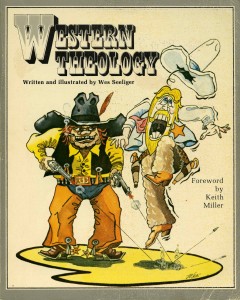
    Western Theology

  • Inebriated by the Gospel

    Smoky Mountain Moonshine

    Great grace laced imagery from Robert Capon:

    The Reformation was a time when men went blind, staggering drunk because they had discovered, in the dusty basement of late medievilism, a whole cellarful of fifteen-hundred-year-old, two-hundred-proof grace – of bottle after bottle of pure distillate of Scripture, one sip of which would convince anyone that God saves us single-handedly. The word of the gospel – after all those centuries of trying to lift yourself into heaven by worrying about the perfection of your bootstraps – suddenly turned out to be a flat announcement that the saved were home before they started… Grace has to be drunk straight: no water, no ice, and certainly no ginger ale; neither goodness, nor badness, nor the flowers that bloom in the spring of super-spirituality could be allowed to enter into the case.

  • Balance of Faith

    Balance Act

    A true, vibrant Christian faith is someting akin to a balancing act.

    In a post this morning, Tim Keller suggested:

    If we are going to grow in grace, we must stay aware of being both sinners and also loved children in Christ.

    Keller’s paradigm reminded me of something Edward Payson – “Praying Payson of Portland” – wrote long ago:

    True Christianity consists of a proper mixture of fear of God, and of hope in his mercy; and wherever either of these is entirely wanting, there can be no true Faith. God has joined these things, and we ought by no means to put them asunder.

    He cannot take pleasure in those who fear him with a slavish fear, without hoping in his mercy, because they seem to consider him a cruel and tyrannical being, who has no mercy or goodness in his nature. And, besides, they implicitly charge him with falsehood, by refusing to believe and hope in his invitations and offers of mercy.

    On the other hand, he cannot be pleased with those who pretend to hope in his mercy without fearing him. For they insult him by supposing there is nothing in him which ought to be feared. And in addition to this, they make him a liar, by disbelieving his awful threatenings denounced against sinners, and call in question his authority, by refusing to obey him.

    Those only who both fear him and hope in his mercy, give him the honor that is due to his name.

    Both Payson and Keller give credence to thw wisdom of Puritan Thomas Watson:

    The two great graces essential to a saint in this life are faith and repentance. These are the two wings by which he flies to heaven.

  • 6 Tips for God’s People in Response to a Culture Changed by Court Decree

    Rainbow Sunset

    While I do not want to become one of those guys who perpetually toots out only one tune, and I certainly do not want to make gay marriage or homosexuality the priamary notes of that tune, I do want to follow up yesterdays post with another reflecting on appropriate responses to the Supreme Court rulings yesterday.  This one is from an acquaintance, John Freeman, President of Harvest USA.

    ***

    As the Supreme Court struck down the 1996 Defense of Marriage Act and the referendum of Proposition 8 in California, it certainly seems that the tide of our culture will continue to steadily move in the direction of the acceptance of gay marriage. So, what now? How are followers of Jesus Christ, and the church, to think about and respond to the recent decision by the Supreme Court? It is crucial that the church as an institution, and individual believers, respond well. John Freeman, president of Harvest USA, a ministry devoted to those struggling with sexual sin, thinks that the best response of the church now is to do the following six things:

    1. We should not lash out in anger or be afraid

    A fight or flight response is normal when cataclysmic events occur. But both these instinctual responses are unhelpful and unproductive. My wife has often told me, “John, when you speak or react out of fear or anger . . . bad things come out of your mouth.” She is usually right. Admittedly, we may legitimately fear where this decision will next take our nation; and we may legitimately be angry over how God’s design for the institution and function of marriage as it has historically benefited society is being hijacked. But we need to keep this in mind: As believers, our true citizenship is in heaven. We must think and act like those whose world has been impacted but not devastated.

    I think a more productive response would be that of grief. We need to be grieved at what happened, grieved at the state of the culture, and grieved at how blind people are to the truth. Jesus wept over Jerusalem and her refusal to turn to him as their shepherd, and the Old Testament displayed a similar common response to tragic national events, where the people grieved in sackcloth and ashes.

    Just grieve? Doesn’t seem very productive or helpful. It feels so powerless! Yes, but we need to remind ourselves that the “weakness” of the church is how the power of God is best displayed. The reason we don’t have to be angry or afraid is because . . .

    2. We need to remind ourselves that God is still on the throne . . . neither slumbering nor sleeping

    Although decided in the private chambers of the Supreme Court, this has not happened out of God’s sight. He is the God who knows all and sees all. This is beyond our rational understanding, but by faith we believe that God remains in control over all things, even over the decisions made by man and society that veer away from his wisdom. To respond with anger or abject fear is to forget this

    Why God has allowed the acceptance of homosexuality and the legalization of same-sex marriage to be so prominent today will remain a mystery at some level. Why he has allowed it to split churches, denominations and families must also be trusted to his providence. We only know what Scripture does tell us: that this is a broken world, a world where his image-bearers are in rebellion against him and his intentional design for creation. Nothing really new here.

    We must, as his followers, trust in Him at all times, especially when it seems that ungodliness has the upper hand. This is the courage of faith, and that courage must also move us to . . .

    3. Boldly and gently proclaim the ultimate destructiveness of ungodly actions

    While many will celebrate this decision as the advancement of an enlightened society and a triumph of inclusiveness and tolerance, the reality is that actions made in opposition to God’s design carry with them significant consequences. Several years ago noted pastor, teacher and author, James Boice, said, “It’s God’s world, not our world. Although we may want to rewrite the rules, we can’t, because it’s God’s world. And sin is destructive, whether or not we admit or agree, it’s still destructive.” By removing the definition of marriage from its historical and God-designed nature as being between one man and one woman, how long will it be before other forms of “marriage” will be legal (such as polygamy and polyamory)? What will be the effect on children and families as we move into territory that is completely new to human society?

    These kind of ungodly decisions serve to remind us that the world in which we live is hostile to things of God. It reminds us that we live here as “aliens and strangers,” that we’re temporary residents of a foreign land. But it still remains a world that God so loved that he sent his only Son, so . . .

    4. We must not avoid our calling: to engage the culture and all people with the truth and mercy of the gospel.

    Even as culture goes off the rails, and we may seem powerless to stop it, we’re not off the hook from engaging the culture and actively loving people. Although we may want to retreat and go into self-protective mode, we must not. The church did not do so as the Roman culture descended into greater ungodliness and injustice. The downward spiral of our society and the increasing celebration of what is explicitly forbidden in God’s word make our sharing the gospel more important than ever! The gospel is the only hope for a broken world and fallen hearts. For this reason the church must not attack and demean gays and lesbians because of this issue. The gospel is a message of hope for everyone; not a platform for condemnation and ridicule. The gospel is heard through the words and deeds of His people. Another way to put this is our need too . . . .

    5. “Keep calm and carry on” as God’s people and his church.

    During World War II, people in Britain, during the bombing, felt that the world was falling apart. “Keep calm and carry on,” became a common phrase on billboards and posters as a way to encourage the British people. We need to follow this advice as well. How do we “keep calm and carry on” when we see everything around us in a downward spiral and decay? We lean on and trust in the Rock of our salvation, who is still with his people while we continue to carry out his Kingdom work.

    We must not let these things have more power over us than they really do. And, thankfully, we still live in a country that allows our views to be heard and we should make our concerns known, about the reality of unintended consequences making further trouble and about the future of religious liberty, two major issues embedded in this controversy. But, again, we should not place our faith in any human political or legal structure as our ultimate protector or savior. Jesus said that his kingdom was “not of this world”—neither is ours. The mission of the church continues. The church cannot be either dismissed or destroyed. It remains God’s vehicle of redemption, worked out through his people. That mission will endure until he returns. And in the meantime, the church—and especially the next generation inside her doors— needs to be strengthened by. . .

    6. Relevant and effective preaching and teaching about sex.

    The silence of the church on many issues has contributed to the emergence of movements that have been detrimental to mankind (see Germany and the rise of Nazism). It can be argued that the church’s failure to preach and teach about why God’s design for sexuality is good, relevant and functional (even in a broken world) has created a vacuum for the acceptance of same-sex relationships. The church has said “No!” for too long as its main message on sexuality and now needs to say “Here’s how,” or here’s how God’s design for sexuality remains the best venue for people and society to flourish.

    ***

    On a more personal note, I am looking forward to having John Freeman at our church this coming Fall.  On November 9 of this year, John will be leading a seminar, Finding Sexual Sanity in Sex-Crazed Society, at Grace Covenant Presbyterian Chuch in Williamsburg.

    If you are interested, check out the Harvest USA blog.  You will find a number of excellent, thoughtful articles on a wide range of matters related to sexual brokenness: Harvest USA Blog

  • Prop 8, DOMA, and the Unchanging God

    Astonished

    In light of the two U.S. Supreme Court decisions today, I was reminded of something my friend Mike Milton wrote that is pertinent to the issues related to these rulings.  Here is what Mike wrote:

    When the rats begin to scramble on board the ship, it is a sure sign that the boat is sinking.

    Self-described freedom-loving libertarians, and now Karl Rove, believe that Conservatives can embrace same sex marriage, or just leave it to the State as it is a personal “liberty” matter. The defense seems to be “Let the State allow whoever wants to be married to be married. It is a legal contract, not a religious ceremony, for goodness sake.”

    Nonsense.

    The nation we live in is grounded in “inalienable rights” that come from God, not from government. Our government was designed to guard and defend these rights, not dispense or arbitrate them, because they are based upon “inviolable” laws which must not be transgressed, dishonored, or broken.

    This is not a so-called “religious” matter, but a matter of “natural law” that transcends government and social trends and attitudes. One of those inviolable laws is the law of marriage. It is a “Creation Ordinance” in that it extends to the very beginning of humankind. It is embedded in our species as surely as murdering another person is or stealing from another is.

    Jesus, when questioned about divorce, appealed to this Creation ordinance when he said, “It was not so in the beginning.” He went on to describe marriage as between a man and a woman and in that union, spiritually, physically, and socially, they become one. Biology itself defends the arrangement, and without ever appealing to St. Paul, I could appeal the universal law that is placed in man’s heart to defend heterosexual marriage.

    The Church did not invent marriage; however, the Church (and the Synagogue) must seek to bless what God has placed in the very nature of mankind and the order of His universe.

    To give in to libertarian or muddleheaded notions and cries for transforming what is encoded into the very law of life is to not only go down with the ship, but share in the culpability of destroying it.

    Marriage between a man and a woman is an inviolable law that cannot be tampered with by man. It is lunacy and suicidal to think and act otherwise. And that is just what the Republicans are doing if they join the ranks of conscience-seared and sadly mistaken people who so cavalierly dislodge the veritable cornerstone of human civilization.

    Be certain of this: a nation which denies the inalienable rights of nature and of nature’s God cannot stand and will eventually perish. Freedom cannot be shackled in the human soul.

    I wholeheartedly agree with what Mike wrote.  And I am disappointed with the decisions of the Supreme Court.

    (more…)