Author: Dennis Griffith

  • Famous and Forgotten

    Shooting Star

    On the Plains of Shinar, according to Genesis 11, the people verbalized both their plan and the motivation driving it:

    “Come, let us build ourselves a city and a tower with its top in the heavens, and let us make a name for ourselves..” (v. 4)

    It was a quest for fame that compelled them to action.  Unfortunately for them, they soon reaped the consequences of their vanity, and in a sad ironic way they reached their goal of lasting notoriety.  They aspired to fame; they achieved infamy.

    I am breaking no new ground when I suggest that our present culture – perhaps especially our youth culture – may benefit from some reflection about aspiring to fame.  While there is nothing inherently wrong with fame, it has been said that fame used to be a by-product of success or achievement, or of some tremendous virtue; but in our media crazy world fame has seemingly become a virtue of it’s own.  There is perhaps no better illustration than the proliferation of Reality TV, and the – which has fastly made famous many with no apparent talents, and many with no apparent virtues.

    The Wall Street Journal recently offered an interesting reflection on the fleetingness of fame: Famous Today, Forgotten Tomorrow.  In this cultural commentary the author recounts the astronomical statures of Bing Crosby, Bob Hope, among others, and how each is all but forgotten – virtually unknown to this present generation.

    It got me thinking.

    While Proverbs 22.1 tells us: “A good name is to be chosen rather than great riches…”, a good name does not necessarily mean a known name.  A good name is one that is respected by all who know it – or rather, appreciated by all who know the person who wears the name.  Just as fame used to be, a good name is inseparably linked to one’s virtues.  And gaining a good name, not a known name, is a noble ambition.

  • Good News From the Front in the War on Christmas

    War on Christmas

    With all the War on Christmas rhetoric that has seemingly spewed these past few years, LifeWay Research has some good news from the front lines.  While I am not certain any full fledged war has actually existed, it seems there have certainly been a variety of insurgences erupting.  Such things have probably almost always existed but, as the culture wars rage, reporting of instances opposing Christmas – some quite ludicrous – seemed more numerous than ever.  But now a recent study offers some calm.

    LifeWay Research data now shows that most Americans favor more traditional expressions of Christmas, and want more emphasis on Jesus during this season of the year. In fact, even most of those with no faith affiliations, dubbed by some as the “Nones”, say they have no problems with expressions celebrating Christ.

    Over on his blog at Christianity Today, The Exchange, Ed Stetzer analyzes the research data, and provides a link to the downloadable research report.  Click: Americans Want to Keep Christ in Christmas.

  • Advent Conspiracy

    Advent Conspiracy is designed to remind us of what really matters during this Christmas season.  While there is nothing inherently wrong with our traditions of gift giving and celebration, consumeristic forces are constantly at work, eroding our connection with the reason we celebrate.  What is helpful to remember is that Christ Jesus came into the world to redeem sinners, to set free those captive to their sin and their situations.  And he has commissioned his followers to be his agents to continue what he began – in the power of his Spirit.  Consider how you can make a difference in some small way.

  • A Christmas Reflection: Allowing God to Work in Us

    Christmas Mary

    Consider Mary’s response to the angel. The angel has come to Mary and says: “Mary, you are going to give birth to the long-promised Messiah.”

    This was a unique promise, and unrepeatable. There is something totally unique here: the birth of the eternal second Person of the Trinity into this world.

    What was her response?

    • She could have rejected the idea and said: “I do not want it: I want to withdraw; I want to run…”
    • She could have said: “I now have the promises, so I will exert my force, my character, and my energy, to bring forth the promised thing.”

    But what she did say is beautiful, it is wonderful. She says:

    “Behold, the bondmaid of the Lord; be it unto me according to thy Word.” – Luke 1.38

    There is an active passivity here. She took her own body, by choice, and put it into the hands of God to do the thing that he said he would do, and Jesus was born. She gave herself to God…

    This is a beautiful, exciting, personal expression of a relationship between a finite person and the God she loves.

    ~ Francis Schaeffer, from True Spirituality

  • For All Life’s Moment

    This touching video evokes bitter-sweet thoughts for me.  As a cancer survivor, it gives me reason for great thankfulness. Yet it is a reminder of my personal frailty, and that I am not promised tomorrow. (Proverbs 27.1)

    I am reminded of how young my own sons were when I was diagnosed – my daughter even younger.  I remember the thoughts during the first moments I was alone, all the ways I had failed them; all that I wanted to share with them – if only given the opportunity of time. I am thankful my sons and daughters have grown, that all of them have given me cause for joy and pride, and that I have been here to see it.

    I am reminded of the importance of priorities – putting first things first.  I continue to fail with this, as all too often I put my own comfort and preferences first. Yet given each new day, I am also given an opportunity to live out my priorities.

    I cannot help but to think of Solomon’s plea:

    “My son, do not forget my teaching, but let your heart keep my commandments, for length of days and years of life and peace they will add to you.” (Proverbs 3.1-2)

    I cannot help but hope in Solomon’s promise:

    “And now, O sons, listen to me: blessed are those who keep my ways. Hear instruction and be wise, and do not neglect it. Blessed is the one who listens to me, watching daily at my gates, waiting beside my doors. For whoever finds me finds life and obtains favor from the Lord, but he who fails to find me injures himself; all who hate me love death.” (Proverbs 8.32-36)

    For these are not only the words of wisdom I have wanted to impart to my sons (and daughter),  they are the words of my heavenly Father to me.

  • Birdwatching: Medicine for My Soul

    Osprey with Fish

    I love this perspective from Paul Tripp:

    “When you are struglling with anxiety, look at creation. Embedded in the physical world are constant reminders that God does not abandon the work of his hands.”

    Tripp appropriately spiritualizes something that I have experienced but had never really contemplated sufficiently.  My tendency has long been to retreat into creation – whether it be the mountains of Tennessee, or the forests and river beaches here in Hampton Roads, or wherever – just to regain a sense of peace. I am reminded of God’s greatness and presence in such places.  And while I have long understood, advocated, and preached that standing on a mountain top or on the ocean shores can offer a sense of God’s awesomeness and beauty, I don’t know that I have really given adequate thought to the the practical theological principle behind the practice that relieves angst.  

    I am reminded of Jesus’ counsel in Matthew 6:

    “Therefore I tell you, do not be anxious about your life, what you will eat or what you will drink, nor about your body, what you will put on. Is not life more than food, and the body more than clothing? Look at the birds of the air: they neither sow nor reap nor gather into barns, and yet your heavenly Father feeds them. Are you not of more value than they? And which of you by being anxious can add a single hour to his span of life? And why are you anxious about clothing? Consider the lilies of the field, how they grow: they neither toil nor spin, yet I tell you, even Solomon in all his glory was not arrayed like one of these. But if God so clothes the grass of the field, which today is alive and tomorrow is thrown into the oven, will he not much more clothe you,O you of little faith? Therefore do not be anxious, saying, ‘What shall we eat?’ or ‘What shall we drink?’ or ‘What shall we wear?’ For the Gentiles seek after all these things, and your heavenly Father knows that you need them all.

    As Tripp suggested: “Bird watching is good for the soul.”  

    Despite what relatively little knowledge I have about ornithology, I now see how beneficial it can be to periodically spend some time quietly watching the birds go about their business and their play.  Not only does it provide for tranquill moments, bird watching offers a much needed and refreshing reminder: If birds live stress free lives, how much more should I.  For while the birds were created to bring pleasure to the Creator, I am one made after the image of God; and as a consequence of the union I have with Jesus, through faith in his redeemeing work, I am one who is (admittedly undeservedly) among those who are the objects of the Father’s affection. If God loves the birds, how much more those who are in Christ – even me!

  • Seed of the Word in the Soil of the Heart

    Sprout in Hand

    “Truly, the Bible as the Word of God has an inherent power, but it is not a coercive power. That is, the Bible does not work it’s effects mechanically. We don’t change just because we read it. Out minds may be engaged in the text, but something must happen in our hearts as well. In the parable of the Sower (Matthew 13.18-23), the seed does not miraculously and independently transform itself into a flowering plant. The condition of the soil effects how well the seed takes root. Our hearts must be receptive to God’s Word in the same way the soil must be rich and conducive to the development of deep roots and luxurient growth. As Oliver Wendell Holmes once said: ‘What you bring away from the Bible depends to some extent on what you carry to it.’”

    Tremper Longman, from Reading the Bible With Heart & Mind

  • Honest Answer to Honest Questions, and Open Dialogue Wherever Possible

    Dialog & Discuss

    Boyce College professor, Denny Burk, has posted an interesting warning about a common tactic employed by some with theological agendas – especially those with liberalizing theological agendas.  His post is titled:  Should Churches “Dialogue” About Sexuality?

    Having read through it a couple of times I find myself appreciating Burk’s concern.  Burk notes that many a subtle debate may begin with a seemingly reasonable appeal:

    “…with the liberals calling for more dialogue about the issue.”

    Then, citing conservative writer Rod Dreher:

    Ah, the old “conversation starter” or “dialogue” trick. Any time you see a progressive member of your church try this, you must understand that this is the wedge that they will use to pry the orthodox out. The “conversation” will be one-sided, and will not end until the orthodox have surrendered or left, because the progressives will never, ever take “no” for an answer.

    While I am not one who is overly concerned about debate, or about being drawn into compromised theology, I have seen this tactic employed.  (For the sake of fairness, I must admit that I have seen the technique attempted by both those on the theological left, and by some on the far right.  It just seems that those on the far right are more likely to quckly show their hand, their agenda.)  So I agree with Burk, we need to be mindful of this, and encourage the people in our churches– or at least our church leaders – to be mindful of this ploy.

    However, what Burk is addressing is not the biggest challenge to the church I serve.  Our congregation is pretty well rooted in sound theology and conservatism.  (NOTE: These are not always the same thing, especially when the conservatism is more political than theological.)  For most of our members it is not difficult to get them to accept the authority of God’s Word on any particular subject.  Our  commitment to deep, rich, historic, orthodoxy is one of the primary reasons they are part of the church.  And while we have many who are doing inspiring works throughout our community, it is far more a concern whether we can get some of the others to love and engage their neighbors – most of whom are likely to differ with us on any number of social issues – than it is whether they will be susceptible to trendy Spirits of the Age.

    So while I appreciate Burk’s wisdom, I believe we also need to prepare people to “dialogue”.

    Dialogue is how we engage people, without requiring that they agree with us as a precondition of  being welcome in our church or wanted as a friend.  Dialogue is one way we are able to express and cultivate love for our neighbors.  Dialogue may be the only way for some to hear what God has to say about a particular subject, as we appropriately bring our understanding of the Word into the conversations. Dialogue about issues in which we (at least) initially differ may be the means by which some hear the gospel for the first time – as the gospel does apply in some manner to all matters.

    No doubt some readers will be uncomfortable with my call to dialogue with unbelievers and with theological compromisers (- which usually qualifies them as unbelievers).  But I am convinced that somewhere, somehow, we need to cultivate environments that encourage dialogue – and we must do this for the sake of the gospel.

    I don’t feel alone in this thought. It is what Francis Schaeffer called for a couple generations ago.  In his Two Contents, Two Realities, the second content was: Honest Answers to Honest Questions.

    I agree that we must be wise, and that there are times when conversation should be cut off – such as when it is apparent that the “dialogue” is not honest but rather a cloak over a subversive agenda. This is what Burk has in view, and so it is why I appreciate his thoughts.  But, just so there is no mistaking Burk’s counsel as an invitation for Evangelicals to hide out in the fortress of the church, I also feel compelled to contend for genuine dialogue, since it is the only way we will have opportunity to hear Honest Questions from our culture to which we may offer Honest Answers from God’s Word.

  • Grace & Peace: The Song

    This song from Sovereign Grace Music, that shares the same title as this blog,  is a three verse meditation on Romans 1.7:

    Verse 1

    Grace and peace, oh how can this be / For lawbreakers and thieves / For the worthless, the least / You have said, that our judgment is death / For all eternity / Without hope, without rest / Oh, what an amazing mystery / What an amazing mystery/ That Your grace has come to me

    Verse 2

    Grace and peace, oh how can this be / The matchless King of all / Paid the blood price for me / Slaughtered lamb, what atonement You bring! / The vilest sinner’s heart / Can be cleansed, can be free /  Oh, what an amazing mystery / What an amazing mystery / That Your grace has come to me

    Verse 3

    Grace and peace, oh how can this be / Let songs of gratefulness / Ever rise, never cease / Loved by God and called as a saint / My heart is satisfied / In the riches of Christ / Oh, what an amazing mystery / What an amazing mystery  / That Your grace has come to me

    TAG

    Oh, what an amazing love I see / What an amazing love I see / That Your grace has come to me / Oh, what an amazing love I see / What an amazing love I see / That Your grace has come to me

    © 2013 Sovereign Grace Worship

  • More Than Numbers

    Miracle Gro

    Here is a needed reminder:

    I’m not so sure God cares how big your church is. Seriously. If your numbers aren’t “growing,” so what? I’m also not sure that the sign of a vibrant healthy church is ever-increasing growth, significant growth. It seems to me that the sign of a vibrant, healthy fully alive church is one where God’s people are growing in love, knowledge, and insight, not numbers. I’d rather be in a church like this than a church that is “growing” with greater numbers of people with shallow faiths who do not love well.

    Where did Paul ever rebuke a church because their numbers were not growing by some set of hoped for percentage points?

    Great point. I would add: Or Jesus, in his Letters to the 7 Churches in Revelation 2-3

    I get the church growth rationale.  And I agree with some of the foundations of it, at least as it was originally developed as a mission strategy. But the American obsession with Bigger is Better has distorted much – maybe most – of the good that the original proponents of church growth may have intended.  Many of us have misapplied the whole concept of growth and mistaken it as the measuring stick for God’s blessing.  Size of a congregation is about as good of an indicator of being blessed by God, as is wealth an indicator of worth; or better still, as height an indicator of greatness.  (In other words, not a valid standard at all.) Consequently, faithfulness and substance is often subverted by gimmicks and pragmatism.  Whatever works to get them in… right?

    Years ago, while I was servivng a fast growing congregation (that a year later showed the evidence of serious fractures), a good and gifted friend was “languishing” in a church that could not quite break the 100 barrier – even on Easter.  He was discouraged –  to put it mildly.  To encourage him, I offered a parallel thought.  Knowing of a huge community college in his city, I asked about the number of students who attended the school. He said he estimated 50,000 – 60,000 students.  So I observed that the school must be some impressive, prestigious place.  After all Harvard has only 6000 or so students.  The guy who is president of that community college must be thought of as having had 10 times the success as the guy who can’t lead a school any larger than Harvard!

    He got the my point of my sarcasm.  It is a ridiculous analogy to compare a community college with a school with the history, the resources, and he selectivity of a Harvard.  Size is no indication of anything.  And neither is size any measure of a church.


    To read the whole short post I quoted at the top, click: A Healthy Vibrant Church May Never Be Big


  • Marriage According to the Bible

    Adam & Eve (Red-Blue)

    by Ray Ortland

    Therefore a man shall leave his father and his mother and hold fast to his wife, and they shall become one flesh.  Genesis 2:24

    It is not true that the Bible teaches multiple views of marriage, and therefore the Bible’s clarity is diminished on this question.  The Bible does record, for example, that “Lamech took two wives” (Genesis 4:19).  But the Bible is not thereby endorsing polygamy, but indeed is casting doubt on polygamy.  The role of Lamech in the text is to show “a progressive hardening in sin” (Waltke, Genesis, page 100).  We invented polygamy, along with other social evils.  But God gave us marriage.

    The Bible defines marriage in Genesis 2:24, quoted above.  Here is what this very significant verse is saying:

    Therefore.  This word signals that Moses is adding an aside to his narrative.  It’s as if we are sitting in Moses’ living room, watching his DVD of the creation of the universe (Genesis 1) and of man and woman (Genesis 2).  At this point he hits the pause button on the remote, the screen freezes, he turns to us post-fall people watching these amazing events and he says, “Now let me explain how what God did so long ago is normative for us today.  Amazingly, we still retain something beautiful from the Garden of Eden.”

    A man shall leave his father and his mother.  In a culture of strong bonds between the generations, this is striking.  A man’s primary human relationship is no longer with his parents or ancestors.  He breaks away from them for the sake of a more profound loyalty.

    And hold fast to his wife.  A man, in marrying, enfolds his wife into his heart.  He rejoices to identify with her: “This at last is bone of my bones and flesh of my flesh” (verse 23).  At every level of his being, he becomes wholeheartedly devoted to her, as to no other.

    And they shall become one flesh.  “One flesh” is essential to the biblical view of marriage.  It means, one mortal life fully shared.  Two selfish me’s start learning to think like one unified us, sharing one everything: one life, one reputation, one bed, one suffering, one budget, one family, one mission, and so forth.  No barriers.  No hiding.  No aloofness.  Now total openness with total sharing and total solidarity, until death parts them.  Moreover, Jesus explained that, behind the word “become,” God is there: “What therefore God has joined together . . .” (Matthew 19:6).  Marriage is not a product of human social evolution.  Marriage came down from God.  And he defined it for us.  He has the right to.  It belongs to him.

    One mortal life fully shared between a man and a woman — this is marriage, according to the Bible, because Genesis 2:24 is not a throw-away line.  Its very purpose is to define.

    What’s more, the apostle Paul quotes Genesis 2:24 to take our understanding a step further — an amazing step: “We are members of [Christ’s] body.  ‘Therefore a man shall leave his father and mother and hold fast to his wife, and the two shall become one flesh’” (Ephesians 5:30-31).  Did you notice his logic?  “We are members of Christ’s body.  He loved us.  He chose us.  He gave himself up for us.  He embraced us.  He is with us.  He will present us someday in splendor.  All of this glory is ours, because we are united with him now and forever.  Therefore, this is why, our union with Christ is the reason why, a man and women get married and live united as ‘one flesh.’  Human marriages are miniature social platforms on which the gospel is to be displayed.”

    Marriage is a gospel issue.  That is the ultimate reason why clarity about its definition matters.  People who depart from, or fail to stand up for, the biblical view of marriage are taking a step away from the gospel itself.  The whole Bible is the story of the marital love of God, as I demonstrate in this book.  Our whole lives are that story, if we have eyes to see.

    Marriage is more than human romance, wonderful as that is.  Marriage is the display of Christ and his Bride in love together.  A beautiful, tender, thriving, Ephesians 5-kind of marriage makes the gospel visible on earth, bringing hope to people who have given up believing there could be any love anywhere for them.  That is why biblical marriage deserves our courageous loyalty today.  And that is why, in our increasingly secular times, biblical marriage is under pressure.  Its true meaning is understood and embodied and sustained only by the power of the gospel.

    We can’t turn the clock back to the days of the Christian social consensus the West has foolishly thrown away.  But we who say we believe the gospel can and must stand up for the biblical definition of marriage.  We must cultivate beautiful marriages ourselves.  We must suffer social rejection bravely.  We must pray for revival.  We must wait for the inevitable collapse of every false view of marriage.  We must lovingly serve all who suffer for their foolish attempts at false “marriages.”  And we must go to church this Sunday and worship the living God with all our hearts, so that we ourselves are sustained for faithfulness over the long haul, because this isn’t going to be easy.

    ***

    Read more from Ray Ortland’s excellent blog: Christ is Deeper Still

  • Heaven is for Real… But What About Near-Death Experience Claims?

    Stairway to Heaven

    Debuting this weekend in theaters across the USA is a heart tugging film, Heaven is For Real.  Based on the book of the same title, the story is about a young boy who ostensibly died and revived. In between his death and his resuscitation he made a brief stop-over in heaven.  At least that’s the story.  In the story, as I understand (having not read the book), the “risen” boy gains inexplicable knowledge, compelling his skeptical family of the genuineness of his experience, and thus the reality of heaven.

    This is just one of scores of such books – people claiming to have “seen the light”, then returning to this present life.  Perhaps most well known, at least before this weekend, is Don Piper’s 90 Minutes in Heaven.  (Though I wonder how many people who bought his book mistakenly thought it had been penned by JOHN Piper.)

    I suppose the intrigue with such books is understandable.  People are looking for hope and assurance. And what better way to learn about heaven than to hear testimonials of those who have ostensibly been there?

    And I get why the release of a film like Heaven is For Real would be scheduled for Easter weekend.  Easter is a day associated with religious hope, resurrection, etc.  So a film like this, especially in a widely biblically illiterate culture, tugs the heart strings while feeding religious (and superstitious) hunger pangs.  I suspect that the film will widen the belief in – or at least interest in – many such claims to these experiences.

    But what should a Christian think about such claims?

    While I cannot claim definitive expertise on this subject, I have some significant qualms about claims to near-death experiences.  For one reason, it seems to me that “near-death” is like “near pregnant” – either one is, or is not.  I get that some flat-line and then resuscitate.  But is that actual death?  Second, the claims I have heard regarding this experience are dubious.  For instance, I have read that in the case of the Heaven Is For Real kid, that there is no record of him having coded…  My greatest skepticism is because few (if any) of those who claim to have gone to heaven for a time make any mention of necessity of Jesus for access.  While this may not be troubling for non-Christians, the Believer must reconcile these claims to what Jesus taught us in such passages as John 14.6.

    Scripture is largely silent about this subject.  In fact, when I think about it, I find it interesting God did not include a testimony from Lazarus about his experience or the reality of heaven anywhere in the New Testament. Perhaps that is because there are things about heaven that are intended to remain a mystery to us for a time.

    In a recent podcast, John Piper does discuss this subject.  In short, Piper says: “If books go beyond scripture, I doubt what they say…”  But take a moment to listen to what Piper has to say:  Heaven Is For Real

  • Thoughts on Easter Giveaways

    Field of Eggs

    I was stunned the first time I read about the plan of a church in the area where we then lived to give away prizes at an Easter gathering.  And they were not just going to give stuff away, they were planning to create a frenzy.  A helicopter was leased, piloted by some guy in an Easter Bunny costume (which alone raises questions).  With people gathered at a rented junior high school soccer field, the Easter Bunny would drop plastic Easter Eggs each filled with either candy, cash, or with redeemable certificates for such items as i-pods, cell phones, etc. And they did this on Easter Sunday right after their services.  It just seemed wrong, but I held my tongue.

    For two weeks leading up to the “drop” the local newspaper contained a full page ad promoting this “celebration”. But it was not until I read an interview with the pastor the day after Easter that I could stand it no longer.  His statement that set me off?  He said:  “We’re just loving on our neighbors.”

    While that statement may seem benign enough, I felt compelled to respond. So I shot him an e-mail.  I had met the guy before, though did not know him well.  But I hoped he would at least consider his actions, or the potential effects of them.  So I wrote him a note challenging his notion of “loving his neighbors”.

    I told him that he was not so much loving his neighbors as he was buying them, or bribing them.  True, he had gathered a large group to an Easter event, but it was not because of the proclamation of Christ crucified and resurrected (- though I assume that was mentioned at the actual church service).  How many in attendance were actually members of other congregations who were enticed only by the promise of goodies? (No, no one from the church I served attended their event.)  I conceded that perhaps such a giveaway would have been an expression of love had they chosen to hold it at one of the local public housing projects, and limited the participation to those with minimal incomes.  After all, that would have given to those who are without, and given to those who can give no more to the church than their presence.  But they had been advertising for weeks to the whole city – wealthy, middle-class, and poor alike.  They were merely buying potential “customers” – just like Wal-Mart, Best Buy, or any other consumer-driven business does.

    Perhaps not surprising, I did not get a response to my e-mail.  The next year the church added a giveaway at the worship service – a new car to some lucky person with the correct number on their Easter Sunday worship bulletin.  I did not bother to send another e-mail.  I just mused in disappointment about what seems to be replacing the gospel in too many churches.

    Apparently I am not alone in my distaste for this practice.  I recently read a post by Jared Wilson, who also has some concerns about it.  In his post Wilson gives ten spot-on-right reasons why he thinks luring people in with cash and prizes is not a good idea:

    1. It creates buzz about cash and prizes, not the Easter event. When the media takes notice, nobody wants to interview these pastors about the resurrection. They want them to talk about the loot.

    2. It identifies the church not with the resurrection, but with giving toys away. It makes us look like entertainment centers or providers of goods and services, not people of the Way who are centered on Christ.

    3. Contrary to some offered justifications, giving prizes away is not parallel to Jesus’ providing for the crowds. Jesus healed people and fed them. This is not the same as giving un-poor people an iPod.

    4. It appeals to greed and consumerism. There is no biblical precedent for appealing to one’s sin before telling them to repent of it. This is a nonsensical appeal.

    5. Yes, Jesus said he would make us fishers of men, but extrapolating from this to devise all means of bait is not only unwarranted, it’s exegetically ignorant. The metaphor Jesus is offering here is just of people moving from the business of fishing to the business of the kingdom. There is no methodology being demonstrated here. (But the most common one would have been throwing out nets anyway, not baiting a hook.)

    6. It is dishonest “bait and switch” methodology. Sure, the people coming for the goodies know they’re coming to church. But it’s still a disingenuous offer. The message of the gospel is not made for Trojan horses.

    7. It demonstrates distrust in the compelling news that a man came back from the dead!! I mean, if nobody’s buying that amazing news, we can’t sell it to them with cheap gadgets.

    8. It demonstrates distrust in the power of the gospel when we think we have to put it inside something more appealing to be effective. What the giveaways really communicate is that we think the gospel needs our help, and that our own community is not attractive enough in our living out of the implications of the gospel.

    9. The emerging data from years of research into this kind of practice of marketing/evangelism attractional church stuff shows the kind of disciples it produces are not strong. I have no doubt these churches are going to see decisions Easter weekend. They’ll herald them on Twitter and on the blogs. As questionable a practice as that can be, I’d be extra interested in how discipled these folks are in a year or two years or three. Hype has always produced “decisions.” Would anyone argue that after 30 years or so of the attractional approach to evangelism the evangelical church is better off, more Christ-centered, more biblically mature?

    10. What you win them with is what you win them to.

  • Numbering the Sheep on the Ranch

    Counting Sheep

    Blogger Tim Challies is at the Together for the Gospel Conference, surrounded by other church leaders.  No surprise then that he is hearing this common question all around him: “How many people go to your church?”  And apparently Challies, whose primary vocation is writer not pastor, has some concerns about this question:

    I’d like to make the same two-part proposal I made a few years back: Let’s stop asking, “How many people go to your church?” And when someone asks us that question, let’s not feel obliged to give a direct answer.

    Challies understands the heart challenge for the pastor in those moments when that question is posed:

    For the pastor this can be a moment of pride or humility, freedom or shame…

    While not presently prone to the tugs toward embellishment, I am not sure whether it is because of personal growth or just that my external circumstances have changed.  I serve a good-sized congregation, with an excellent staff, in a desirable locale.  But I know those feelings well.  On occasions in the past I’ve felt the temptation to exaggerate, such as to cite Easter attendance as if that were the norm. (I know others who have also considered that one.)  The obvious reason for the temptation is embarrassment about the reality, as if the number in attendance is somehow a precise indicator of the abilities or worth of a pastor or congregation, or of God’s pleasure in either.

    Challies writes:

    We all pay lip service to the reality that we cannot necessarily measure the health of a church by its size. We all know that some of the biggest churches in the world are also some of the unhealthiest churches in the world. The history of Christianity has long-since shown that it is not all that difficult to fill a building with unbelievers by just tickling their ears with what they want to hear. We also know that the Lord is sovereign and that he determines how big each church should be and we know that in some areas even a very small church is an absolute triumph of light over darkness. And yet “How big is your church?” is one of the first questions we ask.

    Why is this?

    I don’t know all the reasons but I’d suggest at least two. First, I think our question betrays us and shows that in the back of our minds we equate size and health. Somewhere we make the connection between big and healthy, between big and blessing. We exacerbate the problem when we ask and answer this too-easy question. Second, we just haven’t taken the time and made the effort to form better questions. Instead, we gravitate to the easy one.

    So what might be some better questions to ask?  I appreciate Challies’ suggestions:

    • How have you seen the Lord working in the lives of the people in your church?
    • What evidences of the Lord’s grace has your church experienced in the last few months?
    • What are you excited about in your church right now?
    • Who are you excited about in your church right now?
    • What has the Lord been teaching you?
    • Who have you been discipling recently?
    • Tell me about some of the future leaders at your church.

    These are much better to get a sense of the story in any congregation.

    And inevitably when asked: “How many people go to your church?” Challies suggests answering something like this:

    • As many as the Lord has determined we can care for at this time.
    • Enough that we are actively working toward planting a church.
    • I don’t know, but let me tell you about a few of them…

    Interest in numbers is not wrong.  Numbers tell us things.  But just what numbers tell us is not always readily clear.  Numbers are not wrong, it is the fascination with numbers that is problematic.  Numbers just do not tell a story.  Much more valuable is the number of stories of how God is at work in any congregation.

    To read Challies’ post, click: How Many People?

  • Is Church Membership Really Required?

    Concepts

    by Ricky Jones

    This month we will be inducting new members into the most honored body the world has ever known: the church of Jesus Christ. The initiation fee for this club is so high that no human could have ever paid it; God himself had to pick up the tab. The benefits of the club never expire. The fellowship of the club is unmatched; you receive intimate access to the Lord himself (John 17:23).

    With such benefits, you’d think church membership would be held in infinitely high esteem. But for many reasons, Christians seem to think less of it than ever before. If you’re one who looks upon church membership lightly, then I invite you to reconsider.

    When we hear the word membership, we immediately think of a club. A member pays dues, comes to meetings, and fulfills the obligations of a club member. When you move, or no longer have time for the club, you simply withdraw your membership and move on.

    The Bible says membership is much more intimate. “For no one ever hated his own flesh, but nourishes and cherishes it, just as Christ does the church, because we are members of his body” (Eph. 5:29-30).

    To be a church member means we are a member of Christ’s body—just like your finger is a member of your body. His blood runs through us. His Spirit animates us. His will moves us. He feels our pain, cleanses us when we get dirty, nurses our wounds, and cherishes us with pride.

    Leaving the church is not simply leaving a club. When you walk away, you dismember yourself from the body. Jesus and the rest of the body sorely miss you, and bleed after your departure. You cut yourself off from your only source of life and nourishment. Like an amputated hand, you will slowly bleed out, wither, and die.

    Not Possible, Biblical, or Healthy

    I hear you complaining already. My, he’s being a bit dramatic. I’m a member of Christ; I just can’t find a local church I like. I’m a member of the universal church, just not of any one in particular.

    I want you to understand that being a part of the universal church without submitting to a local church is not possible, biblical, or healthy.

    First, it’s simply not possible. To imply you can be part of the greater community without first being 
    part of the smaller is not logical. You cannot be part of Rotary International without also being part of a local chapter. You cannot be part of the universal human family without first being part of a small
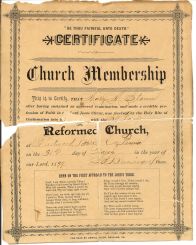
    immediate family.Membership Certificate

    Second, it’s not biblical. Every letter in the New Testament assumes Christians are members of local churches. The letters themselves are addressed to local churches. They teach us how to get along with other members, how to encourage the weak within the church, how to conduct ourselves at church, and what to do with unrepentant sinners in the church. They command us to submit to our elders, and encourage us to go to our elders to pray. All these things are impossible if you aren’t a member of a local church. (See 1 and 2 Corinthians, James, Ephesians, 1 and 2 Timothy, and 1 Peter for references.)

    Asking where the Bible commands you to be a church member is like asking where the USGA rulebook for golf insists you be a human. The whole book is addressed to the church.

    Finally, living without church membership is not healthy. Independence—the desire to choose for yourself what’s right and wrong—is at the heart of sin. You need the humility lesson of submitting to flawed elders. You need the encouragement of sharing victories with your church. You need the fellowship of sharing sufferings with your church.

    You need to know we’re all in this life together, and we won’t walk away from you just because you let us down or we disagree. Together we build each other up into the image of Christ; no one can make it alone. I encourage you to rethink the importance of church membership. Our fellowship may be an affliction, but we are a glorious affliction. And we will walk into glory together.

    ***

    NOTE: This article originally appeared at the RiverOaks Presbyterian Church blog; and also on The Gospel Coalition.

    Ricky Jones is lead pastor of RiverOaks Presbyterian Church in Tulsa, Oklahoma. You can follow him on Twitter