Roots & Wings: Indelible Grace

Kevin Twit and Indelible Grace have helped, directly or indirectly, shape and deepen worship for hundreds and thousands of congregations.  Indelibile Grace was at the forefront of the movement to renew old hymns by setting the rich lyrics to newer music. While, no doubt, this had been tried before, it was Indelible Grace music that seems to have been widely used.  Others followed, also seeing thier songs used in congregational worship throughout the USA, and the Church at large has been blessed by it. at least that is my take on it.

What was, and is, significant about Indelible Grace music, whether the re-written hymns or the newly composed songs, is that they are substantive – they bring to bear deep theological themes and truths and apply them to the emotion, without being emotionally manipulative.  They simply give vioce to deep gospel truth experienced.

This video tells the story of Indelible Grace.  And the featured concert held at the historic Ryman Auditorium in Nashville… I had the privilege to be there – sitting with my wife and several of our closest friends.  Great night; great memories.

In Spirit Produced Corporateness

Naval Academy Rowing Team

As I reflect upon the need of our church to constantly cultivate community among those within our congregation, as well as between those already part of the congregation and those who have newly arrived, I am pondering the poignancy of this statement by Stanley Grenz, from his book Theology for the Community of God:

“Only in our Spirit-produced corporateness do we truly reflect to all creation the grand dynamic that lies at the heart of the triune God. As we share together in the Holy Spirit, therefore, we participate in relationship with the living God and become the community of Christ our Lord.”

Desiring Truth

An Evening Walk (Besnard)

by Wesley Hurd

At the end of one of his films, Deconstructing Harry, writer/actor Woody Allen delivers a movie-ending confession that offers a perverted coherence to the film:

“All people know the truth. Our lives consist of how we choose to distort it.”

For believers, though, desiring truth – undistorted – is central to the process and experience of our salvation. Nothing is more fundamental in our striving for sanctification – our striving to be good as God is good – than our embracing the truth at every level at which it confronts us.

One of the most common names for the presence of God in our lives is the Spirit of Truth. He is the author and source of all that is valuable, good, pure, and true. It follows, then, that believers in the true Gospel – a work the Spirit of Truth authors in our hearts – will seek what is true. Our commitment to living according to what is true is a “litmus test” for whether we are authentically interested in knowing God and learning to love what He loves – truth, justice, and mercy. Are we interested in knowing God? Then, in the end, we will be open to following the truth wherever it leads us. This will be a lifelong process for us, however, because, like our distant ancestors Adam and Eve, we are more inclined to hide from truth than to seek it or to embrace its consequences. Our fallen, darkened hearts do not naturally respond well to truth, especially when it surprises and inconveniences us, when believing and acting upon the truth costs us something.

In his gospel narrative (John 18.28ff), the Apostle John portrays a powerful scene in which Jesus and his captor, Pontius Pilate, engage in a profound exchange over this issue of truth. Their conversation shows two levels at which truth confronts all humans. Both levels can potentially reflect a person’s moral disposition, but the second level proves to be spiritually crucial. Let me explain.

The first level of discovering truth involves whether or not a person believes truth exists at all in a practical and philosophical sense. Is there truth? If so, how do I know it? How can I be confident in what appears to me to be true? In the John passage, Pilate interrogates Jesus and his accusers, attempting to ascertain the true circumstances that led to Jesus’ arrest. At this level of truth seeking, Pilate assumes the truth can be known and assessed. His inquiry proves he believes truth is objectively available and can be sought and found. Having received adequate firsthand testimony, Pilate determines that Jesus is innocent of the allegations against him. The truth made itself plain to Pilate. Pilate then attempts political maneuvers to free Jesus, but he fails when Jesus’ accusers threaten anarchy that would put Pilate himself in political jeopardy.

Yet Jesus intrigues Pilate, who engages Jesus further, asking Him questions that lead Jesus to claim, “For this I have been born…to bear witness to the truth. Every one who is of the truth hears My voice.” Now the second level of our relationship to truth appears. Once we believe we know what is true, are we willing to embrace it and to act accordingly? Pilate was not willing. His reply to Jesus, “What is truth?”, enables Pilate to keep the conversation at the philosophical level rather than going to the second level of personal, existential response.

Jesus identified himself with the vital truths about a person’s relationship to God and eternal destiny. Jesus spoke the truth about God — who He is, what His will is, and how human creatures can align themselves with those truths. Jesus was concerned not only about the factual truthfulness of what one believes (truth at level one), but also about the deeply personal moral posture of one’s heart toward factual truthfulness. Does one’s heart lean toward or away from letting the truth have its way in one’s thought, choices, and behavior? For example, I can know and agree with the theological truthfulness of man’s sin and fallenness, while simultaneously refusing to allow its factual truthfulness to penetrate my personal conscience and thereby own the truth of my guilt and need for repentance.

Continue reading

Role of the Holy Spirit

Holy Spirit (Blue, Yellow, Red)

The Holy Spirit is mysterious to many, perhaps especially to those in more intellectually inclined traditions. Most Christians probably understand that historic orthodoxy recognizes the Holy Spirit to be part of the Trinity, and therefore God, but I suspect many are somewhat less certain about what that means.  Often the Holy Spirit is referred to as a depersonalized “it” despite being the third person of the Trinity. Maybe even more questions surround what exactly the Holy Spirit does.

Some time ago I ran across a satirical confession of faith, one that ostensibly reflects the functional beliefs of a typcical American evanglical. Mimicking the pattern of the Apostle’s Creed, the clause regarding the the Holy Spirit declares:

And I believe in the Holy Ghost, who did some weird stuff at Pentecost, but doesn’t do much more anymore except speak to the hearts of individual believers.

How close to the experience or belief of most, I cannot say. But I suspect, and fear, that it is discomfortingly close to the functional belief of too many.

Recently I have enjoyed a four-part series of posts by Jon Payne from Sovereign Grace Ministries blog, titled: The Role of Holy Spirit. I commend them for a thoughtful introduction and overview:

  • Part 1 – Introduction
  • Part 2 – The Trouble With Nicodemus
  • Part 3 – Who is the Holy Spirit? and What Does He Do?
  • Part 4 – Transaction at the Fountain

I believe this series provides a good Introduction and/or refresher about this one who is often referred to as “The Shy Member of the Trinity”.  Hopefully it will whet your appetite to look further, and to study more deeply.

For those who are interested in digging into this subject, into this Person of the Holy Spirit, I would suggest two things:

First, stay away from some of the more bizarre claims by the likes of Benny Hinn, Perry Stone, Lester Summerall, and others from the Name-It-Claim-It camp, who refer to themselves as “Full Gospel” Christians.  More often than not, there is little gospel reflected in the writings of these folks – at least not the gospel of the Bible.  (See Galatians 1.6-9)  These, at best, offer fascinations that lead away from the Cross.

Second, delve into a copy of one or more of the following books.  This list is hardly exhaustive, but I think all of these provide substantive and sound insights about the Holy Spirit:

9 Reasons People Are Not Singing in Worship

Lift Your Voice II

Charles Spurgeon once quipped: “God is to be praised with the voice, and the heart should go therewith in holy exultation.”

While Spurgeon is right, the problem is that in many congregations the people are not “praising God with the voice”.  If the folks at Renewing Worship are to be believed, part of the reason is that many churches are turning worship into a spectator sport – where attendees watch and listen to a concert as well as a message.  As Kenny Lamm expresses it:

Simply put, we are breeding a culture of spectators in our churches, changing what should be a participative worship environment to a concert event. Worship is moving to its pre-Reformation mess.

Lamm goes on to say he sees nine reasons congregations aren’t singing anymore:

  1. They don’t know the songs.
  2. We are singing songs not suitable for congregational singing.
  3. We are singing in keys too high for the average singer.
  4. The congregation can’t hear people around them singing.
  5. We have created worship services which are spectator events, building a performance environment.
  6. The congregation feels they are not expected to sing.
  7. We fail to have a common body of hymnody.
  8. Worship leaders ad lib too much.
  9. Worship leaders are not connecting with the congregation.

In his article titled 9 Reasons People Aren’t Singing in Worship, Lamm elaborates on each of these observations. His thoughts are worth exploring, and comparing to our own church worship practices.

It may be that your church, like ours, defies this trend. In our church people do sing out, and at times, when the sancturay is full of people, and the voices seem to overflow the sanctuary, it feels majestic. Not only do we encourage singing, but we also usually offer a liturgy that invites the participants to praise God with their voices, even if not in song.  So, if you have a singing congregation, GREAT! Lamm’s observations can serve as a great affirmation. They can also serve as a wise of caution, things to look out for, to minimize the possibility of drifiting.

On the other hand, if your church has been moving more toward the spectator… I hope Lamm’s concerns will challenge you to re-examine what worship is and how it really ought to be done.

Mom Enough

There should be little debate that the most influential group of people in the world are Moms.  While not necessarily true in every individual situation, collectively it is difficult to image any group running even a close second.  With this in mind, John Piper plugs a new book, Mom Enough, written by a collection of godly women who are also gifted writers:

  • Carolyn McCulley
  • Rachel Jankovic
  • Gloria Furman
  • Rachel Pieh Jones
  • Christine Hoover
  • Trillia Newbell
  • Christina Fox

On a personal note, Christina Fox, and her now husband George, were members of the church I had the privilege to pastor in Chattanooga while they were both attending Covenant College.  It has been exciting to see how God has worked in Christina, and how he is now working through her writing and her speaking.  Check out Christina’s blog: To Show Them Jesus

If you are a Mom, know a mom, or have a mom, this book is written for you.

5 Reasons Church Should Not Be the Primary Place Where Children Learn About God

It Takes a Village

I agree with those who suggest that a vibrant children’s ministry is one of the five core programs essential to a healthy church or church plant.  We are fortunate at the church where I serve to have a very capable godly Children’s Ministry Coordinator on our staff.  But even having the best Children’s Ministry Coordinator or the best Children’s Ministry program is no substitute for God’s design.

In a post found on Relevant Children’s Ministry, titled: 5 Reasons Church Should Not Be the Primary Place Where Children Learn About God, we are reminded of what I consider to be the God-given pattern for raising children to grow in the Christian faith. While the church plays an important, even a vital, supplemental role, the church should never usurp the authority or the primacy of the parents.

Here are the five reasons:

  1. God has Called Parents to be the Primary Spiritual Leaders of Their Children
  2. No One Has More Influence in a Child’s Life Than His or Her Parents
  3. Kids Spend Much More Time at Home than They Do at Church
  4. The Church Compliments What Parents Are Teaching Their Kids at Home, but Cannot Replace It
  5. The Church’s Job is to Equip Parents to Lead Their Kids Spiritually

These principles are reflective of what I (and many others) would call a Covenantal Children’s Ministry.

Interesting that while studies have been conducted to discover why so many leave the church upon emerging adulthood (after high school graduation) most of those studies are revealing that in homes and churches where the principles of Covenantal Children’s Ministry are followed, not only do the kids not end up leaving church as often as they do from churches where kids are segregated and entertained, but the vast majority of Covenantal Kids don’t leave the church at all.

Can Anyone Really Know What the Bible Actually Says?

In many ways it seems to be seen as the conversation stopper, the ultimate trump card.  Whenever a skeptic wants to take control of a spiritual conversation, the question gets tossed up like an impenetrable forcefield: With all the different translations and interpretations out there, how can anyone really know what the Bible says.

Of course sometimes it is not a conversation stopper, but a conversation starter. A person genuinely seeking, but perhaps confused or overwhelmed by all the Bible has to say may ask this very question.  Such a person may hope that there is an answer.  The good news is that there is an answer, and that the answer is “Yes”.

In this short 3-minute-plus video, Michael Horton tackles this question and gives a thoughtful response.

How to Preach the Gospel to Yourself

Preaching Gospel to Self

Paul, in Colossians 2.6, instructs us: “So then, just as you received Christ Jesus as Lord, continue to live your lives in him…”  Simple words, but powerfully practical when unpacked.

How did we “receive” Jesus?  By faith and repentance – or by repentance and faith.  We are not quite sure which comes first, but perhaps that does not matter.  It may be that the order is different with different people. What matters is that genuine conversion involves both of these elements: Repentance of our sin and of all our desire and attempts to save ourselves through our good behavior; Faith in the gospel – the good news – of what Jesus has done on our behalf, and what is offered to us in him.

If these are the two elements by which we received Jesus then, according to the Apostle’s instruction, these are the two elements that should be characteristic of our day-to-day life in Jesus.  The old Puritan Thomas Watson once wisely noted: “Faith and repentance are the two wings by which we fly toward heaven.”  In other words, faith and repentance are not only the instruments by which the journey of salvation is initiated, these are the practices by which we travel.  These are the ingredients of spiritual growth leading to maturity.

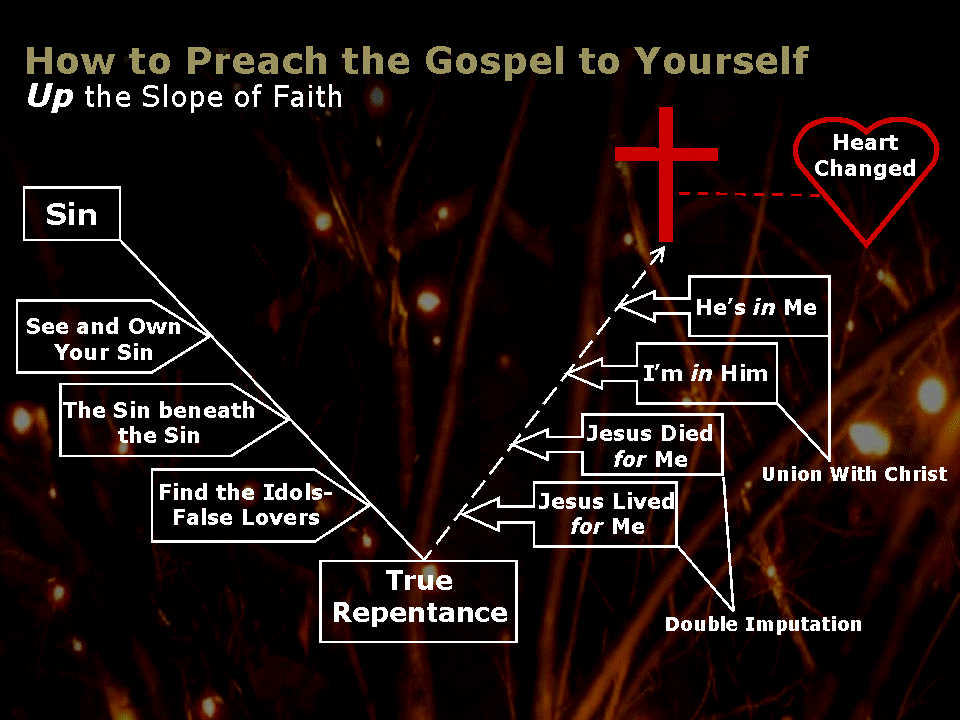
The chart above reflects both faith and repentance, and provides a tool to help us be able to “preach the gospel to ourselves”.

It reminds us that when recognize sin in our lives, our response should not be to simply resolve to “stop it”. We need to discern its source.  In other words, the sin we see, the sin which shows itself in our behavior (and in our attitudes), has deeper roots and causes.  So, like an explorer commissioned to trace the a great river to discover its tributaries and its origin, we are called upon to discover what “root sins” are tributaries of our behavior, and ultimately what idols are the original source.  Once discovered – or even while in the process of discovery – “putting sin to death” requires that we confess it and repent of it.  All of it – the sinful behaviors, the attitudes that lead to it, and the idols that source it.  Growth in grace is greater than mere moral reform.  Growth in grace is a work of the Spirit upon the heart which eventually and inevitably leads to a change in behavior.

Yet growth in grace does not come by confession and repentance alone.  Such may lead to behavior change, if we feel guilty enough and desire to change. But that is not growth in grace.  Growth in grace requires that we believe what grace gives; that we ponder what is true, and good, and beautiful: chiefly among such things is the gospel, the good news of what God promises – and does – when we trust  in Jesus.  (Philippians 4.8)   Reminded of the truths of the gospel, our hearts change; they turn toward God, causing us to hunger to grow more like him, and enabling us to rely more on his promise that what he began he will complete.  (Philippians 1.6)

This is the spiritual discipline of preaching the gospel to ourselves.

Leading in the Construction of Christ’s Church

Blue Construction

As one who has benefited from reading Jim Collins, John Kotter, Stephen Covey, and several other leadership gurus from the business world, I found this quote from Tony Morgan‘s Developing a Theology of Leadership  to be a very helpful reminder and convicting corrective:

It is true that we church leaders can learn from business leaders, but the corporate world should not set the foundation from which we lead. We can also learn from fellow church leaders, but they are also human and don’t provide a perfect model for Biblical leadership. When we look to other leaders, we are essentially holding on to our traditions rather than embracing the truth about leadership found in God’s Word. The Bible needs to become our filter for truth in every area of our life and ministry just because we see others doing it doesn’t mean that’s how God designed it.

Like Morgan, I still believe there is much to be learned from those who are effective in business, government, coaching, and other spheres. But as a pastor of a church – an under-Shepherd of part of the Church that Jesus is building – it is essential that I not fall for the notion that I will or can gain the most wisdom from these sources. I must never neglect or assume what the bible has to say about Leadership. Instead I must constantly submit all ideas of leadership, from whatever sources, to the scrutiny of the Scripture.

Matthew 16.18 reminds me that I am but a foreman, and that it is Jesus who is the architect, developer, and contractor. My job is to follow his design, and his lead.

Fatherhood of God

Neck Tie Quilt

After spending the better part of the past week preparing to preach about the Fatherhood of God, and the amazing doctrine of adoption, from Galatians 3.23-4.7, I am still pondering the richness and beauty of how the Heidelberg Catechism expresses it:

Q 26. What do you believe when you say: I believe in God the Father almighty, Creator of heaven and earth?

A. That the eternal Father of our Lord Jesus Christ, who out of nothing created heaven and earth and all that is in them, and who still upholds and governs them by his eternal counsel and providence, is, for the sake of Christ his Son, my God and my Father. In him I trust so completely as to have no doubt that he will provide me with all things necessary for body and soul, and will also turn to my good whatever adversity he sends me in this life of sorrow. He is able to do so as almighty God, and willing also as a faithful Father.

And this from the shortest chapter of the Westminster Confession, WCF 12:

All those who are justified God graciously guarantees to make partakers of the grace of adoption in and for his only Son, Jesus Christ. By this act they are taken into the number of God’s children and enjoy the liberties and privileges of that relationship; they are given his name; they receive the Spirit of adoption; they have access to the throne of grace with boldness; and they are enabled to cry, “Abba, Father.” Like a father, God has compassion on, protects, provides for, and chastens them; yet, they will never be cast off, but are sealed to the day of redemption, and will inherit the promises as heirs of everlasting salvation.

These are more than definitions.  These are summaries of the the gospel that are worthy of contemplation.  For I suspect most of our spiritual problems, and even our emotional troubles, are in one way or another due to our unbelief or lack of understanding of these great truths: first, God is the Father of all who believe, and who are therefore “in Christ:; second, we who believe, and who are therefore “in Christ”, are the beloved Children of God, who is the Creator and sustainer of the universe.

Culturally Literate Evangelism

Abstract Modern Landscape

Jonathan Dodson offers an astute assessment of the cultural landscape and some practical suggestions about how this effects the way we as Christians ought to engage in evangelistic efforts.  What Dodson offers refelcts the best of contextual ministry: The message should not change, but understanding those to whom we are speaking, knowing their needs and desires, shapes the way we present the message of the gospel.  ~ WDG

***

Cultural shifts have resulted in the collapse of Christendom, an official or unofficial relationship people have with their country and its civil religion. In America, moral views typically associated with Christianity have been replaced by more progressive views associated with libertarianism on marriage, sexuality, and gender.

In addition to loosening the American moral fabric, the collapse of Christendom has left behind a rubble of theological understanding. As the dust settles, we can no longer assume that people know what words like Christ, sin, faith, and God mean. For many, these words may no longer carry their original biblical meaning. We need to become culturally literate in order to be evangelistically fluent. If we don’t, the gospel gets lost in translation.

In secular culture people may actually hear us saying teacher for Christ, bad deeds for sin, wishful thinking for faith, or moldable deity for God. Today, it is a mistake to assume theological literacy. If we are to move forward, the Church must develop its ability to listen to new questions people are asking and learn how to translate the gospel into words and concepts that speak to the heart.

The Need for Cultural Literacy

Consider the need for cultural literacy in this story. A church planter in my city planted little wire signs in grassy medians around the city that read “RepentAustin.org.” I’ll admit it’s a pretty gutsy and confrontational tactic, but Jesus did call people to “repent and believe.” Yet, as I thought about this evangelistic approach, a major objection came to mind. These signs did not take into account contemporary understandings associated with the word “repent.” They conjure up images of judgmental people, filled with hatred toward “sinners,” who self-righteously speak words of condemnation. Instead of intriguing people, it probably elicited disinterest and, perhaps, unduly promoted a distorted view of the Gospel.

What makes this way of presenting the Gospel distorted? First, it does not call attention to Jesus — it focuses on a person’s need to change before they even get to hear about Jesus and what He has done. Second, there are strong cultural memories associated with the word, especially in the South, that are connected with a return to good, moral living — again, a response that has nothing to do with Jesus and what he has done. Many youths, when they hear the word “repent,” associate it with things like: stop listening to secular music, stop sleeping with your girlfriend, and start going to Church. This kind of repentance does not involve turning away from trusting in yourself to trust the Savior. It is simply a switch in lifestyles, secular to Christian. You can alter your behavior without altering your savior.

People adopt the trappings of faith—the religious habits, attempts at moral living, even a new Christianized culture that entails wearing a purity ring and listening to Christian music. But this cultural repentance is not a true turning to Christ; it is a turning to Christianity, to a religious subculture.

Slowing Down to Understand

To be effective in our new cultural landscape, we will have to slow down long enough to understand what people hear and how they speak in order to communicate the gospel in intelligible ways. This involves listening to what people think in order to communicate meaningfully what God thinks. This doesn’t require a PhD in Bible or theology. It requires love: sacrificing our time, tweaking our crammed schedules, putting away our canned responses, and actually conversing with people.

People don’t just need to hear a thirty-second gospel presentation. They need to understand why the Gospel is worth believing. To do this, we must learn their language and know their stories. We need to become “culturally literate in order to be gospel fluent, communicating the gospel in words and idioms that make sense to the people we talk to.

***

Jonathan Dodson (MDiv; ThM) serves as a pastor of City Life Church in Austin, Texas. He is the author of Gospel-Centered Discipleship, The Unbelievable Gospel, andRaised? Twitter: @Jonathan_Dodson

Gospel Greater Than God’s Law

Niagara at Night

Preaching through Paul’s Letter to the Galatians, I have received quite a bit of feedback – more than I receive during most series I have done.  Much to the relief of my thin skin, I have received no criticism (to date).  Most of the comments have been appreciative, either for the reminder of things that we need to remember, or for clarity on matters previously not understood.  (Either way, this is music to any ministers ears!)  The rest are questions – good questions; well-intentioned questions – concerning the role of our obedience. One godly man, a man I respect and enjoy, offered concerns about the possibility of people “hearing” cheap grace, knowing neither I nor our church believes grace is ever cheap.

These interactions have reminded me of what Martyn Lloyd-Jones wrote regarding the possible charge of anti-nomianism:

If your presentation of the Gospel does not expose it to the charge of Anti-nomianism you are probably not putting it correctly.

(NOTE: Anti-nomianism means “against law” or “anti-law.  It is a $20 word for someone who sees no use or present value for God’s law or commands in the Christian Life.)

This semi-famous saying is excerpted from Lloyd-Jones commentary on Romans.  Lloyd-Jones’ insights are so well expressed that they are worth revisiting even now and again.  Below are his thoughts from Romans 3 (which include the above statement):

A very good way of testing any view that you may hold is this one: Is this view humbling to me, glorifying to God? If it is, it is probably right. You won’t go far wrong if whatever view you are holding is glorifying to God, humbling to man. But if your view seems to glorify you and to query God, well (there’s no need to argue or to go into details) it’s wrong. It’s a very good universal rule– that!

My last word of all is, again, a word primarily to preachers – indeed it’s a word to everybody in the sense that if ever you are putting the Gospel to another person, you’ve got a very good test whether you are preaching the Gospel in the right way. What’s that? Well, let me put it like this to you: If your presentation of the Gospel does not expose it to the charge of Antinomianism you are probably not putting it correctly.

What do I mean by that? Just this: The Gospel, you see, comes as this free gift of God – irrespective of what man does.

Now, the moment you say a thing like that, you are liable to provoke somebody to say: “Well, if that is so it doesn’t matter what I do.”

The Apostle takes up that argument more than once in this great epistle. “What then,” he says at the beginning of chapter 6, “shall we do evil – commit sin – that grace might abound?” He’s just been saying: “where sin abounded grace does much more abound.” “Very well,” says someone. “This is a marvelous doctrine, this ‘Go and get drunk, do what you like the grace of God will put you right.’” Anti-nomianism.

Now, this doctrine of the Scriptures – this justification by faith only, this free grace of God in salvation – is always exposed to that charge of Anti-nomianism. Paul was charged with it. He said, “You know, some people say that’s what I’m preaching.” Paul’s preaching was charged with Anti-nomianism…So I say, it is a very good test of preaching.

You see – what is not evangelical preaching is this: It’s the kind of preaching that says to people, “Now, if you live a good life; if you don’t commit certain sins; and if you do good to others; and if you become a church member and attend regularly and are busy and active you will be a fine Christian and you’ll go to Heaven. That’s the opposite of Evangelical preaching – and it isn’t exposed to the charge of Anti-nomianism because…it is telling men to save themselves by their good works…And it’s not the Gospel – because the Gospel always exposes itself to this misunderstanding from the standpoint of Anti-nomianism.

So, let all of us test our preaching, our conversation, our talk to others about the Gospel by that particular test…If you don’t make people say things like that sometimes, if you’re not misunderstood and slanderously reported from the standpoint of Anti-nomianism, it’s because you don’t believe the Gospel truly, and you don’t preach it truly.