Death of Michael Jackson: Reconsidered

The sudden death of music icon Michael Jackson has certainly been the news of the weekend. Peoples’ emotions have run from crying to curious to cynical.  I confess, my own attitude has probably been a little closer to snide.  My mental response to news updates declaring “Latest Details” is to think, sometimes outloud, “Is his status going to change?”

Apparently my reaction was not entirely unique.  According to an article by Mike Cosper of Sojourn Music:

The reaction of Christians to Jackson’s death surprised me. Some reacted with pity and sadness. Others with a tone of indifference. Some reacted harshly, pronouncing final judgment.

Cosper goes on to offer his own perspective about Jackson’s magic & tragic life, about death, and the reaction of the masses.  The article is short and simple, but it convinced me that I was wrong.  My attitude needed some adjustment. Death of a celebrity is more complex than I had considered. 

Check out Cosper’s article: The Good, The Bad, The Ugly.

What is the Gospel?

Wild is the Wind

To say that we, as a church, are centered on the gospel, or Gospel-Driven, is realtively easy. It is quite another thing for the typical church member to know what such phrases actually mean.

The following post, by C.J. Mahaney, was originally published on the Together for the Gospel blog.  I include it here in it’s entirety because it addresses and brings clarity to an issue of the utmost importance…

***

Recently, someone asked two excellent questions on my blog: 

What is the gospel?

What is the most serious threat to the gospel?

The following is my attempt to answer these important questions with the help of those much smarter than myself:

1) What is the gospel?

No question is more important, and biblical clarity in response to this question is critical. Sadly, confusion about the gospel is quite common among professing evangelicals today. I find Graeme Goldsworthy’s comment all too relevant: 

“The main message of the Bible about Jesus Christ can easily become mixed with all sorts of things that are related to it. We see this in the way people define or preach the gospel. But it is important to keep the gospel itself clearly distinct from our response to it or from the results of it in our lives and in the world.” 

So here is my attempt to heed the counsel of Dr. Goldsworthy and keep the gospel “clearly distinct.”

The following definition of the gospel, provided by Jeff Purswell, the Dean of [Sovereign Grace] Pastors College, seeks to capture the substance of the gospel:

“The gospel is the good news of God’s saving activity in the person and work of Christ. This includes his incarnation in which he took to himself full (yet sinless) human nature; his sinless life which fulfilled the perfect law of God; his substitutionary death which paid the penalty for man’s sin and satisfied the righteous wrath of God; his resurrection demonstrating God’s satisfaction with his sacrifice; and his glorification and ascension to the right hand of the Father where he now reigns and intercedes for the church.”

“Such news is specific: there is a defined ‘thatness’ to the gospel which sets forth the content of both our saving faith and our proclamation. It is objective, and not to be confused with our response. It is sufficient: we can add nothing to what Christ has accomplished for us–it falls to us simply to believe this news, turning from our sins and receiving by faith all that God has done for us in Christ.” 

I find this definition of the gospel faithful to the presentation of the four Gospels—they present the person and work of Christ as the good news. In the Apostle Paul’s concise summation of the gospel, he focuses more particularly on Christ’s death and resurrection as the core of his proclamation:

 “For I delivered to you as of first importance what I also received: that Christ died for our sins, in accordance with the Scriptures, that he was buried, that he was raised on the third day in accordance with the Scriptures….” 1 Cor 15:3-4

Focusing more specifically still, the apostle encapsulates the work of Christ by focusing on the cross:

“For I decided to know nothing among you except Jesus Christ and him crucified.” – 1 Corinthians 2:2

So that is the gospel: God’s saving work in and through Christ. And the cross is the pinnacle of that work. Knox Chamblin helpfully notes this emphasis in Paul’s writing and ministry:

“His gospel is ‘the word of the cross’ (1 Cor. 1:17-18); nowhere is there a comparable reference to ‘the word of the resurrection.’ In I Corinthians 1:23-24 it is ‘Christ crucified’ who is identified as ‘the power of God and the wisdom of God,’ not as we might have expected (especially in the case of ‘power’), Christ resurrected…. Both the cross and the resurrection are ‘of first importance’ in Paul’s gospel (I Cor. 15:3-4). Unless Christ has risen from the dead, the preaching of the cross (and of the resurrection) is a waste of time (15:14); but once the resurrection has occurred, the cross remains central.”

And the centrality of the cross isn’t temporary. The cross remains on center stage even when we receive a glimpse of eternity in the New Testament’s final book:

“One is taken aback by the emphasis upon the Cross in Revelation. Heaven does not ‘get over’ the cross, as if there are better things to think about; heaven is not only Christ-centered, but cross-centered, and quite blaring about it.”       – Jim Elliff

There is nothing more important than getting the gospel right. Years ago, John Stott made the following frightening observation of the evangelical church when he wrote, 

“All around us we see Christians relaxing their grasp on the gospel, fumbling it, and in danger of letting it drop from their hands altogether.” 

It is my prayer that God would use the Together for the Gospel conference to strengthen our grip upon the glorious gospel.

2) What is the most serious threat to the gospel?

For this question I think J.C. Ryle provides us with enduring discernment:

“You may spoil the gospel by substitution. You have only to withdraw from the eyes of the sinner the grand object which the Bible proposes to faith–Jesus Christ–and to substitute another object in His place… and the mischief is done.”

“You may spoil the gospel by addition. You have only to add to Christ, the grand object of faith, some other objects as equally worthy of honor, and the mischief is done.”

“You may spoil the gospel by disproportion. You have only to attach an exaggerated importance to the secondary things of Christianity, and a diminished importance to the first things, and the mischief is done.”

“Lastly, but not least, you may completely spoil the gospel by confused and contradictory directions… Confused and disorderly statements about Christianity are almost as bad as no statement at all. Religion of this sort is not evangelical.”

3) Personal Application

It’s not difficult to identify distortions of the gospel. But as a pastor, one of my main concerns for genuine Christians is a more subtle one: either assuming the gospel or neglecting the gospel. I have found this to be the greatest threat to the gospel in my own life. 

Jerry Bridges echoes this concern when he writes, 

“The gospel is not only the most important message in all of history; it is the only essential message in all of history. Yet we allow thousands of professing Christians to live their entire lives without clearly understanding it and experiencing the joy of living by it.”

So let us not only apply discernment to the church at large, but to our own hearts as well. Let us, in the words of Jerry Bridges, “Preach the gospel to ourselves daily.” Let us heed Charles Spurgeon’s exhortation: “Abide hard by the cross and search the mystery of his wounds.” Let us respond to John Stott’s invitation: “The Cross is a blazing fire at which the flame of our love is kindled, but we have to get near enough for its sparks to fall on us.”

So how can we get near enough?

The following are books that will position you to experience the transforming sparks of the gospel:

The Cross of Christ by John Stott. A personal favorite. Stott says of the Savior, “It was by his death that he wished above all else to be remembered.” This book won’t let you forget.

The Gospel for Real Life by Jerry Bridges. The man who taught me how to preach the gospel to myself will teach you to do the same.

The Message of Salvation by Philip Ryken. This excellent book deserves a broad readership. My oldest daughter recently thanked me for recommending this book to her and told me how much she was benefiting from this book. You will benefit as well.

The Message of the New Testament by Mark Dever. My good friend reveals the storyline of the Bible in each and every book of the New Testament. A must read for pastors but highly recommended for all. My wife has really enjoyed reading Mark’s book.

The Cross and Christian Ministry by D.A. Carson. For pastors this is another must-read. I’m indebted to Dr. Carson for this book. It has defined effective pastoral ministry for me, and I pray it will do the same for you.

That ought to get you started. Each of these books will draw you near enough to the “blazing fire of the cross so that its sparks” will fall on you and kindle fresh love for the Savior in your soul.
Infection of Complacency

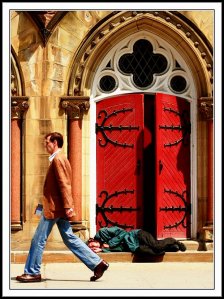
Indifferent

Here is a thought from J.C. Ryle that transcends the gulf between 19th Century Britain to speak to 21st Century American Evangelicals:

The times require distinct and decided views of Christian doctrine. I cannot withhold my conviction that the professing Church is as much damaged by laxity and indistinctness about matters of doctrine within, as it is by skeptics and unbelievers without. Myriads of professing Christians nowadays seem utterly unable to distinguish things that differ. Like people afflicted with color–blindness, they are incapable of discerning what is true and what is false, what is sound and what is unsound. If a preacher of religion is only clever and eloquent and earnest, they appear to think he is all right, however strange and heterogeneous his sermons may be. They are destitute of spiritual sense, apparently, and cannot detect error. The only positive thing about them is that they dislike distinctiveness and think all extreme and decided and positive views are very naughty and very wrong!

These people live in a kind of mist or fog. They see things unclearly, and do not know what they believe. They have not made up their minds about any great point in the Gospel, and seem content to be honorary members of all schools of thought. For their lives they could not tell you what they think is truth about justification, or regeneration, or sanctification, or the Lord’s Supper, or baptism, or faith or conversion, or inspiration, or the future state. They are eaten up with a morbid dread of controversy and an ignorant dislike of party spirit; and yet they really cannot define what they mean by these phrases. And so they live on undecided; and too often undecided; they drift down to the grave, without comfort in their religion, and, I am afraid, often without hope.

The explanation of this boneless, nerveless, jelly–fish condition of soul is not difficult to find. To begin with, the heart of man is naturally in the dark about religion – has no intuitive sense of truth – and really needs instruction and illumination. Besides this, the natural heart in most men hates exertion in religion, and cordially dislikes patient, painstaking inquiry. Above all, the natural heart generally likes the praise of others, shrinks from collision, and loves to be thought charitable and liberal. The whole result is that a kind of broad religious “agnosticism” just suits an immense number of people, and specially suits young persons. They are content to shovel aside all disputed points as rubbish, and if you charge them with indecision, they will tell you: “I do not pretend to understand controversy; I decline to examine controverted points. I dare say it is all the same in the long run” – Who does not know that such people swarm and abound everywhere?

Now I do beseech all to beware of this undecided state of mind in religion. It is a pestilence which walks in darkness, and a destruction that wastes at noonday. It is a lazy, idle frame of soul which, doubtless, saves man the trouble of thought and investigation but it is a frame of soul for which there is no warrant in the Bible. For your own soul’s sake, dare to make up your mind what you believe, and dare to have positive, distinct views of truth and error. Never, never be afraid to hold decided doctrinal opinions; and let no fear of man and no morbid dread of being thought party–spirited, narrow, or controversial, make you rest contented with a bloodless, boneless, tasteless, colorless, lukewarm, undogmatic Christianity.

Mark what I say. If you want to do good in these times, you must throw aside indecision, and take up a distinct, sharply–cut, doctrinal religion. If you believe little, those to whom you try to do good will believe nothing. The victories of Christianity, wherever they have been won, have been won by distinct doctrinal theology; by telling men roundly of Christ’s vicarious death and sacrifice; by showing them Christ’s substitution on the cross, and His precious blood; by teaching them justification by faith, and bidding them believe on a crucified Savior; by preaching ruin by sin, redemption by Christ, regeneration by the Spirit; by lifting up the brazen serpent; by telling them to look and live – to believe, repent, and be converted. This – this is the only teaching which for centuries God had honored with success, and is honoring at the present day both at home and abroad.

It is doctrine – doctrine, clear, ringing doctrine which, like the ram’s horn at Jericho casts down the opposition of the devil and sin. Let us cling to decided doctrinal views, whatever some may please to say in these times, and we shall do well for ourselves, well for others, and well for Christ’s cause in the world.

Pastor Dad: E-book by Mark Driscoll

Pastor Dad

Father’s Day has passed, but I just read a resource I thought I’d pass along to Dads and aspiring dads-to-be.  It is another e-book by Mark Driscoll of Resurgence and Mars Hill Church, this one titled Pastor Dad: Scriptural Insights on Fatherhood

The premise behind this free 48 page book is:

Every dad is a pastor. The important thing is that he is caring for his flock well.

Typical of Driscoll, this book combines sound Biblical insights with some of Driscoll’s brash, over-the-top, in-your-face applications.  So it is not a book for the overly sensitive or the timid.  But, while after a quick read I can say I don’t agree with all his positions, Driscoll’s thoughts are Biblial, practical, and worth considering for those who appreciate, or are at least willing to engage, his style.

Glory Story: The Joel Osteen Phenomena

Osteen v. Horton

I’ve never quite understood the attraction.  His words melt like cotton candy.  Yet he has amassed the largest church and largest television audience in the United States.  Sure, he may be a nice guy, but what is the allure of Joel Osteen?

Like him or loathe him, Osteen’s influence is pervasive. I am frequently asked my opinion of him by members of my own church – usually old ladies, who I assume think he would be a fine son or grandson.

Mike Horton has written a piece I find informative: Joel Osteen and the Story of Glory.

Check it out.

In Constant Prayer

 Prayer Posture

Here is a challenging insight from Robert Benson, taken from his book In Constant Prayer:

Our modern church has some distinct advantages over the early church. Or at least I suspect it does.  We have better youth programs and better acoustics and finer buildings. We have better literature that is more easily available to our flocks, most of whom happen to be literate. We have some pretty fair preachers, or at least we have some who are more fun to listen to than the blessed Saint Augustine. (Have you ever actually attempted to read Augustine?)

We have better choirs, I suspect, and we can put on a Sunday morning service with more art and more dignity and more beauty than ever before. We have mailing lists and newsletters and Web sites. We have educational buildings and discipleship classes and Bible study groups where students bring their own Bibles.  We have Sunday School buses and youth lock-ins and Christian rock-and-roll bands.

What we do not have so much of sometimes, it seems to me, is the depth of spirit and of devotion and of piety – now, there is a scary word – that marked the life of the faithful in the hundreds and thousands of years before us, the centuries that produced the Church we built our buildings and programs around in the first place.

It is worth noting, I believe, that this tradition of daily prayer is one of the practices our modern church does not do that the ancient Church did.  We preach sermons, study the Scriptures, gather to worship on the Sabbath, teach our children the faith, and fellowship with one another – but we do not say our prayers.

Jeremiah: The Blogging Prophet

Adventure

I’ve been reading through the book of Jeremiah this past week. 

One of the “tricks” I have found helpful in maintaining a sense of orientation as I navigate the sea of prophecies of judgement the Lord gives to Jeremiah in chapters 2-26, is to view each of the prophecies as separate blog posts.  Without this mental practice separating the various prophecies, I have a tendency to read them as if they were one big narrative.

When I read theprophecies as one narrative I get confused, and lose the meaning behind both the Lord’s declarations and Jeremiah’s attitude and response.  But seeing each in their own context I get a sense of the character of God, the position of Jeremiah, and the transcendant pertinence from Pre-Exilic Judah to the 21st Century American Church.