Recharging a Spiritual Battery

batteries2

Unfortunately I’m going to miss it.  Our church is hosting a seminar tomorrow.  After scheduling the seminar I received notice that a committee I am on that serves our whole denomination meets the same day.  So I am sitting here writing from my hotel room in Atlanta.

I would not have even considered missing the seminar, excpet that I had already gone through training for this ministry – PLACE – several years ago.place 

PLACE is designed to help Christians discover how they are wired for the purpose of more effective and enjoyable service for the Kingdom of God.  Taking Personality, Spiritual Gift(s), Life Experiences, and Passions & Interests into consideration, each participant develops a profile for himself/herself.  The profiles reflect how each of us is uniquely made. The intent is to help people think through these factors and help them match how they are wired with various opportunities for service and ministry.

Despite missing the kickoff seminar, I am excited about seeing this implemeted in our church.  I am convinced that serving in line with ones interests and in accord with ones gifts not only enhances the effectiveness, but also energizes the one who serves. 

As I see it, functioning according to how one is wired functions in the life of a Christian much like the alternator does in my car.  Now I’m no mechanic, but I’ve had cars with bad alternators. What happens – or what happened – was that my car would work for a while, but eventually, with the alternator malfunctioning, the battery was drained until it was dead.  Likewise, many conscientious Christians serve selflessly in the church and the community.  But when one operates for a length of time without regard for how God has wired us, eventually our batteries run low.  Burnout.  But, when the alternator is functioning properly, the act of service actually recharges the batteries. 

That’s what we are praying for.

Natural Born Skeptics

luther

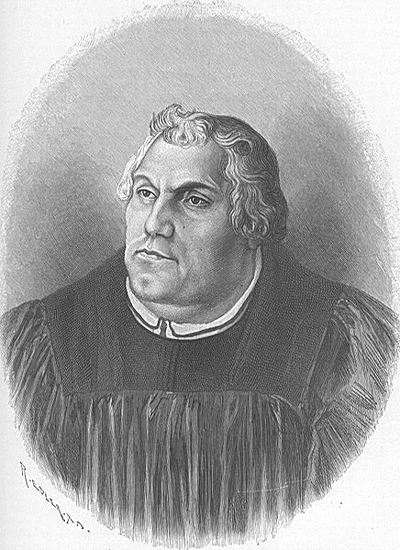
To doubt the good will of God is an inborn suspicion of God with all of us.

Besides, the devil…goes about seeking to devour us by roaring: ‘God is angry at you and is going to destroy you forever.’

In all these difficulties we have only one support, the Gospel of Christ. To hold on to it, that is the trick. 

Christ cannot be perceived with the senses…

The heart does not feel His helpful presence…

Especially in times of trials a Christian feels the power of sin, the infirmity of his flesh, the goading darts of the devil…the scowl and judgment of God.  All these things cry out against us, death thunders at us, the devil roars at us.

In the midst of the clamor the Spirit of Christ cries in our hearts, ‘Abba, Father.’ 

And this little cry of the Spirit transcends the hullabaloo of the Law, sin, death, and the devil, and finds a hearing with God.  The Spirit cries because of our weakness…(and) is sent forth into our hearts…to assure us of the grace of God.”  

– Martin Luther, Commentary on Galatians

Calvinist When Calvinism Wasn’t Cool

comet-mcnaught

To paraphrase Barbara Mandrell, “I was a Calvinst when Calvinism wasn’t cool.”   Historically Calvinism had a long day of being cool.  Then it was cool no more.  Now from all appearances it is cool once again.

This resurgence of Reformed Spirituality is not new news.  Christianity Today, among others, has been talking about it for several years now. But I was not aware that this trend was so apparent that even the non-religious cultural obsevers were aware.  But this week Time Magazine publically recognized that Calvinism  is COOL.  Published under the section: 10 Ideas Changing the World Right Now, The New Calvinism ranks third. (Just behind  Jobs the New Asset and Recycling the Suburbs.)

I’m pretty sure that the editor of this piece doesn’t get the message behind Calvinism.  And while rightly attributing to Piper, Driscoll, and Mohler some of the influence toward growing popularity, I am disappointed that they neglected to mention the Presbyterian Church in America and Reformed University Fellowship.

Nevertheless, the article is worth reading.

Happy St. Patrick’s Day

shamrock

Happy Saint Patrick’s Day!

Did you know that Patrick of Ireland was, in fact, what we would today call an Evangelical?  Despite the tradition that links him to the Roman Catholic Church, Patrick was not part of the church of Rome.  Long after his death Patrick was “adopted” by the Roman church.  Instead, Patrick was British.  We can’t call him a protestant, because  the ‘protests’ were still centuries away.  But his faith was thoroughly Evangelical.

More than that, Patrick was the embodiment of Missional.  He literally sold himself into slavery in order to reach a people he had come to love. And that itself is amazing.

I can’t do the story justice, but I’ll give a brief overview:

When Patrick was a young teenager he and a group of friends were horsing around in their native Briton.  Out of nowhere came a band of savage Celts, capturing Patrick and his friends, taking them to Ireland, and putting them into slavery.  For decades Patrick lived as a slave in Ireland.  But the Lord got hold of his heart and his life during this time.

When Patrick finally escaped – or was he released? I cannot remember – he returned home to a well-to-do family that long presumed him dead.  But rather than settling into a life of ease and prosperity, Patrick began to prepare himself for a life of ministry among the very people who had once captured and enslaved him…

The rest, as they say is history – though much surrounding the story is legend.  Nevertheless, Patrick was God’s vessel to reach an Unreached Pagan people group with the Gospel…

If you want to know more about Patrick, let me commend to you T.M. Moore’s The Legacy of Patrick.  T.M. tells this fascinating story, clarifies some of the myths, and weaves significant spiritual insights gained from Patrick into this book.

But as I think about Patrick I see a man who lived out the Gospel.  I see a man who, by is very life, embodied what it means to live in the Missio Dei (Mission of God).  His purpose was God’s glory to be recognized by a people, a place (Ireland), and a culture (Celt/Druid). 

In recognition of this day that honors Patrick let me encourage you to reflect upon the prayer attributed to him.  Whether Patrick is the actual author seems doubtful. But I think it captures the essence of who Patrick was.  And it is a beautiful prayer and song.

St. Patrick’s Breastplate:

I arise today Through a Mighty Strength, the Invocation of the Trinity, through the belief in the Threeness, and the confession of the Oneness of the Creator of Creation.

(Click above to read the entire prayer.)

Cats & Dogs and God’s Global Glory

First among the Core Values at Walnut Hill Church is God’s Global Glory.  This is the recognition that we do not exist, as a church or as individuals, primarily for ourselves, but for God and for his glory. 

Expressing this as a platitude is one thing.  Getting newcomers to agree with this premise is something else. And getting people to embrace it as an actual value that is lived out in their lives, and in the life of our church, is something else altogether. 

How do we get people to reorient their thinking and make corresponding changes in their lives?  That’s the question the leaders of the church have to wrestle with. Making it all the more difficult is our own inconsistency.  We are the living embodiment of the words from the old hymn: “Prone to wander, Lord, I feel it… Prone to leave the God I love…”  And so are the people we are called to lead. (And, most likely, so are you.)

One of the most effetive tools I am aware of regarding the teaching of this value is Cat & Dog Theology developed by UnveilinGlory.  (See video above.)

I introduced Cat & Dog Theology to our church about a year ago, at our first missions conference at Walnut Hill.  We had Gerald Robison, vice president of UnveilinGlory as the keynote speaker.  From time to time church members still talk about both the conference and, more importantly, what they learned through the messages. 

But how do we build on that?

UnvelinGlory has now developed a series of web-based instructional videos that makes Cat & Dog Theology, along with other resources, available online.  So far I’ve only had opportunity glance through a few of the videos, but it looks promising.  Each of the videos is relatively short – 20 minutes, more or less.  But the videos I’ve seen contain both the substance and style that makes the seminar interesting and instructive. 

I encourage you to check out: Our Journey With Him

While there is an opportunity to sign up for a Premium membership, all the videos are available for free if you sign in as a guest.

Faith in America: Not What it Used to Be?

plantation-church

I appreciate the perspective of this editorial from the March 12, 2009 Kingsport Times-News. The editor integrates both history and contemporary polling data.  It eschews any alarmist inclinations and refutes any distorted notions that America was a distinctively Christian country upon it’s founding. 

I think this perspective is helpful.  I am especially hopeful that it will help in preventing Christians from mistaking either patriotism or isolationism as being synonomous with being a Christian in America. 

Whatever the current data indicates – and I suspect it changes day-to-day – our focus is not changed.  Fundamentally we are called to personally grow in grace and live out the gospel in the communities where God has placed us; to plant churches in areas underserved by faithful congregations; and to partner to see churches planted among Unreached People Groups around the world.

***

KINGSPORT – This week, the results of a new poll were eagerly distributed by national news media as evidence that faith is on the skids in America and that more and more U.S. citizens have no religion at all.

According to the latest American Religious Identification Survey, 15 percent of respondents say they have no religion, compared to 8.2 percent in 1990. The survey also recorded a decline in those identifying themselves as a member of an institutional Christian church. In 1990, 86 percent made that claim; it’s now down to 76 percent.

This isn’t necessarily evidence of anything terribly new or irreversible in the religious life of the nation. Nor do these percentages represent anything even approaching the low point in the history of American church participation. To do that, you have to go back a long, long time.

On the eve of the Revolutionary War, records show fewer than 20 percent of American adults adhered to a church in any significant way — a far cry from today when church membership stands at 146 million or roughly half of the population.

In colonial America, New England was the most churched. Between 1630 and 1660, adult church membership in most New England towns approached 70 or 80 percent. Membership was never universal, however, as these percentages demonstrate. Moreover, the cities of Boston and Salem quickly lost membership. By 1650, for example, fewer than 50 percent of Boston’s adults were church members.

By the 1680s, many New England towns reported church membership rates of no more than 10 to 25 percent. In 1690, on the eve of the Salem witch trials, that town’s churches could claim only 15 percent of its adults as members, including only half of the town’s well-to-do selectmen; yet today, Salem is a byword for religious fanaticism.

Church membership rates in the South were even worse.

In Virginia’s Charles Parish, for example, 85 percent of newborn Caucasian children went unbaptized between 1650 and 1680 — even though the parish supported a clergyman and sustained regular worship throughout the period. South Carolina had the highest church membership of any Southern state during the colonial period, at 16 percent. North Carolina had the lowest, at a mere 4 percent.

In 1780, the great church leader Samuel Mather guessed that scarcely a sixth of Boston’s adults attended church. Historians estimate that in New York City and Philadelphia, church membership probably did not approach 10 percent at that time.

Records also show that most church members during the colonial period were women. Indeed, from the 1680s — and continuing for several decades afterward, well into the 18th century — women constituted about 60 percent of church members in most congregations.

True, revivals temporarily brought more men into congregations, especially in the 1740s, but the women’s numerical majority surfaced again when the revivals faded.

Taken as a whole, at the time of the American Revolution, between 70 and 90 percent of all European colonists in America remained unattached to any church.

Such history demonstrates our ancestors were not the Christian giants they are often made out to be. On the other hand, this week’s Religious Identification Survey merely records that more Americans are opting out of organized religion, but that doesn’t necessarily mean they’ve abandoned faith.

Our Brief B&B Binge

smokies

Just back from a weekend in the Smokies.  Carolyn & I appreciate the generosity of our church, who provided this get-a-way as a gift to us.

Here’s where we stayed, Richmont Inn:

richmont-inn

Making it all the more nostalgic, Carolyn & I had our first date just around the corner from this Inn.  We were, at one time long ago, frequent visitors to the Smokies, with Townsend and Cades Cove among our favorite destinations:

cades-cove-panorama

Natural Evangelism

7608292-lg2

My old friend, and one-time-mentor, Doug Pollock is releasing a new book, expected to be on the bookstore shelves in June.

Doug has travelled the world sharing his faith, and has studied evangelism for the better part of two decades now. He’s also penned a number of articles and co-authored other helpful books about evangelism. But as I read the first chapter of the pre-published manuscript I find myself eagerly awaiting this latest work.

As an old friend it has been interesting, and encouraging, to see how Doug’s understanding and perspective have changed and grown through the years.  Doug’s outward focus has always been keen, but I have appreciated how his upward focus has continually grown.  Doug’s love for our Lord is glaringly obvious.  And because of his love for God, Doug’s love for people is equally obvious.  And that is the key.

It has been said that there are two motives for evangelism: One is “I’m right, you’re wrong.”  The second is “I love you.”  Doug’s latest work exudes the latter motive.  And he does so because it is also Jesus’ motive.

The following is an excerpt of the first chapter of Doug’s upcoming book: God Space: Where Spiritual Conversations Happen Naturally.  This excerpt appeared in his most recent newsletter, which I received this afternoon.  His 10 Questions are worth pondering.  And you can score yourself at the end.

***

Jesus was called many things during his short time here on earth.  My favorite title for him is found in Matthew 11.19 and Luke 7.34 where Jesus acknowledges his awareness of the fact that many were calling him “a friend of sinners”.  In my mind, no title gets at the heart of why Jesus came to earth more than this one.  It so closely coincides with his mission stated in Luke 19.10: “For the Son of Man came to seek and to save what was lost.”

If we are going to make God’s “invisible” kingdom become visible, then Christ’s heart needs to be formed in us.  Prayerfully ponder the following questions. Grade yourself by using the following scale for each question. Jot down a number at the end of each question. When you have finished, add your numbers together to assess where you are in your spiritual journey.

1     2     3     4     5     6     7     8     9     10

 Never              Sometimes              Always

1. Can you overlook ungodly attitudes and lifestyles in your efforts to connect with others?

2. Are you able to suspend your judgment for long periods of time around not-yet Christians?

3. Do you consistently seek to understand the not-yet Christians you know before seeking to be understood by them?

4. Are you patient enough to wait for the not-yet Christians in your life to ask for your opinions?

5. Be honest: Do you like people who are far from God?

6. Do people who are far from God like you?  For example: Are you invited to ‘party parties’?  (Jesus was!)

7. Does your body language communicate an open-hearted acceptance toward the not-yet Christians in your life?

8. Are you able to communicate acceptance to not-yet Christians without endorsing their lifestyle?

9. In your relationships with not-yet Christians, do you typcially offer kindness rather than ‘rightness’?

10. Is your heart consistently broken and filled with compassion for the not-yet Christians in your life?

90-100 – Congratulations! You might be frequently misunderstood by Christians, but the not-yet Christians in your life are undoubtedly drawn toward the heart of Jesus formed in you. Keep walking in this light.

50-90 – You must decrease and Jesus must increase, one heart attitude at a time. Embrace the people and the situations in your life as God attempts to prune those heart attitudes that are not bearng fruit for the Kingdom.

Under 50 – Perhaps Jesus needs to do something in you before He can do something through you.  You may want to consider asking God to do the soul surgery needed to form the heart of Jesus in you.

To read the entire first chapter click: God Space, then click the picture.