7 Principles for Conduct

Reaching

The chief end of man is to glorify God and enjoy him forever.”

C.J. Mahaney has compiled the following questions and relevant scripture passages to help in determining whether or not a particular activity is glorifying to God.  I find these to be very helpful questions.

1. Does it present a temptation to sin?

Romans 13.14 -“Rather, clothe yourselves with the Lord Jesus Christ, and do not think about how to gratify the desires of the sinful nature.”

2 Timothy 2.22 -“Flee the evil desires of youth, and pursue righteousness, faith, love and peace, along with those who call on the Lord out of a pure heart.”

2. Is it beneficial?

1 Corinthians 6.12a -“‘Everything is permissible for me’—but not everything is beneficial.”

1 Corinthians 10.23 -“‘Everything is permissible’—but not everything is beneficial. ‘Everything is permissible’- but not everything is constructive.”

3. Is it enslaving?

1 Corinthians 6.12b – “‘Everything is permissible for me’—but I will not be mastered by anything.”

4. Does it honor and glorify God?

1 Corinthians 10.31 – “So whether you eat or drink or whatever you do, do it all for the glory of God.”

5. Does it promote the good of others?

1 Corinthians 10.33 – “even as I try to please everybody in every way. For I am not seeking my own good but the good of many, so that they may be saved.”

6. Does it cause anyone to stumble?

1 Corinthians 10.32 – “Do not cause anyone to stumble, whether Jews, Greeks or the church of God”

7. Does it arise from a pure motive?

Jeremiah 17.9 – “The heart is deceitful above all things and beyond cure. Who can understand it?”

Rapture Ready

OUCH!  Yesterday I started reading Daniel Radosh’s Rapture Ready!: Adventures In The Parallel Universe Of Christian Pop-Culture.  It is an outsiders observations of the Christian subculture.  And the author really nails his intended target.

Back in my younger, athletic playing, days from time rapture-readyto time I would take a hit right on a muscle that would somehow simultaneously make me wince and chuckle.  The chuckling wasn’t because I was necessarily tough, it was just the nature of the hit.  I knew some bruising and stiffness was sure to develop in the days that followed.  But it didn’t hurt quite enough to cause actual pain.  So my response would be a dull chuckle with just a hint of an ouch.   
That’s how I have felt when reading this book.  I have had to both chuckle and wince at the same time.  Radosh, a self professed Jewish Liberal, is funny and not unkind. He simply points out the absurdity of some of the things he has encountered and observed.  Unless you take yourself way to seriously you’ll laugh too.  But he also points out some things that should leave a mark on any Christian who reads this book.

A few things have already come to mind as I peruse these pages:

1) Many Christians will go to great lengths to be a “witness” for Christ without actually developing relationships with people.  The ineffectiveness of such evangelism is understandable.  Sadly such gimmicks have become acceptable substitutes for evanglism.

2) Many Christians seem to have given very little thought to what it means to be “worldly”.  It is not the tackiness of the products that makes them worldly, but the values and thought-process that leads to the production of this…, uh, stuff, that reflects worldliness. 

3) We need a serious reappraisal of our priorities. Christian kitsch is a $7-billion per year industry.  What impact could be made toward the alleviation of poverty, illiteracy, AIDS and other health issues, if we invested that money directly?  How long would it take to plant churches among the reamaining UnReached People Groups and translate the scriptures into the languages of those Peoples at a rate of $7-billion per year?  And that’s how much cash we would free up just by passing up on stuff that no one needs, and few could possibly really want.

Worldliness in Prespective

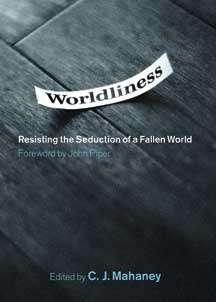
worldliness1

I recently finished reading the short book Worldliness, edited by C.J. Mahaney.  Each chapter is written by different men from the Sovereign Grace family.  I found it very insightful and practical. 

I appreciate that the writers did not merely resort to the worn out separatist “Us vs. The World” rhetoric.  Instead they wrestled intelligently, theologically, and bibilcally about the pertinent questions: What does worldliness actually mean?  What actual problems does worldliness pose?  Only once those questions are amply answered do the writers delve into practical applications in the various spheres of our culture.

I had given some thought to blogging about the book.  Already in previous posts I have elaborated on some of the insights I have gained.  But then on Crossway.blog I have found that Jonathan Leeman of 9 Marks has shared some highlights from each chapter.  Leeman has done such a good job that it made my intentions unnecessary.  I will still likely interact and expound upon some other insights in future posts, but for a good introduction to and overview of the book I encourage you to check out what Leeman has written.  Click: Worldliness

But don’t neglect the book. It is short, but beneficial. I’ve added it to my ‘must read’ list.