Spiritual Pride

Here is a great insight from Jonathan Edwards as relevant today as it was in his Colonial American culture:

The first and worst cause of error that prevails in our day is spiritual pride. This is the main door by which the devil comes into the hearts of those who are zealous for the advancement of Christ. It is the chief inlet of smoke from the bottomless pit to darken the mind and mislead the judgment, and the main handle by which Satan takes hold of Christians to hinder a work of God. Until this disease is cured, medicines are applied in vain to heal all other diseases.

Pride is much more difficult to discern than any other corruption because, by nature, pride is a person having too high a thought of himself. Is it any surprise, then, that a person who has too high a thought of himself is unaware of it? He thinks the opinion he has of himself has just grounds and therefore is not too high. As a result, there is no other matter in which the heart is more deceitful and unsearchable. The very nature of it is to work self-confidence and drive away any suspicion of evil respecting itself.

Pride takes many forms and shapes and encompasses the heart like the layers of an onion- when you pull off one layer, there is another underneath. Therefore, we need to have the greatest watch imaginable over our hearts with respect to this matter and to cry most earnestly to the great searcher of hearts for His help. He who trusts his own heart is a fool.

Since spiritual pride in its own nature is secretive, it cannot be well discerned by immediate intuition of the thing itself. It is best identified by its fruits and effects, some of which I will mention together with the contrary fruits of Christian humility.

The spiritually proud person is full of light already and feels that he does not need instruction, so he is ready to despise the offer of it. On the other hand, the humble person is like a little child who easily receives instruction. He is cautious in his estimate of himself, sensitive as to how liable he is to go astray. If it is suggested to him that he does go astray, he is most ready to inquire into the matter.

Proud people tend to speak of other’s sins, the miserable delusion of hypocrites, the deadness of some saints with bitterness, or the opposition to holiness of many believers. Pure Christian humility, however, is silent about the sins of others, or speaks of them with grief and pity. The spiritually proud person finds fault with other saints for their lack of progress in grace, while the humble Christian sees so much evil in his own heart, and is so concerned about it, that he is not apt to be very busy with other hearts. He complains most of himself and his own spiritual coldness and readily hopes that most everybody has more love and thankfulness to God than he.

Spiritually proud people often speak of almost everything they see in others in the harshest, most severe language. Commonly, their criticism is directed against not only wicked men but also toward true children of God and those who are their superiors. The humble, however, even when they have extraordinary discoveries of God’s glory, are overwhelmed with their own vileness and sinfulness. Their exhortations to fellow Christians are given in a loving and humble manner, and they treat others with as much humility and gentleness as Christ, who is infinitely above them, treats them.

Spiritual pride often disposes people to act different in external appearance, to assume a different way of speaking, countenance, or behavior. However, the humble Christian, though he will be firm in his duty; going the way of heaven alone even if all the world forsake him; yet he does not delight in being different for difference’s sake. He does not try to set himself up to be viewed and observed as one distinguished, but on the contrary, is disposed to become all things to all men, to yield to others, to conform to them, and to please them in all but sin.

Proud people take great notice of opposition and injuries, and are prone to speak often about them with an air of bitterness or contempt. Christian humility, on the other hand, disposes a person to be more like his blessed Lord, who when reviled did not open His mouth but committed Himself in silence to Him who judges righteously. For the humble Christian, the more clamorous and furious the world is against him, the more silent and still he will be.

Another pattern of spiritually proud people is to behave in ways that make them the focus of others. It is natural for a person under the influence of pride to take all the respect that is paid to him. If others show a disposition to submit to him and yield in deference to him, he is open to it and freely receives it. In fact, they come to expect such treatment and to form an ill opinion of those who do not give them what they feel they deserve.

***

Adapted from Jonathan Edwards’ Some Thoughts Concerning the Present Revival of Religion in New England. This article previously appeared in Banner of Truth.

10 Gospel-centered Questions


Here are 10 questions to ask yourself – and maybe those few closest to you – that help uncover rivals of Christ as the functional savior of your heart:

  1. What are you desiring more than anything else?
  2. What do you find yourself day dreaming or fantasizing about?
  3. What lies are you subtly believing that undermine the truth of the gospel?
  4. Are you astonished with the gospel?
  5. In what ways have you recently made much of yourself and little of God?
  6. Is technology stealing attention from your family?
  7. Is work replacing your spouse’s place in your heart?
  8. Where do your thoughts drift to when you enter a social setting?
  9. What fears are paralyzing your heart from enjoying God?
  10. What consumes your thoughts when you have alone time?

Notice that many of these questions assumes some level of guilt. Others are simply good guages of our priorities.  That’s what makes them good gospel-centered questions – questions that continually keep our hearts centered on the gospel.  

Remember the gospel has two aspects – one positive, one negative.  Paraprasing Jack Miller, the gospel reminds us:

  • You are much greater sinner than you would ever dare admit, even to yourself.
  • You are loved far more by God than you would ever dare dream.

Believing the gospel frees us to admit our flaws, and drives us to explore the love of God demonstrated in the Cross of Christ. So go ahead, ask yourself the above questions.

Measuring Up?

Do you ever feel that you have to measure up? 

Do you wonder sometimes how  you are grading out in God’s eyes?  I suspect the answer for most people is “Yes”.    Our theology may tell us otherwise, but I think most people struggle with this from time to time – especially when we feel emotionally tired and as if we are coasting in neutral gear spiritually.   

I’m not sure many people are even aware they feel this way. We know our theology well enough, and so we remind ourselves of the truth of the Gospel: That we are declared righteous in Christ.  This is a wonderful truth.  But sometimes we don’t really live in the light of this truth.  This is the difference between our confessional theology and our functional theology.   

In other words there is sometimes (often?) a gap between what we know to be the facts and the way we allow those facts to impact our heart and emotions.  Put mathmatically, the difference between our confessional theology and our functional theology equals frustration.  (F – C = Frus)

A few months ago I posted an excellent article by Paula Rinehart, that had originally been written for The Navigators’ Discipleship Journal.  Because I know the tendency we have toward wandering onto what Jerry Bridges calls a Performance Treadmill, I wanted to post it again.   

If you ever find yourself tired of trying to measure up, or if know others around you who seem to fall into that trap, you will appreciate: 

Good Enough!

Idol Factory

John Calvin said:

“The human heart is a factory of idols… Every one of us is, from his mother’s womb, expert in inventing idols.”

This truth is difficult to convey. Few people think of themselves as idolators. And when I as a pastor, or a friend, suggest to people that they – like me – struggle from this affliction, the most common response is a grinning dismissal.

For most people the concept of idolatry conjurs mental images of statues and shrines. And since few people I encounter would knowingly do something as primitive as that, it is easy to understand why that notion is so easily ignored.

Nevertheless it is a condition that needs to be recognized.  We need to recognize it as a general condition of humanity. And each of us needs to discover what kinds of idols our own hearts are producing. You see, what my production center cranks out is different than what your production center develops – both in product and in volume.

In a recent post, titled X-Ray Questions, Scott Thomas, President of Acts 29 Network succinctly addresses this subject. And in that post he offers 35 X-Ray Questions for the Heart.  Thomas’ challenge:

Examine the following questions and ponder your heart for the existent idols and then crush the idols of our heart before they crush you.

  1. What do you love? Hate?
  2. What do you want, desire, crave, lust, and wish for? What desires do you serve and obey?
  3. What do you seek, aim for, and pursue?
  4. Where do you bank your hopes?
  5. What do you fear? What do you not want? What do you tend to worry about?
  6. What do you feel like doing?
  7. What do you think you need? What are your ‘felt needs’?
  8. What are your plans, agendas, strategies, and intentions designed to accomplish?
  9. What makes you tick? What sun does your planet revolve around? What do you organize your life around?
  10. Where do you find refuge, safety, comfort, escape, pleasure, and security?
  11. What or whom do you trust?
  12. Whose performance matters? On whose shoulders does the well being of your world rest? Who can make it better, make it work, make it safe, make it successful?
  13. Whom must you please? Whose opinion of you counts? From whom do you desire approval and fear rejection? Whose value system do you measure yourself against? In whose eyes are you living? Whose love and approval do you need?
  14. Who are your role models? What kind of person do you think you ought to be or want to be?
  15. On your deathbed, what would sum up your life as worthwhile? What gives your life meaning?
  16. How do you define and weigh success and failure, right or wrong, desirable or undesirable, in any particular situation?
  17. What would make you feel rich, secure, prosperous? What must you get to make life sing?
  18. What would bring you the greatest pleasure, happiness, and delight? The greatest pain or misery?
  19. Whose coming into political power would make everything better?
  20. Whose victory or success would make your life happy? How do you define victory and success?
  21. What do you see as your rights? What do you feel entitled to?
  22. In what situations do you feel pressured or tense? Confident and relaxed? When you are pressured, where do you turn? What do you think about? What are your escapes? What do you escape from?
  23. What do you want to get out of life? What payoff do you seek out of the things you do?
  24. What do you pray for?
  25. What do you think about most often? What preoccupies or obsesses you? In the morning, to what does your mind drift instinctively?
  26. What do you talk about? What is important to you? What attitudes do you communicate?
  27. How do you spend your time? What are your priorities?
  28. What are your characteristic fantasies, either pleasurable or fearful? Daydreams? What do your night dreams revolve around?
  29. What are the functional beliefs that control how you interpret your life and determine how you act?
  30. What are your idols and false gods? In what do you place your trust, or set your hopes? What do you turn to or seek? Where do you take refuge?
  31. How do you live for yourself?
  32. How do you live as a slave of the devil?
  33. How do you implicitly say, “If only…” (to get what you want, avoid what you don’t want, keep what you have)?
  34. What instinctively seems and feels right to you? What are your opinions, the things you feel true?
  35. Where do you find your identity? How do you define who you are?

Two other worthwhile resources on this subject:

Humble Calvinism: The Idol Factory

Idol Factory – A Series of messages by C.J. Mahaney & Mark Driscoll

Ecstasy & Delight

Ecstasy and delight are essential to the believer’s soul and they promote sanctification.

We were not meant to live without spiritual exhilaration, and the Christian who goes for a long time without the experience of heart-warming will soon find himself tempted to have his emotions satisfied from earthly things and not, as he ought, from the Spirit of God. The soul is so constituted that it craves fulfillment from things outside itself and will embrace earthly joys for satisfaction when it cannot reach spiritual ones…

The believer is in spiritual danger if he allows himself to go for any length of time without tasting the love of Christ and savoring the felt comforts of a Savior’s presence. When Christ ceases to fill the heart with satisfaction, our souls will go in silent search of other lovers…

By the enjoyment of the love of Christ in the heart of a believer, we mean an experience of the “love of God shed abroad in our hearts by the Holy Ghost which is given to us” (Romans 5.5)… because the Lord has made himself accessible to us in the means of grace, it is our duty and privilege to seek this experience from Him in these means till we are made the joyful partakers of it.

– John Flavel (1630-1691)

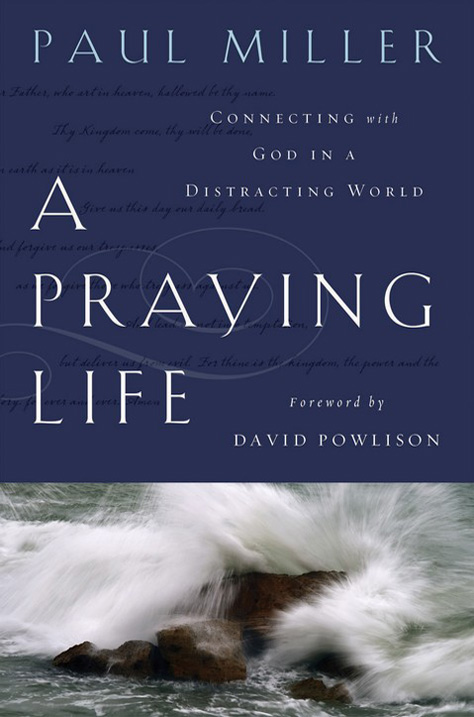
A Praying Life

Praying Life“Lord, teach us to pray.”   That’s the request of the disciple of Jesus. (Luke 11.1)  That’s a request that should not be limited to ages past or the pages of the Bible. It is the heart request of any disciple of Jesus. 

My friend, Paul Miller is Jesus’ tool to answer that request in this generation.  In his book, A Praying Life: Connecting With God in a Distracting World, Paul helps people like me, people who sometimes struggle in knowing how or what to pray; people who find their minds wandering often whenever trying to commit longer periods of time to pray; people who sometimes wonder if God get’s tired of these simple, random, and inarticulate petitions.

Paul reminds us what it means to be a child of God, and the implications that has for our prayer life. He helps us see that God will never reject those who come to him with a child-like heart, and therefore will certainly not be disappointed in us if we come to him with child-like characteristics.  Paul “redeems” the mind-wandering, and sets us free to enjoy our Father in prayer.

Check out a sample chapter and a review from NavPress.

Common Perils of the Professionally Holy

inclement-weather

There are some peculiar perils prevalent among the professional holy – those in full time ministry or service for God. High on this list: We know a lot of stuff and we do a lot of good things.  And it is easy to misconstrue either, or both, of these with being righteous. But neither of these things makes us righteous.

In Christ alone we are declared righteous, by God’s grace through faith in the substitutionary life and death of Jesus. (The theological word is “imputed”.)  Actual righteousness is faith in Christ expressing itself in good actions; or to put it another way, only when our actions are driven by genuine faith are we actually righteous.

Knowing a lot of stuff, even sound, biblical theological stuff is not itself righteousness.  It is not even faith. It may provide the substance for faith, but  right knowledge alone does not necessarily lead to faith.  There are a lot of things that I know, that I agree are true, yet that at any given time I still fail to trust and act upon.  Many things I assent to are not manifest in my character.  Such knowledge is my profession-al faith (that which I profess) but not a functional faith. And that disparity is important.

This is a particular problem in my denominational circles. We have a rich, deep, profound, and thoroughly biblical theological heritage.  It takes discipline and commitment to get a firm grasp on the system of doctrine.  And I suspect it may be for that reason that some have, historically as well as today, felt a sense of righteousness for enduring the rigors of study and learning. 

But apart from actual faith there is no righteousness. In fact, even if faith is present there is no righteousness unless that faith is coupled with good works.  (Please note: I am not suggesting that there is no salvation without “works”.  We are saved – “justified” – by grace through faith in Christ alone.  Nothing else added – nada.  Nor am I suggesting that apart from works there is no “imputed righteousness” – the righteousness of Christ credited to us at the moment of conversion/justification.  What I am saying is that there is no “actual righteousness”, no righteousness of our own, apart from faith being expressed through our conduct.)

Just what makes a good deed “good” I cannot say.  At least I cannot say concisely enough to ponder in this post.  I hope it will suffice to say that good deeds are those things that benefit others and honor God. 

I suspect that many deeds are done to the benefit of others, whether there is any mind toward honoring God or not.  In many cases we would never be able to tell, at least so far as those deeds are done by others. Sometimes, if we are honest, our own good deeds are done without conscious thought of honoring God.  I do not want to make the case here that these deeds are therefore not “good”.  But I do want to again suggest that they fail to qualify as righteous.

Again, righteousness may best be defined as Faith expressed through good deeds.  Genuine faith has a conscious awareness of God, his glory, his grace to us, and his expectations of us. And in this we are all deficient, sometimes more so than at others. 

Jerry Bridges, in his excellent book Respectable Sins, explains that our thoughtlessness about God, those moments or periods when we are not thinking about or conscious of God, demonstrates the very essence of “ungodliness”.  It is the sin of not being conscious of God.  And all are guilty of this sin, to varying degrees.

But if this is so, and I’m convinced it is, it is then possible to do good deeds and sin at the same time, and by the same act.  (Again, it could be reasoned that this negates the idea that the act is good. But for practical reasons I am not making that argument.)  People benefit from our actions, God may even be praised for our work, but we workers fail to recognize God – except maybe in hindsight.  Good as this may be, we must never kid ourselves into mistaking these deeds as righteous. 

Only when our genuine faith is expressed in action that honors God and benefits others, only when all those criteria are met, are we actually righteous. 

As I write I am well aware that most who read this post are probably not in full-time ministry. Nevertheless you most likely will recognize this same tension, this same problem, in your own life.  That’s because, while this problem is prevalent among ministers, it is not limted to us.   It is universal among all who “profess” faith in Christ.  And in that sense, with a little play on words, we can still say this problem is common to the “professional holy”.

So what is the solution?

I don’t have anything profound to say. I know nothing that will eliminate the problem from your life, this side of heaven.  But a couple things do come to mind that may help us deal with it, and perhaps lessen the extent of it over time.

1. Reflect on the meaning of Righteousness. Train yourself to evaluate your life in light of the twin requisites of righteousness: Faith + Good Deeds. Don’t allow yourself to settle for one or the other.  Remember these twins cannot be separated.

2. Deal with it.  Recognize the problem, and the associated sin.  Realize this is not the way it ought to be, but it is the way it is.  Confess the sin.

3. Apply the Gospel to yourself.  Remember, Christ did nto die for the righteous but for the ungodly.  His death has paid the penalty of your sins of ungodliness and lack of righteousness. When you repent of these sins and believe what he has done on your behalf you grow in grace; his righteousness is credited to you.  (What an amazing exchange!)

4. Live in light of that Gospel.  Act toward God in accord with the love he has given to you. Act toward others with the grace & love you know God has demonstrated to you.  And do you know what that is if you do these things?  Righteousness.

Grace of Repentance


Today is Ash Wednesday. That does not mean much to many in my theological circles.  But for many other Christians it is a day that launches the Season leading to Easter – the Season of Lent.  This day is designated Ash Wednesday because of an ancient practice of marking believers with ashes as a symbol of repentance. 

Hopefully it is more than symblolic, but is also a reminder that, as Martin Luther said, “When Christ said ‘Repent’ he called for the entire lives of Believers to be lived out in repentance.” 

Repentance is a lost art.  Repentance is also a neglected practice.  I suspect that many assume repentance is someting to be avoided; that repentance is what we must do if we have sinned; but if we can avoid sin we have no need of repentance. 

Seems logical. Except it mischaracterizes the nature of sin.  Sin is not what we do, sin is the condition we have, whether we are aware of it or not.  I find helpful the old saying: “We are not sinners because we sin. We sin because we are sinners.”  Thus, as Luther suggested, the necessity of life lived out in repentance. 

Perhaps a better way of putting it might be that our lives should include repentance.  I say that because repentance never stands alone. Repentance should always accompany Faith; and Faith should always accompany Repentance.  They are two sides of the same coin of Gospel Christianity.

I like the way the old Puritan Thomas Watson says it:

“Faith and Repentance are the two wings by which we fly toward heaven.” 

I love the imagery. It shows us that our salvation involves not only our conversions (which, by the way, requires both Faith & Repentance), but is a sanctifying journey which requires us to grow in our awarenss of both our ungodliness and the greatness of the Gospel.  To have one wing longer than the other; or worse, to have only one wing, would be disastrous.  Try it for yourself.  Try flying one of those balsa wood planes, with one wing longer than the other and see how it flies.  But this is life without both Faith & Repentance.

Three books I have found helpful in shaping my understanding and appreciation of the need of ongoing repentance:

Repentance & 21st Century Man by C. John Miller

The Doctrine of Repentance by Thomas Watson

Repentance: The First Word of the Gospel by Richard Owen Roberts

The Jesus Pledge


cross-in-the-sky1


What does it mean to be a disciple of Christ? What does it mean to be Gospel-driven?  I think my friend, Paul Miller, expresses it beautifully in The Jesus Pledge:

I pledge my life to Jesus and the Gospel.  I want Jesus not to be just part of my life or something that makes me feel good, but to be the very center – controlling everything.  I want only the knowledge of the love of God.  I want to know Christ. 

I want no desire, idol, or sinful way of dealing with hurt to control any part of my life no matter how small.  I put away from myself the love of money, power, comfort, and success.  I count everything rubbish. 

I bind myself to Christ as bond-servant for life.  I want no master other than Christ.  I purpose to own nothing.  I surrender to Jesus my family, my friends, my ministry, my ideas, my possessions, and my future. 

I commit myself to submission to others and a willingness to learn from all kinds of Christians.  I commit myself to speak only your words, not my own.  I commit myself to speak the truth in love to others.

I want to love people.  I want to lay down my life for others, especially those closest to me, as God gives us grace.  I want to love people by telling them about Jesus.

I understand that this will mean suffering in my life, that I will join in the sufferings of Christ.  But that I always want to be dying, so that I can always be living in Christ. 

Dynamics of the Spiritual Life

Christians who are no longer sure that God loves and accepts them in Jesus, apart from their present spiritual achievements, are subconsciously radically insecure persons – much less secure than non-Christians, because they have too much light to rest easily under the constant bulletins they receive from their Christian environment about the holiness of God and the righteousness they are supposed to have.  Their insecurity shows itself in pride, a fierce defensive assertion of their own righteousness and defensive criticism of others… They cling desperately to legal, pharisaical righteousness, but envy, jealousy and other branches on the tree of sin grow out of their fundamental insecurity…

[I]t is often necessary to convince sinners (even sinful Christians) of the grace and love of God toward them, before we can get them to look at their problems.  Then the vision of grace and the sense of God’s forgiving acceptance may actually cure most of the problems.

This may account for Paul’s frequent fusing of justification and sanctification.  

~ Richard Lovelace, Dynamics of Spiritual Life

Enduring Aroma of the Gospel

painters-cup

People don’t earn God’s approval or receive life and salvation because of anything they’ve done. Rather, the only reason they receive life and salvation is because of God’s kindness through Christ. There is no other way.

Many Christians are tired of hearing this teaching over and over. They think that they learned it all long ago. However, they barely understand how important it really is. If it continues to be taught as truth, the Christian church will remain united and pure — free from decay. This truth alone makes and sustains Christianity. You might hear an immature Christian brag about how well he knows that we receive God’s approval through God’s kindness and not because of anything we do to earn it. But if he goes on to say that this is easy to put into practice, then have no doubt he doesn’t know what he’s talking about, and he probably never will. We can never learn this truth completely or brag that we understand it fully. Learning this truth is an art. We will always remain students of it, and it will always be our teacher.

The people who truly understand that they receive God’s approval by faith and put this into practice don’t brag that they have fully mastered it. Rather, they think of it as a pleasant taste or aroma that they are always pursuing. These people are astonished that they can’t comprehend it as fully as they would like. They hunger and thirst for it. They yearn for it more and more. They never get tired of hearing about this truth.

– Martin Luther

Prerequisites for Effective Prayer

7635039-lg

In order to have an effective prayer life Scripture teaches that there are certain prerequisites.  Among them:

1. Relationship

We must have a relationship with God the Father, which comes only through a relationship with Jesus. (John 14.6)  The preface to the Lord’s Prayer makes a distinction between those who have a right to call God Father and Hypocrites (those who claim the name but have no real interest in or connection with God), and Pagans (those who worship the things of the earth: Nature, self, etc.).  Only those who are Children of God are promised that their prayers will be heard. (See Matthew 6.5-9)

2. Reflection

It is required that we come with some understanding of who God is, and who we are; that God is Holy and Almighty, and we sinners and needy.

3. Righteousness

James 5.16 tells us that the prayers of the righteous are powerful and effective.  There must be some elelment of righteounsess in our lives.

Righteousness defined is: right actions motivated by genuine faith.  Both components are necessary.  Faith comes first, as a gracious gift from God.  It is not something we muster, but receive.  But our faith, if it is genuine, will express itself through outward behaviors.  These behaviors themselves merit us nothing, but are evidences of Faith; they are evidences of a relationship with the Father.

Conclusion

There are requirements in prayer, such as asking, and asking for right things in accordance with God’s Will, and asking with right motives.  But those are not what this post is about.  This post addresses some prerequisites, conditions of our lives enabling us to pray effectively.

The first of these three prerequisites is enduring, it does not change back and forth.  (However, if one does not have a relaionship with God through Jesus, that status can be changed.  But once changed, God does not forget those whom he knows.  John 10.28-29

The last two can change somewhat.  While we are not likely to “un-know” what we know; and once declared righteous by God through faith in Christ (see Galatians 3.6) we do not loose that status, there are actual or functional aspects to both Faith and Righteousness.  Reflection is the exercise of Faith, which like a muscle needs to be used to be strengthened, otherwise it may experience something like atrophy.  Righteousness is the active living out our faith. 

If our prayer lives are dull or ineffective, we would do well to examine if we are negligent in either of these areas.

Prayer: A Way to Take Your Spiritual Pulse

We may judge the state of our hearts by the earnestness of our prayers.  You cannot make a rich man beg like a poor man; you cannot make a man that is full cry for food like one that is hungry.  No more will a man who has a good opinion of himself cry for mercy like one who feels that he is poor and needy.

The symptoms of spiritual decline are like those which attend the decay of bodily health. It genreally commences with a loss of appetite and a disrelish for spiritual food: prayer, reading the Scriptures and devotional books. Whenever you perceive these symptoms, be alarmed, for your spiritual health is in danger. Apply immediately to the Great Physician for a cure.

The best means of keeping near to God is the [prayer] closet. Here the battle is won or lost.

If a man begins to be impatient because his prayers for any blessings are not answered, it is a certain proof that a self-righteous dependence on his own merits prevails in his heart to a great extent; for the language of impatience is: “I deserve the blessing; I had a right to expect that it would be bestowed, and it ought to have been bestowed ‘ere this.” 

It is evident that a man who feels that he deserves nothing will never be impatient because he receives nothing; but will say: “I have nothing to complain of, I receive as much as I deserve.” 

Again, when a man wonders, or thinks it strange, that he does not receive a blessing for which he has prayed, it shows he relies on his own merits. The language of such feeling is: “It is very strange that I, who have prayed so well and so long, and had so much reason to expect a blessing, do not receive it.” 

Persons who feel truly humble, on the contrary, are surprised, not when blessings are withheld, but when they are bestowed.  It appears very strange and wonderful to them that God should bestow any favors on creatures so unworthy as themselves, or pay any regard to prayers so polluted as their own. 

This is the temper to which every person must be brought before God will answer his prayers.

***

This is a reflection from Dr. Edward Payson, 19th Century Evangelical from Portland Maine. 

While Payson is largely unknown today, during the first half of the 19th Century he was among the most well known in America, and was referred to as ‘Praying Payson from Portland Maine’.  Payson’s writings, though a couple hundred years old, are refreshing, and contemporary in both thought and style. There is none of the stilted language often associated with writers from previous centuries. 

I plan to add more of Payson’s reflections in the weeks and months ahead.

Respectable Sins

One of the books on my bedside table is Respectable Sins, by Jerry Bridges.  The subtitle of the book is: Confronting the Sins We Tolerate. The theme becomes self explanatory. 

In his preface Bridges explains the motive behind the book:

“The motivation for this book stems from a growing conviction that those of us whom I call conservative evangelicals may have become so preoccupied with some of the major sins of society around us that we have lost sight of the need to deal with our own more “refined” or subtle sins.”

I think Bridges is correct.  The whole notion of sin seems to have been lost on our society, and confused in our churches. 

Conservatives often lament the absence of any sense of, or concern about, sin reflected in our society.  In this glaring absence in our collective cultural conscience we have seen the arrival of government sanctioned killing through abortion and euthanasia; the crumbling of the family due to divorce, rampant pornography, and the redefining of it to embrace homosexuality as an acceptable norm; and a widespread apathy toward God. Those who speak out about such matters are right to be concerned.  The problem is that while we talk about those things that are infecting others, we are failing to address the very real sin in our own lives.  And we are therefore seen to be hypocrites – and probably rightly so.

Jesus instructed his followers to “first take the plank out of you own eye, then worry about the speck in the eye of another.”  I am not suggesting that those sins that are freely expressed in our society are minor specks.  They are not. They are serious.  And I am convinced that if we heed Jesus’s perscriptive counsel we will again experience the moral authority to speak. 

More serious than even the loss of our moral authority, many Evangelicals are confused about how we relate to God.  We have become disconnected from our own need of the Gospel, and our need of it every day. We fail to see the subtle, yet serious, ways we function as “unbelievers” and tolerate cancerous sin in our own hearts and relationships.  In fact, as the title of Bridges’ book suggests, we have not merely tolerated these things, but have functionally elevated them to a level of respectability.

Recognizing our sin, despite how it may seem, is not an entirely ugly proposition.  It is important to our spiritual vitality.  And makes practical sense. 

Let me explain it this way: We should be at least as concerned about our spiritual vitality as we are about our computers. 

I regularly receive updates from McAfee, and I run a scan on my computer at least a few times a week. Why? Because I have experienced the slow down, the unresponsiveness, and even a crash when I failed to have my computer checked for viruses that can infect it.  Once McAfee has performed a scan, if it has identified any potential threats I am able to deal with it. I either delete it, or in some cases quarantine the file. But either way, my computer functions much better because I have taken the time to perform this taks.

Sin in our lives, even that which seems minor, infects our hearts, our perceptions, our relationships, even our productivity.   We need to “scan” our hearts and lives regularly to see if there is anything there that may cause problems down the road. (This is what the Psalmist is advocating in Psalm 139)  Once we determine if there is anything there we can deal with it accordingly. In taking the appropriate precaustions we prevent problems because we are more able to keep things from spreading over and infecting other areas of our lives.

Despite what you may suspect due to my ranting thus far, this book is actually very positive, practical, and encouraging. 

In chapters 1-4 Bridges does a wonderful job explaining the Gospel, its practical importance, and its important practicality.

Chapter 5 discusses the Power of the Holy Spirit, and expalins how the Spirit is at work in the Gospel.

Chapter 6, titled: Directions for Dealing with Sins, serves as a practical preface to the rest of the book.  This chapter alone would be worth the price of the book, because it shows us how we can practice preaching the Gospel to ourselves. 

Chapters 7-20 deal with specific “acceptable” and “respectable” sins.  I have deeply appreciated Bridges’ talent for defining words of our Christian jargon that have at times confused me, or words that I’ve generally understood yet was still somewhat fuzzy about.  This understanding has been helpful in identifying some of the sin I carry around in my heart, and how it expresses itself in my life and in relationships..

The final chapter, chapter 21, simply asks the question: Where Do We Go from Here?

Each chapter is short and easily readable.  My intention is to read a few chapters a week over the next month or two so that I can digest Bridges’ insight, and deal with my own heart.  I may even journal my insights here on my blog. I haven’t decided yet.

But one thing I have decided to do. My friend, David Zavadil, has been working through this book and posting his observations on his blog, By His Grace.  Whether I develop my own posts or not, I will join the discussion David has started. I invite you to join me over there.