Spiritual Pride

Here is a great insight from Jonathan Edwards as relevant today as it was in his Colonial American culture:

The first and worst cause of error that prevails in our day is spiritual pride. This is the main door by which the devil comes into the hearts of those who are zealous for the advancement of Christ. It is the chief inlet of smoke from the bottomless pit to darken the mind and mislead the judgment, and the main handle by which Satan takes hold of Christians to hinder a work of God. Until this disease is cured, medicines are applied in vain to heal all other diseases.

Pride is much more difficult to discern than any other corruption because, by nature, pride is a person having too high a thought of himself. Is it any surprise, then, that a person who has too high a thought of himself is unaware of it? He thinks the opinion he has of himself has just grounds and therefore is not too high. As a result, there is no other matter in which the heart is more deceitful and unsearchable. The very nature of it is to work self-confidence and drive away any suspicion of evil respecting itself.

Pride takes many forms and shapes and encompasses the heart like the layers of an onion- when you pull off one layer, there is another underneath. Therefore, we need to have the greatest watch imaginable over our hearts with respect to this matter and to cry most earnestly to the great searcher of hearts for His help. He who trusts his own heart is a fool.

Since spiritual pride in its own nature is secretive, it cannot be well discerned by immediate intuition of the thing itself. It is best identified by its fruits and effects, some of which I will mention together with the contrary fruits of Christian humility.

The spiritually proud person is full of light already and feels that he does not need instruction, so he is ready to despise the offer of it. On the other hand, the humble person is like a little child who easily receives instruction. He is cautious in his estimate of himself, sensitive as to how liable he is to go astray. If it is suggested to him that he does go astray, he is most ready to inquire into the matter.

Proud people tend to speak of other’s sins, the miserable delusion of hypocrites, the deadness of some saints with bitterness, or the opposition to holiness of many believers. Pure Christian humility, however, is silent about the sins of others, or speaks of them with grief and pity. The spiritually proud person finds fault with other saints for their lack of progress in grace, while the humble Christian sees so much evil in his own heart, and is so concerned about it, that he is not apt to be very busy with other hearts. He complains most of himself and his own spiritual coldness and readily hopes that most everybody has more love and thankfulness to God than he.

Spiritually proud people often speak of almost everything they see in others in the harshest, most severe language. Commonly, their criticism is directed against not only wicked men but also toward true children of God and those who are their superiors. The humble, however, even when they have extraordinary discoveries of God’s glory, are overwhelmed with their own vileness and sinfulness. Their exhortations to fellow Christians are given in a loving and humble manner, and they treat others with as much humility and gentleness as Christ, who is infinitely above them, treats them.

Spiritual pride often disposes people to act different in external appearance, to assume a different way of speaking, countenance, or behavior. However, the humble Christian, though he will be firm in his duty; going the way of heaven alone even if all the world forsake him; yet he does not delight in being different for difference’s sake. He does not try to set himself up to be viewed and observed as one distinguished, but on the contrary, is disposed to become all things to all men, to yield to others, to conform to them, and to please them in all but sin.

Proud people take great notice of opposition and injuries, and are prone to speak often about them with an air of bitterness or contempt. Christian humility, on the other hand, disposes a person to be more like his blessed Lord, who when reviled did not open His mouth but committed Himself in silence to Him who judges righteously. For the humble Christian, the more clamorous and furious the world is against him, the more silent and still he will be.

Another pattern of spiritually proud people is to behave in ways that make them the focus of others. It is natural for a person under the influence of pride to take all the respect that is paid to him. If others show a disposition to submit to him and yield in deference to him, he is open to it and freely receives it. In fact, they come to expect such treatment and to form an ill opinion of those who do not give them what they feel they deserve.

***

Adapted from Jonathan Edwards’ Some Thoughts Concerning the Present Revival of Religion in New England. This article previously appeared in Banner of Truth.


Pure As the Driven Snow

I don’t think I’ve ever met anyone who enjoys “old” snow – you know, the snow that has been around a few day, has blackened from plowing, is choppy from people playing in the yard.  I know that’s not the type of snow my duaghter enjoys looking at.

After the snowstorm this past Friday night, that dumped 3/4 of a foot all around us, my daughter was concerned that her brothers “messed up” the yard. She likes looking at the pure smoothe snow, untouched by human hand – or boot. 

That started me thinking. There is a methaphor there somewhere.

I think we all have have an innate appreciation for the beauty of purity. Unfortunately, because of our sin, purity does not seem to last long in this life. Sometimes it is corrupted and turns black and ugly. Sometimes it is just messed up by us as we go about our work and play.  But fleeting as it is, while it is here it is something to behold.

This all reminds me that God is on a mission, not simply to “save” a bunch of individuals but, to restore and recreate that which has been corrupted and messed-up.  As beautiful and peaceful as it is to look at the pure snow on the pastures outside my living room window, a beauty is coming that is both incomparable and incorruptable. And that will really be something to see.

Pretentious Piety


The more things have changed, some things have remained the same.  Such is the case for Christians in a typical church.

When Samuel Blair assumed the pulpit of Faggs Manor Presbyteran Church in 1740 he found a congregation in a spiritual condition not uncommon even in our day. Blair wrote that when he came to the church he found many good religious people who performed their religious obligation rather well. Yet they were, in his estimation, somewhat formal and unenthusiastic:

If they performed these duties pretty punctually in their seasons and, as they thought, with good meaning, out of conscience, and not just to obtain a name for religion among men, then they were ready to conclude that they were truly and sincerely religious. A very lamentable ignorance of the main essentials of true practical religion, and the doctrines nearly relating thereunto very generally prevailed.  The nature and necessity of the new birth was but litle known or thought of, the necessity of a conviction of sin and misery, by the Holy Spirit’s opening and applying the law to the conscience, in order to a saving closure with Christ, was hardly known at all to most.  It was thought, that if there was any need of a heart-distressing sight of the soul’s danger, and fear of divine wrath, it wa only needed for the grosser sort of sinners; and for any others to be deeply exercised this way (as might in some rare instances observable), this was generally looked upon to be a great evil and temptation that had befallen those persons.  The common names for such soul-concern were, melancholy, trouble of mind, or despair.  These terms were common, so far as I have been acquainted, indifferently used as synonymous; and trouble of mind was looked upon as a great evil, which all persons that made any sober profession and practice of religion ought carefully avoid.  …There was scarcely any suspicion at all, in general, of any danger of depending upon self-righteousness, and not upon the righteousness of Christ alone for salvation.  Papists [Roman Catholics) and Quakers would be readily acknowldeged guilty of this crime, but hardly any professed Presbyterian. The necessity of being first in Christ by a vital union, and in a justified state, before our religious services can be well pleasing and acceptable to God, was very little understood or thought of; but the common notion seemed to be, that if people were aiming to be in the way of duty as well as they could, at they imagined, there was no reason to be much afraid.

[Source: The Forming of an American Tradition: A Re-Examination of Colonial Presbyterianism, by Leonard J. Trinterud; Westminster Press, 1959; pp. 77-78]

3 Responses to Sin

Howl of Indifference

“When we as Christians sin, we can react in one of three ways:

1) We can become hardened to our sin. 

2) We can sink into utter despair and say, ‘Its all over.’  I’ve known Christians who have spent twenty years despairing over one sin….

[T]he only right course of action for us as Christians is to…

3) become increasingly sensitive to our sin, but also increasingly to know the forgiveness that is ours on the basis of the blood of Christ – to have the assurance that, if Jesus died for me when I was a sinner before my salvation, how much more He must love me now!” 

-Francis Schaeffer, The Finished Work of Christ.

Respectable Sins

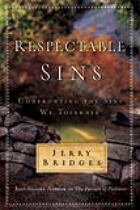
One of the books on my bedside table is Respectable Sins, by Jerry Bridges.  The subtitle of the book is: Confronting the Sins We Tolerate. The theme becomes self explanatory. 
In his preface Bridges explains the motive behind the book:

“The motivation for this book stems from a growing conviction that those of us whom I call conservative evangelicals may have become so preoccupied with some of the major sins of society around us that we have lost sight of the need to deal with our own more “refined” or subtle sins.”

I think Bridges is correct.  The whole notion of sin seems to have been lost on our society, and confused in our churches. 

Conservatives often lament the absence of any sense of, or concern about, sin reflected in our society.  In this glaring absence in our collective cultural conscience we have seen the arrival of government sanctioned killing through abortion and euthanasia; the crumbling of the family due to divorce, rampant pornography, and the redefining of it to embrace homosexuality as an acceptable norm; and a widespread apathy toward God. Those who speak out about such matters are right to be concerned.  The problem is that while we talk about those things that are infecting others, we are failing to address the very real sin in our own lives.  And we are therefore seen to be hypocrites – and probably rightly so.

Jesus instructed his followers to “first take the plank out of you own eye, then worry about the speck in the eye of another.”  I am not suggesting that those sins that are freely expressed in our society are minor specks.  They are not. They are serious.  And I am convinced that if we heed Jesus’s perscriptive counsel we will again experience the moral authority to speak. 

More serious than even the loss of our moral authority, many Evangelicals are confused about how we relate to God.  We have become disconnected from our own need of the Gospel, and our need of it every day. We fail to see the subtle, yet serious, ways we function as “unbelievers” and tolerate cancerous sin in our own hearts and relationships.  In fact, as the title of Bridges’ book suggests, we have not merely tolerated these things, but have functionally elevated them to a level of respectability.

Recognizing our sin, despite how it may seem, is not an entirely ugly proposition.  It is important to our spiritual vitality.  And makes practical sense. 

Let me explain it this way: We should be at least as concerned about our spiritual vitality as we are about our computers. 

I regularly receive updates from McAfee, and I run a scan on my computer at least a few times a week. Why? Because I have experienced the slow down, the unresponsiveness, and even a crash when I failed to have my computer checked for viruses that can infect it.  Once McAfee has performed a scan, if it has identified any potential threats I am able to deal with it. I either delete it, or in some cases quarantine the file. But either way, my computer functions much better because I have taken the time to perform this taks.

Sin in our lives, even that which seems minor, infects our hearts, our perceptions, our relationships, even our productivity.   We need to “scan” our hearts and lives regularly to see if there is anything there that may cause problems down the road. (This is what the Psalmist is advocating in Psalm 139)  Once we determine if there is anything there we can deal with it accordingly. In taking the appropriate precaustions we prevent problems because we are more able to keep things from spreading over and infecting other areas of our lives.

Despite what you may suspect due to my ranting thus far, this book is actually very positive, practical, and encouraging. 

In chapters 1-4 Bridges does a wonderful job explaining the Gospel, its practical importance, and its important practicality.

Chapter 5 discusses the Power of the Holy Spirit, and expalins how the Spirit is at work in the Gospel.

Chapter 6, titled: Directions for Dealing with Sins, serves as a practical preface to the rest of the book.  This chapter alone would be worth the price of the book, because it shows us how we can practice preaching the Gospel to ourselves. 

Chapters 7-20 deal with specific “acceptable” and “respectable” sins.  I have deeply appreciated Bridges’ talent for defining words of our Christian jargon that have at times confused me, or words that I’ve generally understood yet was still somewhat fuzzy about.  This understanding has been helpful in identifying some of the sin I carry around in my heart, and how it expresses itself in my life and in relationships..

The final chapter, chapter 21, simply asks the question: Where Do We Go from Here?

Each chapter is short and easily readable.  My intention is to read a few chapters a week over the next month or two so that I can digest Bridges’ insight, and deal with my own heart.  I may even journal my insights here on my blog. I haven’t decided yet.

But one thing I have decided to do. My friend, David Zavadil, has been working through this book and posting his observations on his blog, By His Grace.  Whether I develop my own posts or not, I will join the discussion David has started. I invite you to join me over there.

The Gospel & Parental Sin

Last week I became rightfully angry at one of my children. (I won’t say which one.)  But in my anger I sinned against him. (Okay, the ‘him’ narrows it down some.) I had neglected the counsel of King David, who wrote: “In your anger do not sin.” (Psalm 4:4)  In my reprimand I was way too harsh.

A few moments later I went back and apologized. While remaining firm about his offense, I told him my offense was even worse and asked for his forgiveness.

Things are normal now.

I am sure I am not the only parent who has crossed this line. In fact we all do. And we may wonder what the lingering effect will be on our child, and on our relationship… 

At such times we need to remind oursleves of the hope of the Gospel.

I appreciate C.J. Mahaney and, right now in particular, a very brief message of his I stumbled across this week titled: The Gospel + Parental Sin.    C.J. discusses our moments of failure as parents, and how the Gospel relates.

If you, like me, ever cross the line as a parent, I recommend taking the time to hear what C.J. has to say. (Run time = 2:39)

Scarlett Letter Today

Inspired by an analysis of Nathaniel Hawthorne’s Scarlett Letter, on NPR’s All Things Considered, my friend Nathan Lewis probes beyond the literary and sociologic interests offered from the program.  Nathan asks two striking questions:

  • “Have we learned from Hawthorne’s scathing presentation of hypocrissy?”
  • “Would Hester [Prynne] be welcome in our community of faith?”

I want to think through both of these questions.

Continue reading

Which Way?

Your life hangs on how you relate these two statements: 

  1. “If anyone sins, we have an advocate with the Father, Jesus Christ, the Righteous” (1 John 2:1).
  2. “Sin no more, that nothing worse may happen to you” (John 5:14). 

Do you experience the first one weakening the second? 

Or do you experience the first one joyfully empowering the second? 

Your life hangs on your answer. 

– by John Piper , via Missio Dei Suburbia 

My Sin is Ever Before Me

untitled-montietalbert-final.jpg

‘My sin is ever before me’ -Psalm 51.3  

A humble soul sees that he can stay no more from sin, than the heart can from panting, and the pulse from beating. He sees his heart and life to be fuller of sin, than the firmament is of stars; and this keeps him low. He sees that sin is so bred in the bone, that till his bones, as Joseph’s, be carried out of the Egypt of this world, it will not out. Though sin and grace were never born together, and though they shall not die together, yet while the believer lives, these two must live together; and this keeps him humble. 

-Thomas Brooks, English Puritan

Sin Boldly

lutherwoodcut.jpgI’m going to start a new category: Graffiti. This categtory will offer some great quotes.   I don’t know many that would top the following from Luther:  

“If you are a preacher of grace, then preach a true and not a fictitious grace; if grace is true, you must bear a true and not a fictitious sin. God does not save people who are only fictitious sinners. Be a sinner and sin boldly, but believe and rejoice in Christ even more boldly, for he is victorious over sin, death, and the world.

As long as we are here [in this world] we have to sin. This life is not the dwelling place of righteousness, but, as Peter says, we look for new heavens and a new earth in which righteousness dwells. It is enough that by the riches of God’s glory we have come to know the Lamb that takes away the sin of the world. No sin will separate us from the Lamb, even though we commit fornication and murder a thousand times a day. Do you think that the purchase price that was paid for the redemption of our sins by so great a Lamb is too small? Pray boldly—you too are a mighty sinner.”

 -Martin Luther, in a letter to Phillip Melancthon 

What is the Gospel?

Gospel means “good news.” The good news is: you (and I) are more sinful and flawed than you (or I) ever dared believe, yet you (and I) can be more accepted and loved than you (or I) ever dared hope at the same time, because Jesus Christ lived and died in our place. As the apostle Paul said, “God made him who had no sin to be sin for us, so that in him we might become the righteousness of God.” (2 Corinthians 5.21)

That paradoxical statement is a simple formulation of the gospel.

More thoroughly we could say that the whole Bible is the gospel. It is a book about the God who rescues people from their moral and spiritual rebellion against him. The teaching of the Bible can be summarized under four headings: God, Man, Jesus Christ, and Our Response. 

Firstly, the gospel teaches that God is our creator. Thus he has the right to rule and command us as he does in his law. God is also holy, that is, he is absolutely pure morally, and he hates and punishes rebellion on the part of his creatures. He is more holy than anyone would ever imagine. 

Secondly, the gospel teaches us about human beings. We are creatures made by God and for God. We were originally created to live in relationship with God and we were morally pure. But because our first parents rebelled against God (just as we also all have done), human beings are now cut off from relationship with God and are subject to his condemnation. We are more sinful than we ever dared believe.  

Thirdly, the gospel teaches us what Jesus Christ has done for sinners like you and me. Jesus became a man and lived a life of perfect obedience to God’s law, and then died as a sacrifice in our place under the judgment of God. He was raised from the dead and now reigns in heaven. The condemnation that he suffered takes away the necessity that we suffer judgment for our own sins- “God made him who had no sin to be sin for us.” The righteous life he lived is credited to us, not because we are actually righteous, but because of God’s mercy and grace- “in him we might become the righteousness of God.” 

Fourthly, the gospel teaches us how to respond to the good news. We turn away from our rebellion and put our trust in Jesus Christ. Despairing of our own worthiness to stand before God, we believe the promise that those who trust in Jesus Christ will be forgiven and declared righteous. Those who put their faith in Jesus Christ are accepted as loved sons and daughters of God, and God sends his Spirit to live in them. 

Counterfeit Gospels

 Martin Luther said that “a sinner trying to believe the gospel was like a drunk man trying to ride a horse; he will always be falling off on one side or the other”. The two errors that the sides of the horse represent are

  • legalism or moralism, and
  • pragmatism or relativism or antinomianism.  

Moralism is the view that a person is made acceptable to God through his own attainments. Moralists are usually very religious, and often very conservative in their religion. Legalism tends to stress truth without grace. Moralists are usually very rules oriented, and depending on their success in keeping the rules they will be either arrogantly self-righteous or depressed and morose. If they go to Jesus for forgiveness, it is just to ask him to fill in the gaps they have left in their own religious performance. For the moralist, the cross is not the only basis for acceptance by God, but is an adjunct to our performance. 

Pragmatists are often irreligious, or prefer more liberal religion. They tend to stress grace over truth, assuming everyone is accepted by God and that we each have to decide what we think is true for us. Often relativists will talk about God’s love, but since they do not see them selves as deeply sinful people, God’s love for them costs him nothing. For them the cross is not the necessary condition of our acceptance by God. 

The gospel holds out to us a whole new system of approach to God. It rejects our attempts to justify ourselves before God, to be our own saviors and lords. It rejects both our pragmatic presumption and our religious attempts to earn our way into God’s favor. It destroys the perception that Christianity is just an invitation to become more religious. The gospel will not let us think Jesus is just a coach to help us get stronger where we are weak. To be a Christian is to turn from self-justification of all sorts and to rely exclusively on Jesus’ record for a relationship with God. 

Christians and non-Christians both stumble over the two counterfeits of the gospel. Many Churches are deeply moralistic or deeply relativistic. Christians who understand the gospel very clearly still look like the drunk man on the horse, as the desire to justify ourselves and trust in our own performance continually reappears. 

The gospel tells the pragmatist that he is more flawed and sinful than he ever dared believe. The gospel tells the moralist that he is more loved and accepted than he ever dared hope.